The perils of Scale models and electric power
by Stan Alexander
onawing4602@att.net
Approximately a third of my models are now electric powered. In some ways it’s a convenience, and in others it’s more complicated and dangerous. With electrics, you don’t have the cleanup you have with two-stroke engines. You also don’t have the sound, but I’ve heard some great sound systems that make electric-powered aircraft sound more scalelike.

When an electric system is armed and you or anyone else is near it, however, you are in danger if you aren’t careful. This is especially true with large electric-powered aircraft, such as the one I’ll discuss this month.
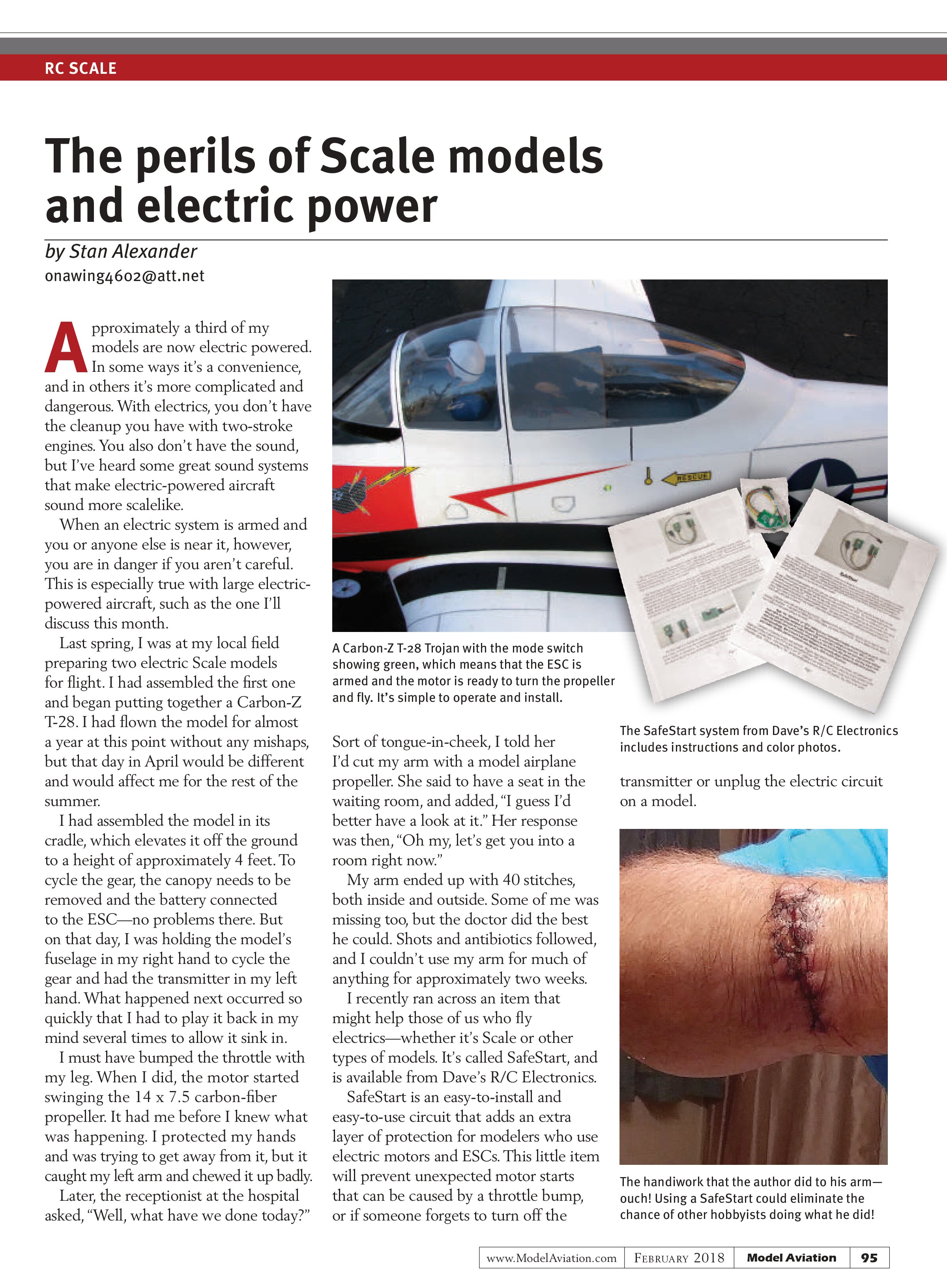
Last spring, I was at my local field preparing two electric Scale models for flight. I had assembled the first one and began putting together a Carbon-Z T-28. I had flown the model for almost a year at this point without any mishaps, but that day in April would be different and would affect me for the rest of the summer.
I had assembled the model in its cradle, which elevates it off the ground to a height of approximately 4 feet. To cycle the gear, the canopy needs to be removed and the battery connected to the ESC—no problems there. But on that day, I was holding the model’s fuselage in my right hand to cycle the gear and had the transmitter in my left hand. What happened next occurred so quickly that I had to play it back in my mind several times to allow it sink in.
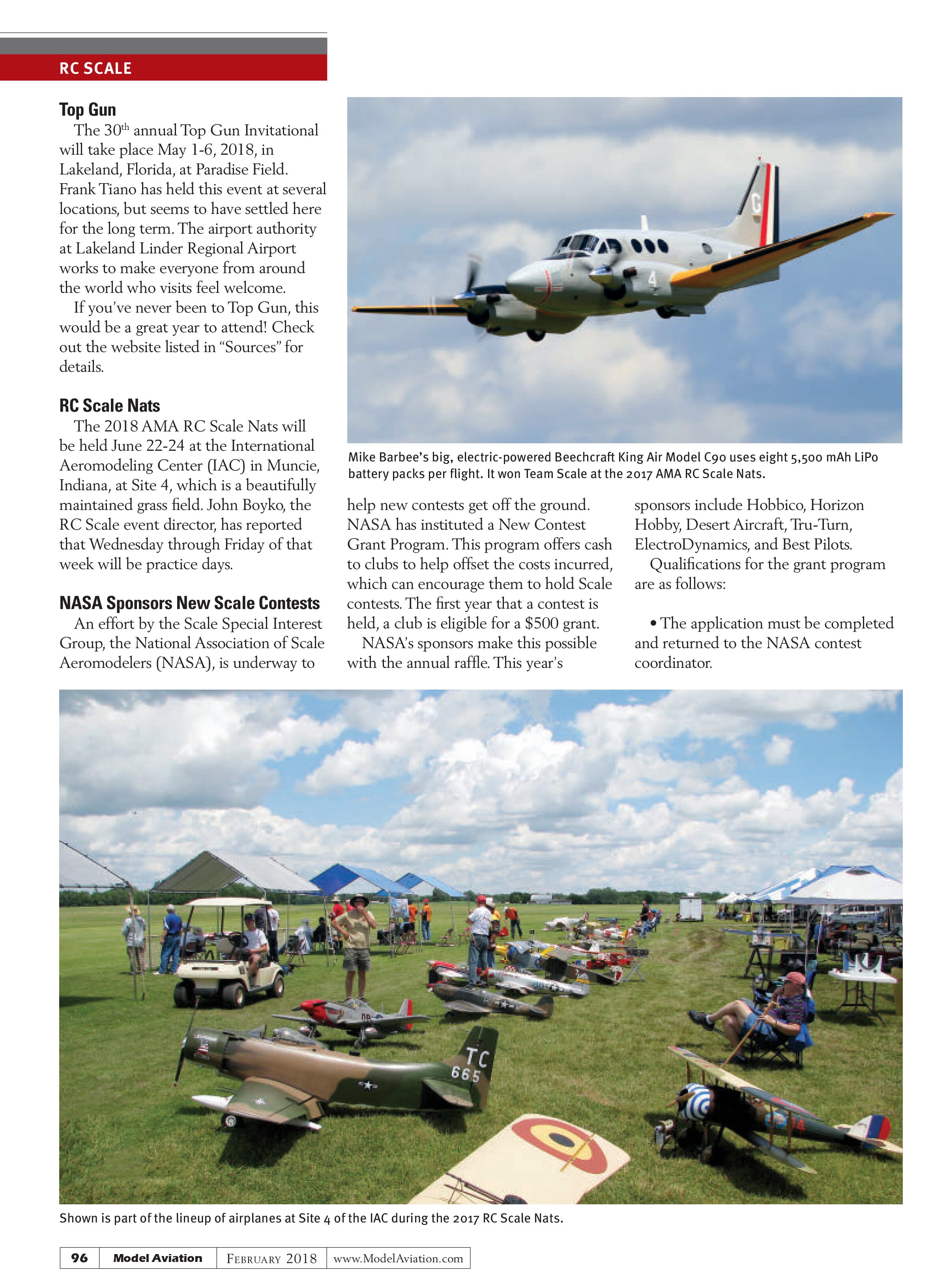
I must have bumped the throttle with my leg. When I did, the motor started swinging the 14 x 7.5 carbon-fiber propeller. It had me before I knew what was happening. I protected my hands and was trying to get away from it, but it caught my left arm and chewed it up badly.
Later, the receptionist at the hospital asked, “Well, what have we done today?”
Sort of tongue-in-cheek, I told her I’d cut my arm with a model airplane propeller. She said to have a seat in the waiting room, and added, “I guess I’d better have a look at it.” Her response was then, “Oh my, let’s get you into a room right now.”
My arm ended up with 40 stitches, both inside and outside. Some of me was missing too, but the doctor did the best he could. Shots and antibiotics followed, and I couldn’t use my arm for much of anything for approximately two weeks.
I recently ran across an item that might help those of us who fly electrics—whether it’s Scale or other types of models. It’s called SafeStart, and is available from Dave’s R/C Electronics. SafeStart is an easy-to-install and easy-to-use circuit that adds an extra layer of protection for modelers who use electric motors and ESCs. This little item will prevent unexpected motor starts that can be caused by a throttle bump, or if someone forgets to turn off the transmitter or unplug the electric circuit on a model.


Top Gun
The 30th annual Top Gun Invitational will take place May 1-6, 2018, in Lakeland, Florida, at Paradise Field. Frank Tiano has held this event at several locations, but seems to have settled here for the long term. The airport authority at Lakeland Linder Regional Airport works to make everyone from around the world who visits feel welcome. If you’ve never been to Top Gun, this would be a great year to attend! Check out the website listed in “Sources” for details.
RC Scale Nats
The 2018 AMA RC Scale Nats will be held June 22-24 at the International Aeromodeling Center (IAC) in Muncie, Indiana, at Site 4, which is a beautifully maintained grass field. John Boyko, the RC Scale event director, has reported that Wednesday through Friday of that week will be practice days.
NASA Sponsors New Scale Contests
An effort by the Scale Special Interest Group, the National Association of Scale Aeromodelers (NASA), is underway to help new contests get off the ground. NASA has instituted a New Contest Grant Program. This program offers cash to clubs to help offset the costs incurred, which can encourage them to hold Scale contests. The first year that a contest is held, a club is eligible for a $500 grant. NASA’s sponsors make this possible with the annual raffle. This year’s sponsors include Hobbico, Horizon Hobby, Desert Aircraft, Tru-Turn, ElectroDynamics, and Best Pilots. Qualifications for the grant program are as follows:
- The application must be completed and returned to the NASA contest coordinator.
- AMA rules for Scale competition and scoring must be followed.
- The contest must include all AMA RC Scale and/or Control Line Scale events.
- The contest must span at least two consecutive days.
- The application must be received six months in advance of the contest date.
- An electronic copy of the contest flyer must be provided with the application.
- NASA score sheets must be used during the event. They are available on the group’s website.
- The contest results must be submitted to the NASA contest coordinator within 30 days after the contest.
Checks will be distributed after the information is received by the NASA secretary/treasurer. Visit the NASA website listed in “Sources.”
Sources:
NASA
www.nasascale.org
Dave’s R/C Electronics
(423) 544-1657
www.davesrce.com
Top Gun Invitational
www.franktiano.com/events/top-gun

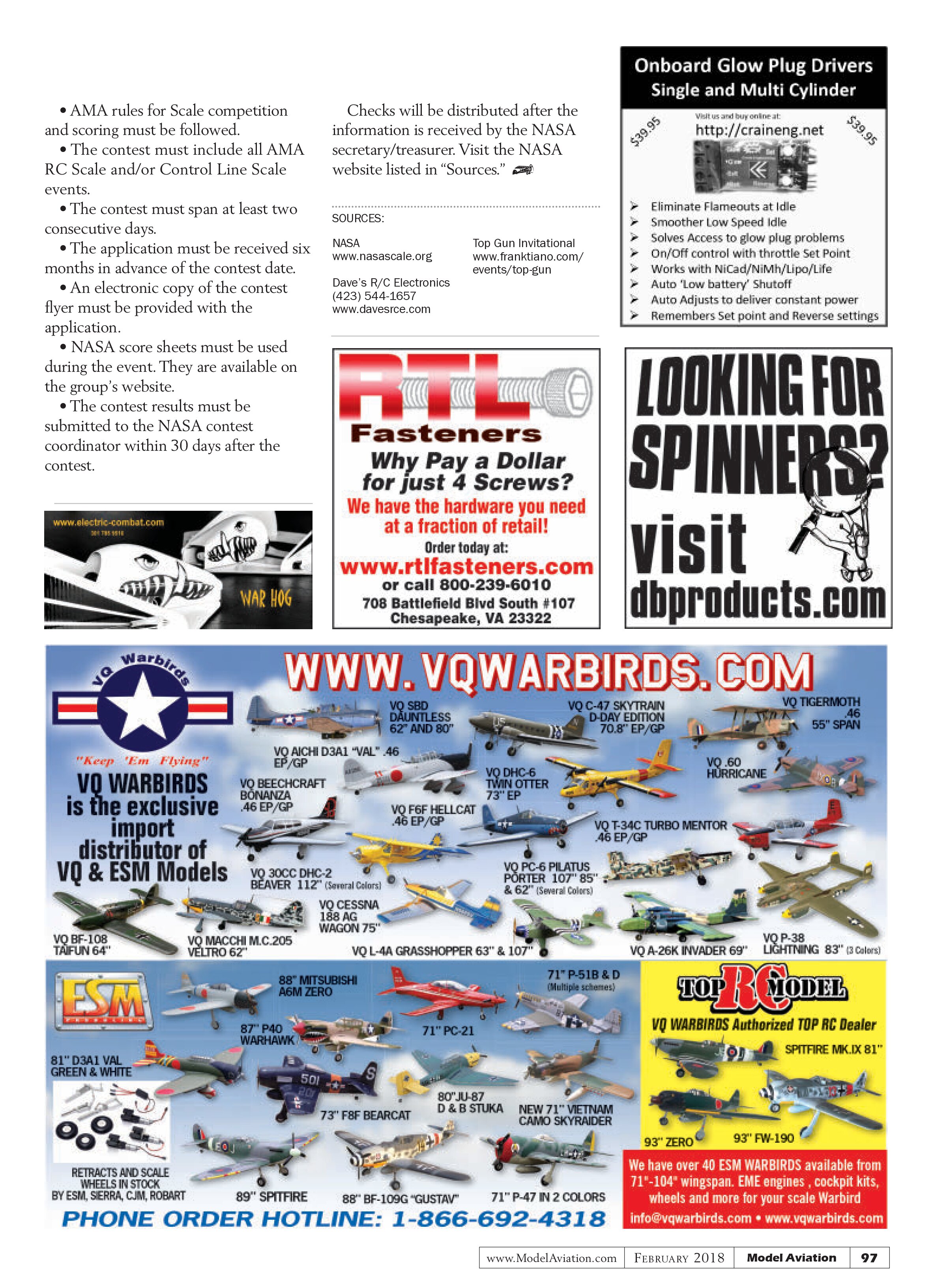
Mike Barbee’s big, electric-powered Beechcraft King Air Model C90 uses eight 5,500 mAh LiPo battery packs per flight. It won Team Scale at the 2017 AMA RC Scale Nats.

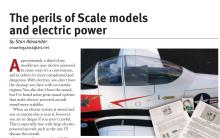
Shown is part of the lineup of airplanes at Site 4 of the IAC during the 2017 RC Scale Nats.