Stable FAC Giant Scale flier “dusts” the competition
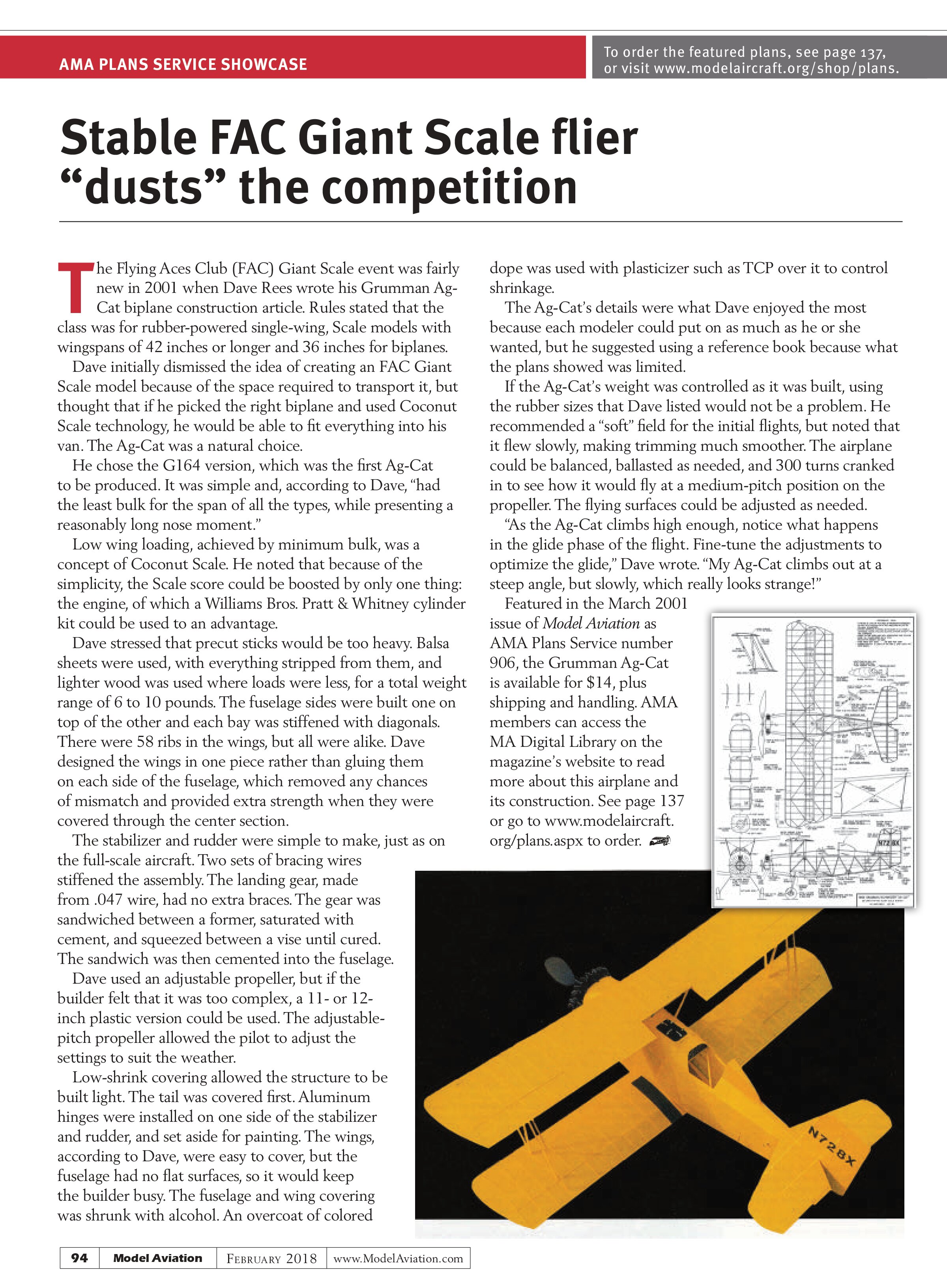
The Flying Aces Club (FAC) Giant Scale event was fairly new in 2001 when Dave Rees wrote his Grumman Ag-Cat biplane construction article. Rules stated that the class was for rubber-powered single-wing, Scale models with wingspans of 42 inches or longer and 36 inches for biplanes.
Dave initially dismissed the idea of creating an FAC Giant Scale model because of the space required to transport it, but thought that if he picked the right biplane and used Coconut Scale technology, he would be able to fit everything into his van. The Ag-Cat was a natural choice.
He chose the G164 version, which was the first Ag-Cat to be produced. It was simple and, according to Dave, “had the least bulk for the span of all the types, while presenting a reasonably long nose moment.”
Low wing loading, achieved by minimum bulk, was a concept of Coconut Scale. He noted that because of the simplicity, the Scale score could be boosted by only one thing: the engine, of which a Williams Bros. Pratt & Whitney cylinder kit could be used to an advantage.
Dave stressed that precut sticks would be too heavy. Balsa sheets were used, with everything stripped from them, and lighter wood was used where loads were less, for a total weight range of 6 to 10 pounds. The fuselage sides were built one on top of the other and each bay was stiffened with diagonals. There were 58 ribs in the wings, but all were alike. Dave designed the wings in one piece rather than gluing them on each side of the fuselage, which removed any chances of mismatch and provided extra strength when they were covered through the center section.
The stabilizer and rudder were simple to make, just as on the full-scale aircraft. Two sets of bracing wires stiffened the assembly. The landing gear, made from .047 wire, had no extra braces. The gear was sandwiched between a former, saturated with cement, and squeezed between a vise until cured. The sandwich was then cemented into the fuselage.
Dave used an adjustable propeller, but if the builder felt that it was too complex, a 11- or 12-inch plastic version could be used. The adjustable-pitch propeller allowed the pilot to adjust the settings to suit the weather.
Low-shrink covering allowed the structure to be built light. The tail was covered first. Aluminum hinges were installed on one side of the stabilizer and rudder, and set aside for painting. The wings, according to Dave, were easy to cover, but the fuselage had no flat surfaces, so it would keep the builder busy. The fuselage and wing covering was shrunk with alcohol. An overcoat of colored dope was used with plasticizer such as TCP over it to control shrinkage.
The Ag-Cat’s details were what Dave enjoyed the most because each modeler could put on as much as he or she wanted, but he suggested using a reference book because what the plans showed was limited.
If the Ag-Cat’s weight was controlled as it was built, using the rubber sizes that Dave listed would not be a problem. He recommended a “soft” field for the initial flights, but noted that it flew slowly, making trimming much smoother. The airplane could be balanced, ballasted as needed, and 300 turns cranked in to see how it would fly at a medium-pitch position on the propeller. The flying surfaces could be adjusted as needed.
“As the Ag-Cat climbs high enough, notice what happens in the glide phase of the flight. Fine-tune the adjustments to optimize the glide,” Dave wrote. “My Ag-Cat climbs out at a steep angle, but slowly, which really looks strange!”
Featured in the March 2001 issue of Model Aviation as AMA Plans Service number 906, the Grumman Ag-Cat is available for $14, plus shipping and handling. AMA members can access the MA Digital Library on the magazine’s website to read more about this airplane and its construction. See page 137 or go to www.modelaircraft.org/plans.aspx to order.