Mel Anderson, engine designer
Bob Angel
samrcflier@verizon.net
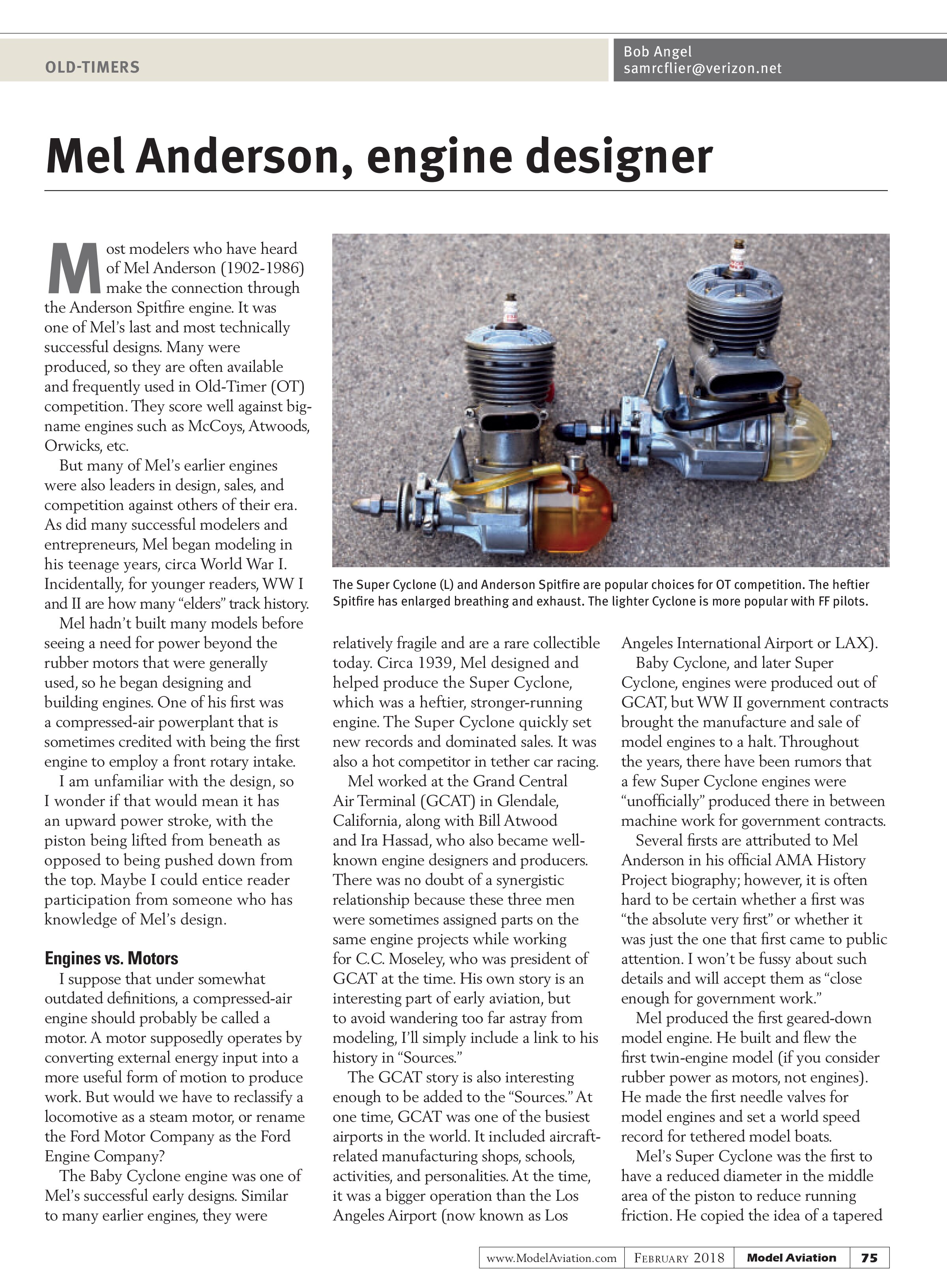
Most modelers who have heard of Mel Anderson (1902-1986) make the connection through the Anderson Spitfire engine. It was one of Mel’s last and most technically successful designs. Many were produced, so they are often available and frequently used in Old-Timer (OT) competition. They score well against big-name engines such as McCoys, Atwoods, Orwicks, etc.
But many of Mel’s earlier engines were also leaders in design, sales, and competition against others of their era. As did many successful modelers and entrepreneurs, Mel began modeling in his teenage years, circa World War I. Incidentally, for younger readers, WW I and II are how many “elders” track history.
Mel hadn’t built many models before seeing a need for power beyond the rubber motors that were generally used, so he began designing and building engines. One of his first was a compressed-air powerplant that is sometimes credited with being the first engine to employ a front rotary intake.
I am unfamiliar with the design, so I wonder if that would mean it has an upward power stroke, with the piston being lifted from beneath as opposed to being pushed down from the top. Maybe I could entice reader participation from someone who has knowledge of Mel’s design.
Engines vs. Motors
I suppose that under somewhat outdated definitions, a compressed-air engine should probably be called a motor. A motor supposedly operates by converting external energy input into a more useful form of motion to produce work. But would we have to reclassify a locomotive as a steam motor, or rename the Ford Motor Company as the Ford Engine Company?
The Baby Cyclone engine was one of Mel’s successful early designs. Similar to many earlier engines, they were

relatively fragile and are a rare collectible today. Circa 1939, Mel designed and helped produce the Super Cyclone, which was a heftier, stronger-running engine. The Super Cyclone quickly set new records and dominated sales. It was also a hot competitor in tether car racing.
Mel worked at the Grand Central Air Terminal (GCAT) in Glendale, California, along with Bill Atwood and Ira Hassad, who also became well-known engine designers and producers. There was no doubt of a synergistic relationship because these three men were sometimes assigned parts on the same engine projects while working for C.C. Moseley, who was president of GCAT at the time. His own story is an interesting part of early aviation, but to avoid wandering too far astray from modeling, I’ll simply include a link to his history in “Sources.”
The GCAT story is also interesting enough to be added to the “Sources.” At one time, GCAT was one of the busiest airports in the world. It included aircraft-related manufacturing shops, schools, activities, and personalities. At the time, it was a bigger operation than the Los Angeles Airport (now known as Los Angeles International Airport or LAX).
Baby Cyclone, and later Super Cyclone, engines were produced out of GCAT, but WW II government contracts brought the manufacture and sale of model engines to a halt. Throughout the years, there have been rumors that a few Super Cyclone engines were “unofficially” produced there in between machine work for government contracts.
Several firsts are attributed to Mel Anderson in his official AMA History Project biography; however, it is often hard to be certain whether a first was “the absolute very first” or whether it was just the one that first came to public attention. I won’t be fussy about such details and will accept them as “close enough for government work.”
Mel produced the first geared-down model engine. He built and flew the first twin-engine model (if you consider rubber power as motors, not engines). He made the first needle valves for model engines and set a world speed record for tethered model boats.
Mel’s Super Cyclone was the first to have a reduced diameter in the middle area of the piston to reduce running friction. He copied the idea of a tapered
cylinder (tighter at the top) from his Indian motorcycle engine into one or more of his experimental engines. That feature is incorporated into modern ABC-type engines.
I don’t know who was first to introduce an early form of sub-induction porting by putting two holes each—front and back—into an engine cylinder, but it might have been Mel. The holes were located to open below the piston skirt as the piston neared the top center to take in an extra gulp of air. Offhand, I only remember some Super Cyclones, Anderson Spitfires, and Orwick engines having this feature. A few Bunch engines used a single hole in the cylinder.
It looked good, but I’m not sure whether or not those holes increased performance. I once ran one of those engines in a shaded area and could see a small spray of fuel mix coming out of the holes. When you think about it, some or all of what’s inducted on the piston’s upstroke might be blown back out again on the downstroke.

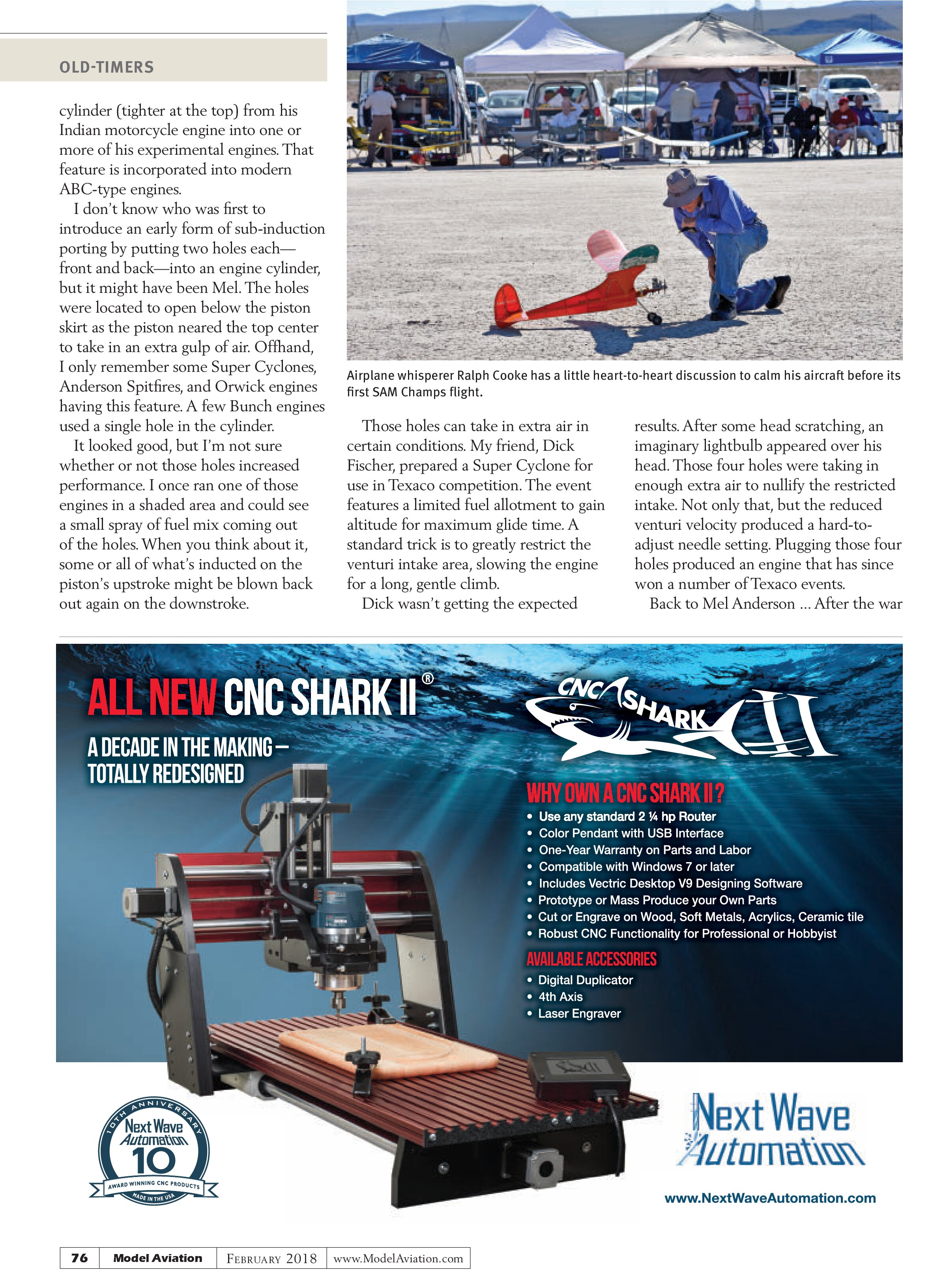
Those holes can take in extra air in certain conditions. My friend, Dick Fischer, prepared a Super Cyclone for use in Texaco competition. The event features a limited fuel allotment to gain altitude for maximum glide time. A standard trick is to greatly restrict the venturi intake area, slowing the engine for a long, gentle climb.
Dick wasn’t getting the expected results. After some head scratching, an imaginary lightbulb appeared over his head. Those four holes were taking in enough extra air to nullify the restricted intake. Not only that, but the reduced venturi velocity produced a hard-to-adjust needle setting. Plugging those four holes produced an engine that has since won a number of Texaco events.
Back to Mel Anderson ... After the war ended, he formed his own company, first designing and producing the Anderson Spitfire engine. The Spitfire is sometimes referred to as a Super Cyclone on steroids. Its basic design is similar to the Cyclone, but everything is sturdier and more intricately designed, and it runs stronger. As smaller engines became popular, Mel produced the successful Spitfire series of ½A-size engines.
Unfortunately, great engine designs were not the only key to commercial success at that time. With wartime contracts gone, dozens of machine shops began turning out model engines. The Mel Anderson Manufacturing Company was among the large number of engine builders that collapsed because too many others were in the same business. Mel became a production engineer for a larger company before his retirement.
SAM Champs
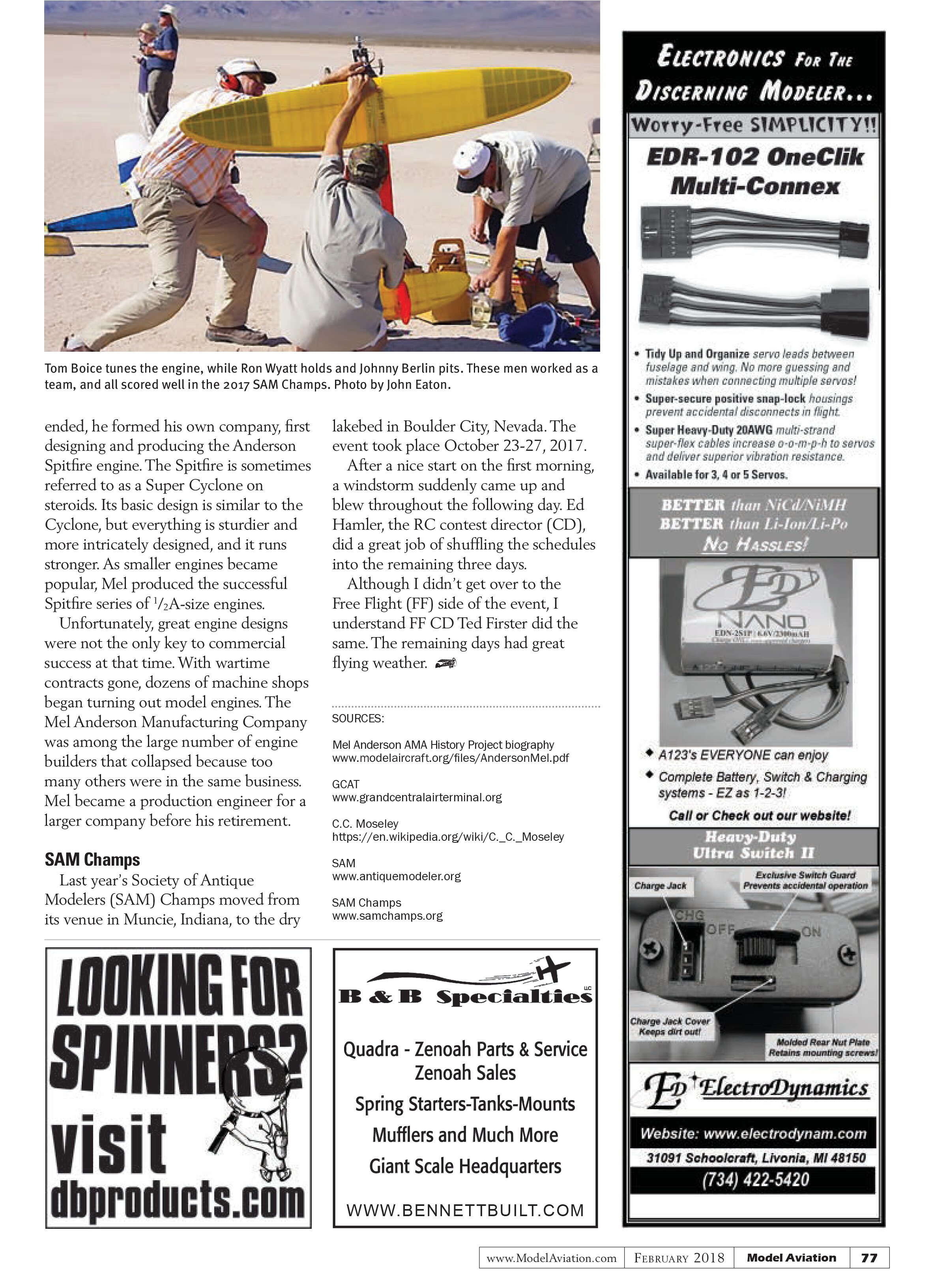
Last year’s Society of Antique Modelers (SAM) Champs moved from its venue in Muncie, Indiana, to the dry lakebed in Boulder City, Nevada. The event took place October 23-27, 2017.
After a nice start on the first morning, a windstorm suddenly came up and blew throughout the following day. Ed Hamler, the RC contest director (CD), did a great job of shuffling the schedules into the remaining three days.
Although I didn’t get over to the Free Flight (FF) side of the event, I understand FF CD Ted Firster did the same. The remaining days had great flying weather.

SOURCES:
Mel Anderson AMA History Project biography
www.modelaircraft.org/files/AndersonMel.pdf
GCAT
www.grandcentralairterminal.org
C.C. Moseley
https://en.wikipedia.org/wiki/C._C._Moseley
SAM Champs
www.samchamps.org