Thermals, towline models, and Juniors
by Louis Joyner
joynerduration@gmail.com

“Quick, get the car. I just lucked into a thermal!” In the 1950s, finding a thermal was considered a matter of happenstance and mostly out of a modeler’s control. Thermals were, and still are, an important factor in Free Flight (FF). Perhaps they are the most important. There is an old saying: “Bad model, bad rubber, good air is better than good model, good rubber, and bad air.”
Back then we knew that thermals are rising columns of warm air. We just didn’t know how to consistently find them. Over time, many methods were developed to help locate thermals, including Mylar streamers and soap bubbles.
Then came sophisticated electronic gadgets that used a thermistor to measure air temperature. These devices graphed temperature variations over time to better understand thermal activity and predict the best times to launch. The current iteration of the thermistor involves multiple sensors placed upwind that wirelessly transmit air temperature and wind speed data to the base unit at the flightline.
Fixed-base thermal detection works well for FF categories flown from a flightline. The sportsman prepares the model, waits patiently for the thermal, and launches the model.
Towline models offer a different challenge. A pilot can wait until a thermal is sensed then tow up into it, or start towing and hope to feel the tug of a thermal through the towline. In the 1950s and 1960s, the latter method could mean a long run upwind until you ran out of field or energy.
With the advent of circle towing in the mid-1960s, the Towline event dramatically changed. The pilot and his or her model became much more mobile. The aircraft, with a 50-meter towline attached, could be flown in
circles. The pilot could move upwind, downwind, or anywhere else on the field in search of a thermal.
This newfound mobility was superbly exploited by Danish flier Thomas Koster at the 1979 Free Flight World Championships in Taft, California. Proxy flying for fellow Dane Per Grunnet, Thomas towed over a group of parked buses and used the heat from the running engines to gain a small advantage in a late afternoon flyoff. Circle towing requires less running, allowing modelers to extend their participation well into their 60s and beyond. Positioning downwind had the advantage of being able to watch models upwind, tow under a model in a thermal as it came overhead, and launch into the same thermal. This practice became known as piggybacking, or euphemistically as “flying with other sportsmen.”
Other technical advances such as the zoom launch, bunt transition, stronger carbon-fiber structures, flaps, low-drag airfoils, and electronic timers have created the modern Towline model. Now the circle-tow bunter dominates both F1A and the smaller F1H Towline categories. In non-thermal conditions, such as an early morning or late afternoon flyoff, the extra height gain—almost double the line length—has greatly increased still-air flight times. In thermal conditions, the mobility on tow has made it easier to place the model into lift.
But circle towing is not without risk. Tangling lines with other fliers was an early problem. In windy conditions, the model can turn downwind and nose into the ground before the pilot can turn the aircraft back into the wind. In calm conditions, the towline’s extra drag can cause the airplane to simply glide to the ground.
Circle towing requires the ability to keep the aircraft safely circling, while simultaneously watching other models to avoid line tangles and scouting for indications of thermal activity. However, another advantage of circle towing is that it can be practiced safely in a small field, especially when combined with the use of a remote dethermalizer to limit

Joel Yori (L) and his grandfather, Bob Sifleet, prepare Joel’s F1A Towline glider for a flight. The large reel holds the 50-meter line. A remote dethermalizer transmitter is strapped to Bob’s arm.
For the past six years, Joel has been coached by his grandfather, Bob Sifleet, who is also an experienced FF pilot with international experience. “Joel has learned to pick air at a high level and seldom misses a thermal,” Bob said. “At the 2017 Nats, he maxed out and won F1A and F1Q, and was in the F1B flyoff.” Joel beat his grandfather by 6 seconds in F1Q.
Joel got his start in FF with building and flying P-30 Rubber models. “He then flew elementary F1Q models and has moved on to modern high-tech models that he flies with little or no input from me,” said Bob.
Bob has also introduced Joel to one of the lesser-known FF events, F1E. Popular in Europe, the Slope Gliding event has only started to draw a small, but growing, number of fliers in this country. “Joel flew at the last three F1E World Championships as our only Junior member,” Bob said. “He placed fifth in 2013.”
The Junior FF World Championships offers a great opportunity for young men and women to compete in world competition. It also offers the opportunity for a parent, grandparent, or even a club to work with a young modeler to develop his or her skills to the highest level.
The US Junior World team will compete this summer in Bulgaria in F1A Towline Glider, F1B Wakefield Rubber, and F1P Power. The next Junior World Championships will be in 2020. If you know of someone who might be interested in trying out for the 2020 team, you can find information about the program on the National Free Flight Society’s (NFFS) website. Look under “Competition” then “Juniors.”
flight time after the launch.
Junior World Championships
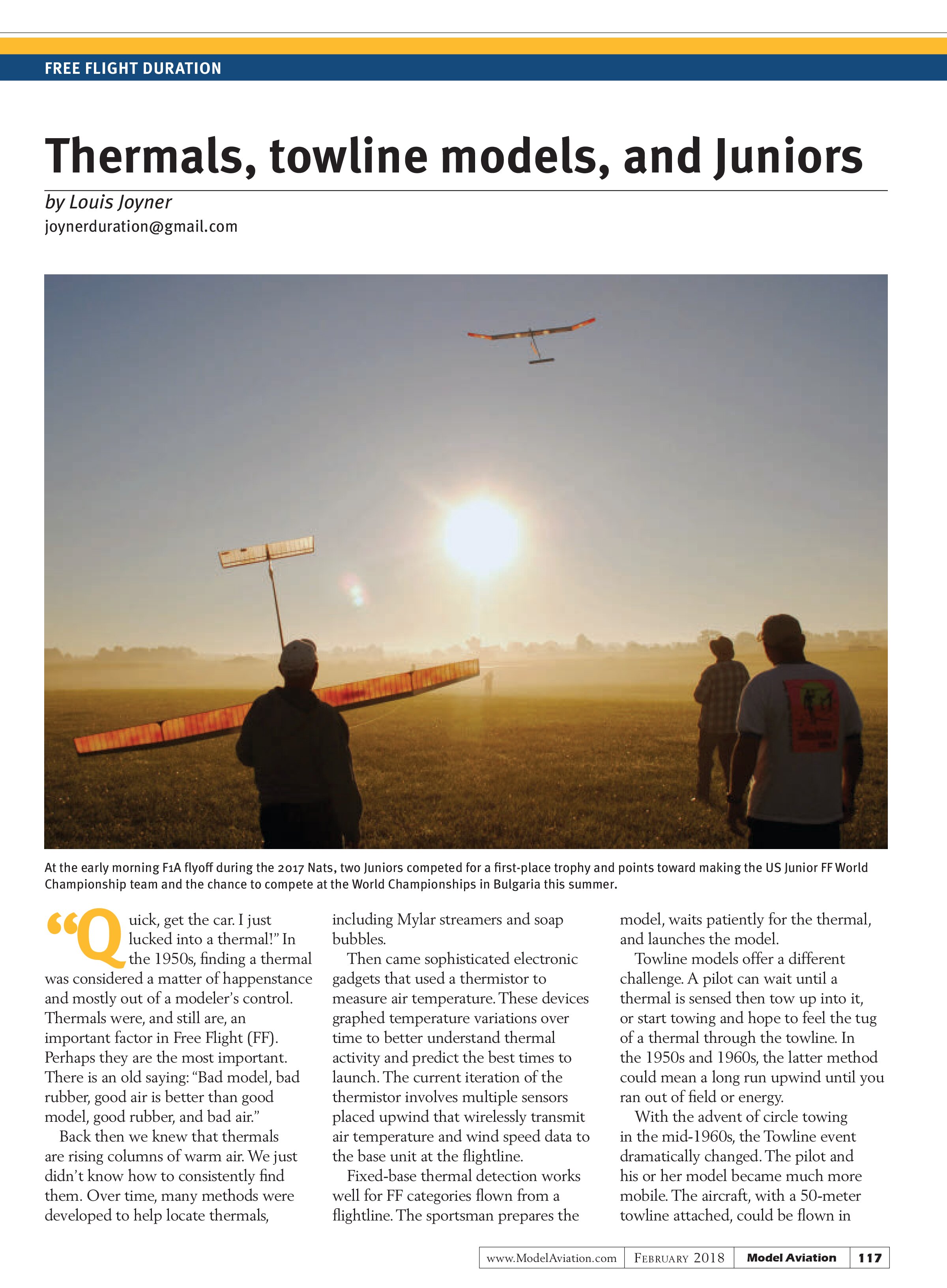
F1A Towline is one of three FF events flown at the biennial Junior FF World Championships. At the 2017 Nats, several Juniors competed with more than six former US FF team members, including one former world champion, Mike McKeever. After seven rounds, only two fliers, both Juniors, were maxed out.
Cade Fedor and Joel Yori are experienced pilots and former members of the US Junior team. The next morning, Cade and Joel flew off for first place overall. Joel ended up in first by 42 seconds, but Cade also received a first-place ranking as the high AMA Junior pilot.
Although his model was equipped for a circle tow, Cade preferred to wait for indications of upwind thermal activity then straight tow the model into lift. “I piggybacked all of them,” Cade said, referring to his seven flights and those of the older pilots.
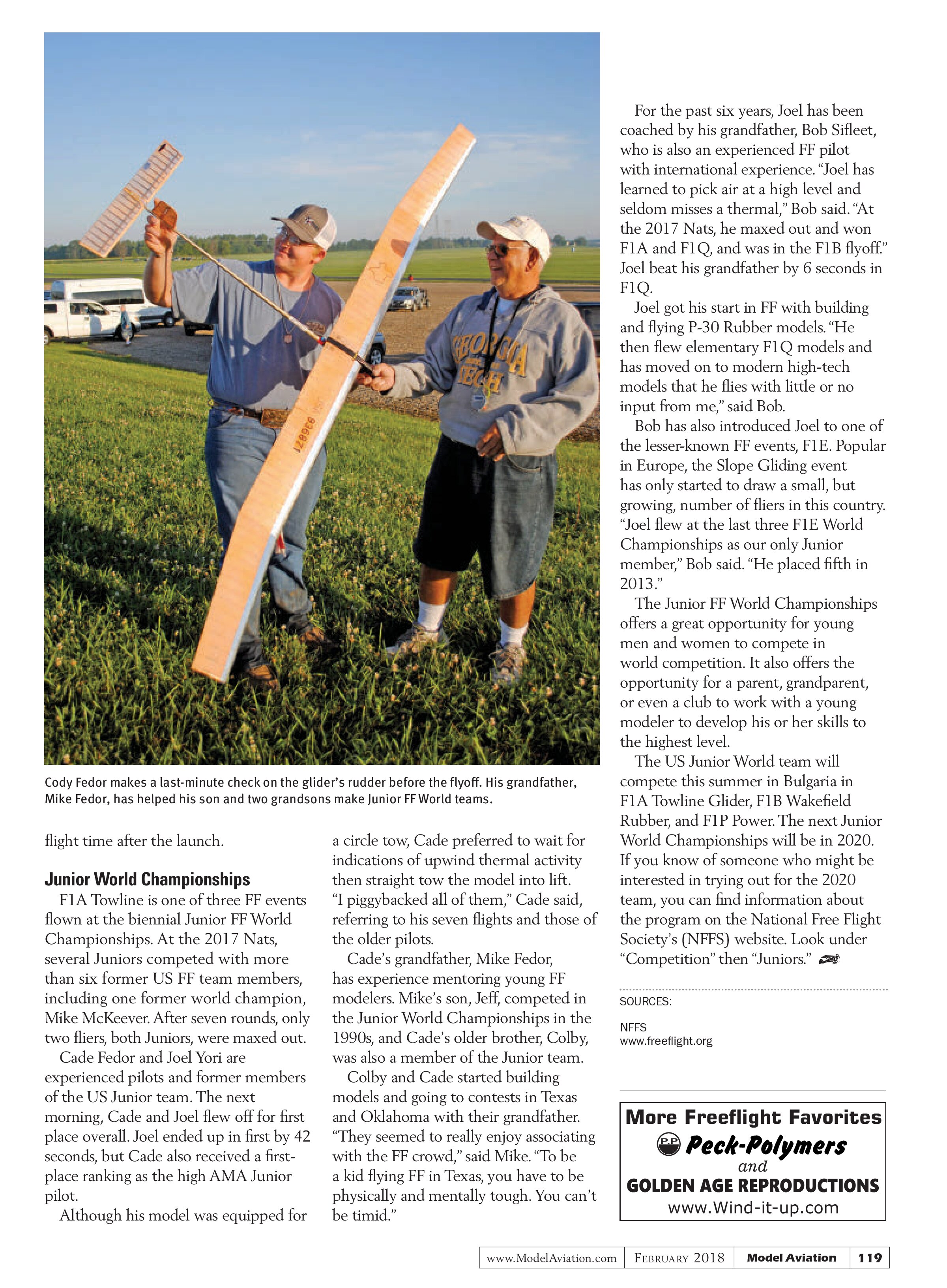
Cade’s grandfather, Mike Fedor, has experience mentoring young FF modelers. Mike’s son, Jeff, competed in the Junior World Championships in the 1990s, and Cade’s older brother, Colby, was also a member of the Junior team.
Colby and Cade started building models and going to contests in Texas and Oklahoma with their grandfather. “They seemed to really enjoy associating with the FF crowd,” said Mike. “To be a kid flying FF in Texas, you have to be physically and mentally tough. You can’t be timid.”

Cody Fedor makes a last-minute check on the glider’s rudder before the flyoff. His grandfather, Mike Fedor, has helped his son and two grandsons make Junior FF World teams.
For the past six years, Joel has been coached by his grandfather, Bob Sifleet, who is also an experienced FF pilot with international experience. “Joel has learned to pick air at a high level and seldom misses a thermal,” Bob said. “At the 2017 Nats, he maxed out and won F1A and F1Q, and was in the F1B flyoff.” Joel beat his grandfather by 6 seconds in F1Q.
Joel got his start in FF with building and flying P-30 Rubber models. “He then flew elementary F1Q models and has moved on to modern high-tech models that he flies with little or no input from me,” said Bob.
Bob has also introduced Joel to one of the lesser-known FF events, F1E. Popular in Europe, the Slope Gliding event has only started to draw a small, but growing, number of fliers in this country. “Joel flew at the last three F1E World Championships as our only Junior member,” Bob said. “He placed fifth in 2013.”
The Junior FF World Championships offers a great opportunity for young men and women to compete in world competition. It also offers the opportunity for a parent, grandparent, or even a club to work with a young modeler to develop his or her skills to the highest level.
The US Junior World team will compete this summer in Bulgaria in F1A Towline Glider, F1B Wakefield Rubber, and F1P Power. The next Junior World Championships will be in 2020. If you know of someone who might be interested in trying out for the 2020 team, you can find information about the program on the National Free Flight Society’s (NFFS) website. Look under “Competition” then “Juniors.”