Focal Point

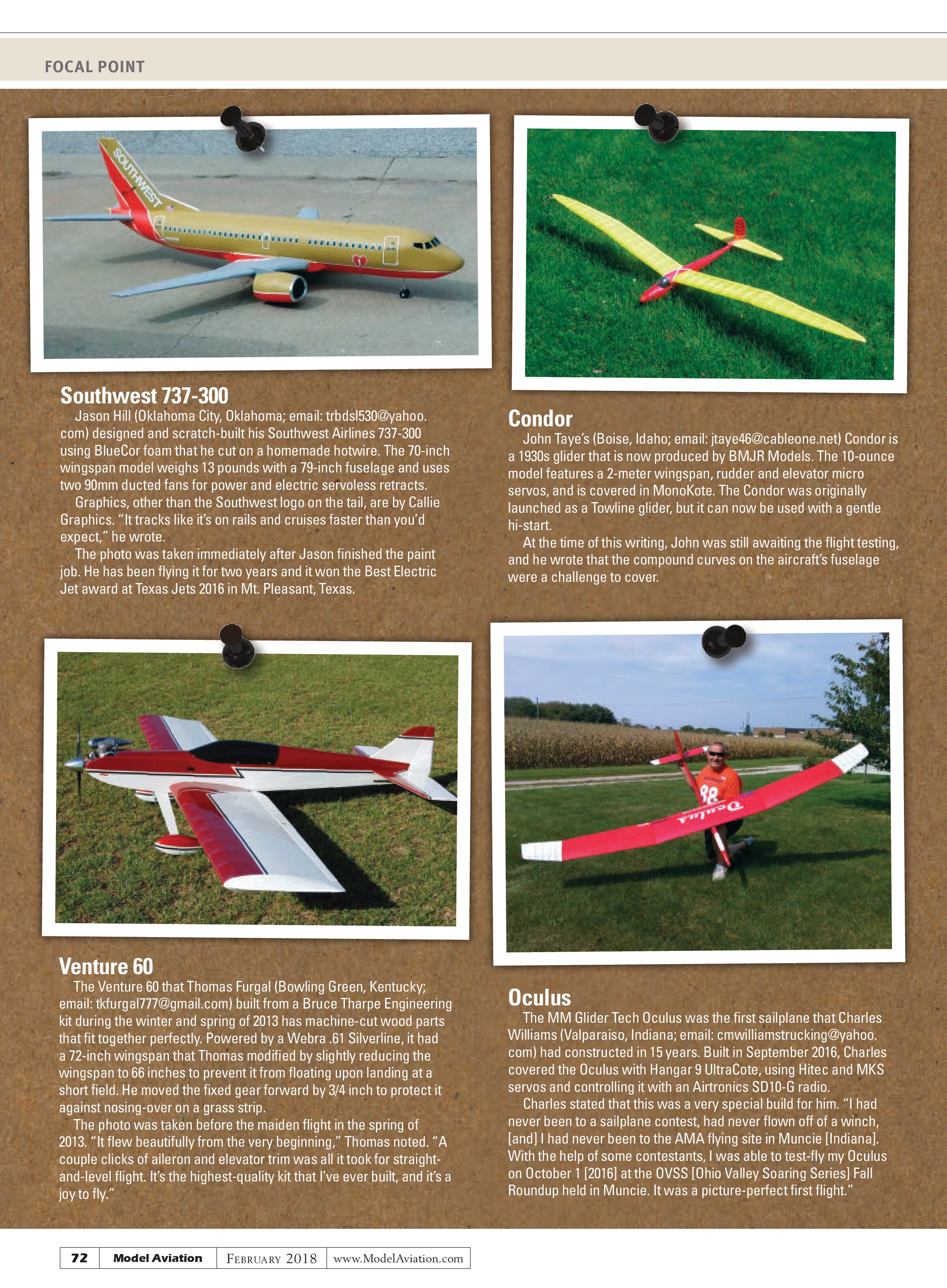
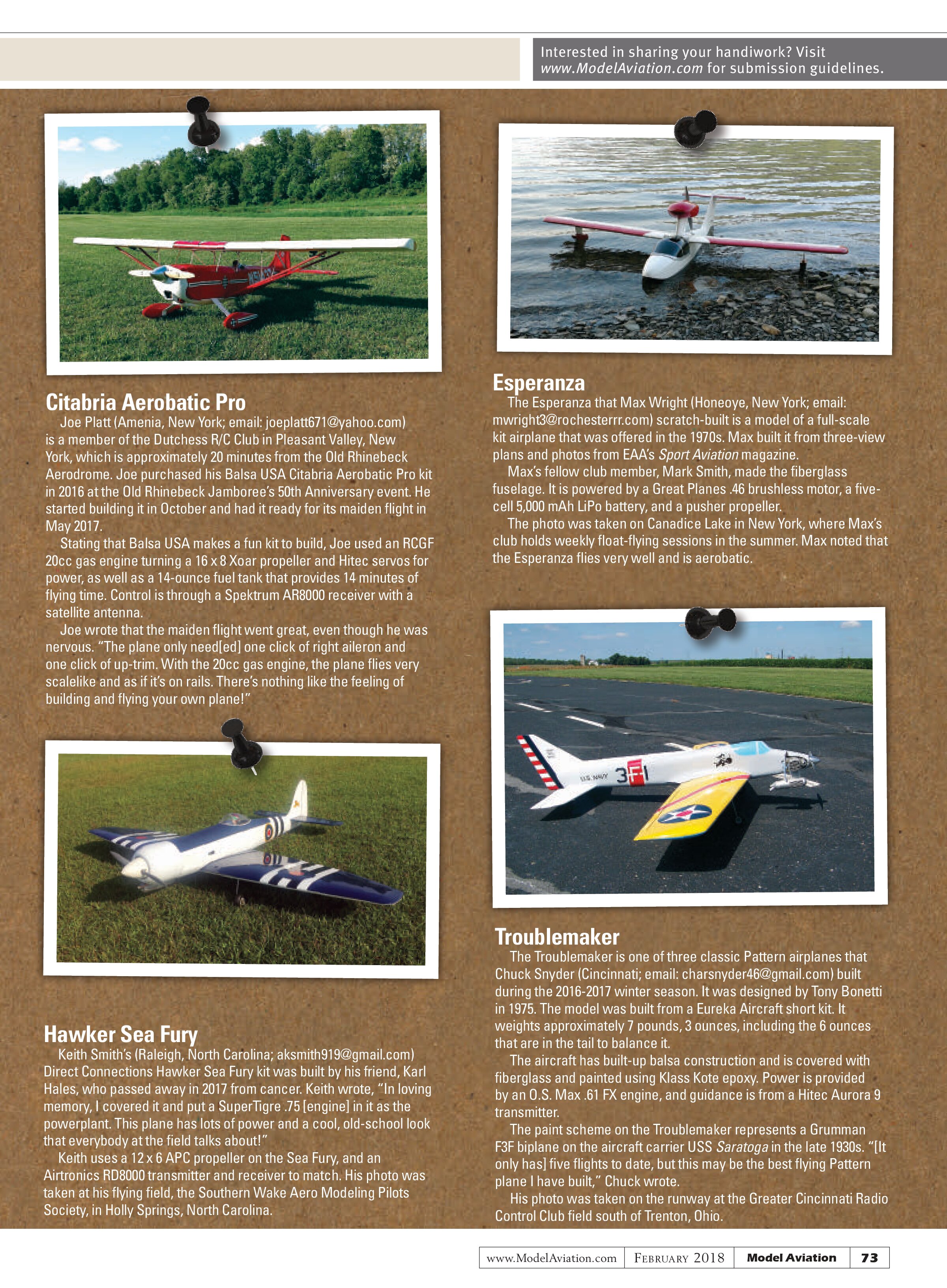
Southwest 737-300
Jason Hill (Oklahoma City, Oklahoma; email: trbdsl530@yahoo.com) designed and scratch-built his Southwest Airlines 737-300 using BlueCor foam that he cut on a homemade hotwire. The 70-inch wingspan model weighs 13 pounds with a 79-inch fuselage and uses two 90mm ducted fans for power and electric servoless retracts. Graphics, other than the Southwest logo on the tail, are by Callie Graphics. “It tracks like it’s on rails and cruises faster than you’d expect,” he wrote.
The photo was taken immediately after Jason finished the paint job. He has been flying it for two years and it won the Best Electric Jet award at Texas Jets 2016 in Mt. Pleasant, Texas.

Condor
John Taye’s (Boise, Idaho; email: jtaye46@cableone.net) Condor is a 1930s glider that is now produced by BMJR Models. The 10-ounce model features a 2-meter wingspan, rudder and elevator micro servos, and is covered in MonoKote. The Condor was originally launched as a Towline glider, but it can now be used with a gentle hi-start.
At the time of this writing, John was still awaiting the flight testing, and he wrote that the compound curves on the aircraft’s fuselage were a challenge to cover.

Venture 60
The Venture 60 that Thomas Furgal (Bowling Green, Kentucky; email: tkfurgal777@gmail.com) built from a Bruce Tharpe Engineering kit during the winter and spring of 2013 has machine-cut wood parts that fit together perfectly. Powered by a Webra .61 Silverline, it had a 72-inch wingspan that Thomas modified by slightly reducing the wingspan to 66 inches to prevent it from floating upon landing at a short field. He moved the fixed gear forward by 3/4 inch to protect it against nosing-over on a grass strip.
The photo was taken before the maiden flight in the spring of 2013. “It flew beautifully from the very beginning,” Thomas noted. “A couple clicks of aileron and elevator trim was all it took for straight-and-level flight. It’s the highest-quality kit that I’ve ever built, and it’s a joy to fly.”

Oculus
The MM Glider Tech Oculus was the first sailplane that Charles Williams (Valparaiso, Indiana; email: cmwilliamstrucking@yahoo.com) had constructed in 15 years. Built in September 2016, Charles covered the Oculus with Hangar 9 UltraCote, using Hitec and MKS servos and controlling it with an Airtronics SD10-G radio.
Charles stated that this was a very special build for him. “I had never been to a sailplane contest, had never flown off of a winch, [and] I had never been to the AMA flying site in Muncie [Indiana]. With the help of some contestants, I was able to test-fly my Oculus on October 1 [2016] at the OVSS [Ohio Valley Soaring Series] Fall Roundup held in Muncie. It was a picture-perfect first flight.”

Citabria Aerobatic Pro
Joe Platt (Amenia, New York; email: joeplatt671@yahoo.com) is a member of the Dutchess R/C Club in Pleasant Valley, New York, which is approximately 20 minutes from the Old Rhinebeck Aerodrome. Joe purchased his Balsa USA Citabria Aerobatic Pro kit in 2016 at the Old Rhinebeck Jamboree’s 50th Anniversary event. He started building it in October and had it ready for its maiden flight in May 2017.
Stating that Balsa USA makes a fun kit to build, Joe used an RCGF 20cc gas engine turning a 16 x 8 Xoar propeller and Hitec servos for power, as well as a 14-ounce fuel tank that provides 14 minutes of flying time. Control is through a Spektrum AR8000 receiver with a satellite antenna.
Joe wrote that the maiden flight went great, even though he was nervous. “The plane only need[ed] one click of right aileron and one click of up-trim. With the 20cc gas engine, the plane flies very scalelike and as if it’s on rails. There’s nothing like the feeling of building and flying your own plane!”

Esperanza
The Esperanza that Max Wright (Honeoye, New York; email: mwright3@rochesterrr.com) scratch-built is a model of a full-scale kit airplane that was offered in the 1970s. Max built it from three-view plans and photos from EAA’s Sport Aviation magazine.
Max’s fellow club member, Mark Smith, made the fiberglass fuselage. It is powered by a Great Planes .46 brushless motor, a five-cell 5,000 mAh LiPo battery, and a pusher propeller.
The photo was taken on Canadice Lake in New York, where Max’s club holds weekly float-flying sessions in the summer. Max noted that the Esperanza flies very well and is aerobatic.

Hawker Sea Fury
Keith Smith’s (Raleigh, North Carolina; aksmith919@gmail.com) Direct Connections Hawker Sea Fury kit was built by his friend, Karl Hales, who passed away in 2017 from cancer. Keith wrote, “In loving memory, I covered it and put a SuperTigre .75 [engine] in it as the powerplant. This plane has lots of power and a cool, old-school look that everybody at the field talks about!”
Keith uses a 12 x 6 APC propeller on the Sea Fury, and an Airtronics RD8000 transmitter and receiver to match. His photo was taken at his flying field, the Southern Wake Aero Modeling Pilots Society, in Holly Springs, North Carolina.

Troublemaker
The Troublemaker is one of three classic Pattern airplanes that Chuck Snyder (Cincinnati; email: charsnyder46@gmail.com) built during the 2016-2017 winter season. It was designed by Tony Bonetti in 1975. The model was built from a Eureka Aircraft short kit. It weighs approximately 7 pounds, 3 ounces, including the 6 ounces that are in the tail to balance it.
The aircraft has built-up balsa construction and is covered with fiberglass and painted using Klass Kote epoxy. Power is provided by an O.S. Max .61 FX engine, and guidance is from a Hitec Aurora 9 transmitter.
The paint scheme on the Troublemaker represents a Grumman F3F biplane on the aircraft carrier USS Saratoga in the late 1930s. “[It only has] five flights to date, but this may be the best flying Pattern plane I have built,” Chuck wrote.
His photo was taken on the runway at the Greater Cincinnati Radio Control Club field south of Trenton, Ohio.