Education Through Aviation
by Bill Pritchett, Education Director
“Whoso neglects learning in his youth, loses the past and is dead for the future.” —Euripides

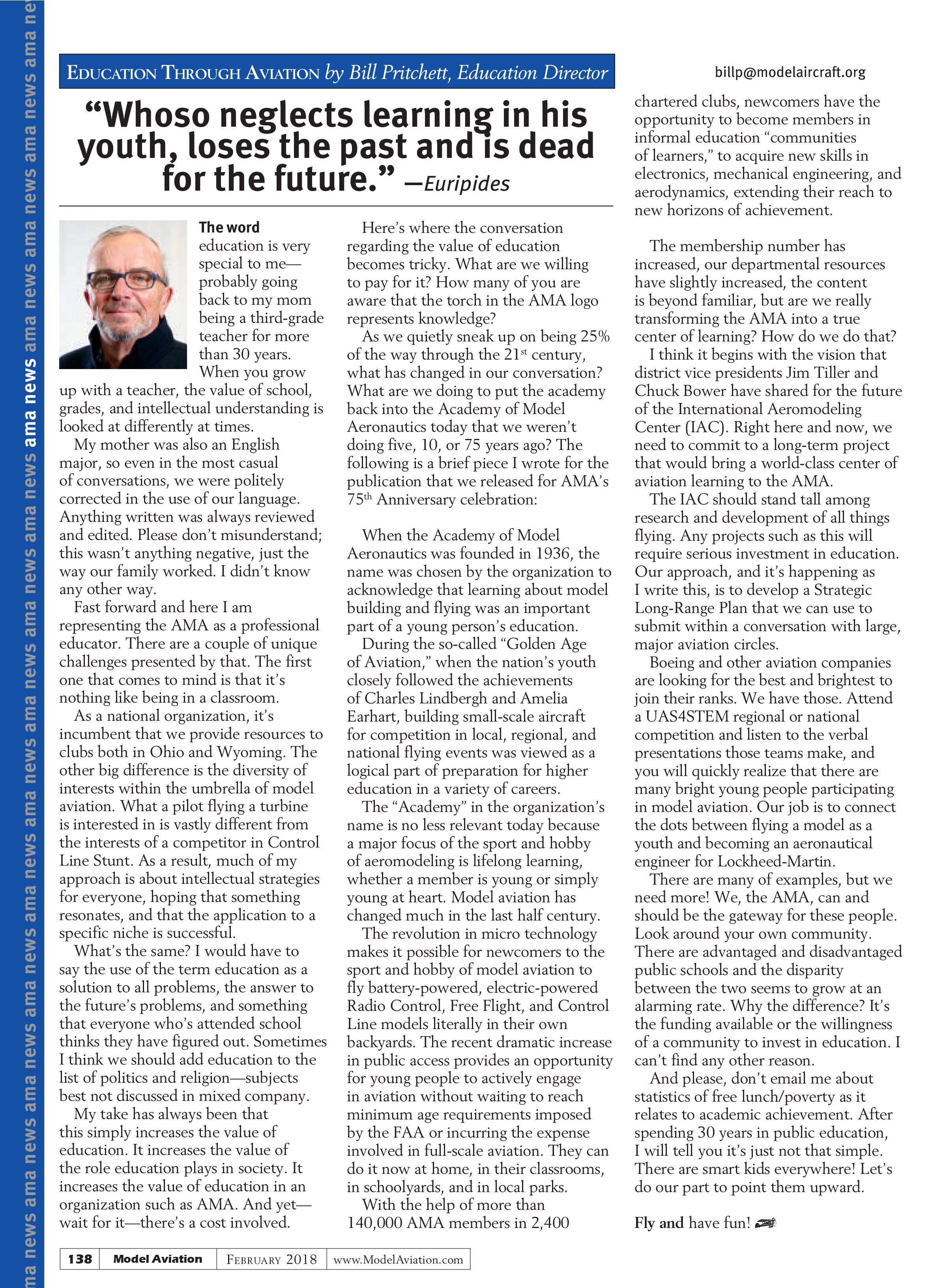
The word education is very special to me—probably going back to my mom being a third-grade teacher for more than 30 years. When you grow up with a teacher, the value of school, grades, and intellectual understanding is looked at differently at times.
My mother was also an English major, so even in the most casual of conversations, we were politely corrected in the use of our language. Anything written was always reviewed and edited. Please don’t misunderstand; this wasn’t anything negative, just the way our family worked. I didn’t know any other way.
Fast forward and here I am representing the AMA as a professional educator. There are a couple of unique challenges presented by that. The first one that comes to mind is that it’s nothing like being in a classroom.
As a national organization, it’s incumbent that we provide resources to clubs both in Ohio and Wyoming. The other big difference is the diversity of interests within the umbrella of model aviation. What a pilot flying a turbine is interested in is vastly different from the interests of a competitor in Control Line Stunt. As a result, much of my approach is about intellectual strategies for everyone, hoping that something resonates, and that the application to a specific niche is successful.
What’s the same? I would have to say the use of the term education as a solution to all problems, the answer to the future’s problems, and something that everyone who’s attended school thinks they have figured out. Sometimes I think we should add education to the list of politics and religion—subjects best not discussed in mixed company.
My take has always been that this simply increases the value of education. It increases the value of the role education plays in society. It increases the value of education in an organization such as AMA. And yet—wait for it—there’s a cost involved.
Here’s where the conversation regarding the value of education becomes tricky. What are we willing to pay for it? How many of you are aware that the torch in the AMA logo represents knowledge?
As we quietly sneak up on being 25% of the way through the 21st century, what has changed in our conversation? What are we doing to put the academy back into the Academy of Model Aeronautics today that we weren’t doing five, 10, or 75 years ago? The following is a brief piece I wrote for the publication that we released for AMA’s 75th Anniversary celebration:
When the Academy of Model Aeronautics was founded in 1936, the name was chosen by the organization to acknowledge that learning about model building and flying was an important part of a young person’s education.
During the so-called “Golden Age of Aviation,” when the nation’s youth closely followed the achievements of Charles Lindbergh and Amelia Earhart, building small-scale aircraft for competition in local, regional, and national flying events was viewed as a logical part of preparation for higher education in a variety of careers.
The “Academy” in the organization’s name is no less relevant today because a major focus of the sport and hobby of aeromodeling is lifelong learning, whether a member is young or simply young at heart. Model aviation has changed much in the last half century.
The revolution in micro technology makes it possible for newcomers to the sport and hobby of model aviation to fly battery-powered, electric-powered Radio Control, Free Flight, and Control Line models literally in their own backyards. The recent dramatic increase in public access provides an opportunity for young people to actively engage in aviation without waiting to reach minimum age requirements imposed by the FAA or incurring the expense involved in full-scale aviation. They can do it now at home, in their classrooms, in schoolyards, and in local parks.
With the help of more than 140,000 AMA members in 2,400 chartered clubs, newcomers have the opportunity to become members in informal education “communities of learners,” to acquire new skills in electronics, mechanical engineering, and aerodynamics, extending their reach to new horizons of achievement.
The membership number has increased, our departmental resources have slightly increased, the content is beyond familiar, but are we really transforming the AMA into a true center of learning? How do we do that?
I think it begins with the vision that district vice presidents Jim Tiller and Chuck Bower have shared for the future of the International Aeromodeling Center (IAC). Right here and now, we need to commit to a long-term project that would bring a world-class center of aviation learning to the AMA.
The IAC should stand tall among research and development of all things flying. Any projects such as this will require serious investment in education. Our approach, and it’s happening as I write this, is to develop a Strategic Long-Range Plan that we can use to submit within a conversation with large, major aviation circles.
Boeing and other aviation companies are looking for the best and brightest to join their ranks. We have those. Attend a UAS4STEM regional or national competition and listen to the verbal presentations those teams make, and you will quickly realize that there are many bright young people participating in model aviation. Our job is to connect the dots between flying a model as a youth and becoming an aeronautical engineer for Lockheed-Martin.
There are many of examples, but we need more! We, the AMA, can and should be the gateway for these people. Look around your own community. There are advantaged and disadvantaged public schools and the disparity between the two seems to grow at an alarming rate. Why the difference? It’s the funding available or the willingness of a community to invest in education. I can’t find any other reason.
And please, don’t email me about statistics of free lunch/poverty as it relates to academic achievement. After spending 30 years in public education, I will tell you it’s just not that simple. There are smart kids everywhere! Let’s do our part to point them upward.
Fly and have fun!