Recreational drone operator strikes a Black Hawk helicopter
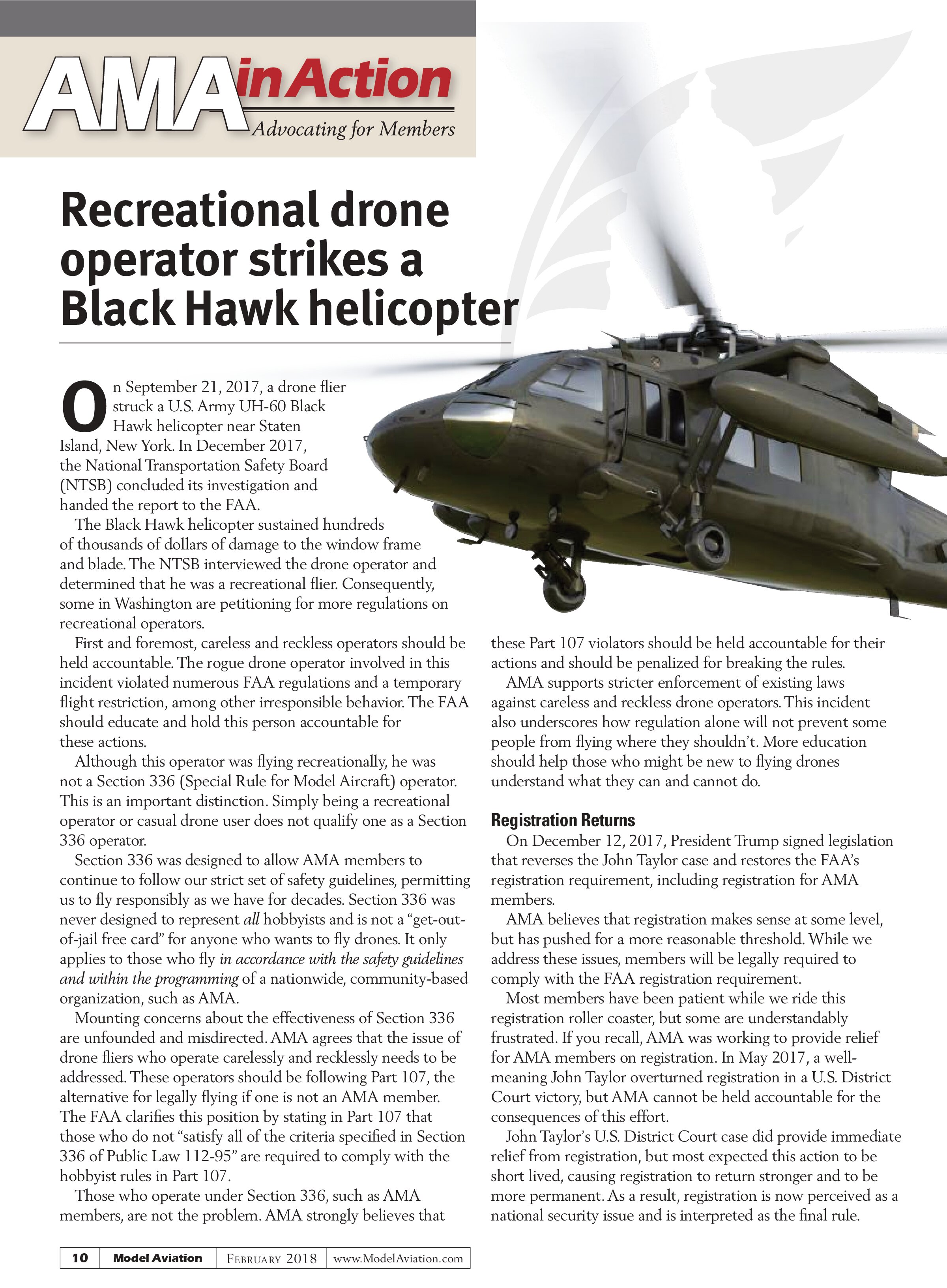
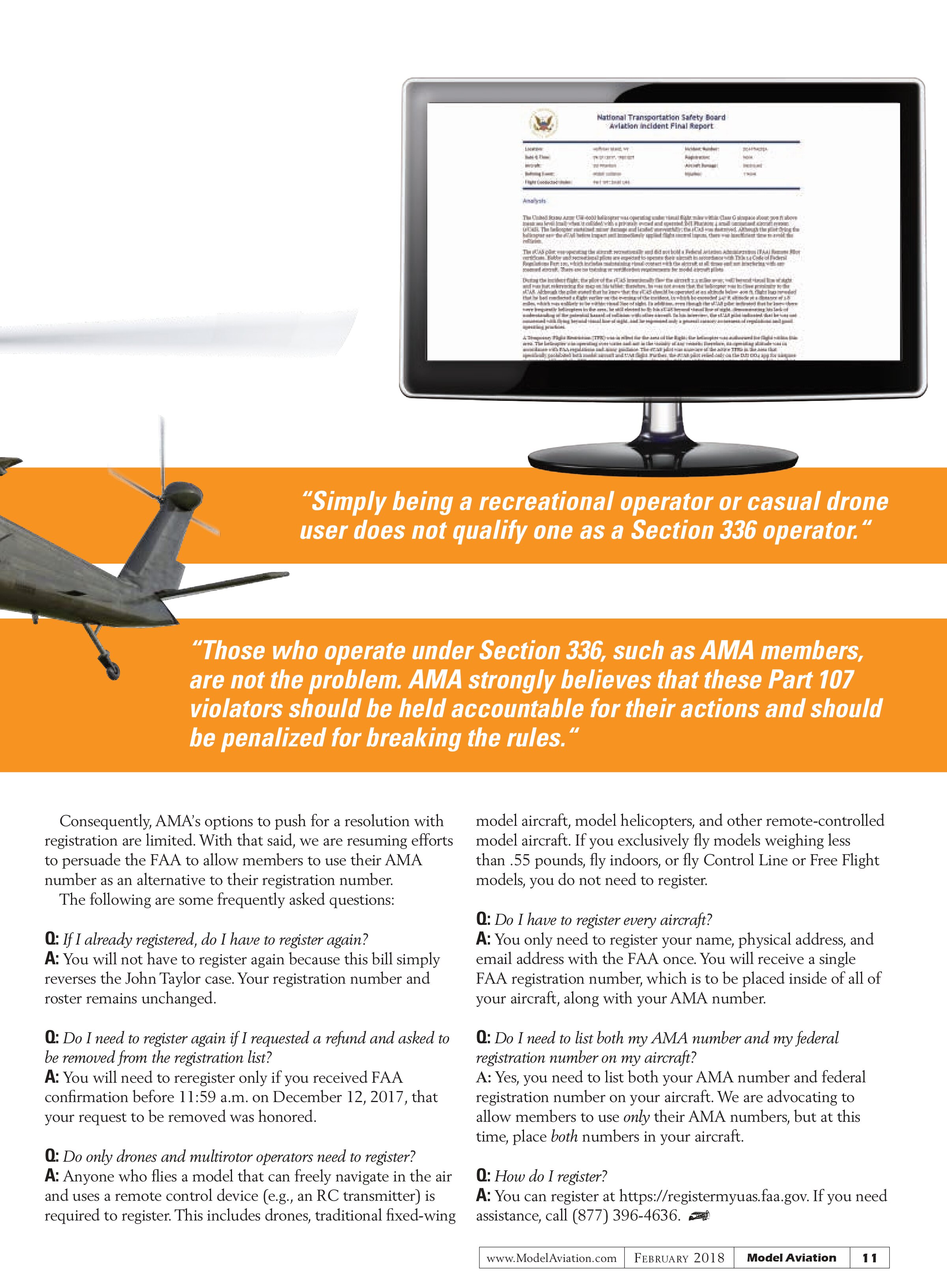
On September 21, 2017, a drone flier struck a U.S. Army UH-60 Black Hawk helicopter near Staten Island, New York. In December 2017, the National Transportation Safety Board (NTSB) concluded its investigation and handed the report to the FAA.
The Black Hawk helicopter sustained hundreds of thousands of dollars of damage to the window frame and blade. The NTSB interviewed the drone operator and determined that he was a recreational flier. Consequently, some in Washington are petitioning for more regulations on recreational operators.
First and foremost, careless and reckless operators should be held accountable. The rogue drone operator involved in this incident violated numerous FAA regulations and a temporary flight restriction, among other irresponsible behavior. The FAA should educate and hold this person accountable for these actions.
Although this operator was flying recreationally, he was not a Section 336 (Special Rule for Model Aircraft) operator. This is an important distinction. Simply being a recreational operator or casual drone user does not qualify one as a Section 336 operator.
Section 336 was designed to allow AMA members to continue to follow our strict set of safety guidelines, permitting us to fly responsibly as we have for decades. Section 336 was never designed to represent all hobbyists and is not a “get-out-of-jail free card” for anyone who wants to fly drones. It only applies to those who fly in accordance with the safety guidelines and within the programming of a nationwide, community-based organization, such as AMA.
Mounting concerns about the effectiveness of Section 336 are unfounded and misdirected. AMA agrees that the issue of drone fliers who operate carelessly and recklessly needs to be addressed. These operators should be following Part 107, the alternative for legally flying if one is not an AMA member. The FAA clarifies this position by stating in Part 107 that those who do not “satisfy all of the criteria specified in Section 336 of Public Law 112-95” are required to comply with the hobbyist rules in Part 107.
Those who operate under Section 336, such as AMA members, are not the problem. AMA strongly believes that these Part 107 violators should be held accountable for their actions and should be penalized for breaking the rules.
AMA supports stricter enforcement of existing laws against careless and reckless drone operators. This incident also underscores how regulation alone will not prevent some people from flying where they shouldn’t. More education should help those who might be new to flying drones understand what they can and cannot do.
Registration Returns
On December 12, 2017, President Trump signed legislation that reverses the John Taylor case and restores the FAA’s registration requirement, including registration for AMA members.
AMA believes that registration makes sense at some level, but has pushed for a more reasonable threshold. While we address these issues, members will be legally required to comply with the FAA registration requirement.
Most members have been patient while we ride this registration roller coaster, but some are understandably frustrated. If you recall, AMA was working to provide relief for AMA members on registration. In May 2017, a well-meaning John Taylor overturned registration in a U.S. District Court victory, but AMA cannot be held accountable for the consequences of this effort.
John Taylor’s U.S. District Court case did provide immediate relief from registration, but most expected this action to be short lived, causing registration to return stronger and to be more permanent. As a result, registration is now perceived as a national security issue and is interpreted as the final rule.
Consequently, AMA’s options to push for a resolution with registration are limited. With that said, we are resuming efforts to persuade the FAA to allow members to use their AMA number as an alternative to their registration number.
The following are some frequently asked questions:
Q: If I already registered, do I have to register again?
A: You will not have to register again because this bill simply reverses the John Taylor case. Your registration number and roster remains unchanged.
Q: Do I need to register again if I requested a refund and asked to be removed from the registration list?
A: You will need to reregister only if you received FAA confirmation before 11:59 a.m. on December 12, 2017, that your request to be removed was honored.
Q: Do only drones and multirotor operators need to register?
A: Anyone who flies a model that can freely navigate in the air and uses a remote control device (e.g., an RC transmitter) is required to register. This includes drones, traditional fixed-wing model aircraft, model helicopters, and other remote-controlled model aircraft. If you exclusively fly models weighing less than .55 pounds, fly indoors, or fly Control Line or Free Flight models, you do not need to register.
Q: Do I have to register every aircraft?
A: You only need to register your name, physical address, and email address with the FAA once. You will receive a single FAA registration number, which is to be placed inside of all of your aircraft, along with your AMA number.
Q: Do I need to list both my AMA number and my federal registration number on my aircraft?
A: Yes, you need to list both your AMA number and federal registration number on your aircraft. We are advocating to allow members to use only their AMA numbers, but at this time, place both numbers in your aircraft.
Q: How do I register?
A: You can register at https://registermyuas.faa.gov. If you need assistance, call (877) 396-4636.