Warbirds Over Texas
Military aircraft take flight in Dallas
by Larry Kruse | Photos by the author

The unexpected torrential rains that inundated the area the night before the 2017 Warbirds Over Texas event was set to begin, undoubtedly gave pause to the organizers. As the rain continued to fall, memories of the devastating 2015 Trinity River flood that covered the North Dallas Radio Control Club’s pastoral field with more than 5 feet of water, certainly was fresh in the minds of Contest Director (CD) Ed Kettler, and Charlie Shafer, who was in charge of the ground crew. Fortunately, Mother Nature did not feel compelled to offer an encore performance.
The heavy rain and high wind subsided by the next morning, leaving only a few collapsed pop-up tents and puddles for pilots to either jump or skirt as the event began. Demonstrating their satisfaction with previous Warbirds Over Texas events, many of the attendees had been there before and parked their campers and trailers on the still-soggy field. Those veterans, coupled with newcomers lured by the prospect of flying at one of the premier club sites in the Southwest, added to the ranks of participants. By midday on Saturday, June 10,
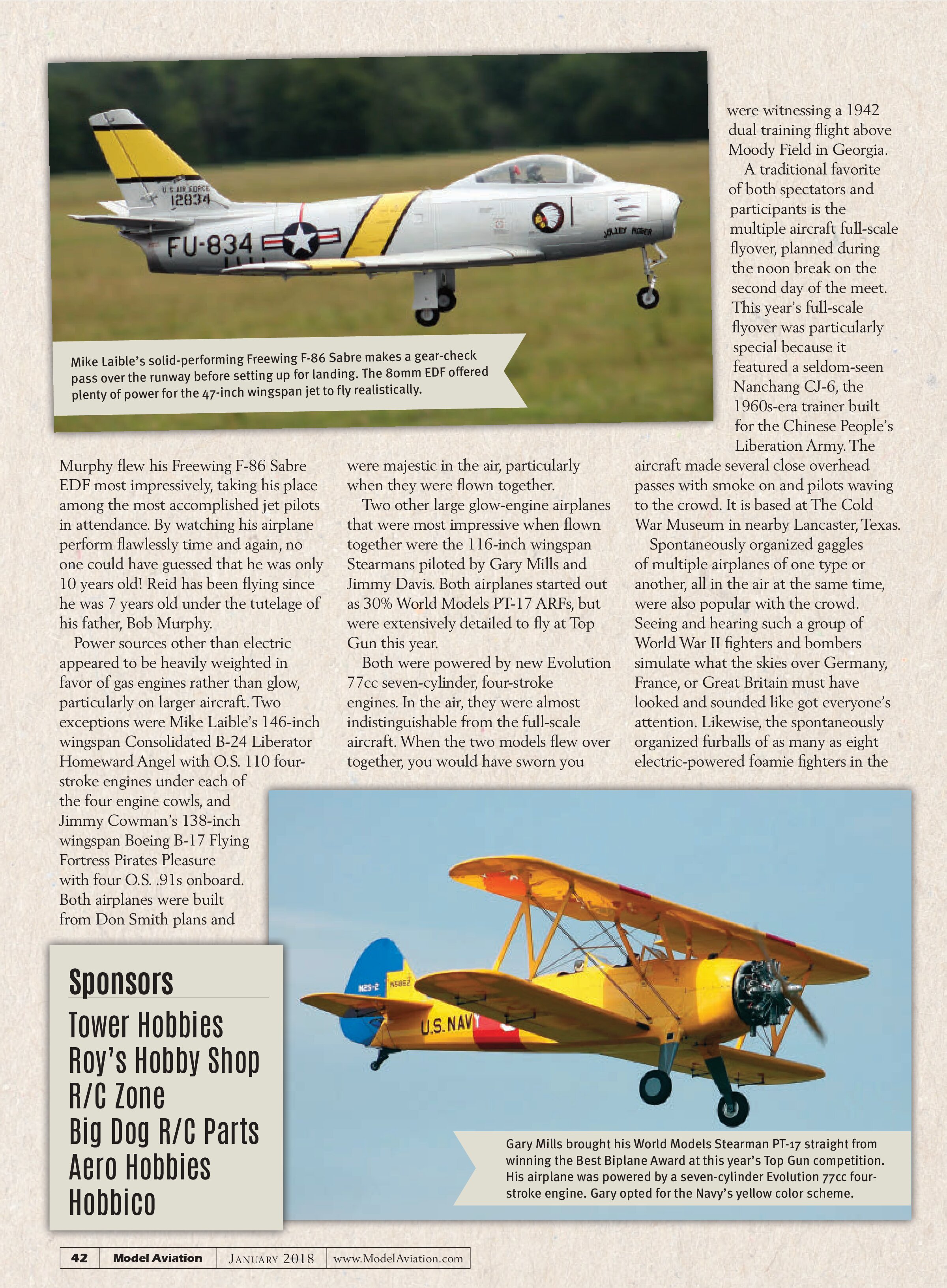
more than 70 pilots and 250 airplanes from Texas and six surrounding states bet on clearing skies and improving weather for the meet, and they were not disappointed. The leaden gray skies of Saturday morning turned into bright sunshine with a light wind by early afternoon, the puddles disappeared, and the flightline became increasingly busy. The field lends itself well to warbirds and similar events with its north/south 720-foot paved, slightly crowned runway and generous grass aprons on each side for those who prefer taking off and landing on grass. The single, wide taxiway that opens up to the runway is flanked by pilot stations on either side, with models ready for flight queued up in double lines along either side of the taxiway. Farther out, grass areas on both sides of the taxiway provide space for preparation and engine startups. To the rear of the runway and preparation area is a large sheltered pavilion used for pilot registration, a concession area, and spectator seating. Safety is always of paramount concern at Warbirds Over Texas, so initial safety checks of each aircraft are performed by assigned club members. The flight boss duties are performed on a rotating basis throughout the day by the CD and other key club members who direct all takeoffs and landings, assisted by each pilot’s required spotter and verbal announcements of the pilot’s intentions. Now in its seventh year, Warbirds Over Texas gave evidence of the club’s collective experience base and ran smoothly in all respects, particularly as things began to dry out on Saturday. Past Warbirds Over Texas meets have been notable for the variety of airplanes that have run the gamut of sizes and power types. This year continued that pattern with a good representation of glow, gas, and electric power, although notably scarce were turbine engines. Most of the jet model pilots present opted for electric ducted-fan (EDF) models that were nonetheless exciting in the air. Tom Blakeney’s silver Freewing MiG-21 Fishbed was powered with an 80mm motor turning a 12-blade fan. It flies wickedly fast with its lawn-dart planform flashing over the runway in a “don’t-blink-or-you’ll-miss-it” fashion. Similarly, AMA Youth member Reid

Murphy flew his Freewing F-86 Sabre EDF most impressively, taking his place among the most accomplished jet pilots in attendance. By watching his airplane perform flawlessly time and again, no one could have guessed that he was only 10 years old! Reid has been flying since he was 7 years old under the tutelage of his father, Bob Murphy.
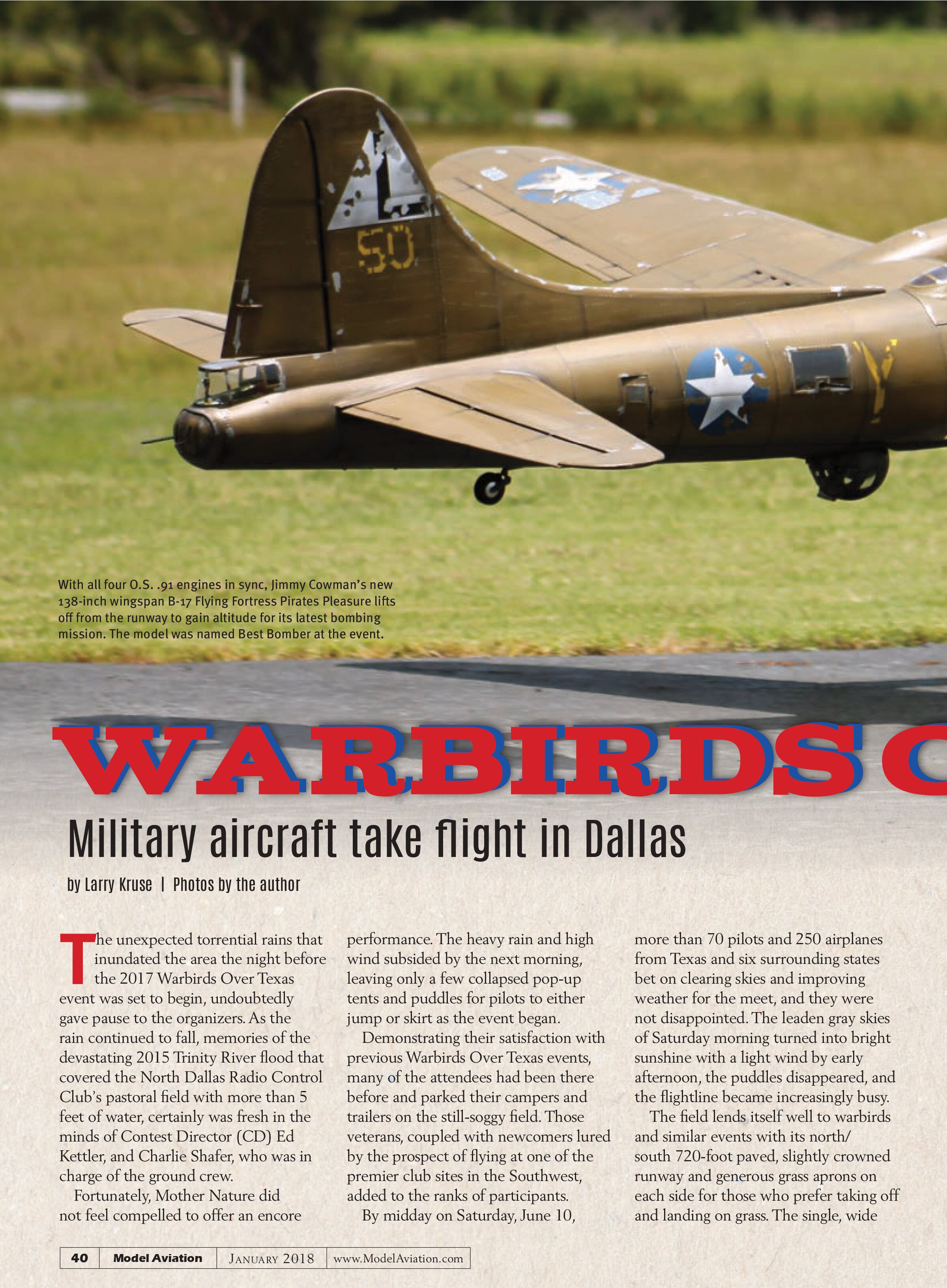
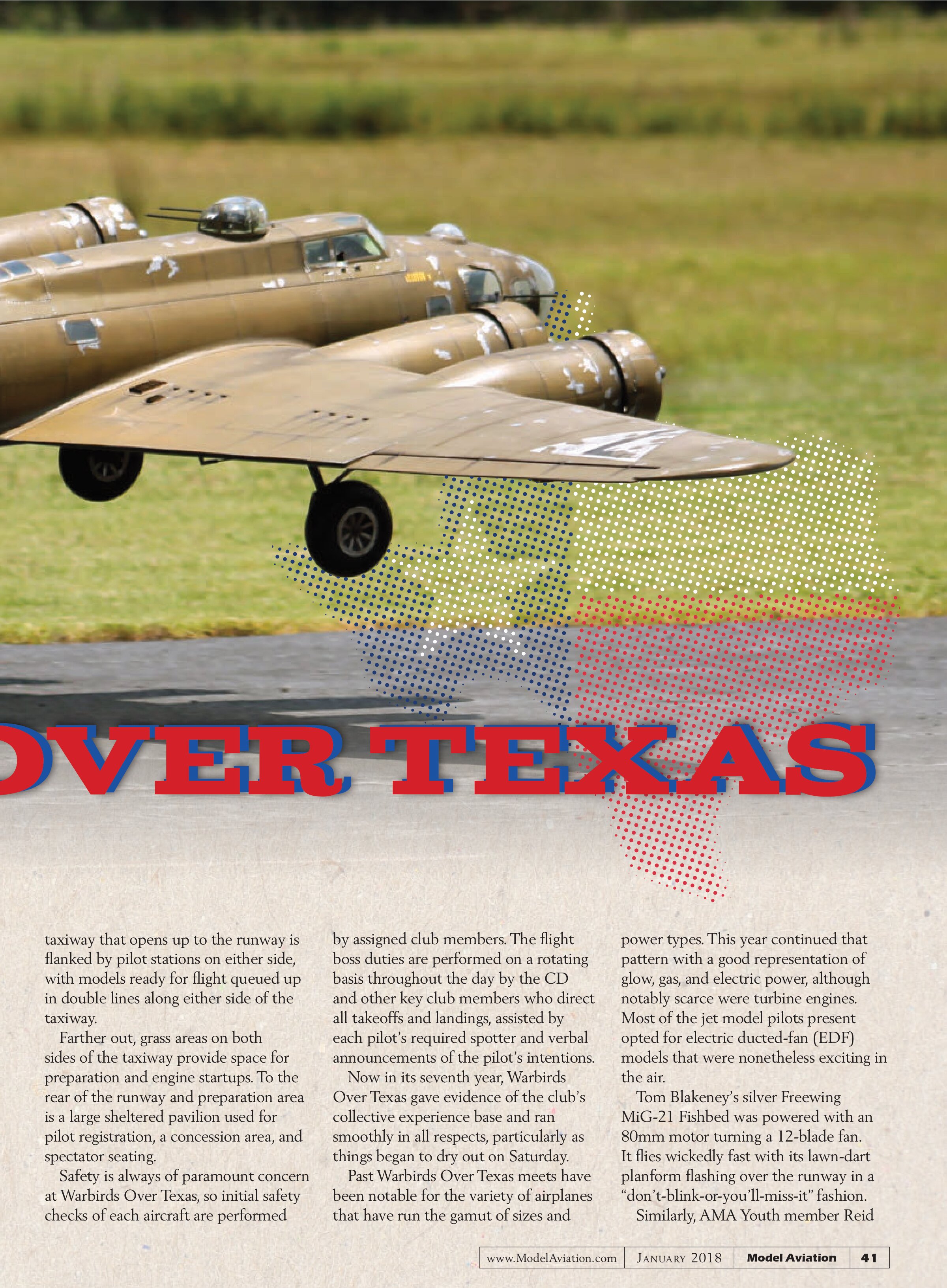
Power sources other than electric appeared to be heavily weighted in favor of gas engines rather than glow, particularly on larger aircraft. Two exceptions were Mike Laible’s 146-inch wingspan Consolidated B-24 Liberator Homeward Angel with O.S. 110 four-stroke engines under each of the four engine cowls, and Jimmy Cowman’s 138-inch wingspan Boeing B-17 Flying Fortress Pirates Pleasure with four O.S. .91s onboard. Both airplanes were built from Don Smith plans and
were majestic in the air, particularly when they were flown together.
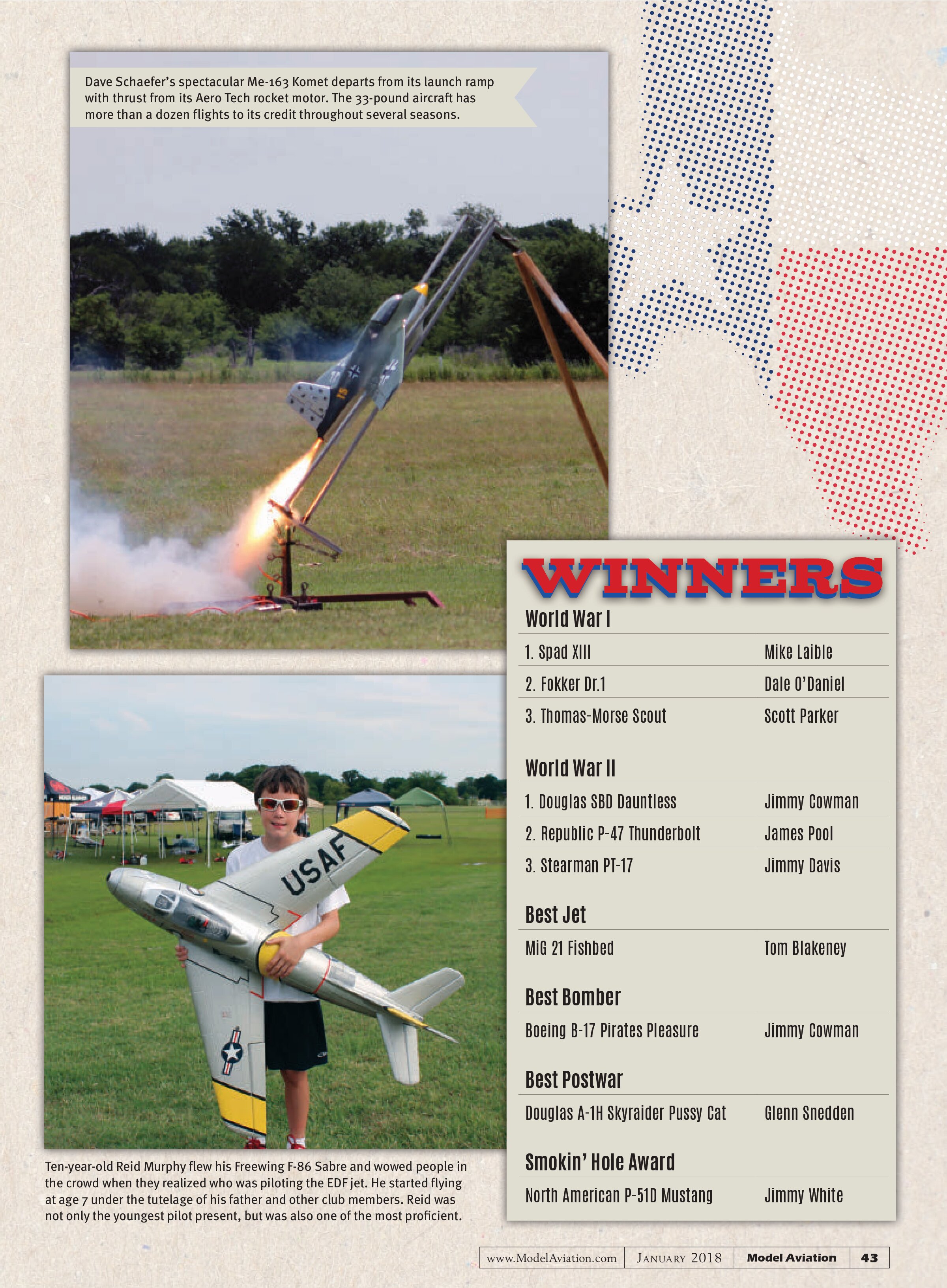
Two other large glow-engine airplanes that were most impressive when flown together were the 116-inch wingspan Stearmans piloted by Gary Mills and Jimmy Davis. Both airplanes started out as 30% World Models PT-17 ARFs, but were extensively detailed to fly at Top Gun this year.
Both were powered by new Evolution 77cc seven-cylinder, four-stroke engines. In the air, they were almost indistinguishable from the full-scale aircraft. When the two models flew over together, you would have sworn you

Sponsors
Tower Hobbies
Roy’s Hobby Shop
R/C Zone
Big Dog R/C Parts
Aero Hobbies
Hobbico
were witnessing a 1942 dual training flight above Moody Field in Georgia. A traditional favorite of both spectators and participants is the multiple aircraft full-scale flyover, planned during the noon break on the second day of the meet. This year’s full-scale flyover was particularly special because it featured a seldom-seen Nanchang CJ-6, the 1960s-era trainer built for the Chinese People’s Liberation Army. The aircraft made several close overhead passes with smoke on and pilots waving to the crowd. It is based at The Cold War Museum in nearby Lancaster, Texas.
Spontaneously organized gaggles of multiple airplanes of one type or another, all in the air at the same time, were also popular with the crowd. Seeing and hearing such a group of World War II fighters and bombers simulate what the skies over Germany, France, or Great Britain must have looked and sounded like got everyone’s attention. Likewise, the spontaneously organized furballs of as many as eight electric-powered foamie fighters in the


Winners
World War I
- Spad XIII — Mike Laible
- Fokker Dr.1 — Dale O’Daniel
- Thomas-Morse Scout — Scott Parker
World War II
- Douglas SBD Dauntless — Jimmy Cowman
- Republic P-47 Thunderbolt — James Pool
- Stearman PT-17 — Jimmy Davis
Best Jet
MiG 21 Fishbed — Tom Blakeney
Best Bomber
Boeing B-17 Pirates Pleasure — Jimmy Cowman
Best Postwar
Douglas A-1H Skyraider Pussy Cat — Glenn Snedden
Smokin’ Hole Award
North American P-51D Mustang — Jimmy White

air simultaneously wheeling, dodging, strafing, and colliding with each other proved entertaining and exciting.
Following the series of melees, Dave Schaefer flew his spectacular Messerschmitt Me-163 Komet, the only rocket-powered fighter of WW II, to dizzying heights on a 2-second AeroTech rocket motor burn, and then guided the 33-pound aircraft to a landing at its launch point.
Probably the most important pilot/spectator interaction took place during the noon break on Sunday, the final day of the event. Flying was shut down and pilots were asked to bring their airplanes to the center of the runway so that spectators could come out, photograph the models, and talk to the pilots about their creations.
Having the models arrayed along the length of the runway gave many non-modelers, particularly the young people present, a greater insight and appreciation of what the hobby/sport is all about. It was an appropriate way to bring two great days of flying to a close and recognize the collective efforts of the North Dallas RC Club, the pilots who brought their airplanes, and the many spectators who came out to watch this successful edition of Warbirds Over Texas.
—Larry Kruse
aircats@att.net
SOURCES:
North Dallas RC Club
www.ndrcc.com