Dave Platt and the Contender
Bob Noll
bobrc@aol.com
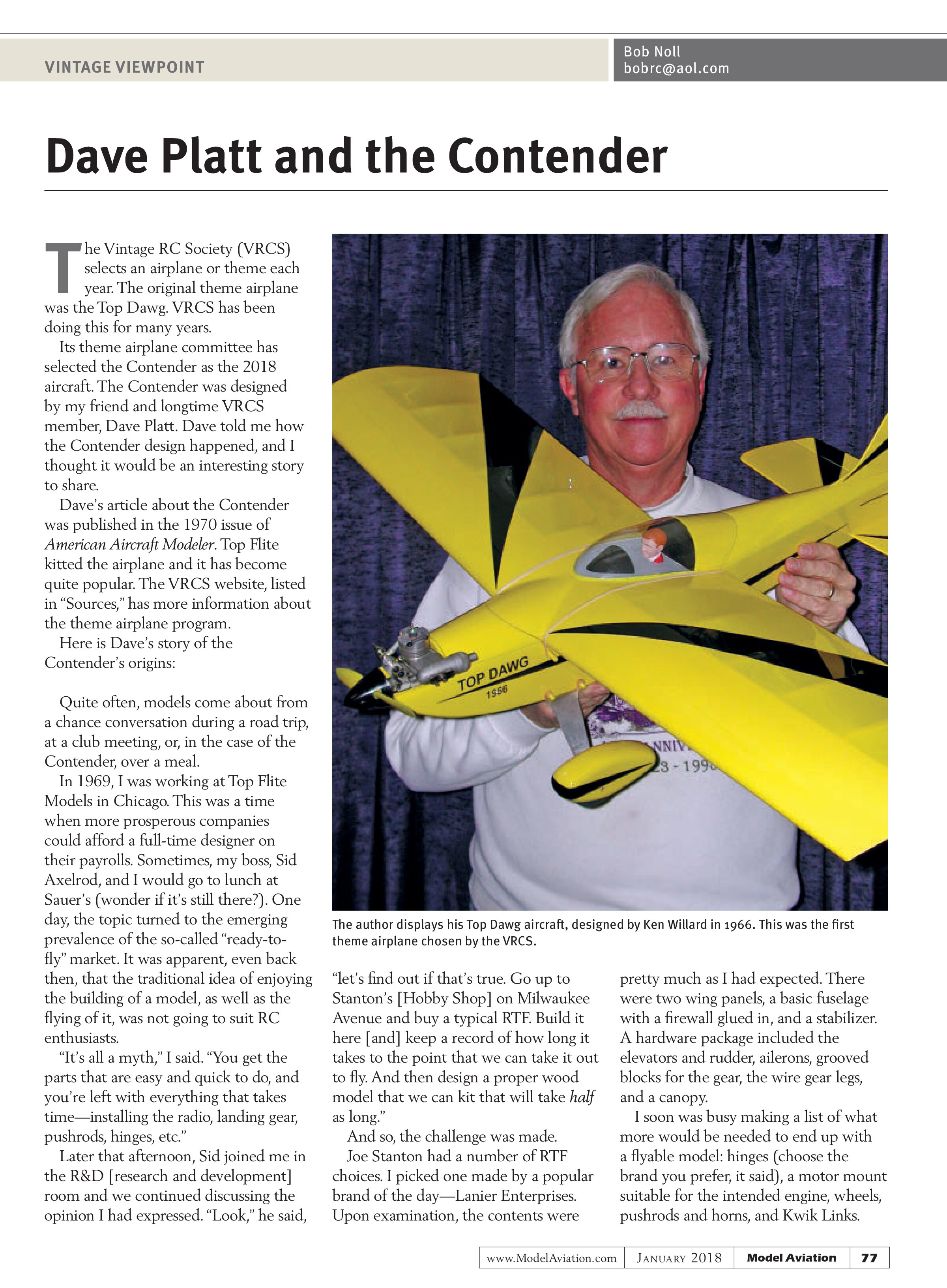
The Vintage RC Society (VRCS) selects an airplane or theme each year. The original theme airplane was the Top Dawg. VRCS has been doing this for many years.
Its theme airplane committee has selected the Contender as the 2018 aircraft. The Contender was designed by my friend and longtime VRCS member, Dave Platt. Dave told me how the Contender design happened, and I thought it would be an interesting story to share.
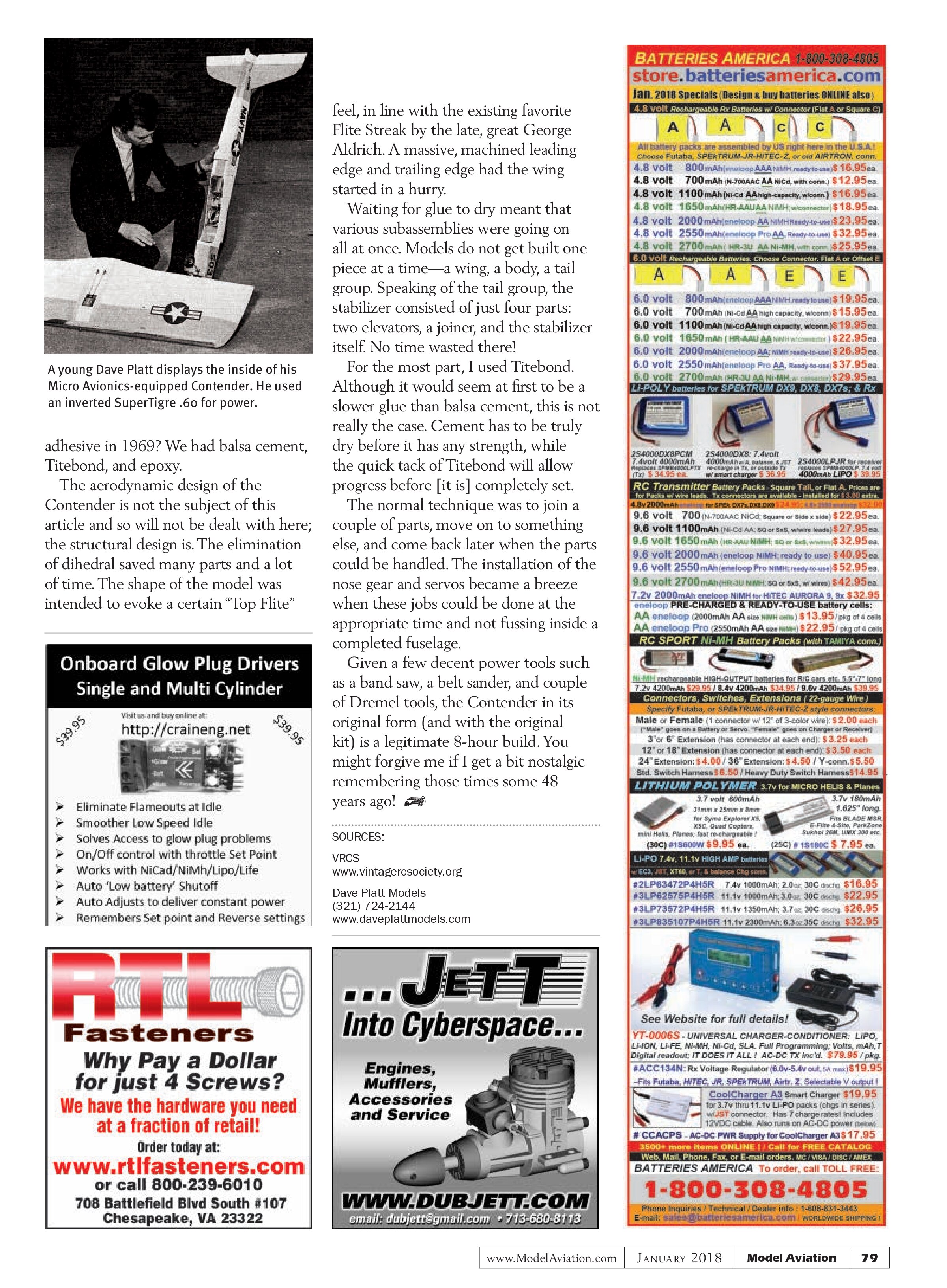
Dave’s article about the Contender was published in the 1970 issue of American Aircraft Modeler. Top Flite kitted the airplane and it has become quite popular. The VRCS website, listed in “Sources,” has more information about the theme airplane program.
Here is Dave’s story of the Contender’s origins:
Quite often, models come about from a chance conversation during a road trip, at a club meeting, or, in the case of the Contender, over a meal.
In 1969, I was working at Top Flite Models in Chicago. This was a time when more prosperous companies could afford a full-time designer on their payrolls. Sometimes, my boss, Sid Axelrod, and I would go to lunch at Sauer’s (wonder if it’s still there?). One day, the topic turned to the emerging prevalence of the so-called “ready-to-fly” market. It was apparent, even back then, that the traditional idea of enjoying the building of a model, as well as the flying of it, was not going to suit RC enthusiasts.
“It’s all a myth,” I said. “You get the parts that are easy and quick to do, and you’re left with everything that takes time—installing the radio, landing gear, pushrods, hinges, etc.”
Later that afternoon, Sid joined me in the R&D [research and development] room and we continued discussing the opinion I had expressed. “Look,” he said,

“let’s find out if that’s true. Go up to Stanton’s [Hobby Shop] on Milwaukee Avenue and buy a typical RTF. Build it here [and] keep a record of how long it takes to the point that we can take it out to fly. And then design a proper wood model that we can kit that will take half as long.”
And so, the challenge was made. Joe Stanton had a number of RTF choices. I picked one made by a popular brand of the day—Lanier Enterprises. Upon examination, the contents were pretty much as I had expected. There were two wing panels, a basic fuselage with a firewall glued in, and a stabilizer. A hardware package included the elevators and rudder, ailerons, grooved blocks for the gear, the wire gear legs, and a canopy.
I soon was busy making a list of what more would be needed to end up with a flyable model: hinges (choose the brand you prefer, it said), a motor mount suitable for the intended engine, wheels, pushrods and horns, and Kwik Links.
I did not, of course, include ordinary workshop items such as glue, sandpaper, pins, etc.
With these items acquired, the timing began. Following the instructions, I soon had the model underway. The wing turned out to be about a day’s work, with joining the panels, fiberglassing the joint, installing the landing gear, and ailerons with servos, etc. The fuselage and tail group took somewhat more time because there was so much more to install and hook up.
The nose gear steering was one snag-infested job. The rest was plain sailing enough. Between the said nose gear, the engine, servos, pushrods, and horns, about two days got the job done.
In all, it had taken roughly 28 hours to get the model ready to fly. Not bad, I thought. For its time, the Lanier was a reasonably quick project. Today’s RTFs are a different breed, of course—not only in completeness, but also in quality of construction. But it needs to be remembered that 50 more years of

experience, together with significant improvements in equipment, have gone into their development.
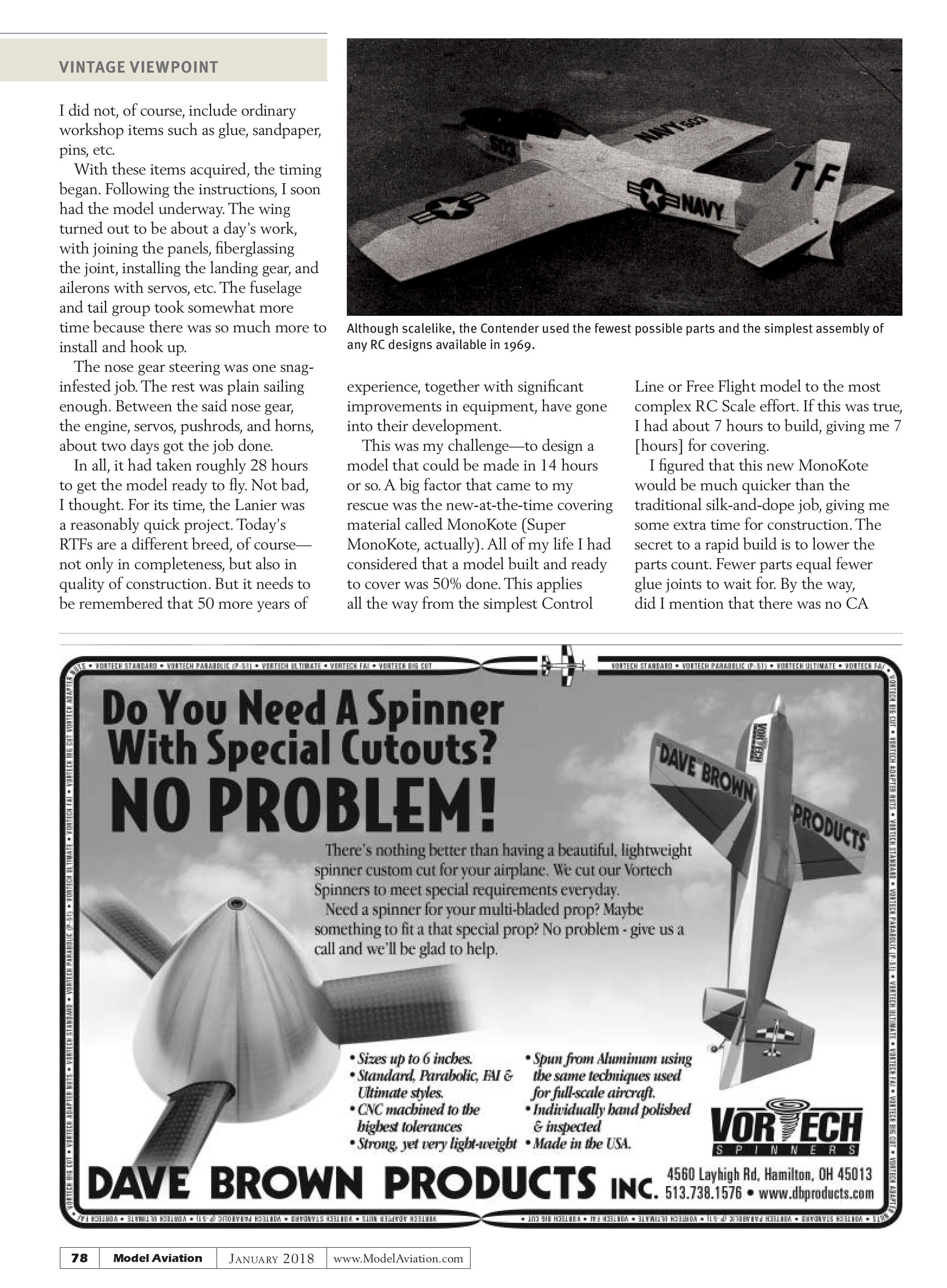
This was my challenge—to design a model that could be made in 14 hours or so. A big factor that came to my rescue was the new-at-the-time covering material called MonoKote (Super MonoKote, actually). All of my life I had considered that a model built and ready to cover was 50% done. This applies all the way from the simplest Control Line or Free Flight model to the most complex RC Scale effort. If this was true, I had about 7 hours to build, giving me 7 [hours] for covering.
I figured that this new MonoKote would be much quicker than the traditional silk-and-dope job, giving me some extra time for construction. The secret to a rapid build is to lower the parts count. Fewer parts equal fewer glue joints to wait for. By the way, did I mention that there was no CA

adhesive in 1969? We had balsa cement, Titebond, and epoxy.
The aerodynamic design of the Contender is not the subject of this article and so will not be dealt with here; the structural design is. The elimination of dihedral saved many parts and a lot of time. The shape of the model was intended to evoke a certain “Top Flite”
feel, in line with the existing favorite Flite Streak by the late, great George Aldrich. A massive, machined leading edge and trailing edge had the wing started in a hurry.
Waiting for glue to dry meant that various subassemblies were going on all at once. Models do not get built one piece at a time—a wing, a body, a tail group. Speaking of the tail group, the stabilizer consisted of just four parts: two elevators, a joiner, and the stabilizer itself. No time wasted there!
For the most part, I used Titebond. Although it would seem at first to be a slower glue than balsa cement, this is not really the case. Cement has to be truly dry before it has any strength, while the quick tack of Titebond will allow progress before [it is] completely set.
The normal technique was to join a couple of parts, move on to something else, and come back later when the parts could be handled. The installation of the nose gear and servos became a breeze when these jobs could be done at the appropriate time and not fussing inside a completed fuselage.
Given a few decent power tools such as a band saw, a belt sander, and couple of Dremel tools, the Contender in its original form (and with the original kit) is a legitimate 8-hour build. You might forgive me if I get a bit nostalgic remembering those times some 48 years ago!
SOURCES:
Dave Platt Models
(321) 724-2144
www.daveplattmodels.com