Victor Stanzel & Co.
The dawn of Control Line flying
by Bob Sowder | Photos by the author

While helping my friend, Larry Davidson, who is a member of the AMA Model Aviation Hall of Fame and the National Free Flight Society Hall of Fame, move to his new home, my eye was drawn to an old model in dire need of restoration. Larry had acquired it from a customer when he owned Larry’s Hobbies on Long Island, New York, and there it sat for years, in need of some serious attention. I had a keen interest in restoring it to its early 1940s appearance and control system, and Larry agreed to part with it.
At the time, I knew little about Victor Stanzel & Co. in Schulenberg, Texas, and its amazing accomplishments in Control Line (CL) model airplanes and the retail toy business of the 1930s through the 1990s.
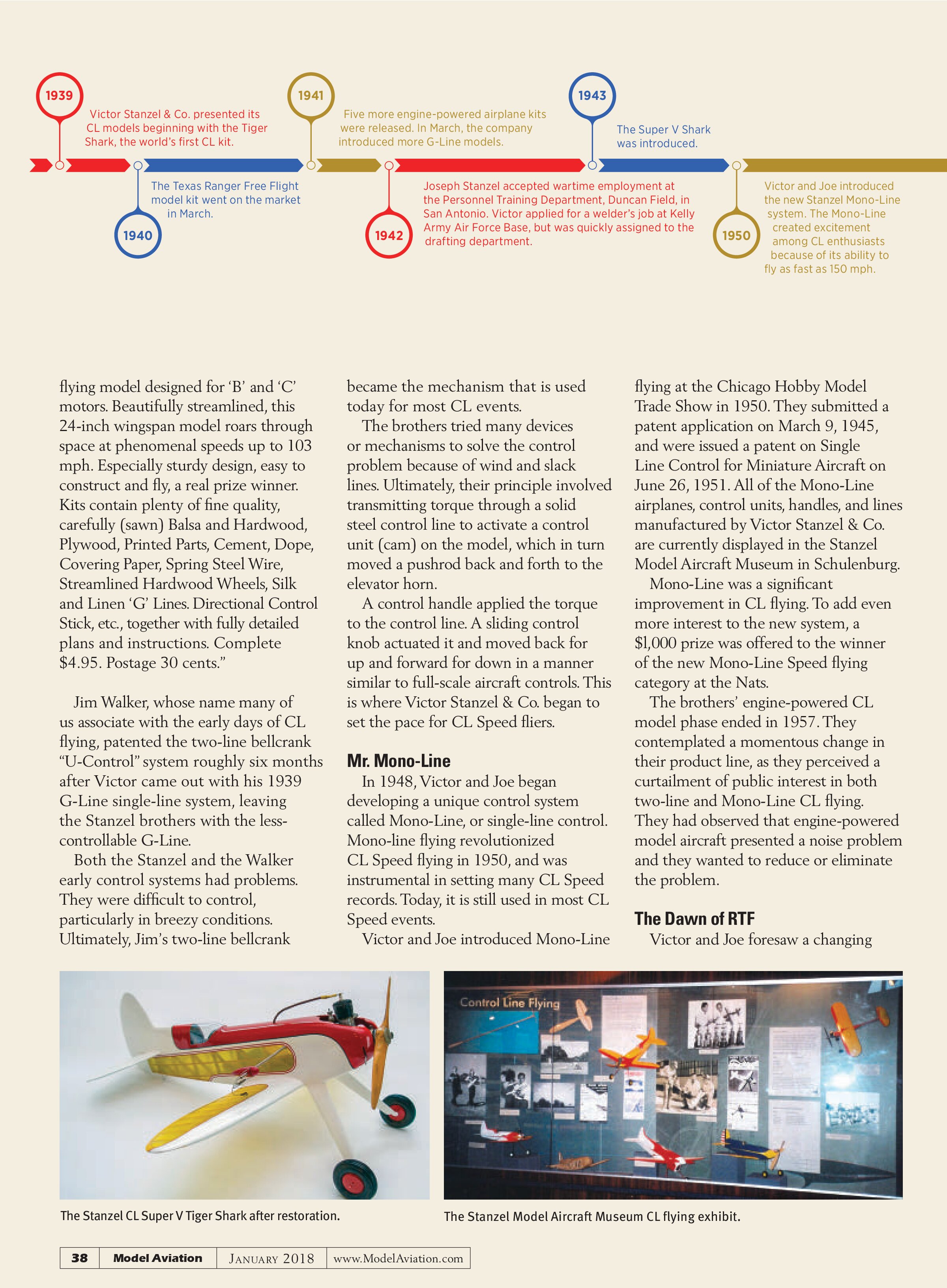
As I began restoring the model, I learned much about the Stanzel brothers, Victor and Joe, and the “speedy-looking” 1943 CL Super V Tiger Shark and its various siblings.
First Commercially Available CL Kit
With roots in CL model airplanes going back to 1939, Victor and Joe began a partnership that lasted for nearly six decades. Victor was the visionary and Joe was the craftsman. With their combined talents they produced the first commercially available, gas-powered CL model airplane—the Tiger Shark. Advertised as “easy to build, easy to fly,” the kit was introduced in the December 1939 issue of Model Airplane News. The description, by today’s standards, is quite an advertising overstatement.
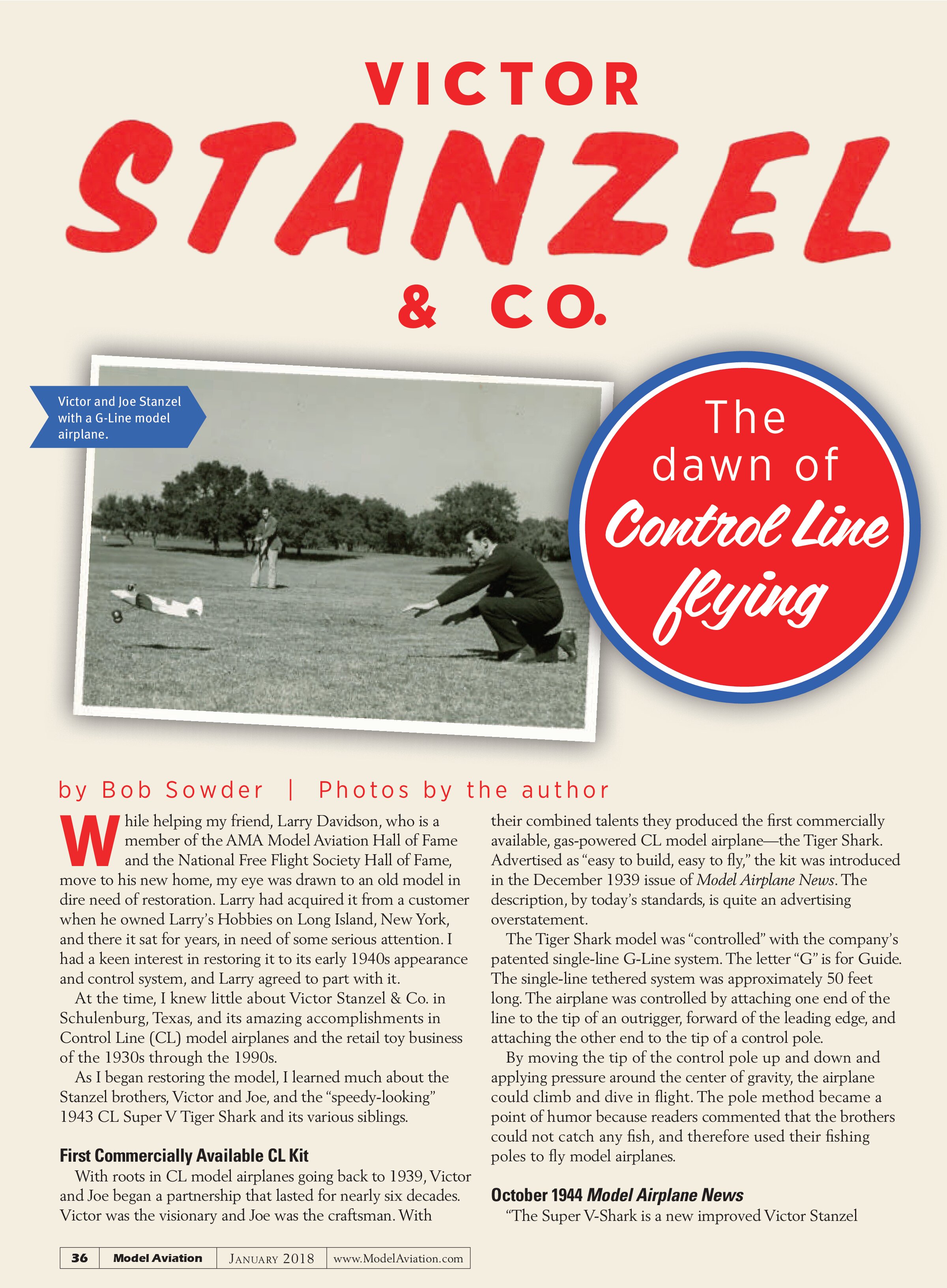
The Tiger Shark model was “controlled” with the company’s patented single-line G-Line system. The letter “G” is for Guide. The single-line tethered system was approximately 50 feet long. The airplane was controlled by attaching one end of the line to the tip of an outrigger, forward of the leading edge, and attaching the other end to the tip of a control pole.
By moving the tip of the control pole up and down and applying pressure around the center of gravity, the airplane could climb and dive in flight. The pole method became a point of humor because readers commented that the brothers could not catch any fish, and therefore used their fishing poles to fly model airplanes.
October 1944 Model Airplane News
“The Super V-Shark is a new improved Victor Stanzel

flying model designed for ‘B’ and ‘C’ motors. Beautifully streamlined, this 24-inch wingspan model roars through space at phenomenal speeds up to 103 mph. Especially sturdy design, easy to construct and fly, a real prize winner. Kits contain plenty of fine quality, carefully (sawn) Balsa and Hardwood, Plywood, Printed Parts, Cement, Dope, Covering Paper, Spring Steel Wire, Streamlined Hardwood Wheels, Silk and Linen ‘G’ Lines. Directional Control Stick, etc., together with fully detailed plans and instructions. Complete $4.95. Postage 30 cents.”
Jim Walker, whose name many of us associate with the early days of CL flying, patented the two-line bellcrank “U-Control” system roughly six months after Victor came out with his 1939 G-Line single-line system, leaving the Stanzel brothers with the less-controllable G-Line.
Both the Stanzel and the Walker early control systems had problems. They were difficult to control, particularly in breezy conditions. Ultimately, Jim’s two-line bellcrank became the mechanism that is used today for most CL events.
The brothers tried many devices or mechanisms to solve the control problem because of wind and slack lines. Ultimately, their principle involved transmitting torque through a solid steel control line to activate a control unit (cam) on the model, which in turn moved a pushrod back and forth to the elevator horn.
A control handle applied the torque to the control line. A sliding control knob actuated it and moved back for up and forward for down in a manner similar to full-scale aircraft controls. This is where Victor Stanzel & Co. began to set the pace for CL Speed fliers.
Mr. Mono-Line
In 1948, Victor and Joe began developing a unique control system called Mono-Line, or single-line control. Mono-line flying revolutionized CL Speed flying in 1950, and was instrumental in setting many CL Speed records. Today, it is still used in most CL Speed events.
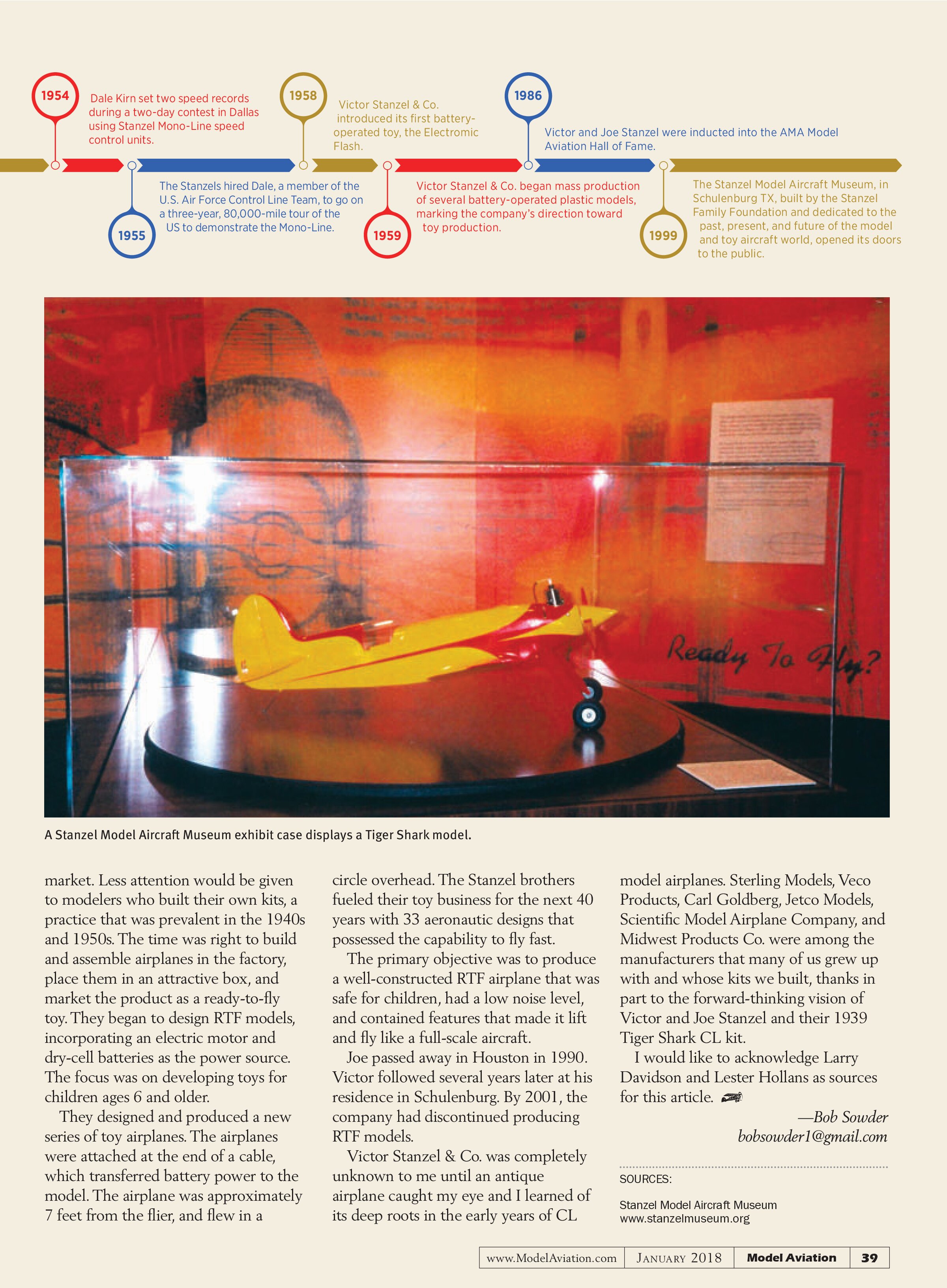
Victor and Joe introduced Mono-Line flying at the Chicago Hobby Model Trade Show in 1950. They submitted a patent application on March 9, 1945, and were issued a patent on Single Line Control for Miniature Aircraft on June 26, 1951. All of the Mono-Line airplanes, control units, handles, and lines manufactured by Victor Stanzel & Co. are currently displayed in the Stanzel Model Aircraft Museum in Schulenburg.
Mono-Line was a significant improvement in CL flying. To add even more interest to the new system, a $1,000 prize was offered to the winner of the new Mono-Line Speed flying category at the Nats.
The brothers’ engine-powered CL model phase ended in 1957. They contemplated a momentous change in their product line, as they perceived a curtailment of public interest in both two-line and Mono-Line CL flying. They had observed that engine-powered model aircraft presented a noise problem and they wanted to reduce or eliminate the problem.
The Dawn of RTF
Victor and Joe foresaw a changing market. Less attention would be given to modelers who built their own kits, a practice that was prevalent in the 1940s and 1950s. The time was right to build and assemble airplanes in the factory, place them in an attractive box, and market the product as a ready-to-fly toy. They began to design RTF models, incorporating an electric motor and dry-cell batteries as the power source. The focus was on developing toys for children ages 6 and older.
They designed and produced a new series of toy airplanes. The airplanes were attached at the end of a cable, which transferred battery power to the model. The airplane was approximately 7 feet from the flier, and flew in a circle overhead. The Stanzel brothers fueled their toy business for the next 40 years with 33 aeronautic designs that possessed the capability to fly fast.
The primary objective was to produce a well-constructed RTF airplane that was safe for children, had a low noise level, and contained features that made it lift and fly like a full-scale aircraft.
Joe passed away in Houston in 1990. Victor followed several years later at his residence in Schulenburg. By 2001, the company had discontinued producing RTF models.
Victor Stanzel & Co. was completely unknown to me until an antique airplane caught my eye and I learned of its deep roots in the early years of CL model airplanes. Sterling Models, Veco Products, Carl Goldberg, Jetco Models, Scientific Model Airplane Company, and Midwest Products Co. were among the manufacturers that many of us grew up with and whose kits we built, thanks in part to the forward-thinking vision of Victor and Joe Stanzel and their 1939 Tiger Shark CL kit.
I would like to acknowledge Larry Davidson and Lester Hollans as sources for this article.
—Bob Sowder
bobsowder1@gmail.com
SOURCES:
Stanzel Model Aircraft Museum
www.stanzelmuseum.org