Separation anxiety
A few readers suggested that I discuss propeller failures. They sent me some chilling pictures and videos to prove the point.
Loose prop nuts can allow a spinning airscrew to escape from the prop shaft. That’s scary enough, but when a damaged propeller is reused, it sometimes comes apart and sends pieces speeding through the air.
Thrown blades are less common these days because propellers and rotors on model aircraft have become more reliable. That’s no excuse to slack off! Experienced pilots know they need to change them out after receiving the slightest damage.
When blade failures happen, things can get ugly fast. I watched a couple of internet videos showing “catastrophic separation” of damaged propeller blades. If you’re in the way, you’re in big trouble. It’s hard to stay out of the propeller or rotor arc all of the time, but we should try to minimize our exposure.
Look at your model and consider where a loose blade would go. Imagine the propeller disc extended and plan to keep that arc clear as much as possible. After the engine has been started, you and your helper should stay behind the propeller.
Helicopters and multirotors are tougher because the blade propeller arcs are horizontal. I still suggest figuring out how to minimize exposure and put the odds in your favor as much as possible. It might involve a low wall or plastic fencing, or a line of small shrubs between you and the takeoff pad. I’ve seen all of these ideas used to help keep broken rotor blades away from pilots’ shins.
A Pair of Jokers
Here are a couple of sad multirotor stories. (If you want happy ones, check out Patrick Sherman’s “Advanced Flight Technologies” column.)
The first tale features a friend of mine from work—a nice guy. He’s a talented “video-techie” who sees his fancy new quadcopter more as a flying camera than a model aircraft.


One morning, he couldn’t wait to show me a freshly made video of crisp, aerial shots. It’s an eye-catcher all right—with the quad flying over a major amusement park!
The camera then approaches a large roller coaster and records people riding up and down as the multirotor hovers too closely overhead. The slightest glitch could have brought the drone down on the unsuspecting passengers or onto the ride mechanism. There was an awkward silence as my friend remembered that I write this column.
“Uh, maybe I shouldn’t have shown this to you.”
I answered with, “Well, what kind of cake do you like?”
“Huh?”
“Well, when you’re in federal prison, I’ll bake you a cake with a file inside. Is chocolate okay?”
We then had a serious discussion about how endangering the lives of strangers is impolite and illegal, and how a little research and training could allow him to enjoy his cake as a free man instead of as an inmate. We also covered how he shouldn’t count on his pals to be coconspirators and not turn him in if an incident ever occurred.
My friend simply hadn’t grasped the danger of the situation that he created. He thought of the drone camera as an extension of himself, safe on the ground, and was badly shaken by what might have happened.
He promised to mend his ways and make use of the latest drone-flying information available through the AMA website,

and even to consider joining our organization.
Strike Two
Another friend reported an incident and asked for my opinion. He was with some Free Flight pilots at a public park, with their chairs and folding tables set up under a shady tree line. An open area of grass was that day’s impromptu flying field. Few people were present, and their rubber-powered models were appropriate for the site.
A small group of multirotor pilots was some distance away. My pal wrote:
“They were flying their craft very fast, in and around the trees, as if practicing for a race. One of the drones crashed into a tree then into my lower back. It got me in two places. Not a serious injury, but it did bleed a little and I have a very sore spot back there.
“The pilot of the drone came over and apologized and I accepted it. I didn’t want to raise [trouble] right there because I figured [that] if we got the park police or administrators involved, they would ban us all.
“I told the pilot that the way they were flying was dangerous and that they should look for a spot away from other people. I don’t think he paid any attention to what I said, or didn’t care, because when we were packing up, they put several more drones in the air. These [multirotors] are really scary as they scream around. Someone could get seriously injured.
“Do you have any thoughts about how we might convince these guys that there might be a safer or better place to fly their drones?”
As a matter of fact, I do indeed have some opinions about this incident. Casually putting other people in danger is unacceptable. This kind of operator gives every responsible quadcopter owner a black eye.
Furthermore, I think my friend was exceptionally forgiving and patient. He was certainly right that an official report could backfire on legitimate, safety-conscious modelers. I’ll bet the rent that the multirotor pilot was not an AMA member.
Readers, do you have any new ideas about how to handle this problem? I’ll gladly share good tactical or strategic suggestions. My email address is at the beginning of the column.
Say Cheese!
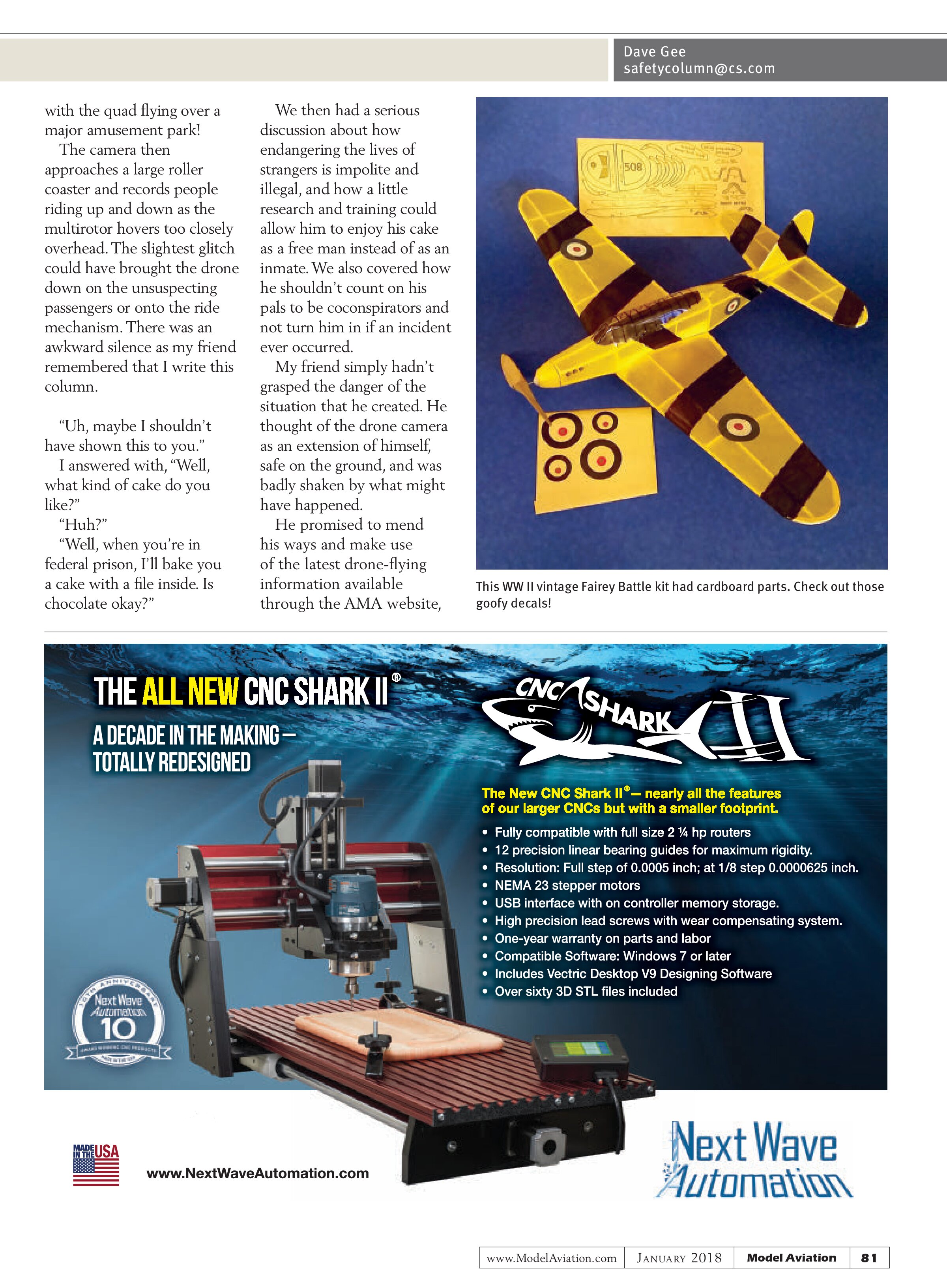
You can also use that email address to send me your guess about the identity of the mystery airplane. It is a famously beautiful and sleek aircraft that is a popular Scale model. The photo shows a distinctive cowl and landing gear, which should make it easy to identify. If not, here’s a clue: This particular airplane once belonged to Minnie Mouse.
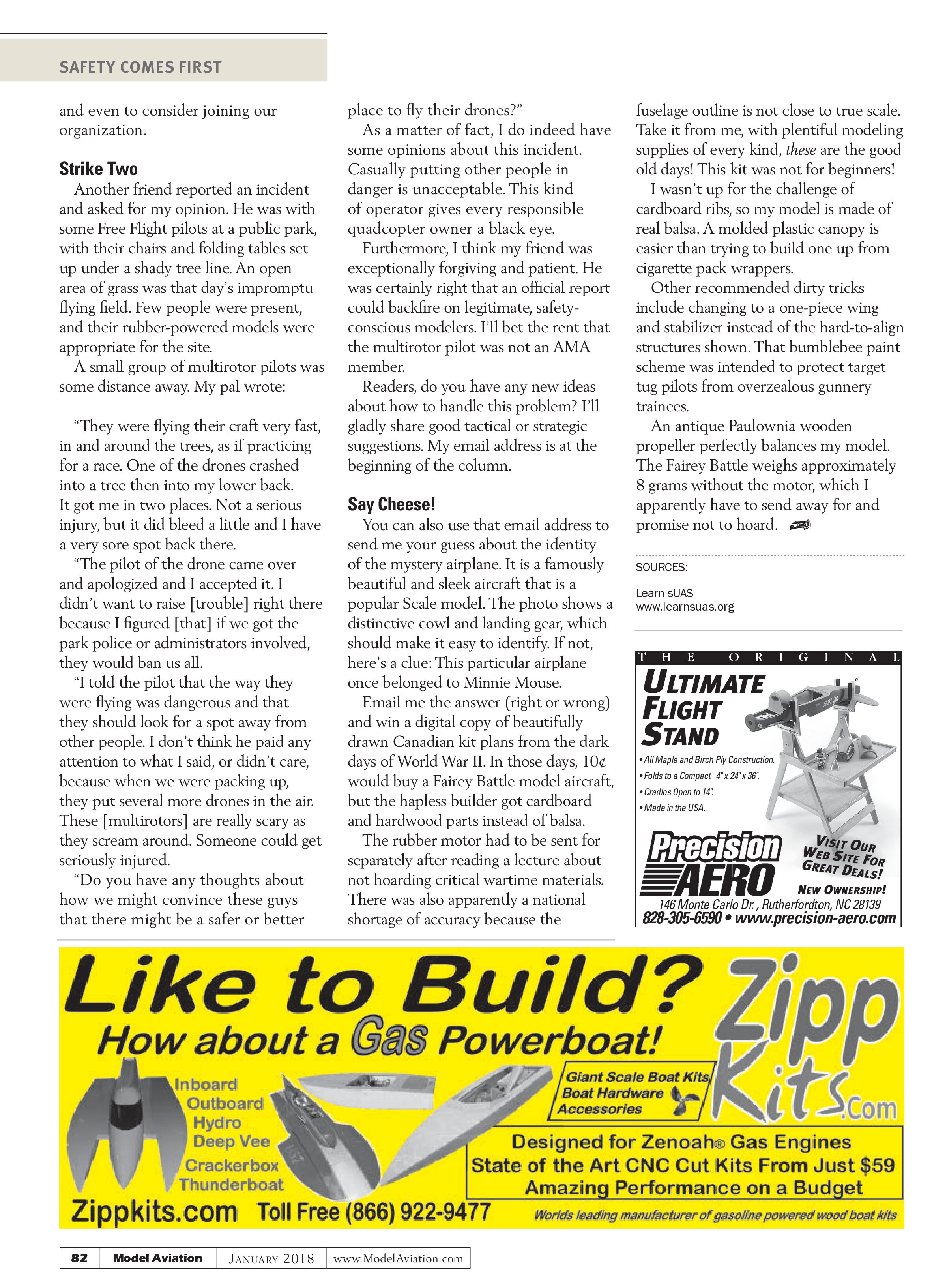
Email me the answer (right or wrong) and win a digital copy of beautifully drawn Canadian kit plans from the dark days of World War II. In those days, 10¢ would buy a Fairey Battle model aircraft, but the hapless builder got cardboard and hardwood parts instead of balsa.
The rubber motor had to be sent for separately after reading a lecture about not hoarding critical wartime materials. There was also apparently a national shortage of accuracy because the fuselage outline is not close to true scale. Take it from me, with plentiful modeling supplies of every kind, these are the good old days! This kit was not for beginners!
I wasn’t up for the challenge of cardboard ribs, so my model is made of real balsa. A molded plastic canopy is easier than trying to build one up from cigarette pack wrappers.
Other recommended dirty tricks include changing to a one-piece wing and stabilizer instead of the hard-to-align structures shown. That bumblebee paint scheme was intended to protect target tug pilots from overzealous gunnery trainees.
An antique Paulownia wooden propeller perfectly balances my model. The Fairey Battle weighs approximately 8 grams without the motor, which I apparently have to send away for and promise not to hoard.
SOURCES:
Learn sUAS
www.learnsuas.org