National F3J team selection
by Gordon Buckland
gordon@gatorf3b.com

Every two years, the best pilots in the world gather for two weeks of intense competition at the FAI World Championship for F3J Model Soaring. This contest decides who will be the next world champions in the sport of Thermal Duration Soaring. The US has always fielded a competitive team, and the 2018 F3J World Championship in Buzau, Romania, will be no exception.
A strong US team was chosen at a special three-day team selection event at Santa Margarita Ranch in central California on September 16-18, 2017. The team selection event consists of two long days of 10-minute F3J rounds, followed by one day of 15-minute rounds.
I have attended four team selection events and each time, the weather varied significantly enough during the three days to really test an aspiring pilot’s abilities in some tough conditions. In most cases, increased wind played a big part in making the event into a real skill test, but the best pilots soldiered through all types of conditions to rise to the top.
The 2017 event was organized by the San Luis Obispo Flyers. F3J stalwart Rick Johnston prepared the field and organized an excellent band of helpers to make the contest run smoothly. Thirty-six pilots traveled from across the US to attend the event.
The first contest round began shortly after 8 a.m. on Saturday, with the air barely starting to percolate. The flying location was in a valley next to the small town of Santa Margarita, with many houses close by to the south and a variety of topography on both sides, including a hill approximately 400 feet high that sloped upward away to the east. A few smaller hills angled away to the west, from where the sea breeze would come each afternoon.
The mornings on days one and two were relatively uneventful, with gentle lift developing steadily throughout the day. Getting 10-minute flights was fairly easy for any pilot who took a decent tow. Except for the long 3-second-plus tows used in the first round (when lift was scarce), the serious pilots were content with 2- to 2.5-second tows to get good launches and make every max.
These easy conditions made the landing zone an important factor in scoring, but because the field is a cow paddock, the surface was extremely hard. The contest director allowed the teams to water down the landing zones to allow for sudden arrivals without the fear of broken models.
The fun began after lunch. The conditions changed quickly with the arrival of a steady sea breeze. Within a few minutes, the wind direction settled in from the southwest to blow all of the lift east toward the big hill, making getting home difficult for an unballasted aircraft.
Many pilots were caught by surprise and a bunch of outlandings ensued in round five, including big names such as Jody Miller and Daryl Perkins. The sudden change in conditions caught pilots off guard and they didn’t recognize the significance or strength of the breeze midround.
These days, with many four-meter models weighing approximately 60 ounces, it is easy to finish far from home when the wind picks up. Interestingly, the eastern slope provided a huge boost for all of the lift that formed in the valley. The sea breeze carried this warmer air downwind and up the hill.
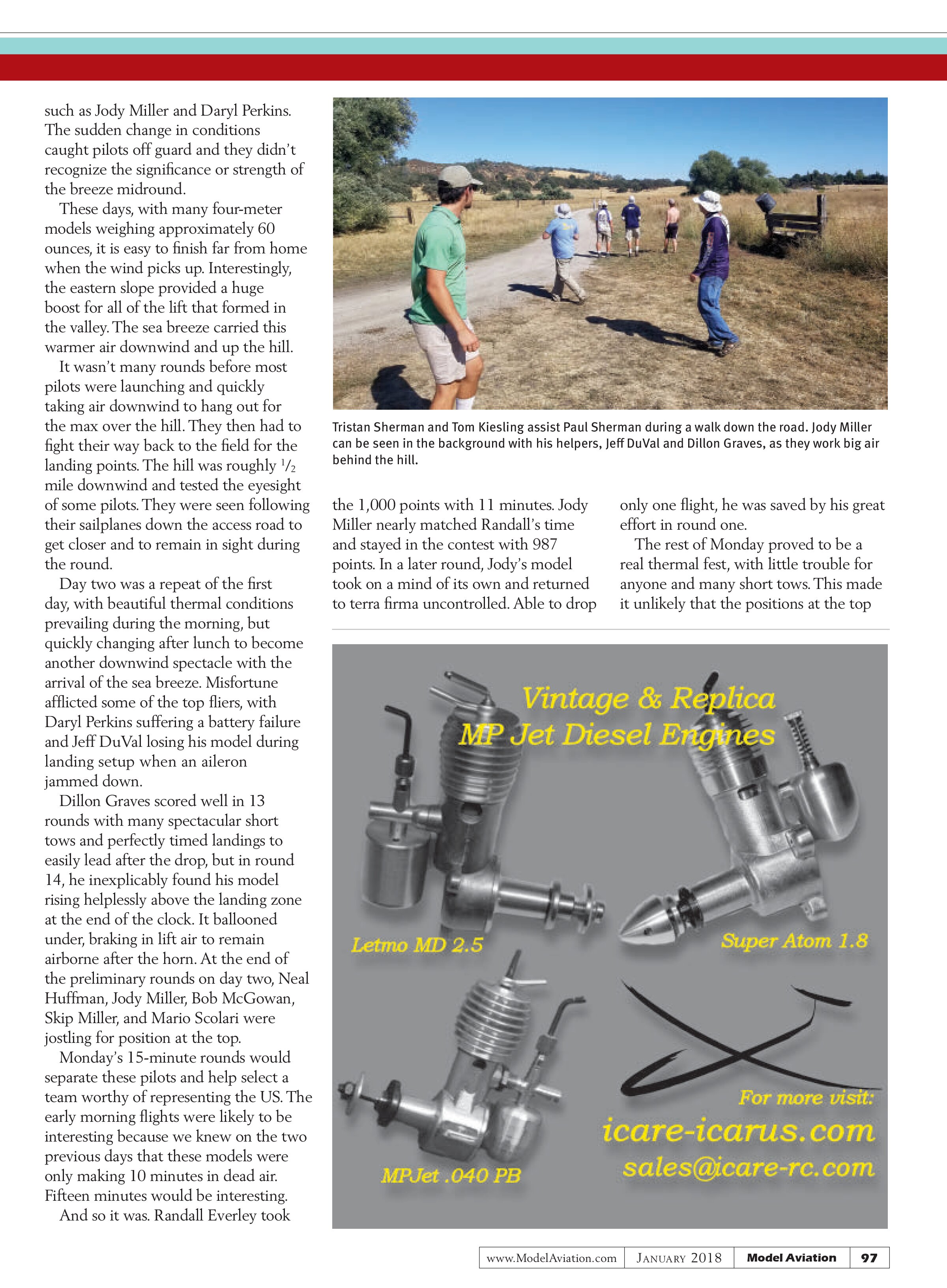
It wasn’t many rounds before most pilots were launching and quickly taking air downwind to hang out for the max over the hill. They then had to fight their way back to the field for the landing points. The hill was roughly ½ mile downwind and tested the eyesight of some pilots. They were seen following their sailplanes down the access road to get closer and to remain in sight during the round.
Day two was a repeat of the first day, with beautiful thermal conditions prevailing during the morning, but quickly changing after lunch to become another downwind spectacle with the arrival of the sea breeze. Misfortune afflicted some of the top fliers, with Daryl Perkins suffering a battery failure and Jeff DuVal losing his model during landing setup when an aileron jammed down.
Dillon Graves scored well in 13 rounds with many spectacular short tows and perfectly timed landings to easily lead after the drop, but in round 14, he inexplicably found his model rising helplessly above the landing zone at the end of the clock. It ballooned under, braking in lift air to remain airborne after the horn. At the end of the preliminary rounds on day two, Neal Huffman, Jody Miller, Bob McGowan, Skip Miller, and Mario Scolari were jostling for position at the top.
Monday’s 15-minute rounds would separate these pilots and help select a team worthy of representing the US. The early morning flights were likely to be interesting because we knew on the two previous days that these models were only making 10 minutes in dead air. Fifteen minutes would be interesting.
And so it was. Randall Everley took the 1,000 points with 11 minutes. Jody Miller nearly matched Randall’s time and stayed in the contest with 987 points. In a later round, Jody’s model took on a mind of its own and returned to terra firma uncontrolled. Able to drop only one flight, he was saved by his great effort in round one.
The rest of Monday proved to be a real thermal fest, with little trouble for anyone and many short tows. This made it unlikely that the positions at the top

would change much after the first round. Unless someone made a serious mistake, it was hard to gain points with the easy air. Although the breeze came up again, the downwind hill became home for almost everyone’s aircraft. They rode the many thermals up the slope and hung out for the 15 minutes with relative ease.
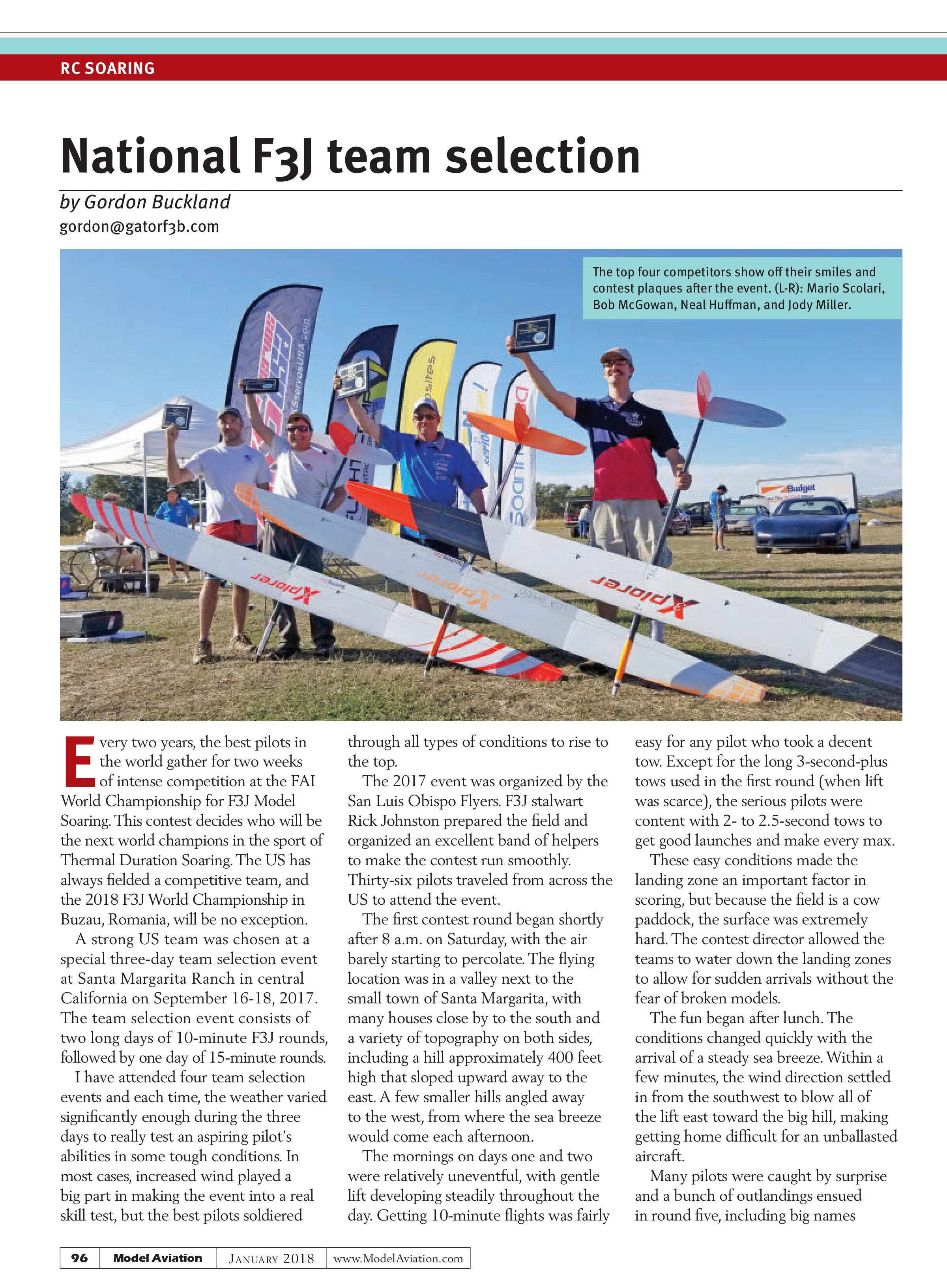
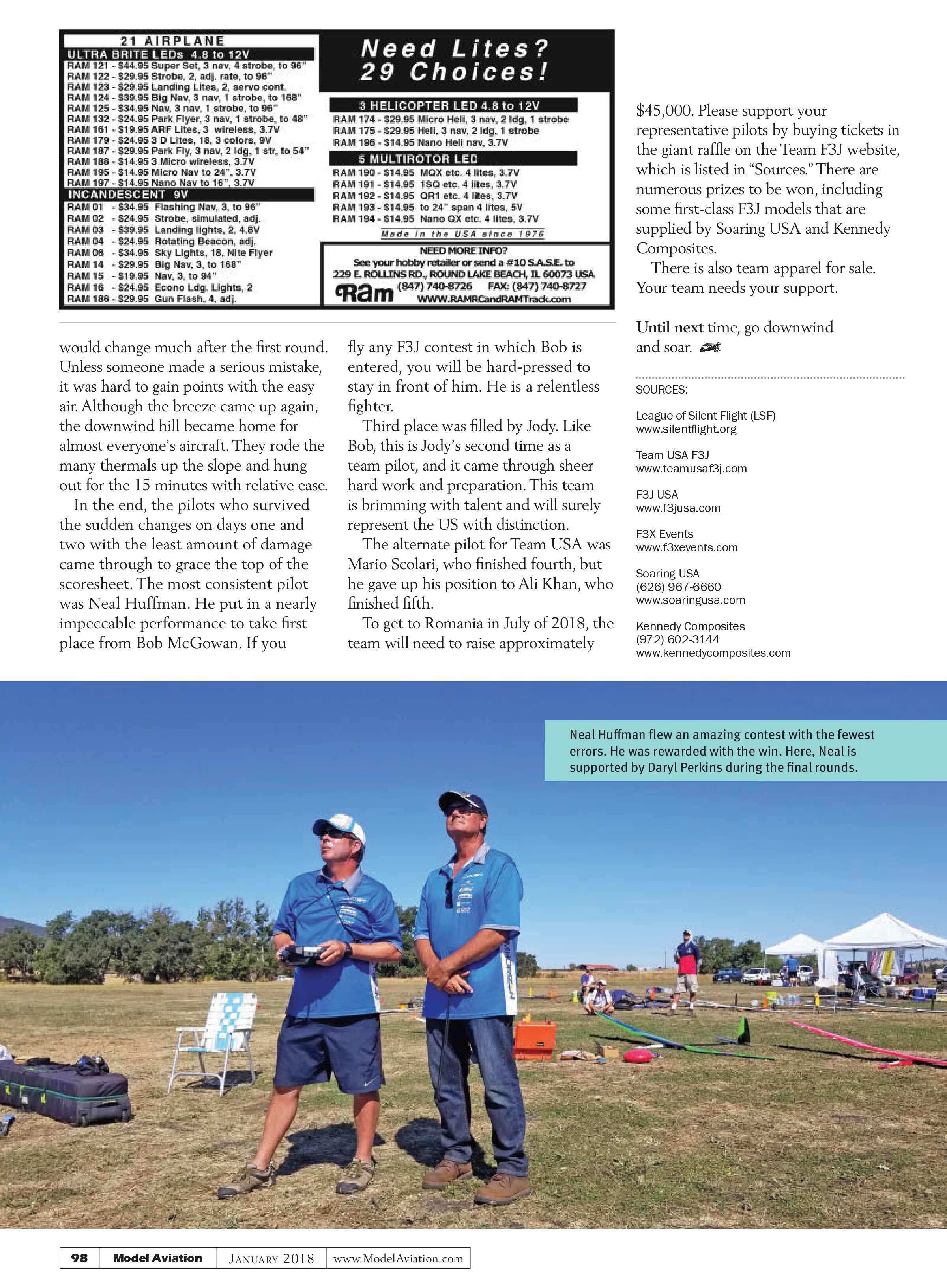
In the end, the pilots who survived the sudden changes on days one and two with the least amount of damage came through to grace the top of the scoresheet. The most consistent pilot was Neal Huffman. He put in a nearly impeccable performance to take first place from Bob McGowan. If you
fly any F3J contest in which Bob is entered, you will be hard-pressed to stay in front of him. He is a relentless fighter.
Third place was filled by Jody. Like Bob, this is Jody’s second time as a team pilot, and it came through sheer hard work and preparation. This team is brimming with talent and will surely represent the US with distinction.
The alternate pilot for Team USA was Mario Scolari, who finished fourth, but he gave up his position to Ali Khan, who finished fifth.
To get to Romania in July of 2018, the team will need to raise approximately $45,000. Please support your representative pilots by buying tickets in the giant raffle on the Team F3J website, which is listed in “Sources.” There are numerous prizes to be won, including some first-class F3J models that are supplied by Soaring USA and Kennedy Composites. There is also team apparel for sale. Your team needs your support.
Until next time, go downwind and soar.
SOURCES:
League of Silent Flight (LSF)
www.silentflight.org
Team USA F3J
www.teamusaf3j.com
F3J USA
www.f3jusa.com
F3X Events
www.f3xevents.com
Soaring USA
www.soaringusa.com
Kennedy Composites
www.kennedycomposites.com