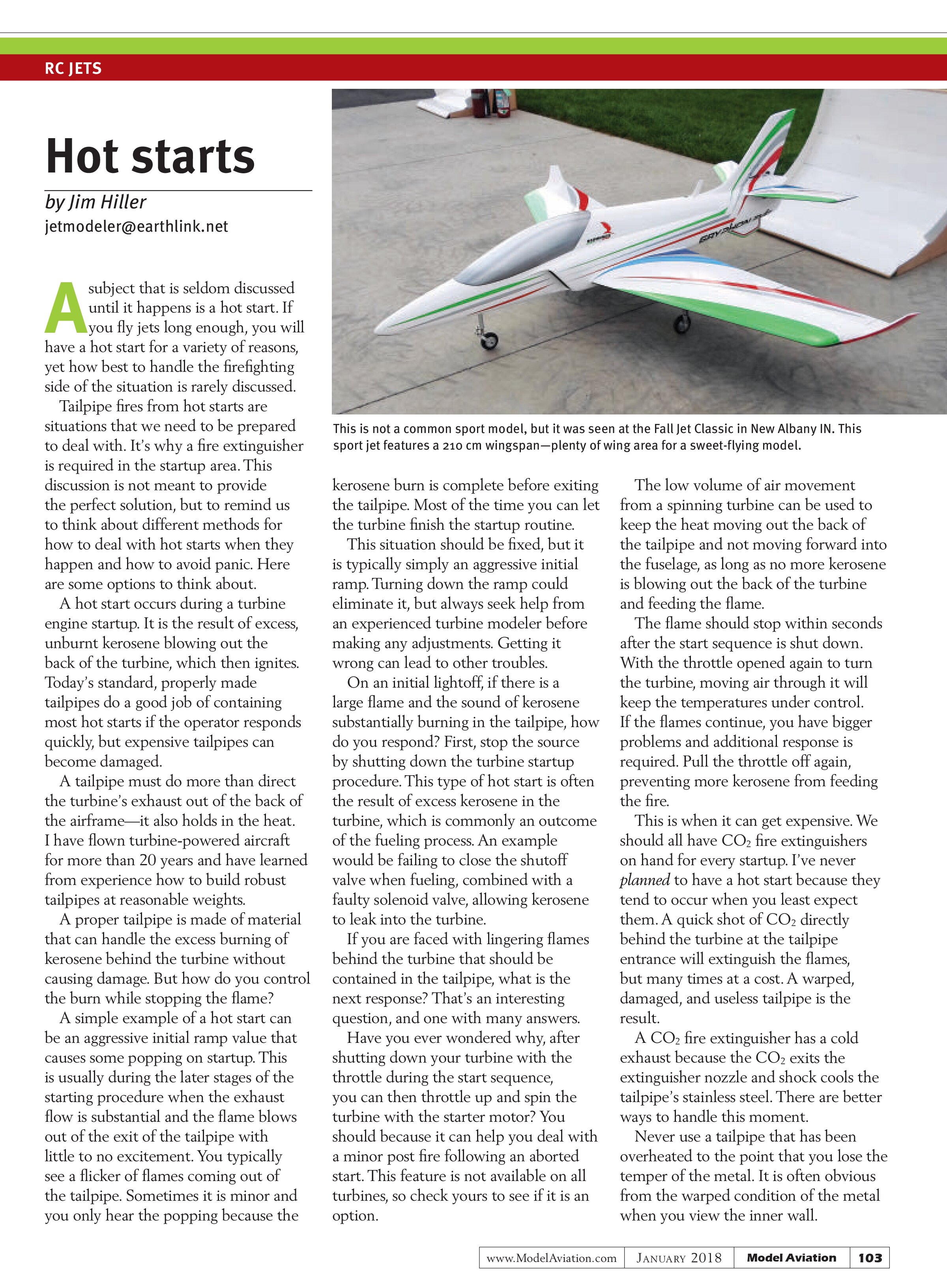
Hot starts
by Jim Hiller
jetmodeler@earthlink.net

A subject that is seldom discussed until it happens is a hot start. If you fly jets long enough, you will have a hot start for a variety of reasons, yet how best to handle the firefighting side of the situation is rarely discussed.
Tailpipe fires from hot starts are situations that we need to be prepared to deal with. It’s why a fire extinguisher is required in the startup area. This discussion is not meant to provide the perfect solution, but to remind us to think about different methods for how to deal with hot starts when they happen and how to avoid panic. Here are some options to think about.
A hot start occurs during a turbine engine startup. It is the result of excess, unburnt kerosene blowing out the back of the turbine, which then ignites. Today’s standard, properly made tailpipes do a good job of containing most hot starts if the operator responds quickly, but expensive tailpipes can become damaged.
A tailpipe must do more than direct the turbine’s exhaust out of the back of the airframe—it also holds in the heat. I have flown turbine-powered aircraft for more than 20 years and have learned from experience how to build robust tailpipes at reasonable weights.
A proper tailpipe is made of material that can handle the excess burning of kerosene behind the turbine without causing damage. But how do you control the burn while stopping the flame?
A simple example of a hot start can be an aggressive initial ramp value that causes some popping on startup. This is usually during the later stages of the starting procedure when the exhaust flow is substantial and the flame blows out of the exit of the tailpipe with little to no excitement. You typically see a flicker of flames coming out of the tailpipe. Sometimes it is minor and you only hear the popping because the kerosene burn is complete before exiting the tailpipe. Most of the time you can let the turbine finish the startup routine.
This situation should be fixed, but it is typically simply an aggressive initial ramp. Turning down the ramp could eliminate it, but always seek help from an experienced turbine modeler before making any adjustments. Getting it wrong can lead to other troubles.
On an initial lightoff, if there is a large flame and the sound of kerosene substantially burning in the tailpipe, how do you respond? First, stop the source by shutting down the turbine startup procedure. This type of hot start is often the result of excess kerosene in the turbine, which is commonly an outcome of the fueling process. An example would be failing to close the shutoff valve when fueling, combined with a faulty solenoid valve, allowing kerosene to leak into the turbine.
If you are faced with lingering flames behind the turbine that should be contained in the tailpipe, what is the next response? That’s an interesting question, and one with many answers.
Have you ever wondered why, after shutting down your turbine with the throttle during the start sequence, you can then throttle up and spin the turbine with the starter motor? You should because it can help you deal with a minor post fire following an aborted start. This feature is not available on all turbines, so check yours to see if it is an option.
The low volume of air movement from a spinning turbine can be used to keep the heat moving out the back of the tailpipe and not moving forward into the fuselage, as long as no more kerosene is blowing out the back of the turbine and feeding the flame.
The flame should stop within seconds after the start sequence is shut down. With the throttle opened again to turn the turbine, moving air through it will keep the temperatures under control. If the flames continue, you have bigger problems and additional response is required. Pull the throttle off again, preventing more kerosene from feeding the fire.
This is when it can get expensive. We should all have CO₂ fire extinguishers on hand for every startup. I’ve never planned to have a hot start because they tend to occur when you least expect them. A quick shot of CO₂ directly behind the turbine at the tailpipe entrance will extinguish the flames, but many times at a cost. A warped, damaged, and useless tailpipe is the result.
A CO₂ fire extinguisher has a cold exhaust because the CO₂ exits the extinguisher nozzle and shock cools the tailpipe’s stainless steel. There are better ways to handle this moment.
Never use a tailpipe that has been overheated to the point that you lose the temper of the metal. It is often obvious from the warped condition of the metal when you view the inner wall.
is required. Excessive use of your fire extinguisher will only shock cool the turbine and tailpipe, so less is better. Avoid discharging the CO2 directly up the tailpipe exit because it can shock cool the stainless steel tailpipe, leading to warping, which is an expensive mistake.
Here is a quick note about a fire in a fully ducted system: You cannot easily see it. Remember that there is a low spot under the turbine where kerosene can pool and catch fire. After you put the fire out, that kerosene could be lying under the turbine and waiting to cause further problems during your next restart.
After a hot start on a fully ducted system, lift the airplane and position the nose skyward to drain any kerosene that might be under the turbine.
My experience has been that most hot starts are the result of operator error, improper fueling techniques combined with component failures, or an aggressive priming of fuel lines when manually priming a new installation.
Another common issue is failing to spin the turbine up to speed properly, which is usually caused by a starter slippage, failed starter motor, or signs of even bigger problems, such as bearings beginning to fail. This can result in a difficult-to-turn turbine. Proper care of tailpipes and the response to tailpipe fires at startup can help prevent expensive repairs. It’s best to be prepared.
SOURCES:
Jet Pilots’ Organization (JPO)
www.jetpilots.org

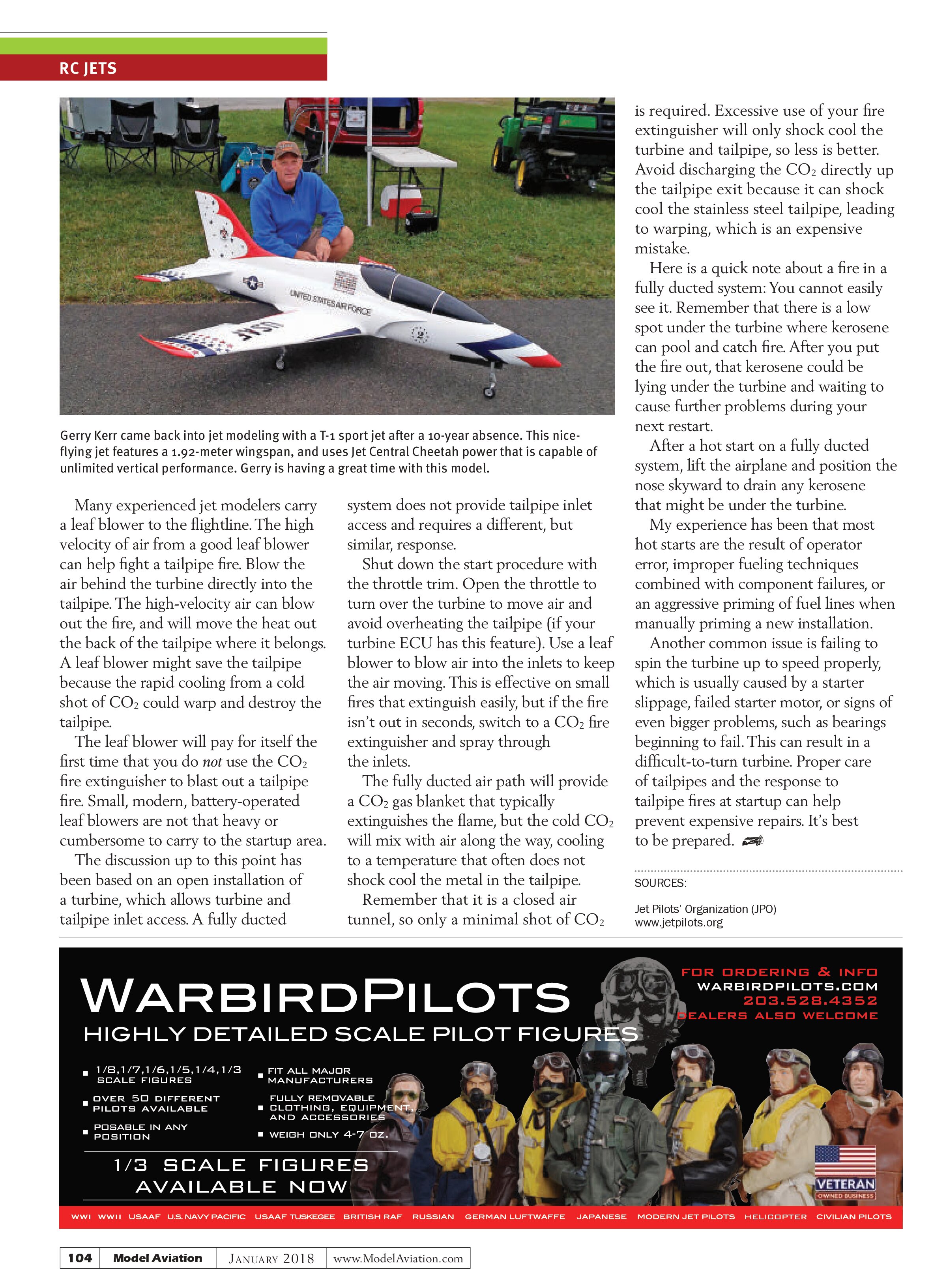
Gerry Kerr came back into jet modeling with a T-1 sport jet after a 10-year absence. This nice-flying jet features a 1.92-meter wingspan, and uses Jet Central Cheetah power that is capable of unlimited vertical performance. Gerry is having a great time with this model.
Many experienced jet modelers carry a leaf blower to the flightline. The high velocity of air from a good leaf blower can help fight a tailpipe fire. Blow the air behind the turbine directly into the tailpipe. The high-velocity air can blow out the fire, and will move the heat out the back of the tailpipe where it belongs. A leaf blower might save the tailpipe because the rapid cooling from a cold shot of CO2 could warp and destroy the tailpipe.
The leaf blower will pay for itself the first time that you do not use the CO2 fire extinguisher to blast out a tailpipe fire. Small, modern, battery-operated leaf blowers are not that heavy or cumbersome to carry to the startup area.
The discussion up to this point has been based on an open installation of a turbine, which allows turbine and tailpipe inlet access. A fully ducted system does not provide tailpipe inlet access and requires a different, but similar, response.
Shut down the start procedure with the throttle trim. Open the throttle to turn over the turbine to move air and avoid overheating the tailpipe (if your turbine ECU has this feature). Use a leaf blower to blow air into the inlets to keep the air moving. This is effective on small fires that extinguish easily, but if the fire isn’t out in seconds, switch to a CO2 fire extinguisher and spray through the inlets.
The fully ducted air path will provide a CO2 gas blanket that typically extinguishes the flame, but the cold CO2 will mix with air along the way, cooling to a temperature that often does not shock cool the metal in the tailpipe.
Remember that it is a closed air tunnel, so only a minimal shot of CO2