1/2A or .09 Stunt model isn’t “cheap” on fun
Jim Thomerson enjoyed designing and building small Control Line (CL) Stunt aircraft and flew Stunt (also known as Precision Aerobatics) competitively. His goal was to maintain and increase his competence so that he could “conduct flying sessions without mishap and fly my airplanes well enough for all present to enjoy them.”
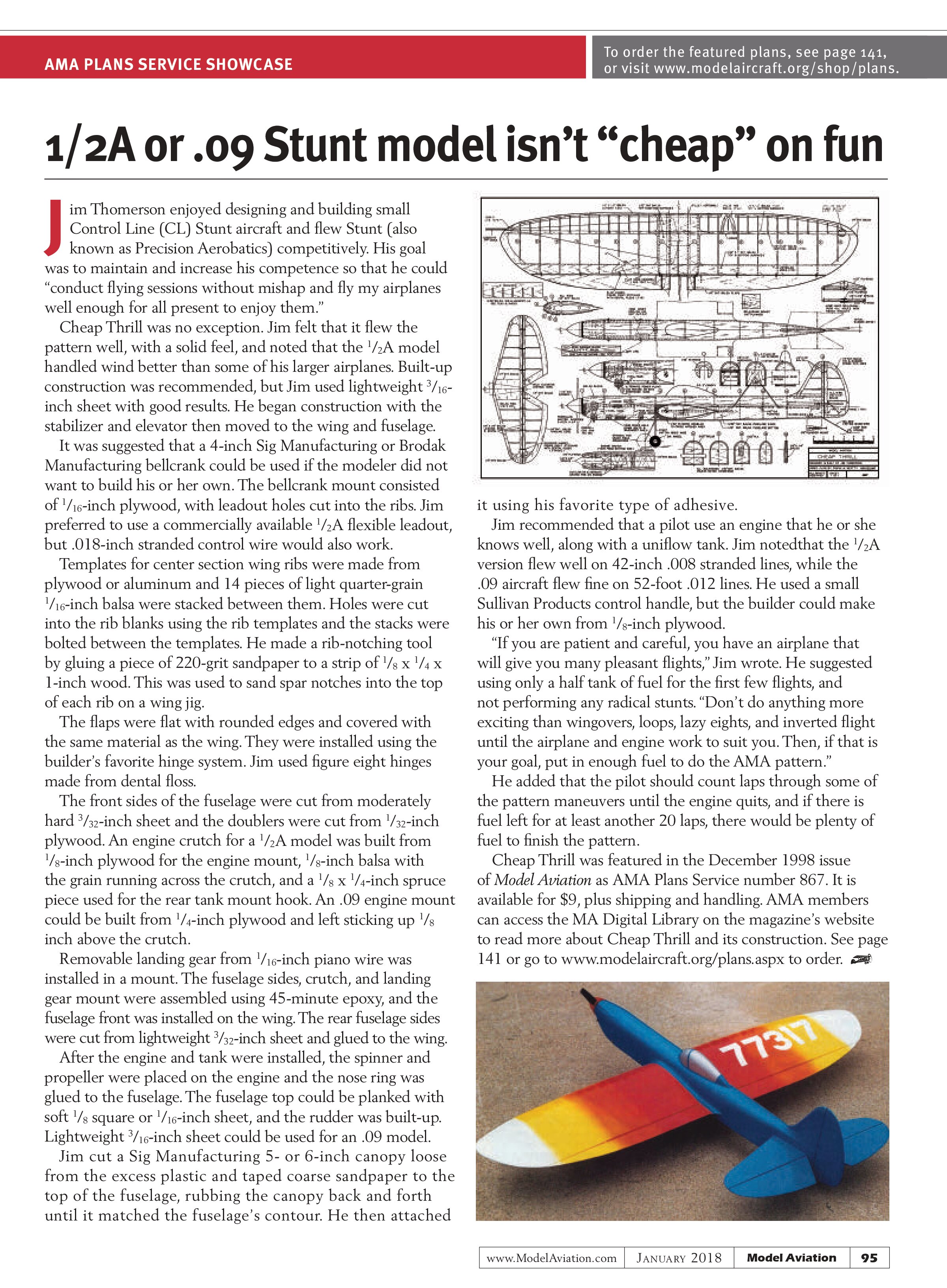
Cheap Thrill was no exception. Jim felt that it flew the pattern well, with a solid feel, and noted that the 1/2A model handled wind better than some of his larger airplanes. Built-up construction was recommended, but Jim used lightweight 3/16-inch sheet with good results. He began construction with the stabilizer and elevator then moved to the wing and fuselage.
It was suggested that a 4-inch Sig Manufacturing or Brodak Manufacturing bellcrank could be used if the modeler did not want to build his or her own. The bellcrank mount consisted of 1/16-inch plywood, with leadout holes cut into the ribs. Jim preferred to use a commercially available 1/2A flexible leadout, but .018-inch stranded control wire would also work.
Templates for center section wing ribs were made from plywood or aluminum and 14 pieces of light quarter-grain 1/16-inch balsa were stacked between them. Holes were cut into the rib blanks using the rib templates and the stacks were bolted between the templates. He made a rib-notching tool by gluing a piece of 220-grit sandpaper to a strip of 1/8 x 1/4 x 1-inch wood. This was used to sand spar notches into the top of each rib on a wing jig.
The flaps were flat with rounded edges and covered with the same material as the wing. They were installed using the builder’s favorite hinge system. Jim used figure eight hinges made from dental floss.
The front sides of the fuselage were cut from moderately hard 3/32-inch sheet and the doublers were cut from 1/32-inch plywood. An engine crutch for a 1/2A model was built from 1/8-inch plywood for the engine mount, 1/8-inch balsa with the grain running across the crutch, and a 1/8 x 1/4-inch spruce piece used for the rear tank mount hook. An .09 engine mount could be built from 1/4-inch plywood and left sticking up 1/8 inch above the crutch.
Removable landing gear from 1/16-inch piano wire was installed in a mount. The fuselage sides, crutch, and landing gear mount were assembled using 45-minute epoxy, and the fuselage front was installed on the wing. The rear fuselage sides were cut from lightweight 3/32-inch sheet and glued to the wing.
After the engine and tank were installed, the spinner and propeller were placed on the engine and the nose ring was glued to the fuselage. The fuselage top could be planked with soft 1/8 square or 1/16-inch sheet, and the rudder was built-up. Lightweight 3/16-inch sheet could be used for an .09 model.
Jim cut a Sig Manufacturing 5- or 6-inch canopy loose from the excess plastic and taped coarse sandpaper to the top of the fuselage, rubbing the canopy back and forth until it matched the fuselage’s contour. He then attached

Jim recommended that a pilot use an engine that he or she knows well, along with a uniflow tank. Jim noted that the 1/2A version flew well on 42-inch .008 stranded lines, while the .09 aircraft flew fine on 52-foot .012 lines. He used a small Sullivan Products control handle, but the builder could make his or her own from 1/8-inch plywood.
“If you are patient and careful, you have an airplane that will give you many pleasant flights,” Jim wrote. He suggested using only a half tank of fuel for the first few flights, and not performing any radical stunts. “Don’t do anything more exciting than wingovers, loops, lazy eights, and inverted flight until the airplane and engine work to suit you. Then, if that is your goal, put in enough fuel to do the AMA pattern.”
He added that the pilot should count laps through some of the pattern maneuvers until the engine quits, and if there is fuel left for at least another 20 laps, there would be plenty of fuel to finish the pattern.
Cheap Thrill was featured in the December 1998 issue of Model Aviation as AMA Plans Service number 867. It is available for $9, plus shipping and handling. AMA members can access the MA Digital Library on the magazine’s website to read more about Cheap Thrill and its construction. See page 141 or go to www.modelaircraft.org/plans.aspx to order.