Gas and Rubber One-Design aircraft
by Gene Smith
grwhiskey@brightok.net
The gas-powered One-Design airplanes for 2018 are both Early Nostalgia: the Smarty and the Jasco Streak. Build and fly them with early ½A Nostalgia Gas rules and engines.
Jasco Streak plans are available from the AMA Plans Service (#24388). A laser-cut kit is available from BMJR Models for each of those aircraft. Start now so you will have plenty of time to build and test-fly your model.
The 2018 rubber-powered One-Design airplane is Betty’s Baby. It is also eligible for the Andrade Rubber event because the model was designed by Paul Andrade. Andrade Rubber originated in roughly 2006 as Small Mulvihill. The name and rules were changed to allow new, simpler designs.
There are few rules: no auto functions, 20 grams maximum of lubed rubber, 200 square inches maximum of wing area, and no minimum weight. By the time you read this, there should be plans and a short kit by Jim O’Reilly Model Plans.
Betty’s Baby is a small, easy-to-build aircraft that is barely larger than a P-30 and uses a Gollywock propeller. With 20 grams of rubber and a Gollywock propeller, it should be a hoot to fly!
Helping Friends
For me, one of the highlights of last summer’s AMA Nats was being able to help a couple of friends, both excellent builders and fliers, with their models. The first was a Nostalgia Gas aircraft that had a perfect climb and transition on the 9-second engine run, but a poor transition into a stalling glide on the 6-second engine run.
I suggested raising the back of the stabilizer. The model already had several 1/32-inch plywood shims beneath the front of the stabilizer, so one of the shims was removed and that

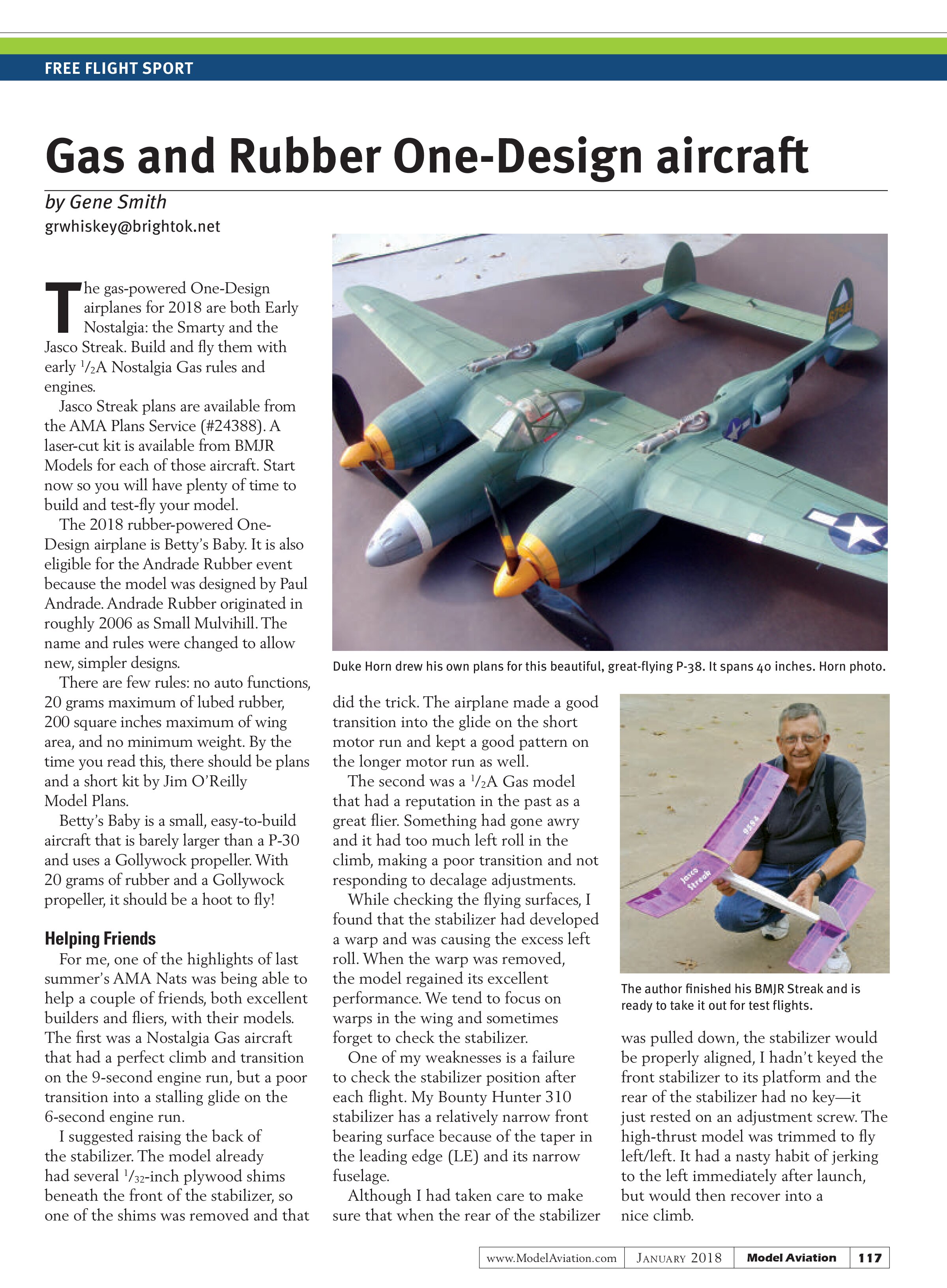
The Duke Horn drew his own plans for this beautiful, great-flying P-38. It spans 40 inches. Horn photo.
did the trick. The airplane made a good transition into the glide on the short motor run and kept a good pattern on the longer motor run as well.
The second was a ½A Gas model that had a reputation in the past as a great flier. Something had gone awry and it had too much left roll in the climb, making a poor transition and not responding to decalage adjustments.
While checking the flying surfaces, I found that the stabilizer had developed a warp and was causing the excess left roll. When the warp was removed, the model regained its excellent performance. We tend to focus on warps in the wing and sometimes forget to check the stabilizer.
One of my weaknesses is a failure to check the stabilizer position after each flight. My Bounty Hunter 310 stabilizer has a relatively narrow front bearing surface because of the taper in the leading edge (LE) and its narrow fuselage.
Although I had taken care to make sure that when the rear of the stabilizer was pulled down, the stabilizer would be properly aligned, I hadn’t keyed the front stabilizer to its platform and the rear of the stabilizer had no key—it just rested on an adjustment screw. The high-thrust model was trimmed to fly left/left. It had a nasty habit of jerking to the left immediately after launch, but would then recover into a nice climb.

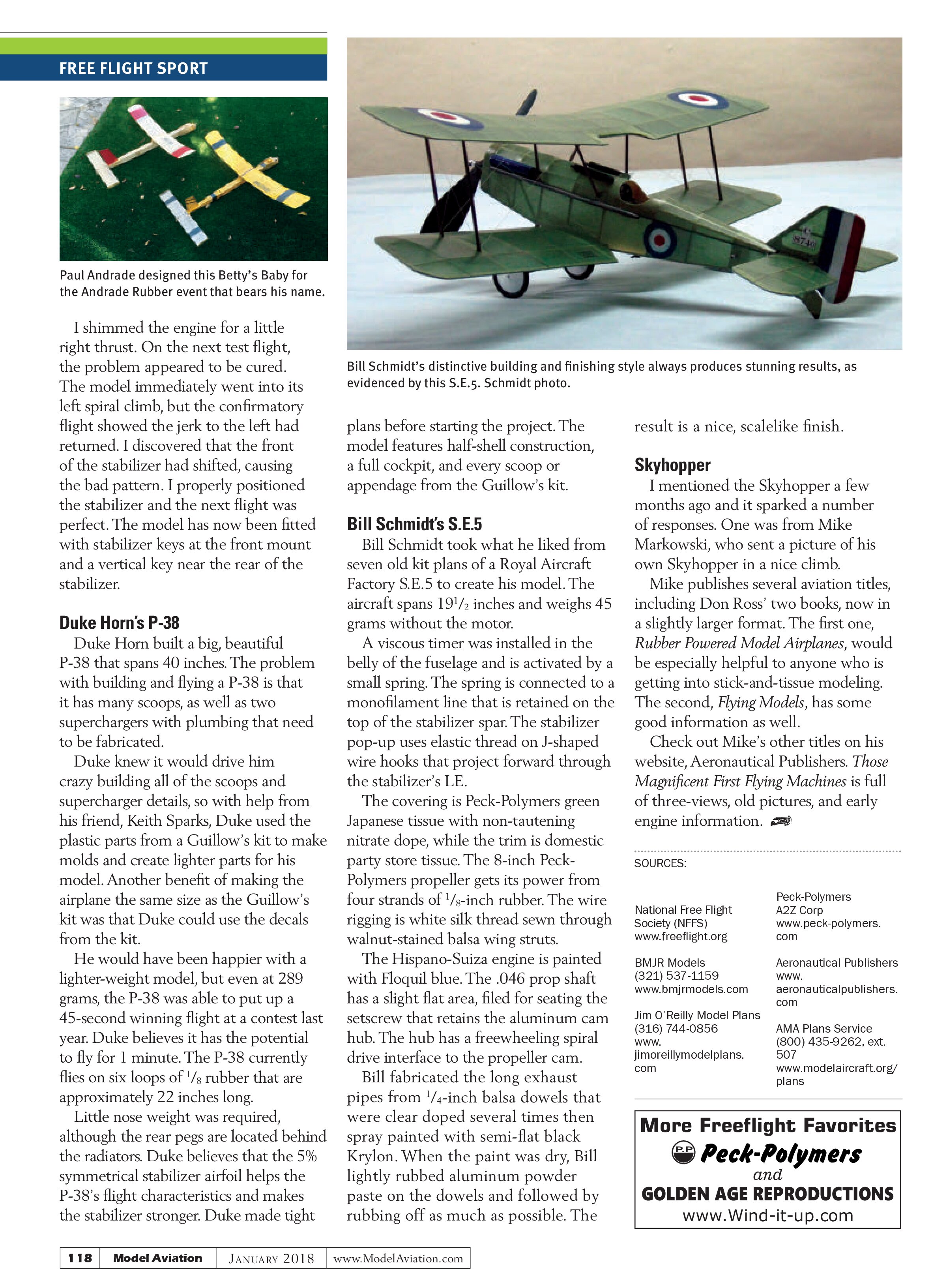
The author finished his BMJR Streak and is ready to take it out for test flights.

I shimmed the engine for a little right thrust. On the next test flight, the problem appeared to be cured. The model immediately went into its left spiral climb, but the confirmatory flight showed the jerk to the left had returned. I discovered that the front of the stabilizer had shifted, causing the bad pattern. I properly positioned the stabilizer and the next flight was perfect. The model has now been fitted with stabilizer keys at the front mount and a vertical key near the rear of the stabilizer.
Duke Horn’s P-38
Duke Horn built a big, beautiful P-38 that spans 40 inches. The problem with building and flying a P-38 is that it has many scoops, as well as two superchargers with plumbing that need to be fabricated.
Duke knew it would drive him crazy building all of the scoops and supercharger details, so with help from his friend, Keith Sparks, Duke used the plastic parts from a Guillow’s kit to make molds and create lighter parts for his model. Another benefit of making the airplane the same size as the Guillow’s kit was that Duke could use the decals from the kit.
He would have been happier with a lighter-weight model, but even at 289 grams, the P-38 was able to put up a 45-second winning flight at a contest last year. Duke believes it has the potential to fly for 1 minute. The P-38 currently flies on six loops of ⅛ rubber that are approximately 22 inches long.
Little nose weight was required, although the rear pegs are located behind the radiators. Duke believes that the 5% symmetrical stabilizer airfoil helps the P-38’s flight characteristics and makes the stabilizer stronger. Duke made tight

plans before starting the project. The model features half-shell construction, a full cockpit, and every scoop or appendage from the Guillow’s kit.
Bill Schmidt’s S.E.5
Bill Schmidt took what he liked from seven old kit plans of a Royal Aircraft Factory S.E.5 to create his model. The aircraft spans 19 ½ inches and weighs 45 grams without the motor.
A viscous timer was installed in the belly of the fuselage and is activated by a small spring. The spring is connected to a monofilament line that is retained on the top of the stabilizer spar. The stabilizer pop-up uses elastic thread on J-shaped wire hooks that project forward through the stabilizer’s LE.
The covering is Peck-Polymers green Japanese tissue with non-tautening nitrate dope, while the trim is domestic party store tissue. The 8-inch Peck-Polymers propeller gets its power from four strands of ⅛-inch rubber. The wire rigging is white silk thread sewn through walnut-stained balsa wing struts.
The Hispano-Suiza engine is painted with Floquil blue. The .046 prop shaft has a slight flat area, filed for seating the setscrew that retains the aluminum cam hub. The hub has a freewheeling spiral drive interface to the propeller cam.
Bill fabricated the long exhaust pipes from ¼-inch balsa dowels that were clear doped several times then spray painted with semi-flat black Krylon. When the paint was dry, Bill lightly rubbed aluminum powder paste on the dowels and followed by rubbing off as much as possible. The
result is a nice, scalelike finish.
Skyhopper
I mentioned the Skyhopper a few months ago and it sparked a number of responses. One was from Mike Markowski, who sent a picture of his own Skyhopper in a nice climb.
Mike publishes several aviation titles, including Don Ross’ two books, now in a slightly larger format. The first one, Rubber Powered Model Airplanes, would be especially helpful to anyone who is getting into stick-and-tissue modeling. The second, Flying Models, has some good information as well.
Check out Mike’s other titles on his website, Aeronautical Publishers. Those Magnificent First Flying Machines is full of three-views, old pictures, and early engine information.
SOURCES:
National Free Flight Society (NFFS)
www.freeflight.org
BMJR Models
(321) 537-1159
www.bmjmodels.com
Jim O’Reilly Model Plans
(316) 744-0856
www.jimoreillymodelplans.com
Peck-Polymers
A2Z Corp
www.peck-polymers.com
Aeronautical Publishers
www.aeronauticalpublishers.com
AMA Plans Service
(800) 435-9262, ext. 507
www.modelaircraft.org/plans