Electric Carrier records
by Dick Perry
tailhooker@comcast.net
The traditional topic for my January “Control Line Navy Carrier” column has been a rundown of the models used in the Nats. As was reported in NatsNews, Pete Mazur established three national records in the electric-powered Carrier events. Since then, he has twice increased the records in Class I and Class II.
I haven’t often discussed details about electric models in the past, so I’ll concentrate on Pete’s models and his record performances, and then I’ll provide some summary data for the gas models from the Nats.
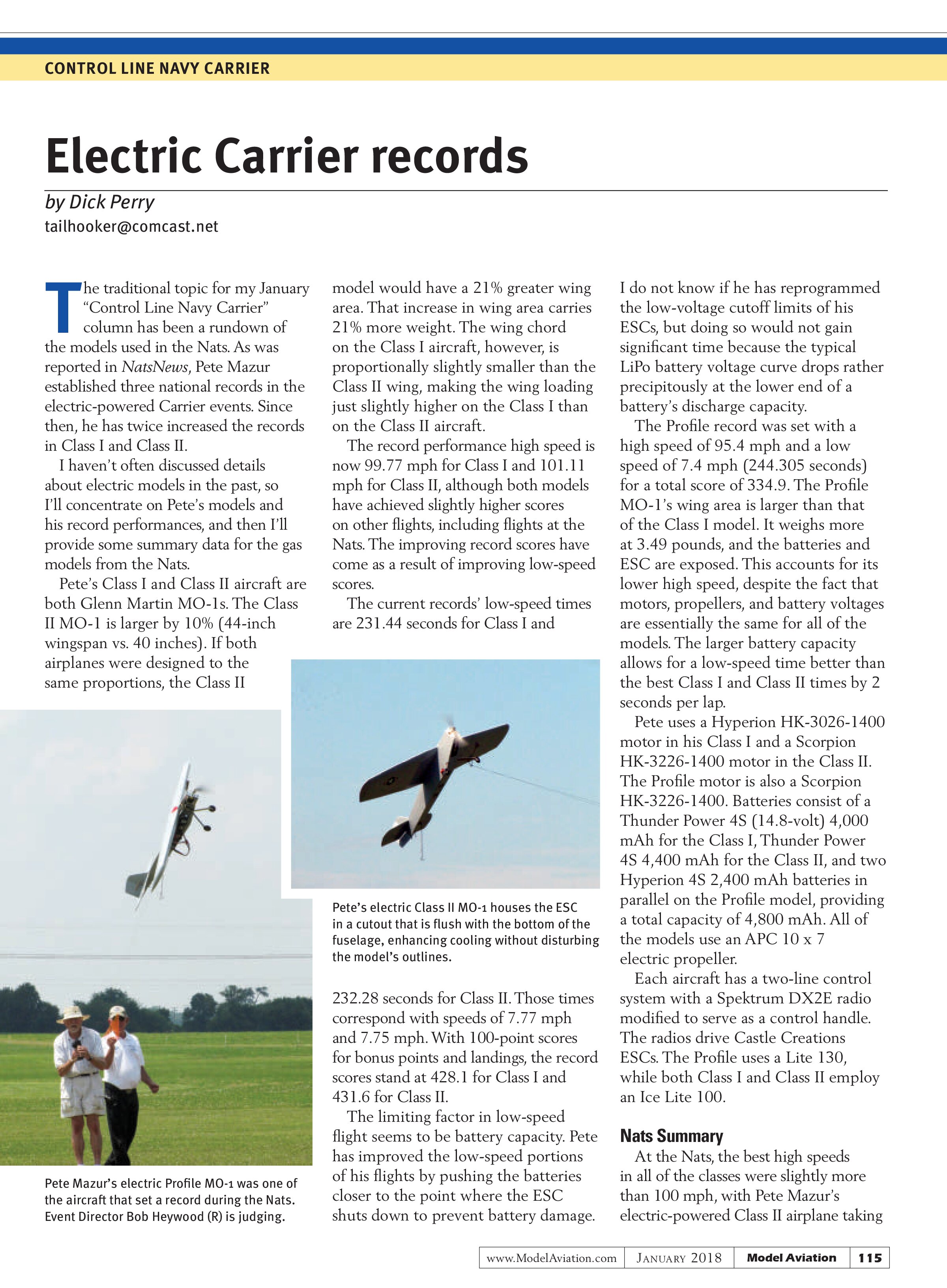
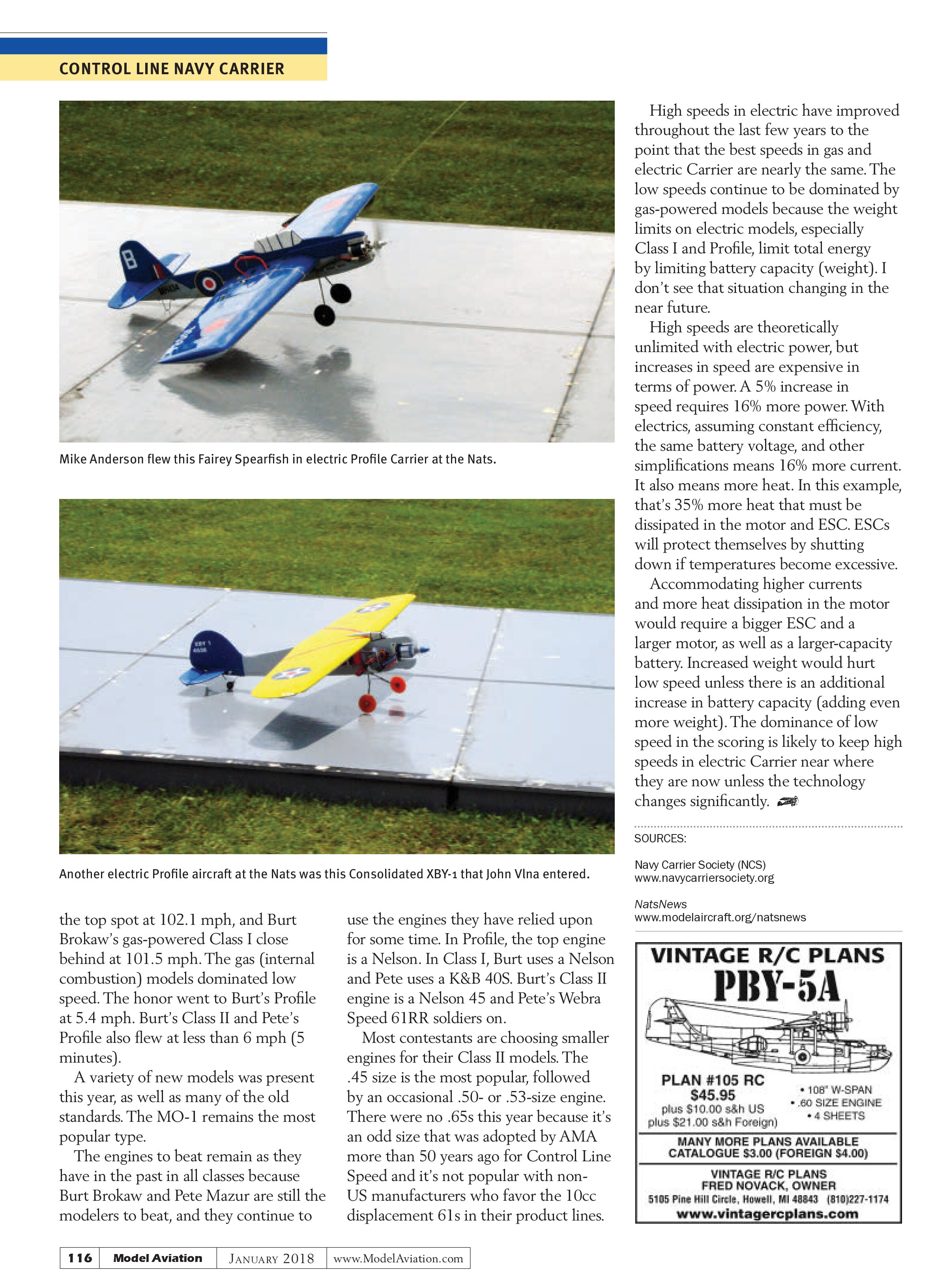
Pete’s Class I and Class II aircraft are both Glenn Martin MO-1s. The Class II MO-1 is larger by 10% (44-inch wingspan vs. 40 inches). If both airplanes were designed to the same proportions, the Class II model would have a 21% greater wing area. That increase in wing area carries 21% more weight. The wing chord on the Class I aircraft, however, is proportionally slightly smaller than the Class II wing, making the wing loading just slightly higher on the Class I than on the Class II aircraft.
The record performance high speed is now 99.77 mph for Class I and 101.11 mph for Class II, although both models have achieved slightly higher scores on other flights, including flights at the Nats. The improving record scores have come as a result of improving low-speed scores.
The current records’ low-speed times are 231.44 seconds for Class I and


232.28 seconds for Class II. Those times correspond with speeds of 7.77 mph and 7.75 mph. With 100-point scores for bonus points and landings, the record scores stand at 428.1 for Class I and 431.6 for Class II.
The limiting factor in low-speed flight seems to be battery capacity. Pete has improved the low-speed portions of his flights by pushing the batteries closer to the point where the ESC shuts down to prevent battery damage.
I do not know if he has reprogrammed the low-voltage cutoff limits of his ESCs, but doing so would not gain significant time because the typical LiPo battery voltage curve drops rather precipitously at the lower end of a battery’s discharge capacity.
The Profile record was set with a high speed of 95.4 mph and a low speed of 7.4 mph (244.305 seconds) for a total score of 334.9. The Profile MO-1’s wing area is larger than that of the Class I model. It weighs more at 3.49 pounds, and the batteries and ESC are exposed. This accounts for its lower high speed, despite the fact that motors, propellers, and battery voltages are essentially the same for all of the models. The larger battery capacity allows for a low-speed time better than the best Class I and Class II times by 2 seconds per lap.
Pete uses a Hyperion HK-3026-1400 motor in his Class I and a Scorpion HK-3226-1400 motor in the Class II. The Profile motor is also a Scorpion HK-3226-1400. Batteries consist of a Thunder Power 4S (14.8-volt) 4,000 mAh for the Class I, Thunder Power 4S 4,400 mAh for the Class II, and two Hyperion 4S 2,400 mAh batteries in parallel on the Profile model, providing a total capacity of 4,800 mAh. All of the models use an APC 10 x 7 electric propeller.
Each aircraft has a two-line control system with a Spektrum DX2E radio modified to serve as a control handle. The radios drive Castle Creations ESCs. The Profile uses a Lite 130, while both Class I and Class II employ an Ice Lite 100.
Nats Summary
At the Nats, the best high speeds in all of the classes were slightly more than 100 mph, with Pete Mazur’s electric-powered Class II airplane taking
High speeds in electric have improved throughout the last few years to the point that the best speeds in gas and electric Carrier are nearly the same. The low speeds continue to be dominated by gas-powered models because the weight limits on electric models, especially Class I and Profile, limit total energy by limiting battery capacity (weight). I don’t see that situation changing in the near future.
High speeds are theoretically unlimited with electric power, but increases in speed are expensive in terms of power. A 5% increase in speed requires 16% more power. With electrics, assuming constant efficiency, the same battery voltage, and other simplifications means 16% more current. It also means more heat. In this example, that’s 35% more heat that must be dissipated in the motor and ESC. ESCs will protect themselves by shutting down if temperatures become excessive.
Accommodating higher currents and more heat dissipation in the motor would require a bigger ESC and a larger motor, as well as a larger-capacity battery. Increased weight would hurt low speed unless there is an additional increase in battery capacity (adding even more weight). The dominance of low speed in the scoring is likely to keep high speeds in electric Carrier near where they are now unless the technology changes significantly.


the top spot at 102.1 mph, and Burt Brokaw’s gas-powered Class I close behind at 101.5 mph. The gas (internal combustion) models dominated low speed. The honor went to Burt’s Profile at 5.4 mph. Burt’s Class II and Pete’s Profile also flew at less than 6 mph (5 minutes).
A variety of new models was present this year, as well as many of the old standards. The MO-1 remains the most popular type.
The engines to beat remain as they have in the past in all classes because Burt Brokaw and Pete Mazur are still the modelers to beat, and they continue to use the engines they have relied upon for some time. In Profile, the top engine is a Nelson. In Class I, Burt uses a Nelson and Pete uses a K&B 40S. Burt’s Class II engine is a Nelson 45 and Pete’s Webra Speed 61RR soldiers on.
Most contestants are choosing smaller engines for their Class II models. The .45 size is the most popular, followed by an occasional .50- or .53-size engine. There were no .65s this year because it’s an odd size that was adopted by AMA more than 50 years ago for Control Line Speed and it’s not popular with non-US manufacturers who favor the 10cc displacement 61s in their product lines.
SOURCES:
Navy Carrier Society (NCS)
www.navycarriersociety.org
NatsNews
www.modelaircraft.org/natsnews