Wading through piles of airplanes
by Mark Rudner
rudner@mit.edu
Happy 2018, everyone. Another year has passed, and an exciting year of flying lies ahead of us. To start the year off right, I wish everyone lots of air time, plenty of cuts, and the best of luck in the circle—unless you’re flying against me, of course!
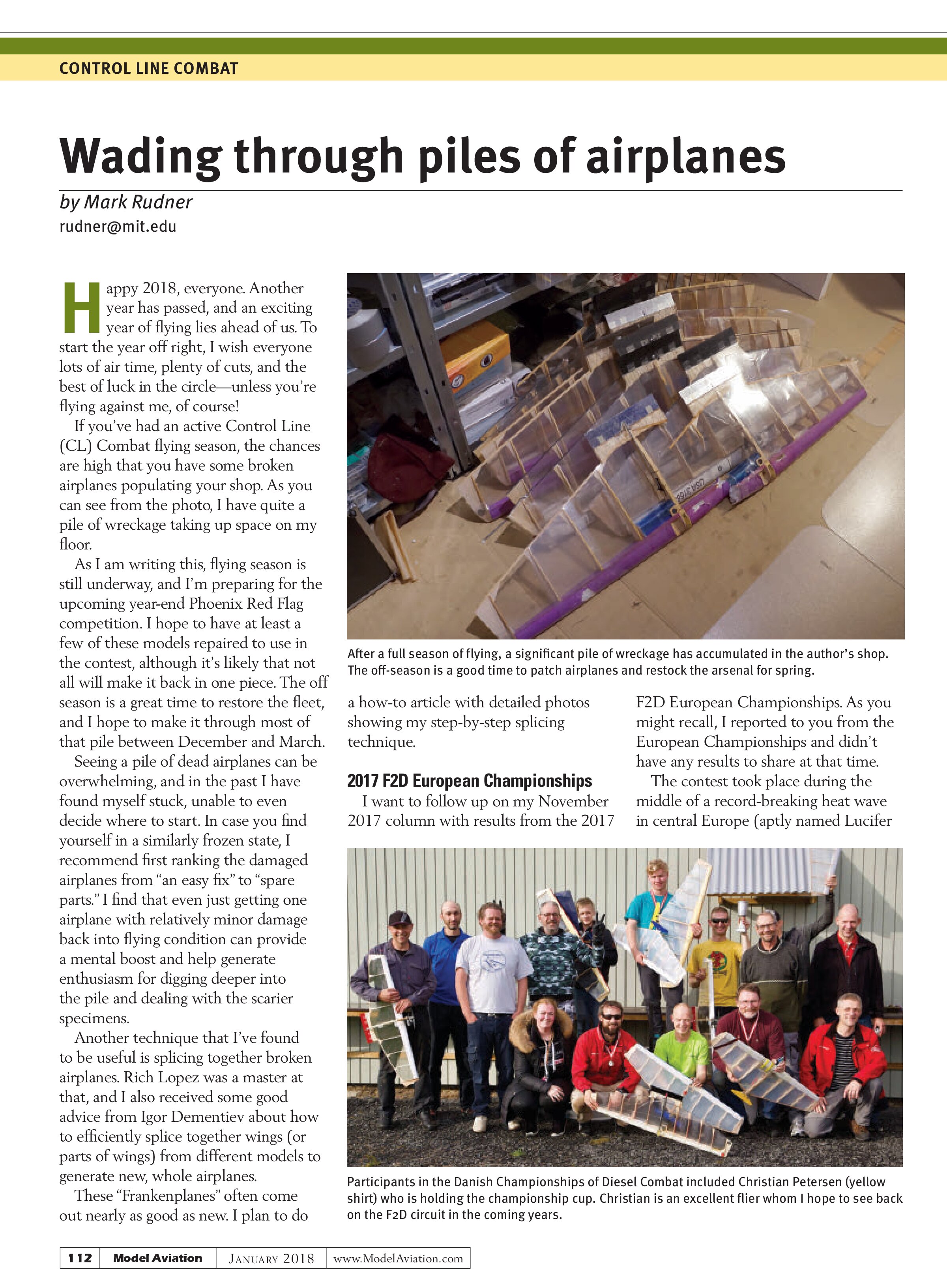
If you’ve had an active Control Line (CL) Combat flying season, the chances are high that you have some broken airplanes populating your shop. As you can see from the photo, I have quite a pile of wreckage taking up space on my floor.
As I am writing this, flying season is still underway, and I’m preparing for the upcoming year-end Phoenix Red Flag competition. I hope to have at least a few of these models repaired to use in the contest, although it’s likely that not all will make it back in one piece. The off season is a great time to restore the fleet, and I hope to make it through most of that pile between December and March.
Seeing a pile of dead airplanes can be overwhelming, and in the past I have found myself stuck, unable to even decide where to start. In case you find yourself in a similarly frozen state, I recommend first ranking the damaged airplanes from “an easy fix” to “spare parts.” I find that even just getting one airplane with relatively minor damage back into flying condition can provide a mental boost and help generate enthusiasm for digging deeper into the pile and dealing with the scarier specimens.
Another technique that I’ve found to be useful is splicing together broken airplanes. Rich Lopez was a master at that, and I also received some good advice from Igor Dementiev about how to efficiently splice together wings (or parts of wings) from different models to generate new, whole airplanes. These “Frankenplanes” often come out nearly as good as new. I plan to do

a how-to article with detailed photos showing my step-by-step splicing technique.
2017 F2D European Championships
I want to follow up on my November 2017 column with results from the 2017 F2D European Championships. As you might recall, I reported to you from the European Championships and didn’t have any results to share at that time. The contest took place during the middle of a record-breaking heat wave in central Europe (aptly named Lucifer by meteorologists). Temperatures were well above 100° for several days, and we found little respite from the sweltering heat on the field. Fortunately, there was a water spigot close to where we had set up our shade tent. Throughout the day, competitors passed by and doused themselves with cold tap water.
Aside from some discomfort, the heat brought many challenges to the competition. In addition to the usual challenges of restarting hot engines, the heat generated much fatigue among competitors. In a sport such as Combat, which requires the utmost concentration and quickest reaction times, even slight mental and physical fatigue can strongly impact performance. As the week went on, you could see the heat taking its toll. In the end, it was the strong who survived.
When the dust settled, Ignacio “Nacho” Rioja, of Spain, took home the title of 2017 CL Combat European Champion. Nacho is a Junior and has been a force to reckon with for several years. He was solid throughout the contest, and made his way past many tough opponents. Audrius Rastenis, of Lithuania, and Pavel Narkevich, of Russia, took home the silver and bronze medals, respectively.
Interestingly, at this moment, both the reigning World and European Champions in CL Combat are Juniors. As far as I can remember, this is the first time this has happened. It is a great sign that we have new blood in the hobby and that these young pilots are doing so well.
Diesel Combat
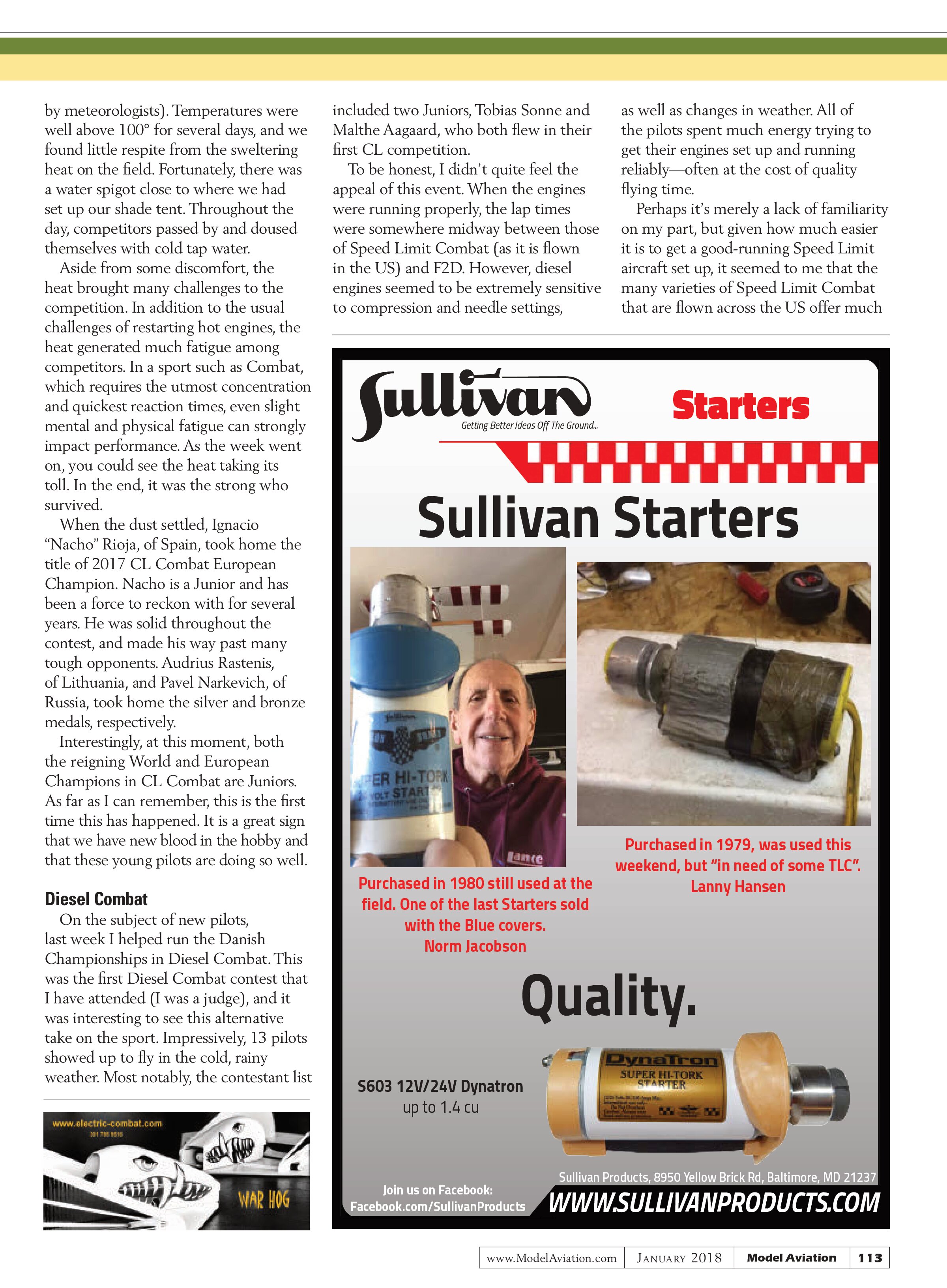
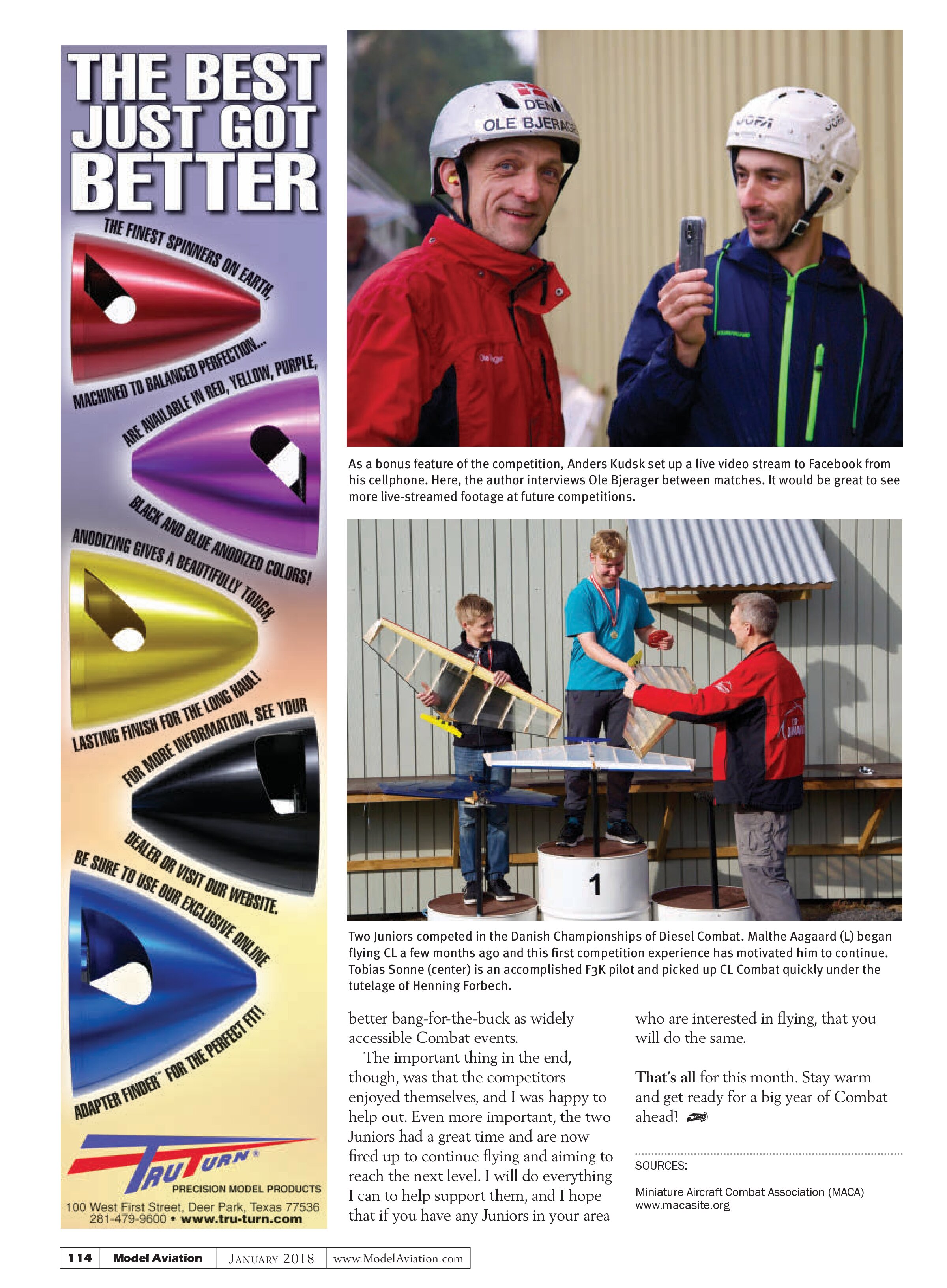
On the subject of new pilots, last week I helped run the Danish Championships in Diesel Combat. This was the first Diesel Combat contest that I have attended (I was a judge), and it was interesting to see this alternative take on the sport. Impressively, 13 pilots showed up to fly in the cold, rainy weather. Most notably, the contestant list included two Juniors, Tobias Sonne and Malthe Aagaard, who both flew in their first CL competition.
To be honest, I didn’t quite feel the appeal of this event. When the engines were running properly, the lap times were somewhere midway between those of Speed Limit Combat (as it is flown in the US) and F2D. However, diesel engines seemed to be extremely sensitive to compression and needle settings, as well as changes in weather. All of the pilots spent much energy trying to get their engines set up and running reliably—often at the cost of quality flying time.
Perhaps it’s merely a lack of familiarity on my part, but given how much easier it is to get a good-running Speed Limit aircraft set up, it seemed to me that the many varieties of Speed Limit Combat that are flown across the US offer much


better bang-for-the-buck as widely accessible Combat events.
The important thing in the end, though, was that the competitors enjoyed themselves, and I was happy to help out. Even more important, the two Juniors had a great time and are now fired up to continue flying and aiming to reach the next level. I will do everything I can to help support them, and I hope that if you have any Juniors in your area who are interested in flying, that you will do the same.
That’s all for this month. Stay warm and get ready for a big year of Combat ahead!
SOURCES:
Miniature Aircraft Combat Association (MACA)
www.mac asite.org