Team trials held at alternate site
by Bob Hunt
robinhunt@rcn.com
I reported in my September 2017 column that the 2017 FAI F2B (Stunt) Team Selection contest to determine the 2018 US F2B team was scheduled to be held October 14-15, 2017, in Houston at Scobee Field. Mother Nature had a hand in rearranging that contest when Hurricane Harvey devastated the region approximately a month and a half before the contest was to happen.
The contest management was uncertain that the water would recede in time for the contest to take place. Even if it did, there would be plenty of work required to get the field in shape for such an auspicious event. The decision was made to move the contest to Hobby Field in Garland, Texas (a suburb of Dallas), and hold it on the original dates.
Kudos to Event Director Frank Williams and his great crew for being able and willing to pivot so quickly from the original plans and change venues. Credit also goes to the wonderful people in Dallas for their outstanding help and support. This is what teamwork is really about!
More Moldy Stuff
In my last column, the many merits of balsa molding were discussed, and I began making a set of straight-form, molded-balsa leading edge (LE) shells. The EPS foam LE mold bucks were fitted with medium-density fiberboard backing pieces to prevent them from twisting and/or bowing during the molding process. The balsa LE blanks were glued together, sanded, and ready for molding.
In the past, it was standard practice to immerse the entire LE blank in a tub of hot water for several minutes then remove it and wipe off the excess water before positioning it accurately on—and folding it around—the mold buck. It was also standard practice to wrap the LE blanks tight against the mold bucks using an ACE elastic bandage. This practice still works fine, but there is (in my opinion) a better way!


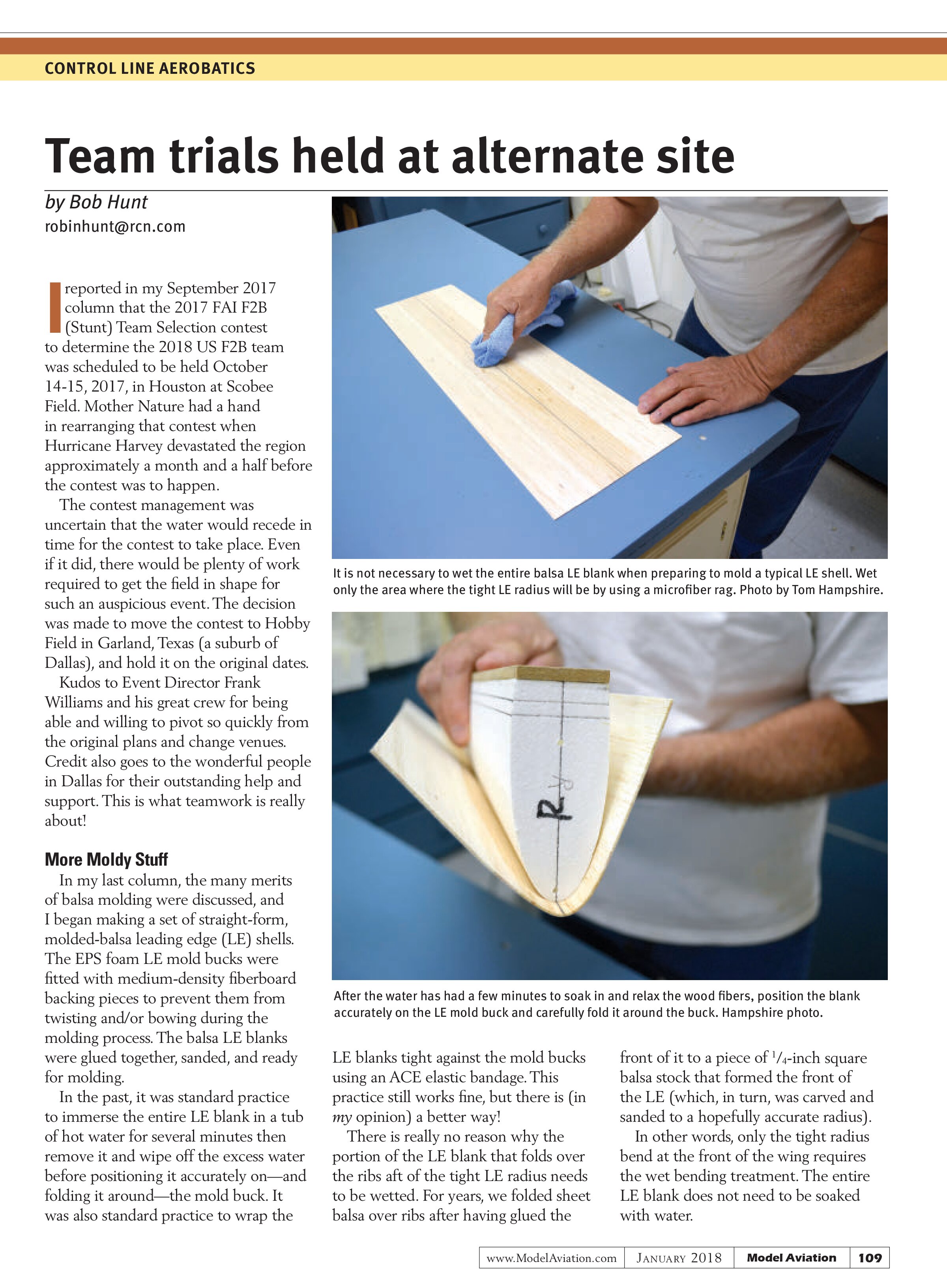
There is really no reason why the portion of the LE blank that folds over the ribs aft of the tight LE radius needs to be wetted. For years, we folded sheet balsa over ribs after having glued the front of it to a piece of ¼-inch square balsa stock that formed the front of the LE (which, in turn, was carved and sanded to a hopefully accurate radius). In other words, only the tight radius bend at the front of the wing requires the wet bending treatment. The entire LE blank does not need to be soaked with water.

It is a simple matter to soak a microfiber cloth or a paper towel in hot water and then simply wet the area that will fold around the LE radius on the buck. This typically means that you will not have to wet any of the spanwise joints made when gluing the LE blanks. That’s a good thing because sometimes the joints can separate when the entire blank is immersed in water.
You can use apple cider vinegar in place of hot water to relax the wood fibers (as I described in my last column), or even use a solution of ammonia and hot water to wet the required area on the LE blank. One note, though—I have been told that ammonia tends to make the wood brittle after it evaporates. I’ve used ammonia on many molded pieces, and I have not experienced this brittleness. (Caution: Only use ammonia in a well-ventilated area and follow all of the the safety warnings on the label!) Lately I have just used hot water or apple cider vinegar when molding balsa. I only use vinegar when I have an extremely tight bend to make.
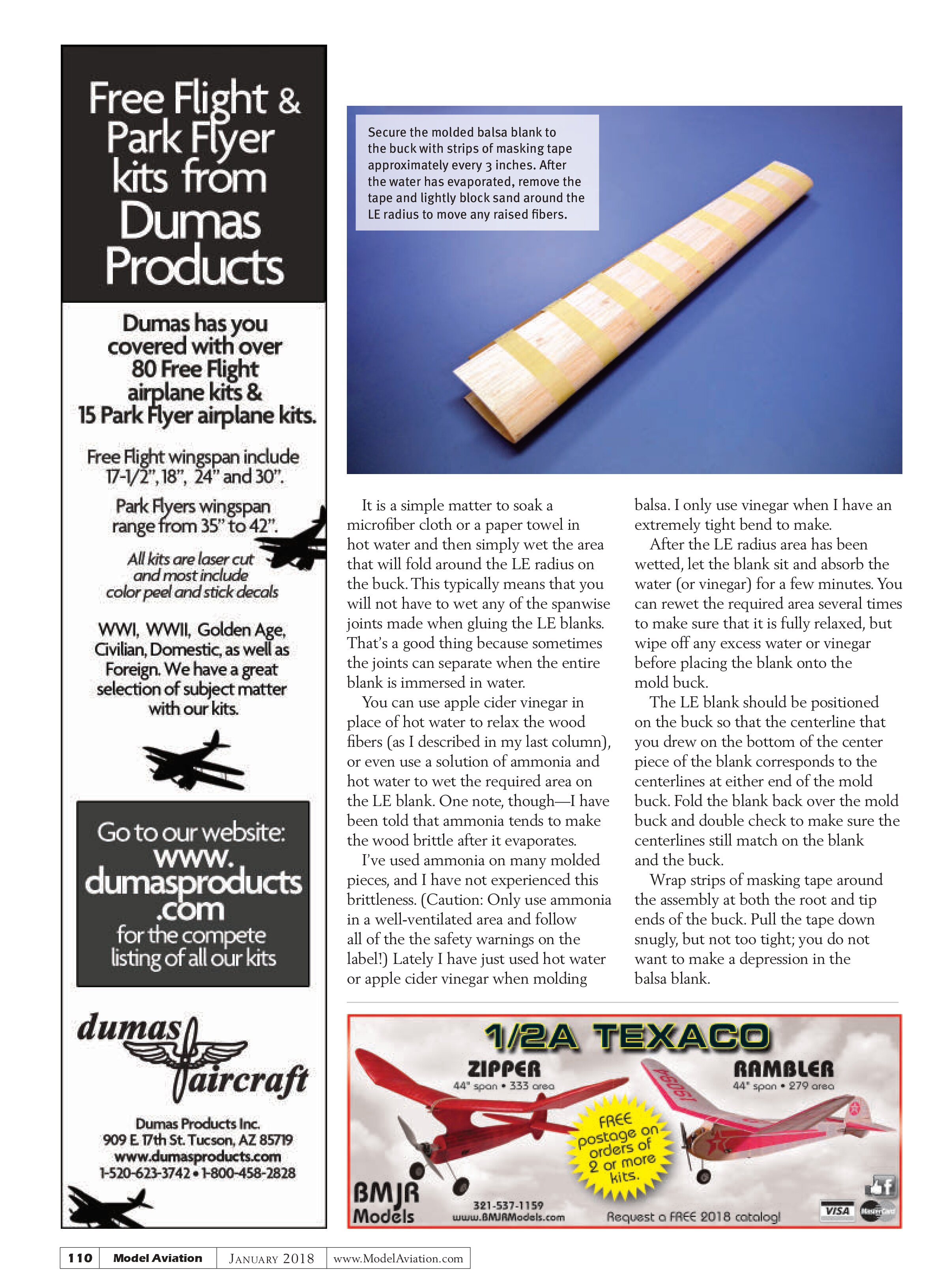
After the LE radius area has been wetted, let the blank sit and absorb the water (or vinegar) for a few minutes. You can rewet the required area several times to make sure that it is fully relaxed, but wipe off any excess water or vinegar before placing the blank onto the mold buck.
The LE blank should be positioned on the buck so that the centerline that you drew on the bottom of the center piece of the blank corresponds to the centerlines at either end of the mold buck. Fold the blank back over the mold buck and double check to make sure the centerlines still match on the blank and the buck.
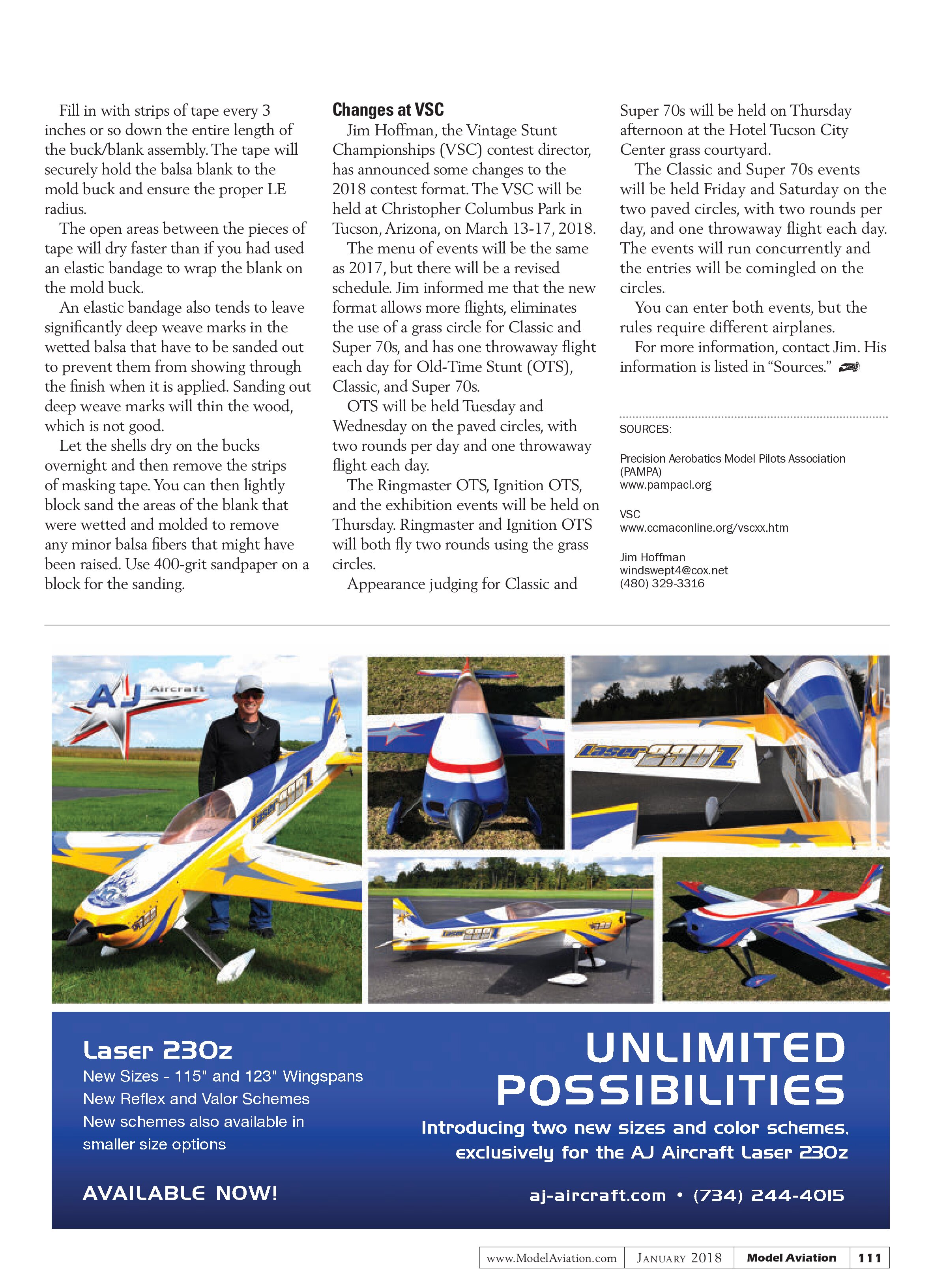
Wrap strips of masking tape around the assembly at both the root and tip ends of the buck. Pull the tape down snugly, but not too tight; you do not want to make a depression in the balsa blank.
Fill in with strips of tape every 3 inches or so down the entire length of the buck/blank assembly. The tape will securely hold the balsa blank to the mold buck and ensure the proper LE radius.
The open areas between the pieces of tape will dry faster than if you had used an elastic bandage to wrap the blank on the mold buck.
An elastic bandage also tends to leave significantly deep weave marks in the wetted balsa that have to be sanded out to prevent them from showing through the finish when it is applied. Sanding out deep weave marks will thin the wood, which is not good.
Let the shells dry on the bucks overnight and then remove the strips of masking tape. You can then lightly block sand the areas of the blank that were wetted and molded to remove any minor balsa fibers that might have been raised. Use 400-grit sandpaper on a block for the sanding.
Changes at VSC
Jim Hoffman, the Vintage Stunt Championships (VSC) contest director, has announced some changes to the 2018 contest format. The VSC will be held at Christopher Columbus Park in Tucson, Arizona, on March 13-17, 2018.
The menu of events will be the same as 2017, but there will be a revised schedule. Jim informed me that the new format allows more flights, eliminates the use of a grass circle for Classic and Super 70s, and has one throwaway flight each day for Old-Time Stunt (OTS), Classic, and Super 70s.
OTS will be held Tuesday and Wednesday on the paved circles, with two rounds per day and one throwaway flight each day.
The Ringmaster OTS, Ignition OTS, and the exhibition events will be held on Thursday. Ringmaster and Ignition OTS will both fly two rounds using the grass circles.
Appearance judging for Classic and Super 70s will be held on Thursday afternoon at the Hotel Tucson City Center grass courtyard.
The Classic and Super 70s events will be held Friday and Saturday on the two paved circles, with two rounds per day, and one throwaway flight each day. The events will run concurrently and the entries will be comingled on the circles.
You can enter both events, but the rules require different airplanes.
For more information, contact Jim. His information is listed in “Sources.”
Sources
Precision Aerobatics Model Pilots Association (PAMPA)
www.pampacl.org
VSC
www.ccmaconline.org/vscxx.htm
Jim Hoffman
windswept4@cox.net
(480) 329-3316