Alternative energy
Patrick Sherman
lucidity@roswellflighttestcrew.com

Winston Churchill, the wartime prime minister of the United Kingdom, once quipped, “Democracy is the worst form of government—except for all of the other forms which have been tried from time to time.”
That sentiment could easily describe the relationship that many pilots have with LiPo batteries, the current state-of-the-art solution for powering drones and other electric-powered flying machines. They are the most energy-dense batteries currently available, but they come with serious drawbacks.
LiPo batteries are expensive, degrade with use, and most importantly, are dangerously volatile. Incorrectly charge one, discharge it too far, puncture it, get it wet, or stare at it cross-eyed, and you risk having it burst into flames.
These batteries are so hazardous that they cannot be shipped as air cargo because—you guessed it—there is a nonnegligible risk that they will spontaneously burst into flames. If these batteries didn’t make it possible for us to fly our drones and other electric-powered model aircraft, we wouldn’t allow them in our country, much less our homes.
Furthermore, we have reached the

limits to what this technology can deliver. We won’t be squeezing any more power out of them. Try it and you’ll end up with the Samsung Galaxy Note 7. That’s also a problem because, manufacturers’ claims aside, multirotor drones are limited to flying for roughly 20 minutes.
To make meaningful advances in flight time, we need to find alternative sources of energy to power our aircraft.
Battery Park
My guest for the future of drone power technology began at the Culham Science Centre in Oxfordshire, England.
A former Royal Navy air station, it became the home to the UK Atomic Energy Authority in the 1950s. Today it is the site of an experimental fusion reactor.
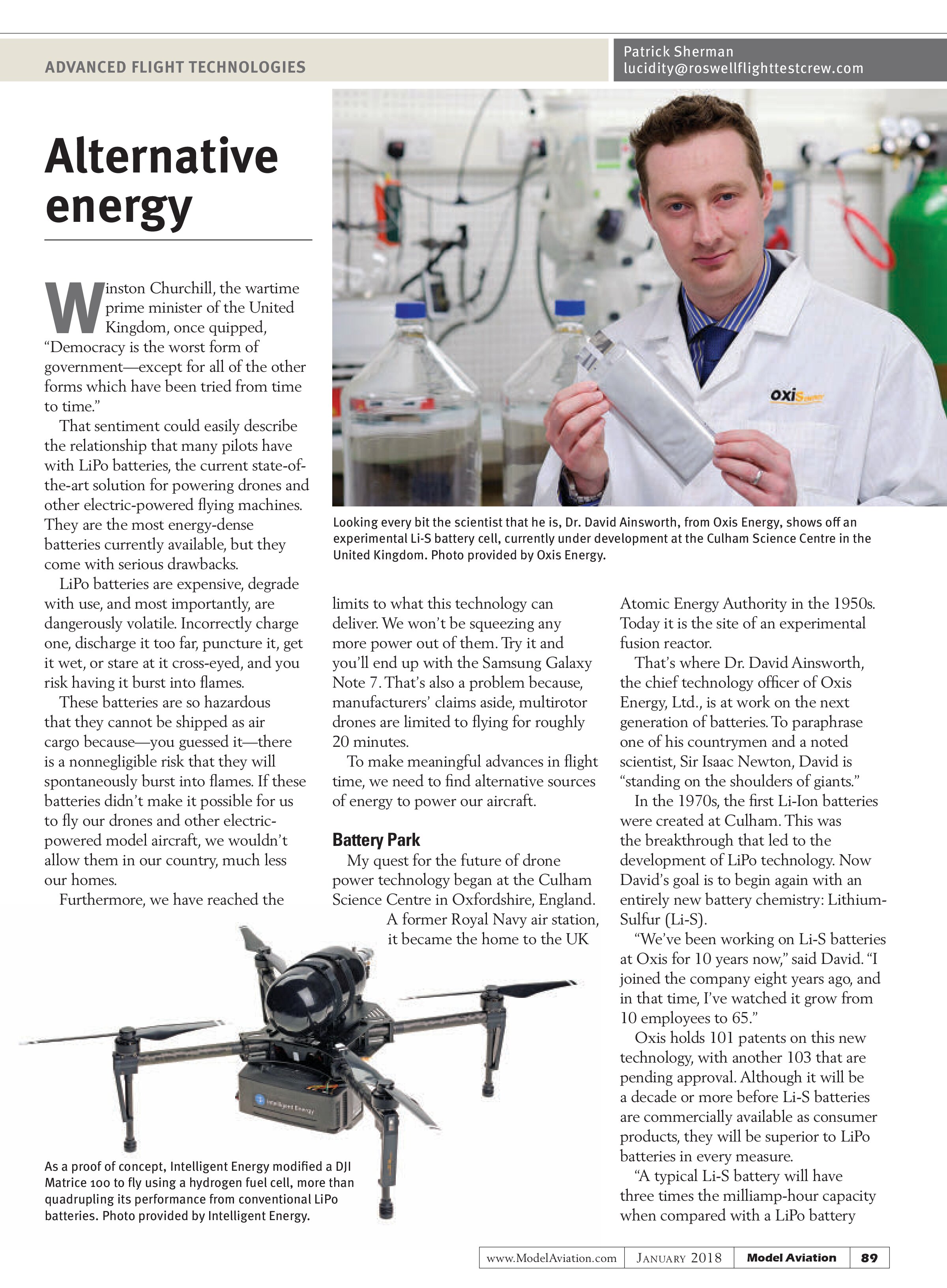
That’s where Dr. David Ainsworth, the chief technology officer of Oxis Energy, Ltd., is at work on the next generation of batteries. To paraphrase one of his countrymen and a noted scientist, Sir Isaac Newton, David is “standing on the shoulders of giants.”
In the 1970s, the first Li-Ion batteries were created at Culham. This was the breakthrough that led to the development of LiPo technology. Now David’s goal is to begin again with an entirely new battery chemistry: Lithium-Sulfur (Li-S).
“We’ve been working on Li-S batteries at Oxis for 10 years now,” said David. “I joined the company eight years ago, and in that time, I’ve watched it grow from 10 employees to 65.”
Oxis holds 101 patents on this new technology, with another 103 that are pending approval. Although it will be a decade or more before Li-S batteries are commercially available as consumer products, they will be superior to LiPo batteries in every measure.
“A typical Li-S battery will have three times the milliamp-hour capacity when compared with a LiPo battery
kilowatt hours per kilogram (kWh/kg) of weight. LiPos provide between 100 and 250 kWh/kg, whereas Li-S batteries provide 400 kWh/kg, with the potential of reaching 500 as development continues.
It’s a Gas
Another approach we could take to improve flight time is to eschew batteries altogether in favor of an entirely different source of power: hydrogen fuel cells. That’s the mission of another Englishman, Julian Hughes, a senior vice president at Intelligent Energy, based in Loughborough, United Kingdom. Founded in 1988, the company has offices around the world and has worked with global transportation companies that include Boeing, Suzuki, and Peugeot.
Although hydrogen fuel cells might seem like a futuristic technology, they were first described by Welsh physicist Sir William Grove in 1838. Sir William built a primitive system using sheet iron, copper, and porcelain plates. Francis Thomas Bacon, also working in the United Kingdom, developed a 5kW fuel cell in 1959.
Fuel cells are not that dissimilar from batteries. Both use a chemical reaction to generate electrical energy; however, unlike a battery that must be

of comparable weight and size,” he explained.
Li-S batteries will be less volatile than LiPos. For example, a puncture will not result in an immediate risk of fire. They will also stand up better to repeated use and will be able to endure 1,500 charge/discharge cycles before losing significant capacity. Best of all, when produced in industrial quantities, they will cost less than a comparable LiPo battery.
This possibility is resulting in interest from many industries and potential customers. David cites electric vehicle manufacturers such as Tesla as potential customers, and has seen interest from the aerospace field.
In September 2017, Oxis provided samples of its latest generation of batteries to the Jet Propulsion Laboratory for use on future NASA missions, including manned and unmanned spaceflight, as well as drones, balloons, and high-altitude aircraft. David added, “We’re also in the middle of conducting programs working with large organizations, flying high-altitude, fixed-wing drones that require high gravimetric energy batteries.”
His use of the word “gravimetric” refers to the yield of the battery in
Do not try this with your LiPo batteries unless you are prepared to cope with the release of toxic gases and a fire. Li-S batteries are less volatile than LiPos and are manufactured without using toxic materials.
recharged when depleted, a fuel cell will continue to generate electricity as long as a steady supply of hydrogen is available. Of course, the question quickly becomes: How much hydrogen can you carry onboard your drone?
Hydrogen is stored as a pressurized gas inside of a lightweight, composite cylinder that is designed to withstand as much as 5,000 pounds of pressure per square inch. Need to fly even longer? Just swap out the empty tank for a full one (which takes about as much time as changing a battery) and you’re back up and flying.
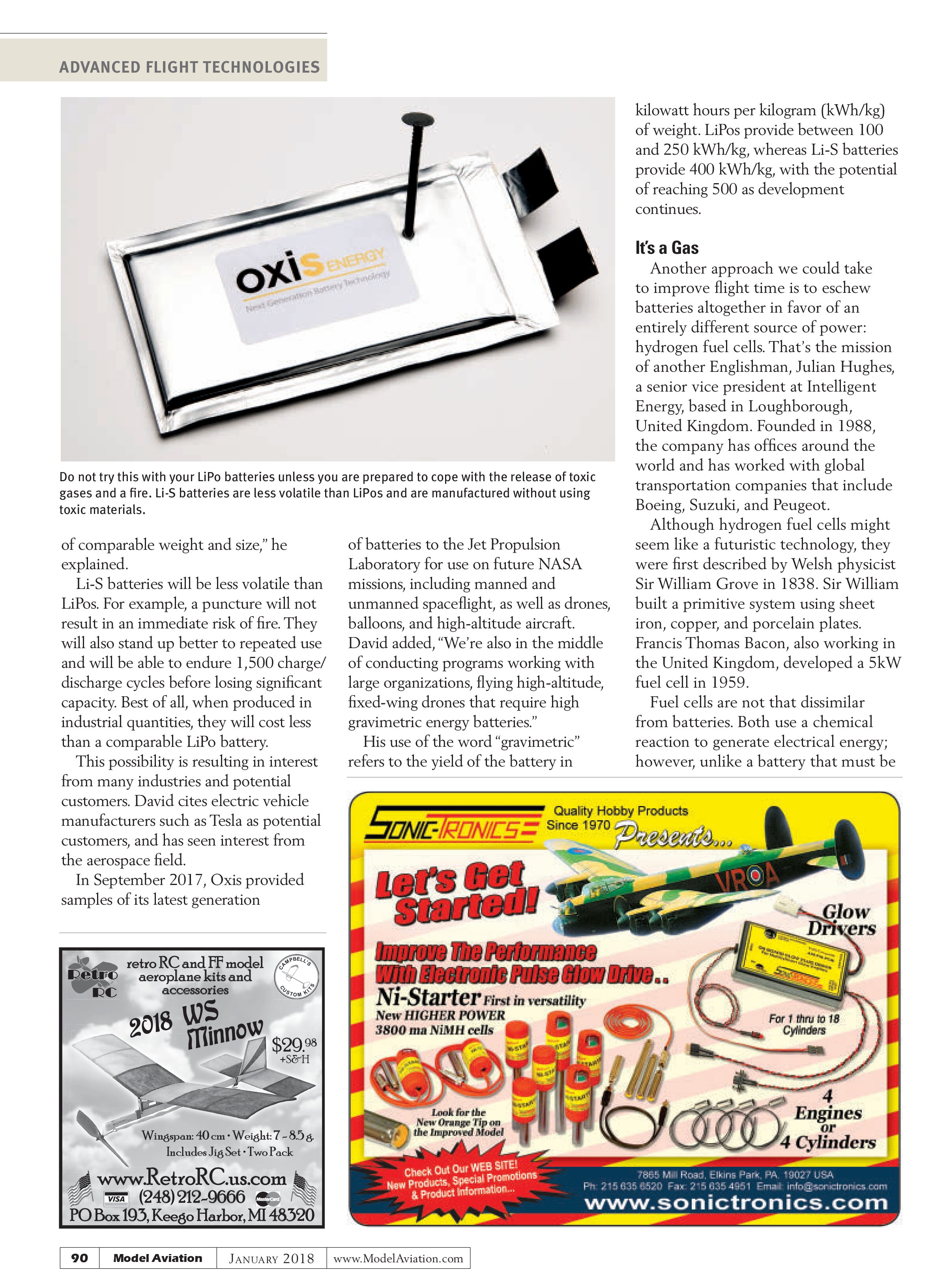
“Fuel cells are three or more times energy dense than a comparable LiPo battery,” Julian said. “To give [you] an example, we modified a DJI Matrice 100 [multirotor] to use one of our fuel cells, and we’re getting 90 minutes of flight time versus 20 minutes with batteries.”
I pointed out that the combination of hydrogen and aviation has a less-than-perfect safety record and specifically cited the fiery end of the Hindenburg airship at Lakehurst Naval Air Station in New Jersey on May 6, 1937. Julian rolled his eyes and pointed out two facts. First, the Hindenburg was coated with flammable paint, which many experts have cited as the likely cause of the disaster. Second, fuel
cells have been used safely in aviation for decades, including on the Apollo missions to the moon.
In fact, hydrogen gas is widely used in industrial applications, and 50 million tons are produced and consumed worldwide annually with an excellent safety record. “Hydrogen gas is available from all of the industrial gas suppliers,” Julian said. “Not many people know that because they don’t ask for hydrogen, but it’s as easy to get as barbecue [propane] gas.”
Like hydrogen gas itself, Intelligent Energy’s fuel cell technology is currently available. The company offers a standalone system that can be integrated into a drone such as the Matrice 100 for $8,500 and is working with FlightWave Aerospace Systems, Inc. to build and sell a hydrogen-powered platform.
SOURCES:
Culham Science Centre
www.culham.org.uk
Oxis Energy, Ltd
info@oxisenergy.com
www.oxisenergy.com
Intelligent Energy
www.intelligent-energy.com
FlightWave Aerospace Systems, Inc.
www.flightwave.aero