Preparing for a maiden flight
Can you believe that we’re already closing in on the end of another year? If it’s true that “time flies when you’re having fun,” I must be having a ball because this year flew by at warp speed. It was a good year despite its rapid passing, and much has been accomplished.
This year I finished four new airplanes—three were multiengine and one a Free Flight model. I also finished two boats and even a few plastic models. Calling the year “productive” could be looked upon as an understatement. The good news is that all went basically well—although not from lack of preparation.
When it comes to building “flying” models, the whole idea is ultimately to fly them. I still get as excited doing a maiden flight today as I did 25 years ago. Admittedly, the models have become slightly more sophisticated, but generally speaking, the same rules apply to maiden flights, whether it’s a simple three-channel trainer or a four-engine bomber.
No matter what you’re flying, preparation is a key factor. I also know that there are some modelers out there who fly their own designs, and although flying an untested design adds another wrinkle to the program, the same rules apply.
What does it mean to properly prepare for a maiden flight? There are several things to look at when preparing a new model to fly.
The most important thing for ensuring a successful maiden flight is to not rush it. We work hard to finish our models, and when we’re talking about spending weeks or months on a project, another couple of days won’t matter. The main thing is that all of the systems are working properly—the propeller(s) turn in the right direction, the control throws are set up correctly and moving in the right direction, and last, but certainly not least, that the center of gravity is correct. The airframe must also be free of warps and twists to eliminate the possibility of any big surprises.
When flying day arrives, check everything again before the first flight. When it all looks good, you’re ready.
Weather is a prime factor in flying any model, so choose a calm day; nothing is harder than trying to trim a new model in blustery air. Even when fully prepared, new airplanes sometimes do weird things, so be ready for anything. Now that you’re physically and mentally set, it’s time to fly.
When flying a new model, don’t simply pour the coal to it and let ’er rip. Taxi the model around first to get a feel for ground handling. Even a high-speed taxi test or two could help you get a feel for its available power.
When it feels right, take off and climb at a shallow angle to a safe altitude and trim the model for straight-and-level flight at a comfortable cruise speed. If things don’t go right, land the model immediately and fix the problem.
Case in point: On its second flight, my Avro Lancaster threw a propeller shortly after takeoff. Not knowing which propeller made that first turn interesting. When those surprises do come, don’t panic and forget to fly the model—a rough landing won’t do as much damage as a full-blown crash!
When flying a multiengine airplane, turning into a dead motor is a no-no. Often you won’t know which engine quit until you’re up to your eyeballs in trouble! So be ready—even if it means flying a multiengine glider.
After the model is trimmed, perform stall tests so you’ll know what to expect when landing, and then make your first approach and landing with a little extra speed.
If you follow those simple guidelines, your first flight will likely be successful. Make any necessary adjustments and enjoy the fruits of your labor.
From Readers
First we have Jeff Cowles with his
Pat Trittle
patscustommodels@gmail.com
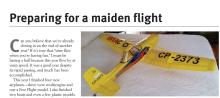
Dumas Nieuport 28. Jeff hasn’t built an RC model in more than 32 years, but he certainly didn’t lose his skills during that time. Originally designed for three-channel RC, Jeff reduced the dihedral and added ailerons, using torque rods actuated by a single servo. The model is powered by a Suppo 2208 outrunner motor and an 800 mAh 2S LiPo battery, with a flying weight of 11.5 ounces. Because two of Jeff’s five servos failed right out of the box, he built access panels on the fuselage for easy access, should the servos in the model fail. It’s always good to plan ahead.

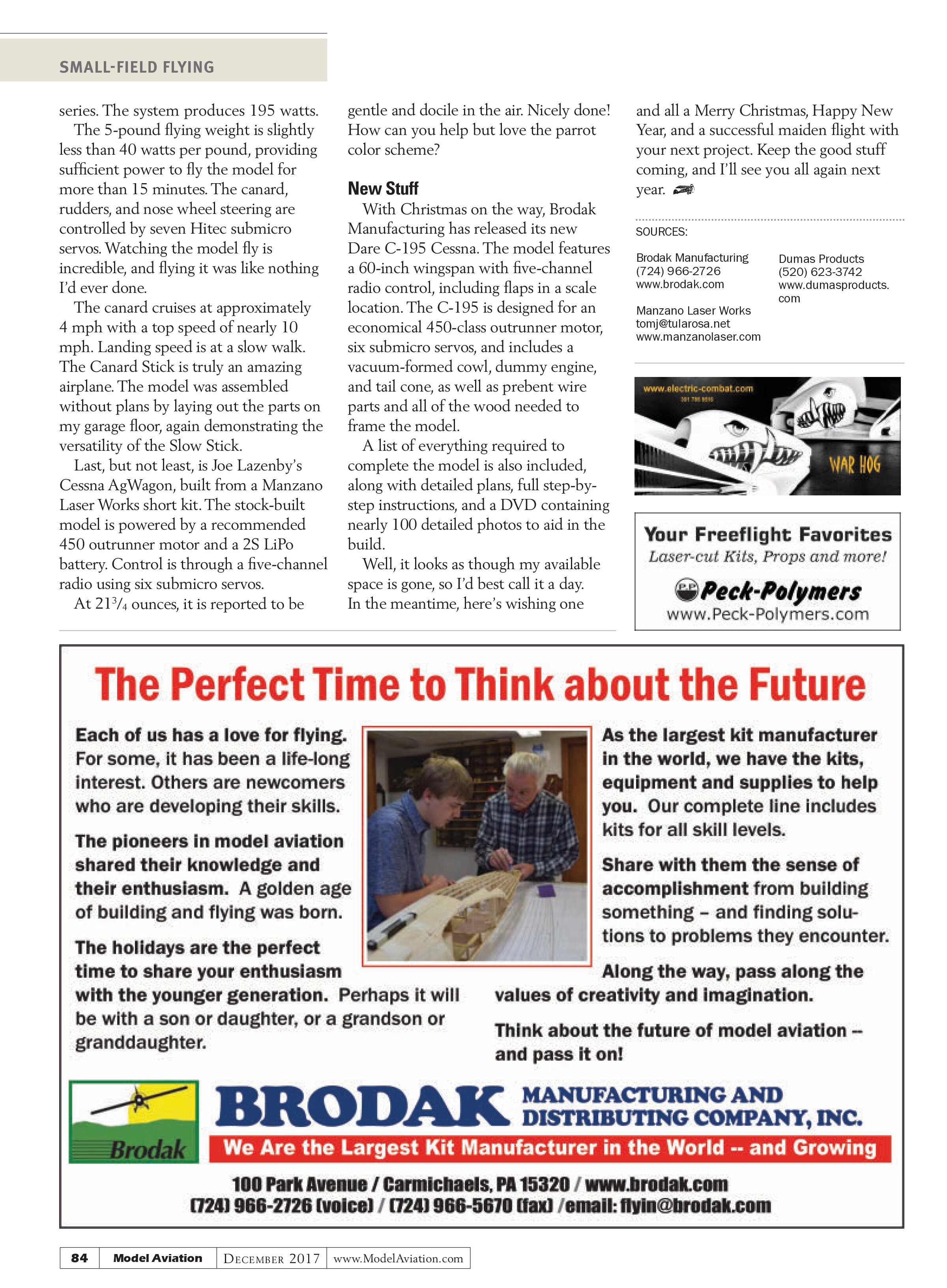
Next up is one of my local fliers, Greg Rullman, who conjured his Canard Stick, modeled after the tried-and-true Slow Stick. It is built from foam parts that Greg has been gathering throughout the years. Park flyers are generally rather small, but this multiengine aircraft has a 10-foot wingspan and a 50-inch canard and flies slower than anything I’ve yet seen. The model is powered by three geared Speed 280 motors, wired in series with a Pixie 20-amp ESC, a Castle Creations 10-amp BEC, and two 1,300 mAh 3S LiPo batteries, also in

The possibilities for Slow Stick modifications are endless, but Greg Rullman’s Canard Stick is one of the most unusual iterations yet. Built from parts from four kits, the model is perfect for moderate-size parks, despite its massive size.

After a 32-year hiatus, Jeff Cowles built his 35-inch wingspan Nieuport 28 from a Dumas kit. The kit was originally designed for three-channel radio control, but Jeff went the extra mile and added ailerons to his build.

series. The system produces 195 watts. The 5-pound flying weight is slightly less than 40 watts per pound, providing sufficient power to fly the model for more than 15 minutes. The canard, rudders, and nose wheel steering are controlled by seven Hitec submicro servos. Watching the model fly is incredible, and flying it was like nothing I’d ever done.
The canard cruises at approximately 4 mph with a top speed of nearly 10 mph. Landing speed is at a slow walk. The Canard Stick is truly an amazing airplane. The model was assembled without plans by laying out the parts on my garage floor, again demonstrating the versatility of the Slow Stick.
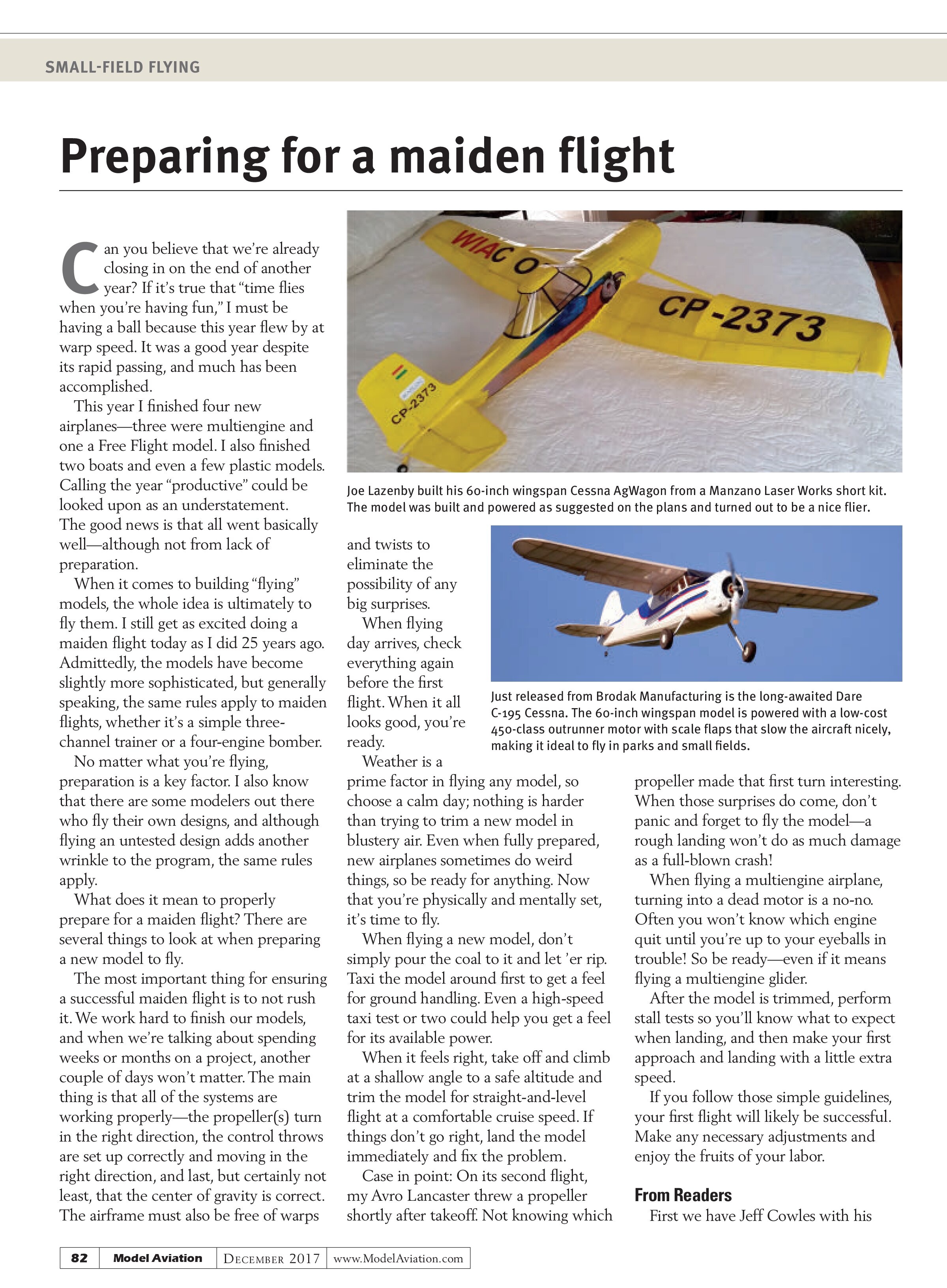
Last, but not least, is Joe Lazenby’s Cessna AgWagon, built from a Manzano Laser Works short kit. The stock-built model is powered by a recommended 450 outrunner motor and a 2S LiPo battery. Control is through a five-channel radio using six submicro servos.
At 21¾ ounces, it is reported to be gentle and docile in the air. Nicely done! How can you help but love the parrot color scheme?
New Stuff
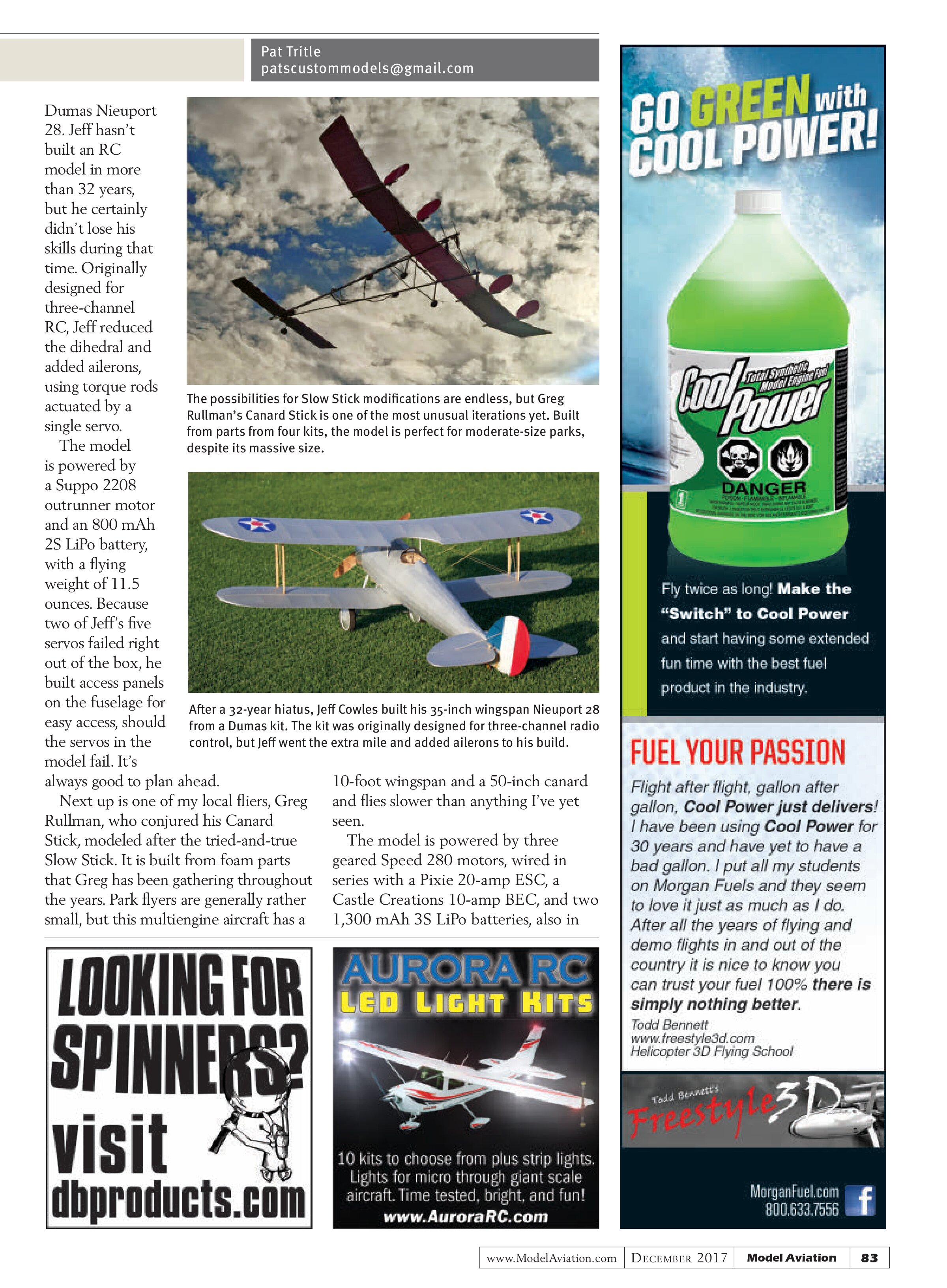
With Christmas on the way, Brodak Manufacturing has released its new Dare C-195 Cessna. The model features a 60-inch wingspan with five-channel radio control, including flaps in a scale location. The C-195 is designed for an economical 450-class outrunner motor, six submicro servos, and includes a vacuum-formed cowl, dummy engine, and tail cone, as well as prebent wire parts and all of the wood needed to frame the model.
A list of everything required to complete the model is also included, along with detailed plans, full step-by-step instructions, and a DVD containing nearly 100 detailed photos to aid in the build.
Well, it looks as though my available space is gone, so I’d best call it a day. In the meantime, here’s wishing one and all a Merry Christmas, Happy New Year, and a successful maiden flight with your next project. Keep the good stuff coming, and I’ll see you all again next year.
SOURCES:
Brodak Manufacturing
(724) 966-2726
www.brodak.com
Manzano Laser Works
tomj@tularosa.net
www.manzanolaser.com
Dumas Products
(520) 623-3742
www.dumasproducts.com