Speaking for all of us ...
Dave Gee
safetycolumn@cs.com
Our sport appeals to people of all ages, and we can enjoy model aircraft from childhood into our golden years of life. There are plenty of enthusiasts in the “senior citizen” category who are having fun and contributing to the hobby.
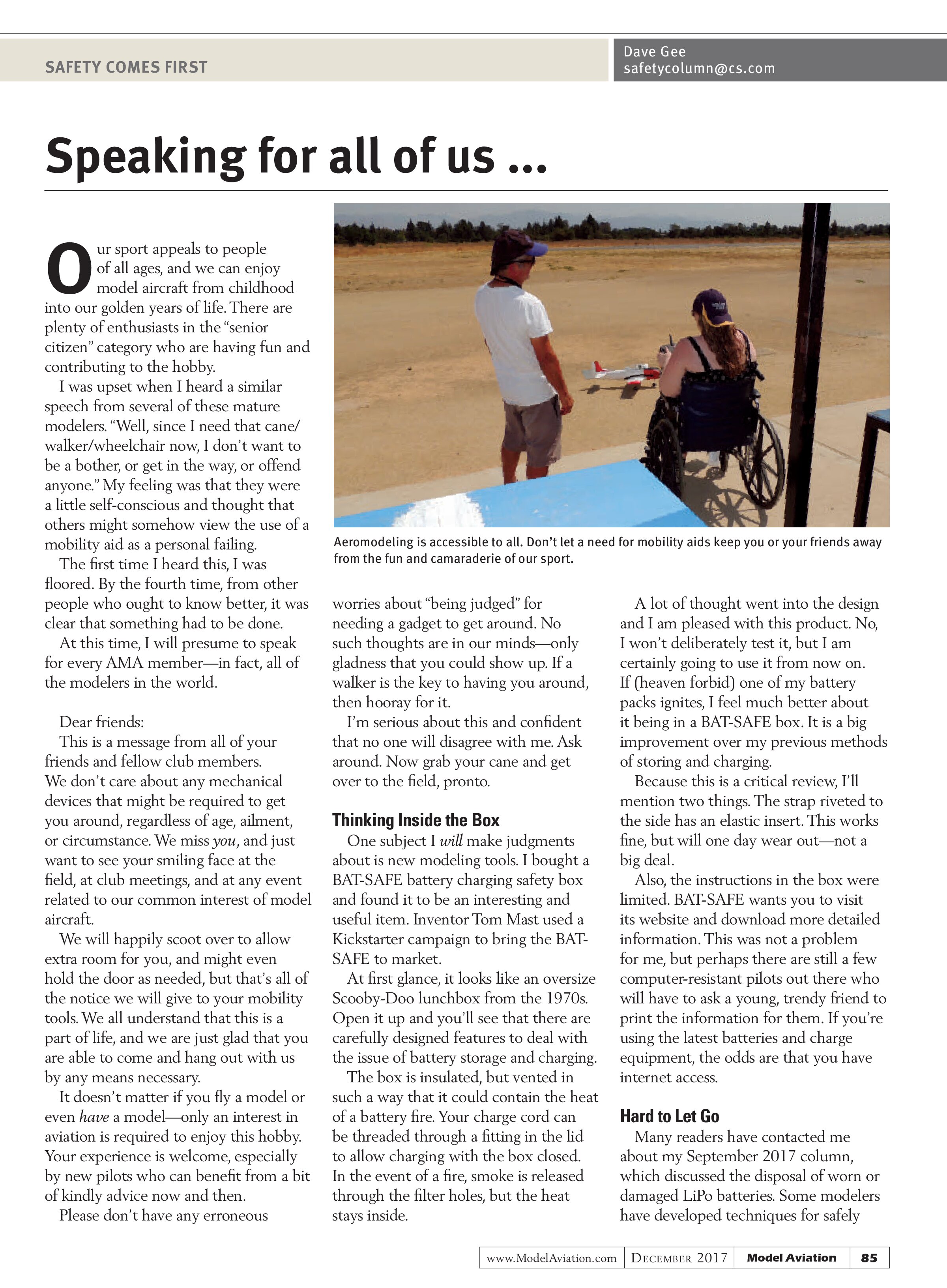
I was upset when I heard a similar speech from several of these mature modelers. “Well, since I need that cane/walker/wheelchair now, I don’t want to be a bother, or get in the way, or offend anyone.” My feeling was that they were a little self-conscious and thought that others might somehow view the use of a mobility aid as a personal failing.
The first time I heard this, I was floored. By the fourth time, from other people who ought to know better, it was clear that something had to be done.
At this time, I will presume to speak for every AMA member—in fact, all of the modelers in the world.
Dear friends:
This is a message from all of your friends and fellow club members. We don’t care about any mechanical devices that might be required to get you around, regardless of age, ailment, or circumstance. We miss you, and just want to see your smiling face at the field, at club meetings, and at any event related to our common interest of model aircraft.
We will happily scoot over to allow extra room for you, and might even hold the door as needed, but that’s all of the notice we will give to your mobility tools. We all understand that this is a part of life, and we are just glad that you are able to come and hang out with us by any means necessary.
It doesn’t matter if you fly a model or even have a model—only an interest in aviation is required to enjoy this hobby. Your experience is welcome, especially by new pilots who can benefit from a bit of kindly advice now and then.
Please don’t have any erroneous

worries about “being judged” for needing a gadget to get around. No such thoughts are in our minds—only gladness that you could show up. If a walker is the key to having you around, then hooray for it.
I’m serious about this and confident that no one will disagree with me. Ask around. Now grab your cane and get over to the field, pronto.
Thinking Inside the Box
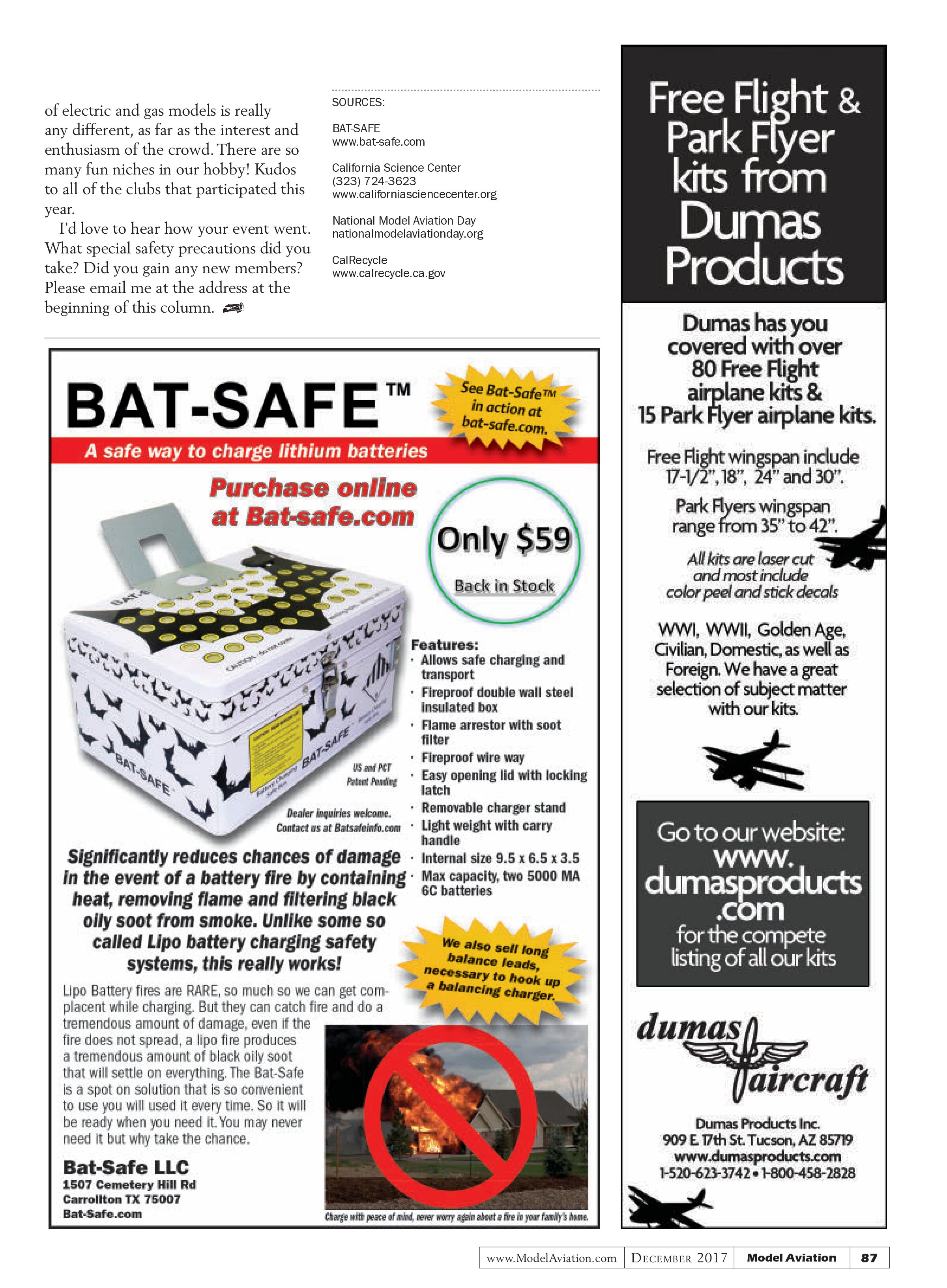
One subject I will make judgments about is new modeling tools. I bought a BAT-SAFE battery charging safety box and found it to be an interesting and useful item. Inventor Tom Mast used a Kickstarter campaign to bring the BAT-SAFE to market.
At first glance, it looks like an oversize Scooby-Doo lunchbox from the 1970s. Open it up and you’ll see that there are carefully designed features to deal with the issue of battery storage and charging.
The box is insulated, but vented in such a way that it could contain the heat of a battery fire. Your charge cord can be threaded through a fitting in the lid to allow charging with the box closed. In the event of a fire, smoke is released through the filter holes, but the heat stays inside.
A lot of thought went into the design and I am pleased with this product. No, I won’t deliberately test it, but I am certainly going to use it from now on. If (heaven forbid) one of my battery packs ignites, I feel much better about it being in a BAT-SAFE box. It is a big improvement over my previous methods of storing and charging.
Because this is a critical review, I’ll mention two things. The strap riveted to the side has an elastic insert. This works fine, but will one day wear out—not a big deal.
Also, the instructions in the box were limited. BAT-SAFE wants you to visit its website and download more detailed information. This was not a problem for me, but perhaps there are still a few computer-resistant pilots out there who will have to ask a young, trendy friend to print the information for them. If you’re using the latest batteries and charge equipment, the odds are that you have internet access.
Hard to Let Go
Many readers have contacted me about my September 2017 column, which discussed the disposal of worn or damaged LiPo batteries. Some modelers have developed techniques for safely
discharging a problem battery. The average pilot might have trouble with these complicated procedures. There are pitfalls to avoid and consequences could be severe.
Depending on where you live, there might or might not be an official place that accepts these cells. A few cities run collection sites or occasional events for hazardous materials.
The problem is that if you damage a battery at the field, or notice that it is puffed, storing and transporting it is a worrisome matter. This part of the problem still has few answers. Who wants to drive around with a damaged cell? And not everyone has a safe place to leave it at home until the hazmat collection event the next weekend.
Some (but not all) hardware store chains offer a free battery collection service. I think they are kind and wise to do so. The goodwill that they receive from customers is worth more than any advertisement they could purchase. You can visit the CalRecycle website listed in “Sources” to find dropoff locations in California. I hope that this trend catches on nationwide for the benefit of all.

Out in Public
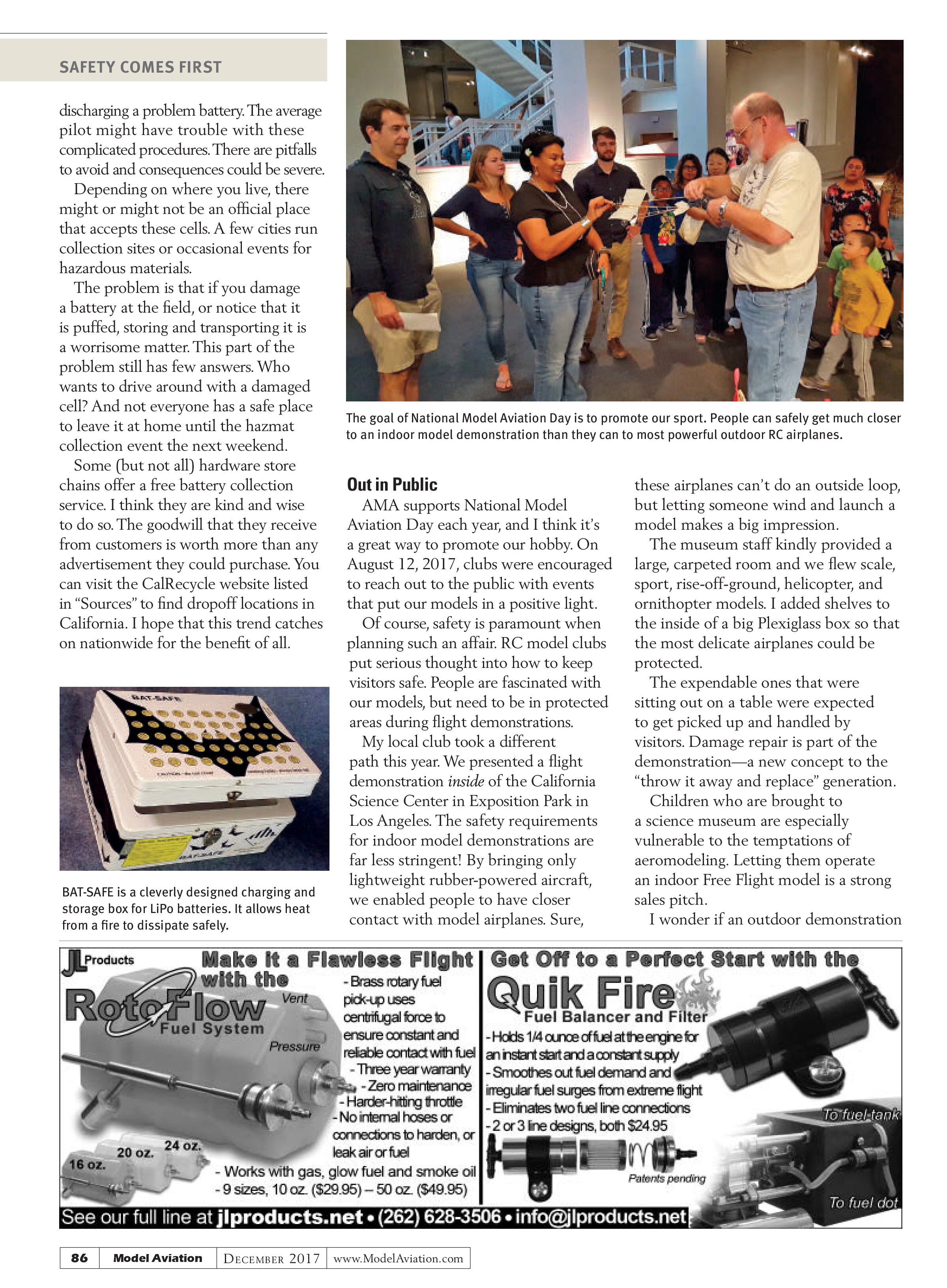
AMA supports National Model Aviation Day each year, and I think it’s a great way to promote our hobby. On August 12, 2017, clubs were encouraged to reach out to the public with events that put our models in a positive light.
Of course, safety is paramount when planning such an affair. RC model clubs put serious thought into how to keep visitors safe. People are fascinated with our models, but need to be in protected areas during flight demonstrations.
My local club took a different path this year. We presented a flight demonstration inside of the California Science Center in Exposition Park in Los Angeles. The safety requirements for indoor model demonstrations are far less stringent! By bringing only lightweight rubber-powered aircraft, we enabled people to have closer contact with model airplanes. Sure,

these airplanes can’t do an outside loop, but letting someone wind and launch a model makes a big impression.
The museum staff kindly provided a large, carpeted room and we flew scale, sport, rise-off-ground, helicopter, and ornithopter models. I added shelves to the inside of a big Plexiglass box so that the most delicate airplanes could be protected.
The expendable ones that were sitting out on a table were expected to get picked up and handled by visitors. Damage repair is part of the demonstration—a new concept to the “throw it away and replace” generation.
Children who are brought to a science museum are especially vulnerable to the temptations of aeromodeling. Letting them operate an indoor Free Flight model is a strong sales pitch.
I wonder if an outdoor demonstration of electric and gas models is really any different, as far as the interest and enthusiasm of the crowd. There are so many fun niches in our hobby! Kudos to all of the clubs that participated this year.
I’d love to hear how your event went. What special safety precautions did you take? Did you gain any new members? Please email me at the address at the beginning of this column.
Sources:
BAT-SAFE
www.bat-safe.com
California Science Center
(323) 724-3623
www.californiasciencecenter.org
National Model Aviation Day
nationalmodelaviationday.org
CalRecycle
www.calrecycle.ca.gov