New sailplanes: the Ahi and 1-26
by Dave Garwood
dave.garwood.518@gmail.com
Here are two new Slope sailplanes of note. One is a new design and the other is an updated classic design, with its kit production line restarted.
Dream-Flight Ahi
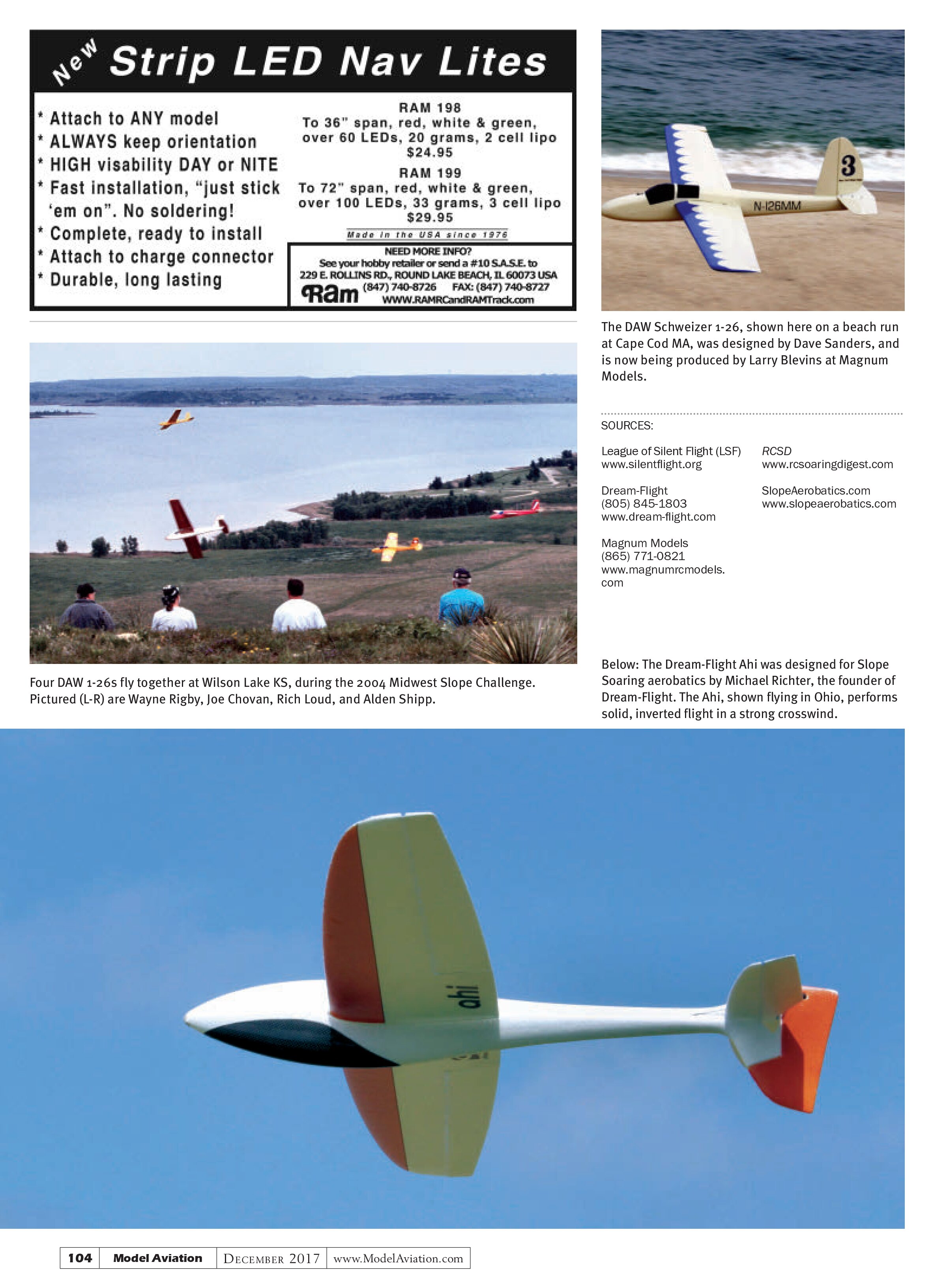
The Dream-Flight Ahi (Hawaiian for tuna) is an all-molded, low parts count, quick to assemble, fun to fly aerobat. It’s a modern design by Michael Richter. It builds and fits out in an hour and flies in surprisingly tough lift conditions.
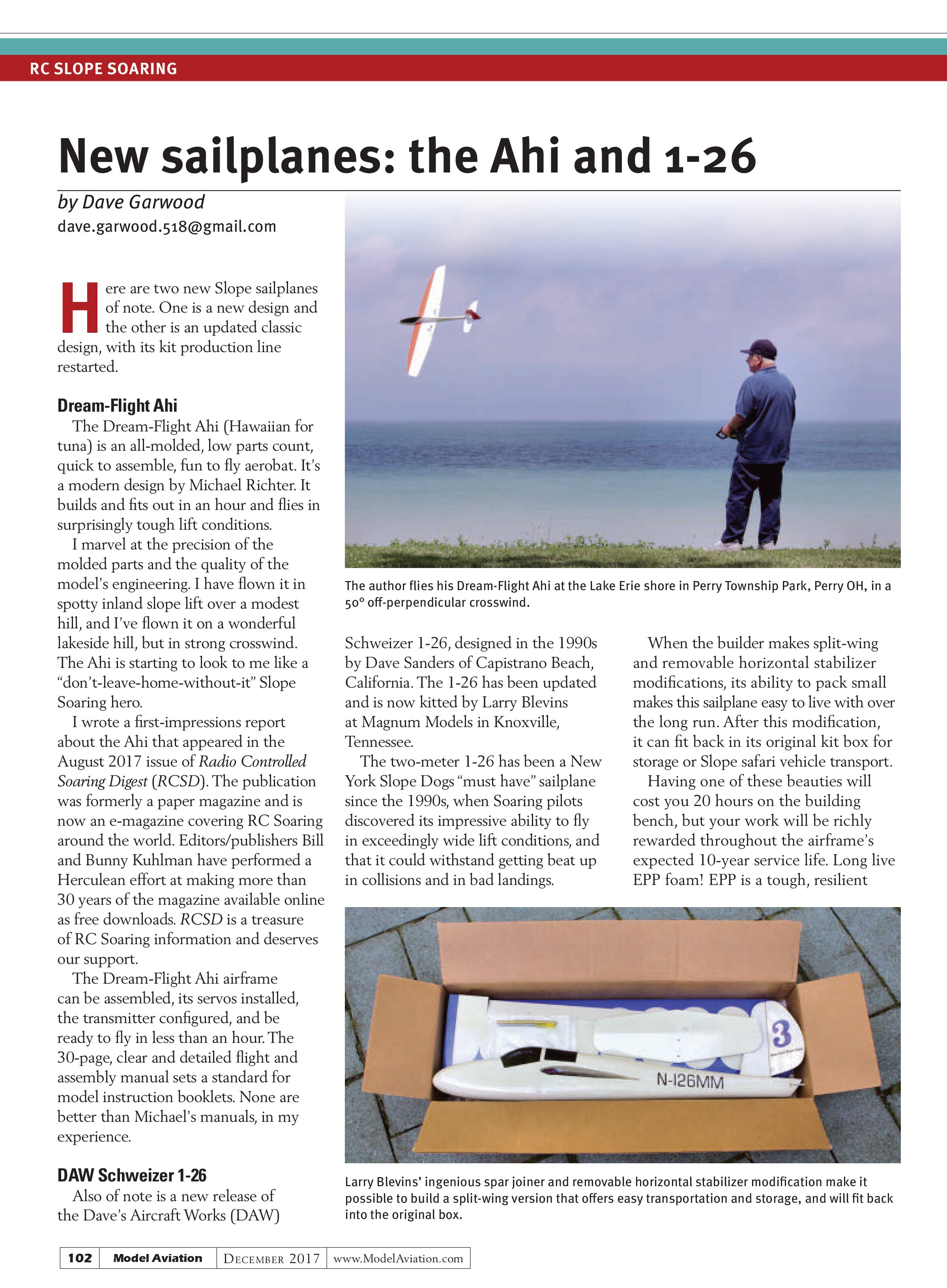
I marvel at the precision of the molded parts and the quality of the model’s engineering. I have flown it in spotty inland slope lift over a modest hill, and I’ve flown it on a wonderful lakeside hill, but in strong crosswind. The Ahi is starting to look to me like a “don’t-leave-home-without-it” Slope Soaring hero.
I wrote a first-impressions report about the Ahi that appeared in the August 2017 issue of Radio Controlled Soaring Digest (RCSD). The publication was formerly a paper magazine and is now an e-magazine covering RC Soaring around the world. Editors/publishers Bill and Bunny Kuhlman have performed a Herculean effort at making more than 30 years of the magazine available online as free downloads. RCSD is a treasure of RC Soaring information and deserves our support.
The Dream-Flight Ahi airframe can be assembled, its servos installed, the transmitter configured, and be ready to fly in less than an hour. The 30-page, clear and detailed flight and assembly manual sets a standard for model instruction booklets. None are better than Michael’s manuals, in my experience.
DAW Schweizer 1-26
Also of note is a new release of the Dave’s Aircraft Works (DAW)

Schweizer 1-26, designed in the 1990s by Dave Sanders of Capistrano Beach, California. The 1-26 has been updated and is now kitted by Larry Blevins at Magnum Models in Knoxville, Tennessee.
The two-meter 1-26 has been a New York Slope Dogs “must have” sailplane since the 1990s, when Soaring pilots discovered its impressive ability to fly in exceedingly wide lift conditions, and that it could withstand getting beat up in collisions and in bad landings.
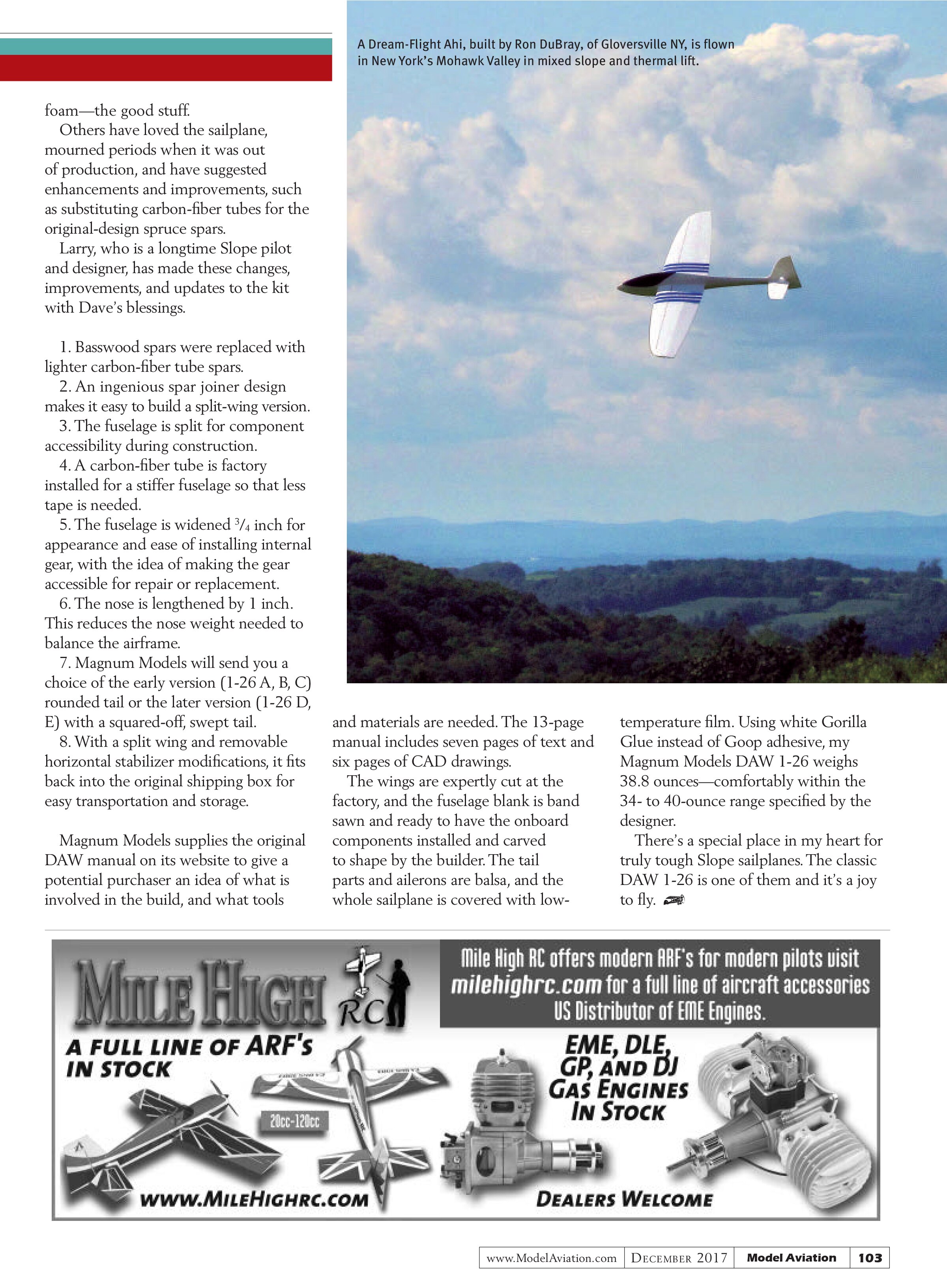
When the builder makes split-wing and removable horizontal stabilizer modifications, its ability to pack small makes this sailplane easy to live with over the long run. After this modification, it can fit back in its original kit box for storage or Slope safari vehicle transport.
Having one of these beauties will cost you 20 hours on the building bench, but your work will be richly rewarded throughout the airframe’s expected 10-year service life. Long live EPP foam! EPP is a tough, resilient

Larry Blevins’ ingenious spar joiner and removable horizontal stabilizer modification make it possible to build a split-wing version that offers easy transportation and storage, and will fit back into the original box.
foam—the good stuff.
Others have loved the sailplane, mourned periods when it was out of production, and have suggested enhancements and improvements, such as substituting carbon-fiber tubes for the original-design spruce spars.
Larry, who is a longtime Slope pilot and designer, has made these changes, improvements, and updates to the kit with Dave’s blessings.
- Basswood spars were replaced with lighter carbon-fiber tube spars.
- An ingenious spar joiner design makes it easy to build a split-wing version.
- The fuselage is split for component accessibility during construction.
- A carbon-fiber tube is factory installed for a stiffer fuselage so that less tape is needed.
- The fuselage is widened ¾ inch for appearance and ease of installing internal gear, with the idea of making the gear accessible for repair or replacement.
- The nose is lengthened by 1 inch. This reduces the nose weight needed to balance the airframe.
- Magnum Models will send you a choice of the early version (1-26 A, B, C) rounded tail or the later version (1-26 D, E) with a squared-off, swept tail.
- With a split wing and removable horizontal stabilizer modifications, it fits back into the original shipping box for easy transportation and storage.
Magnum Models supplies the original DAW manual on its website to give a potential purchaser an idea of what is involved in the build, and what tools and materials are needed. The 13-page manual includes seven pages of text and six pages of CAD drawings.
The wings are expertly cut at the factory, and the fuselage blank is band sawn and ready to have the onboard components installed and carved to shape by the builder. The tail parts and ailerons are balsa, and the whole sailplane is covered with low-temperature film.
Using white Gorilla Glue instead of Goop adhesive, my Magnum Models DAW 1-26 weighs 38.8 ounces—comfortably within the 34- to 40-ounce range specified by the designer.
There’s a special place in my heart for truly tough Slope sailplanes. The classic DAW 1-26 is one of them and it’s a joy to fly.


SOURCES:
League of Silent Flight (LSF)
www.silentflight.org
Dream-Flight
(805) 845-1803
www.dream-flight.com
Magnum Models
(865) 771-0821
www.magnummodels.com
SlopeAerobatics.com
www.slopeaerobatics.com