Giant Scale aircraft from fellow AMA modelers
by Sal Calvagna
rcgiants@optonline.net
Welcome back. The holiday season is upon us as 2017 comes to a close. I hope the hurricane season is also behind us and that all fellow AMA members and their families who were affected by these natural disasters are safe, sound, and returning to a normal, day-to-day life.
This month’s column focuses on some of my fellow AMA members and their excellent RC Giants that I have photographed or received pictures of throughout the past year. I hope you enjoy them.
Brian Dean’s Morane-Saulnier Type N
Brian Dean, of East Hampton, New York, built this magnificent 1/3-scale Morane-Saulnier Type N using older Nick Ziroli plans. He modified the plans to include wing warping and an all-flying stabilizer such as what was in the full-scale aircraft.
Brian powers the Morane with a 3W-55i gas engine using a quiet K&S canister muffler. The model is covered with Solartex and painted with Nelson Paint Company acrylic hobby paints. It is a superb flier. Congratulations to you, Brian.
The full-scale Type N entered service in April of 1915, but was short-lived because more advanced aircraft quickly overtook the design. A mere 49 were built.
It was the first French aircraft specifically designed to be a fighter. It was armed with a forward-firing machine gun (no interrupter gear), so the propeller was protected by steel plates, which deflected any bullets that struck. Although it was fast and maneuverable, it was difficult to fly and unpopular with pilots.


Walt Moucha’s Bristol M.1C
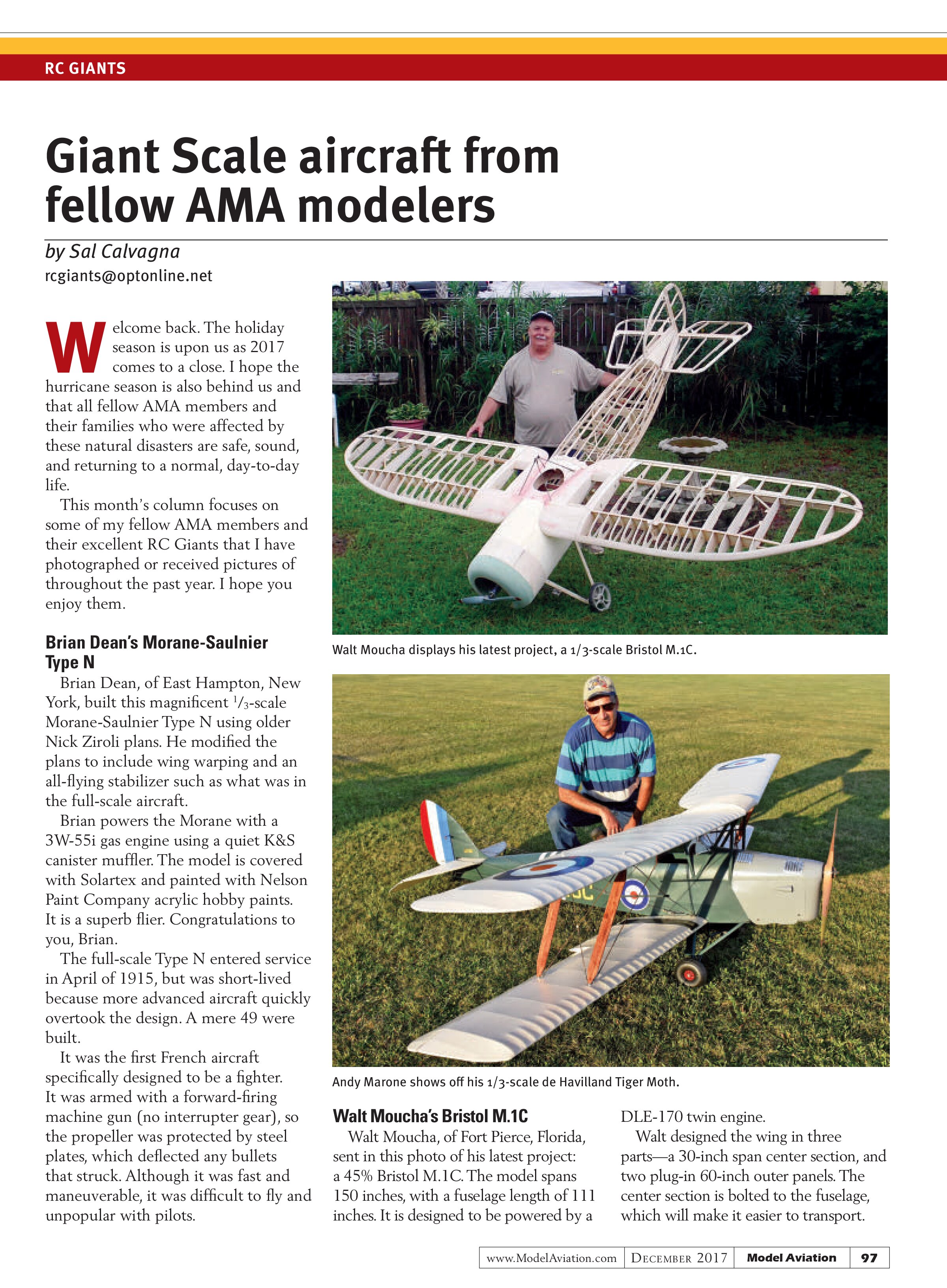
Walt Moucha, of Fort Pierce, Florida, sent in this photo of his latest project: a 45% Bristol M.1C. The model spans 150 inches, with a fuselage length of 111 inches. It is designed to be powered by a DLE-170 twin engine.
Walt designed the wing in three parts—a 30-inch span center section, and two plug-in 60-inch outer panels. The center section is bolted to the fuselage, which will make it easier to transport.
The stabilizer spans 48 inches, the cowl is 17 inches in diameter, and the model has an overall height of 39 inches. Walt plans to cover the Bristol M.1C with 21st Century covering and enamel paints.
The Bristol M.1 was faster than the Fokker Eindecker and the Morane-Saulnier monoplanes. Although it had good performance, it was rejected for the Western Front operations because it required a higher landing speed of approximately 50 mph.
Much of its negativity stems from a deep mistrust of monoplanes in combat at the time. Approximately 125 were built; most were sent to the Balkans and the Middle East, and some were even sent to Chile.
Mike Ronig’s P-51
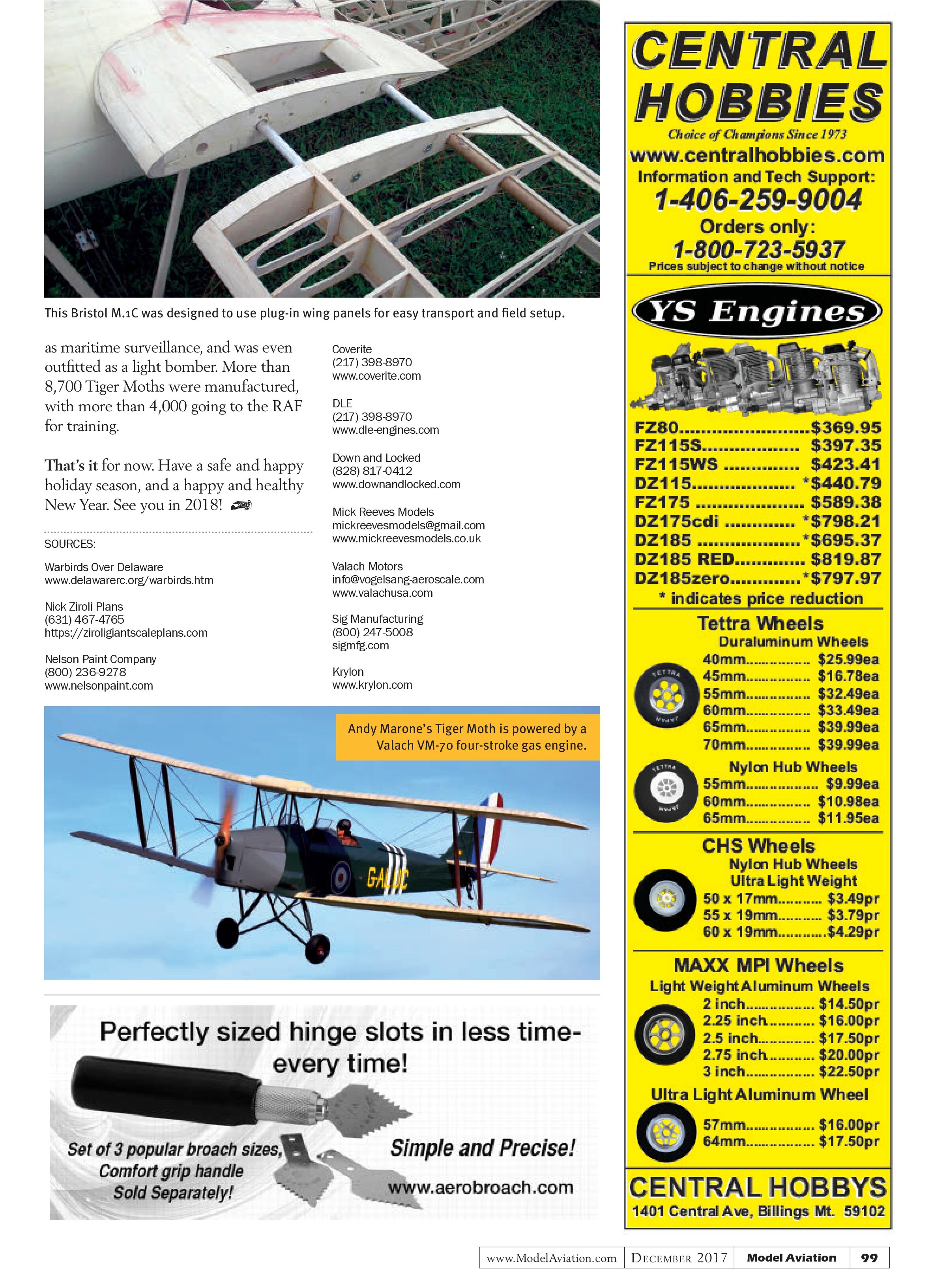
Mike Ronig, of New Castle, Delaware, is one of the hard-working Delaware RC club members who hosts the Warbirds Over Delaware event, which has been taking place for more than 25 years. Mike is pictured with his Aeroworks P-51 Mustang. It is powered by a DLE-55 engine and sports Down and Locked retracts. Mike uses a Spektrum radio for control.

What is different about Mike’s model is that he used a photo of his sweetheart to make the nose art on the P-51.
Andy Marone’s Tiger Moth
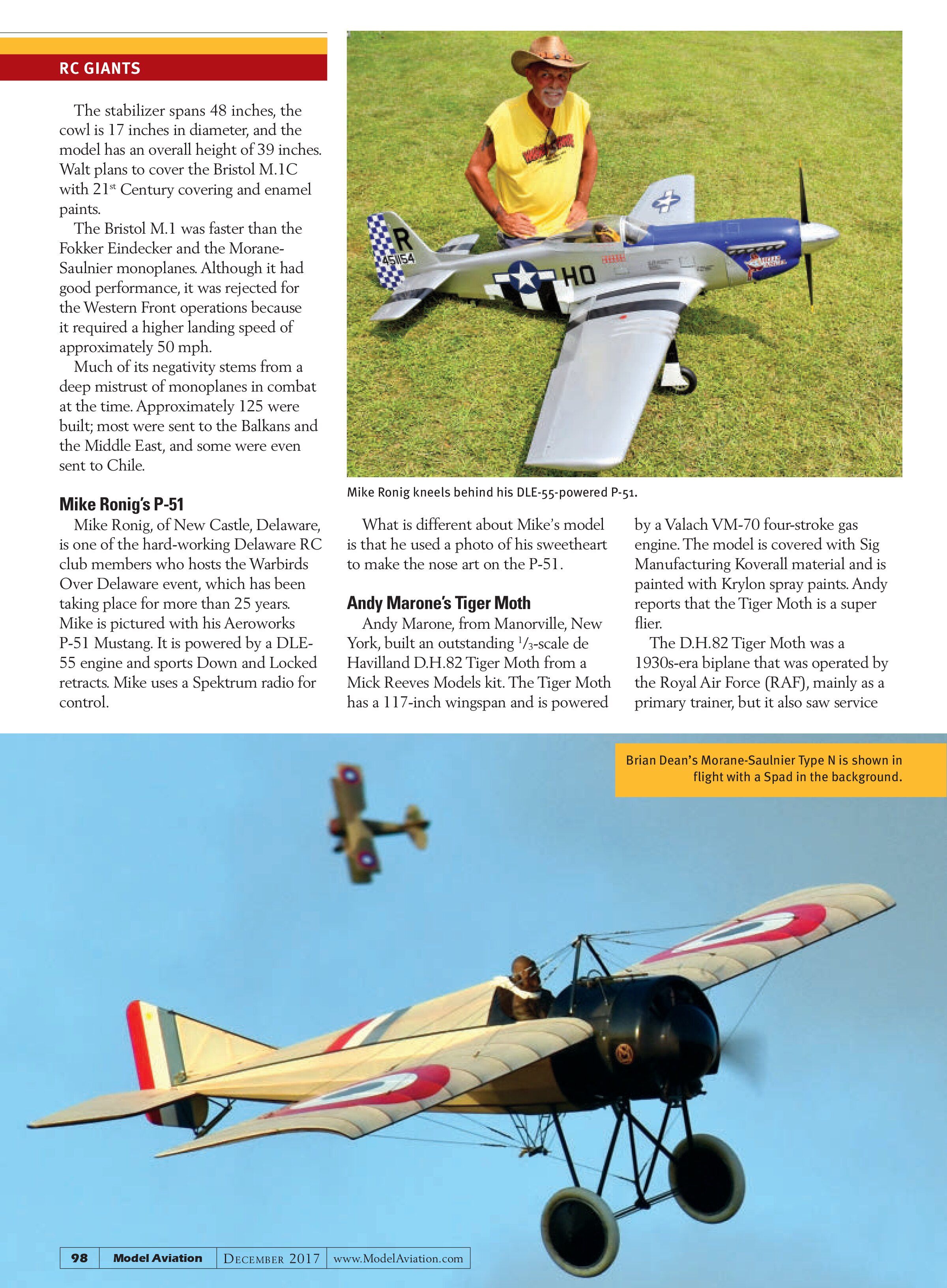
Andy Marone, from Manorville, New York, built an outstanding ⅓-scale de Havilland D.H.82 Tiger Moth from a Mick Reeves Models kit. The Tiger Moth has a 117-inch wingspan and is powered by a Valach VM-70 four-stroke gas engine. The model is covered with Sig Manufacturing Koverall material and is painted with Krylon spray paints. Andy reports that the Tiger Moth is a super flier.
The D.H.82 Tiger Moth was a 1930s-era biplane that was operated by the Royal Air Force (RAF), mainly as a primary trainer, but it also saw service as maritime surveillance, and was even outfitted as a light bomber. More than 8,700 Tiger Moths were manufactured, with more than 4,000 going to the RAF for training.
That’s it for now. Have a safe and happy holiday season, and a happy and healthy New Year. See you in 2018!
SOURCES:
Warbirds Over Delaware
www.delawarerc.org/warbirds.htm
Nick Ziroli Plans
(631) 467-4765
https://ziroligantscaleplans.com
Nelson Paint Company
(800) 236-9278
www.nelsonpaint.com
Coverite
(217) 398-8970
www.coverite.com
DLE
(217) 398-8970
www.dle-engines.com
Down and Locked
(828) 817-0412
www.downandlocked.com
Mick Reeves Models
mickreevesmodels@gmail.com
www.mickreevesmodels.co.uk
Valach Motors
info@vogelsang-aeroscale.com
www.valachusa.com
Sig Manufacturing
(800) 247-5008
sigmfg.com
Krylon
www.krylon.com