George Aldrich remembered
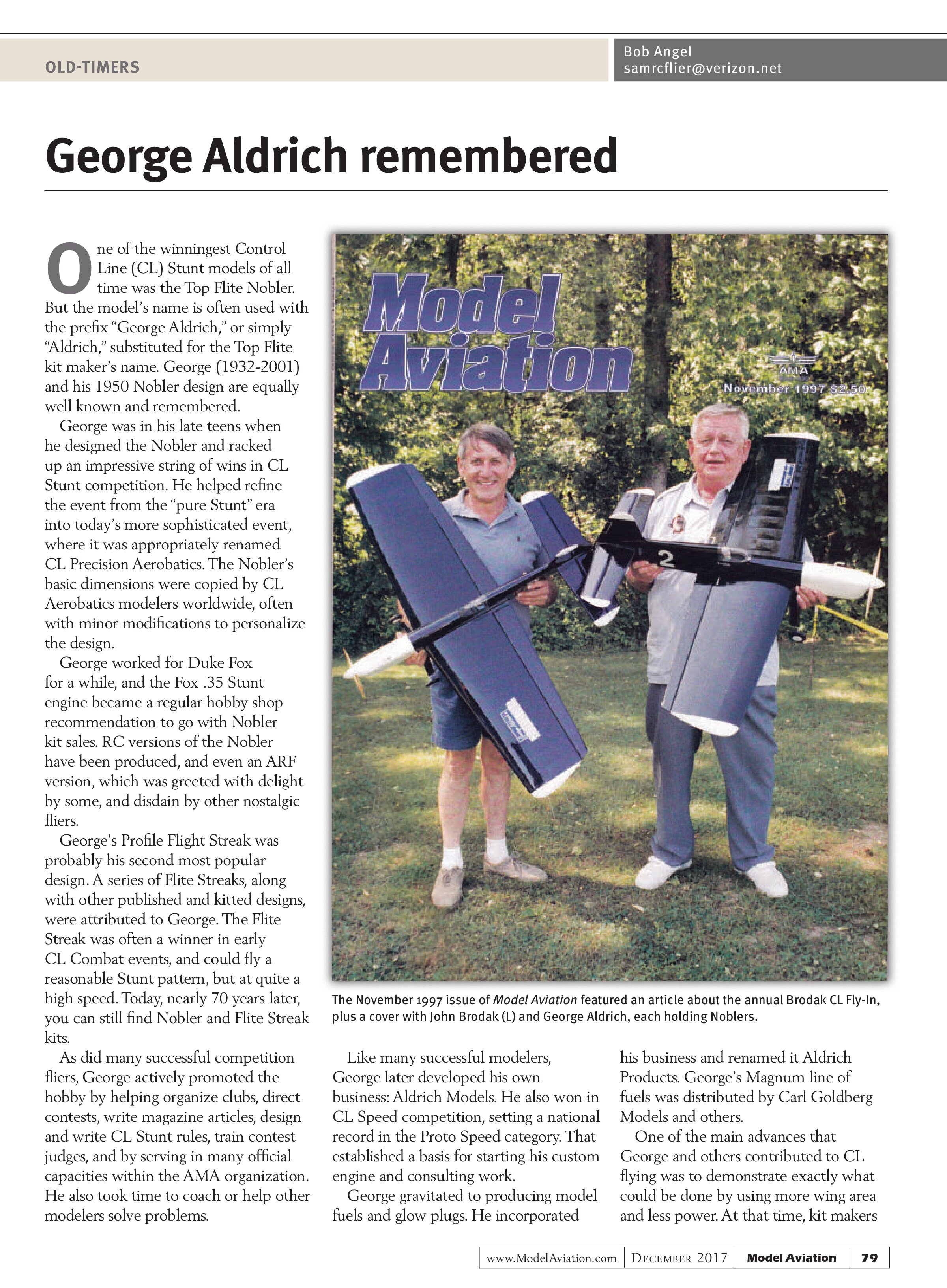
One of the winningest Control Line (CL) Stunt models of all time was the Top Flite Nobler. But the model’s name is often used with the prefix “George Aldrich,” or simply “Aldrich,” substituted for the Top Flite kit maker’s name. George (1932-2001) and his 1950 Nobler design are equally well known and remembered.
George was in his late teens when he designed the Nobler and racked up an impressive string of wins in CL Stunt competition. He helped refine the event from the “pure Stunt” era into today’s more sophisticated event, where it was appropriately renamed CL Precision Aerobatics. The Nobler’s basic dimensions were copied by CL Aerobatics modelers worldwide, often with minor modifications to personalize the design.
George worked for Duke Fox for a while, and the Fox .35 Stunt engine became a regular hobby shop recommendation to go with Nobler kit sales. RC versions of the Nobler have been produced, and even an ARF version, which was greeted with delight by some, and disdain by other nostalgic fliers.
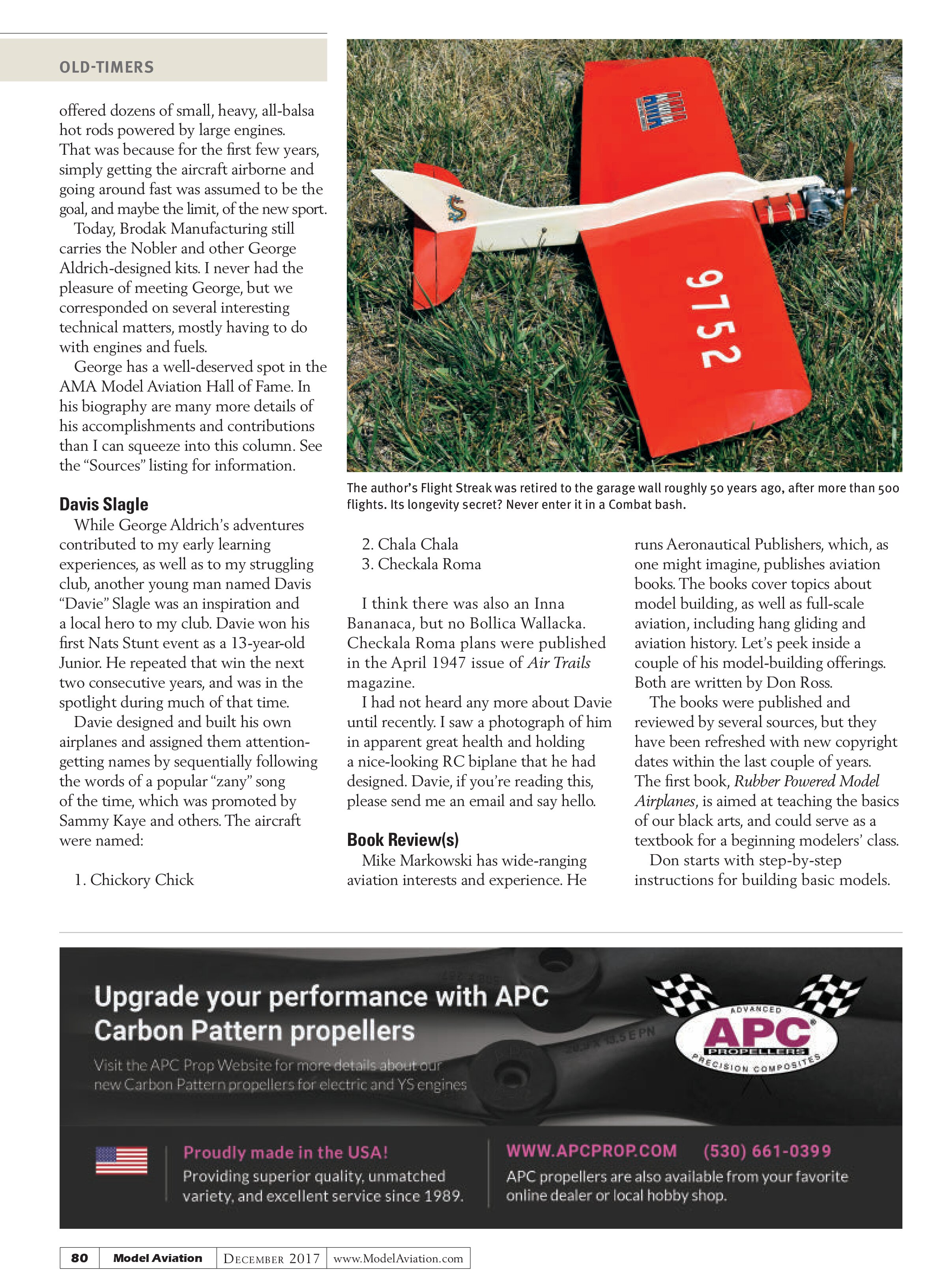
George’s Profile Flight Streak was probably his second most popular design. A series of Flite Streaks, along with other published and kitted designs, were attributed to George. The Flite Streak was often a winner in early CL Combat events, and could fly a reasonable Stunt pattern, but at quite a high speed. Today, nearly 70 years later, you can still find Nobler and Flite Streak kits.

As did many successful competition fliers, George actively promoted the hobby by helping organize clubs, direct contests, write magazine articles, design and write CL Stunt rules, train contest judges, and by serving in many official capacities within the AMA organization. He also took time to coach or help other modelers solve problems.
Like many successful modelers, George later developed his own business: Aldrich Models. He also won in CL Speed competition, setting a national record in the Proto Speed category. That established a basis for starting his custom engine and consulting work.
George gravitated to producing model fuels and glow plugs. He incorporated his business and renamed it Aldrich Products. George’s Magnum line of fuels was distributed by Carl Goldberg Models and others.
One of the main advances that George and others contributed to CL flying was to demonstrate exactly what could be done by using more wing area and less power. At that time, kit makers
offered dozens of small, heavy, all-balsa hot rods powered by large engines. That was because for the first few years, simply getting the aircraft airborne and going around fast was assumed to be the goal, and maybe the limit, of the new sport.
Today, Brodak Manufacturing still carries the Nobler and other George Aldrich-designed kits. I never had the pleasure of meeting George, but we corresponded on several interesting technical matters, mostly having to do with engines and fuels.
George has a well-deserved spot in the AMA Model Aviation Hall of Fame. In his biography are many more details of his accomplishments and contributions than I can squeeze into this column. See the “Sources” listing for information.
Davis Slagle
While George Aldrich’s adventures contributed to my early learning experiences, as well as to my struggling club, another young man named Davis “Davie” Slagle was an inspiration and a local hero to my club. Davie won his first Nats Stunt event as a 13-year-old Junior. He repeated that win the next two consecutive years, and was in the spotlight during much of that time.
Davie designed and built his own airplanes and assigned them attention-getting names by sequentially following the words of a popular “zany” song of the time, which was promoted by Sammy Kaye and others. The aircraft were named:
- Chickory Chick
- Chala Chala
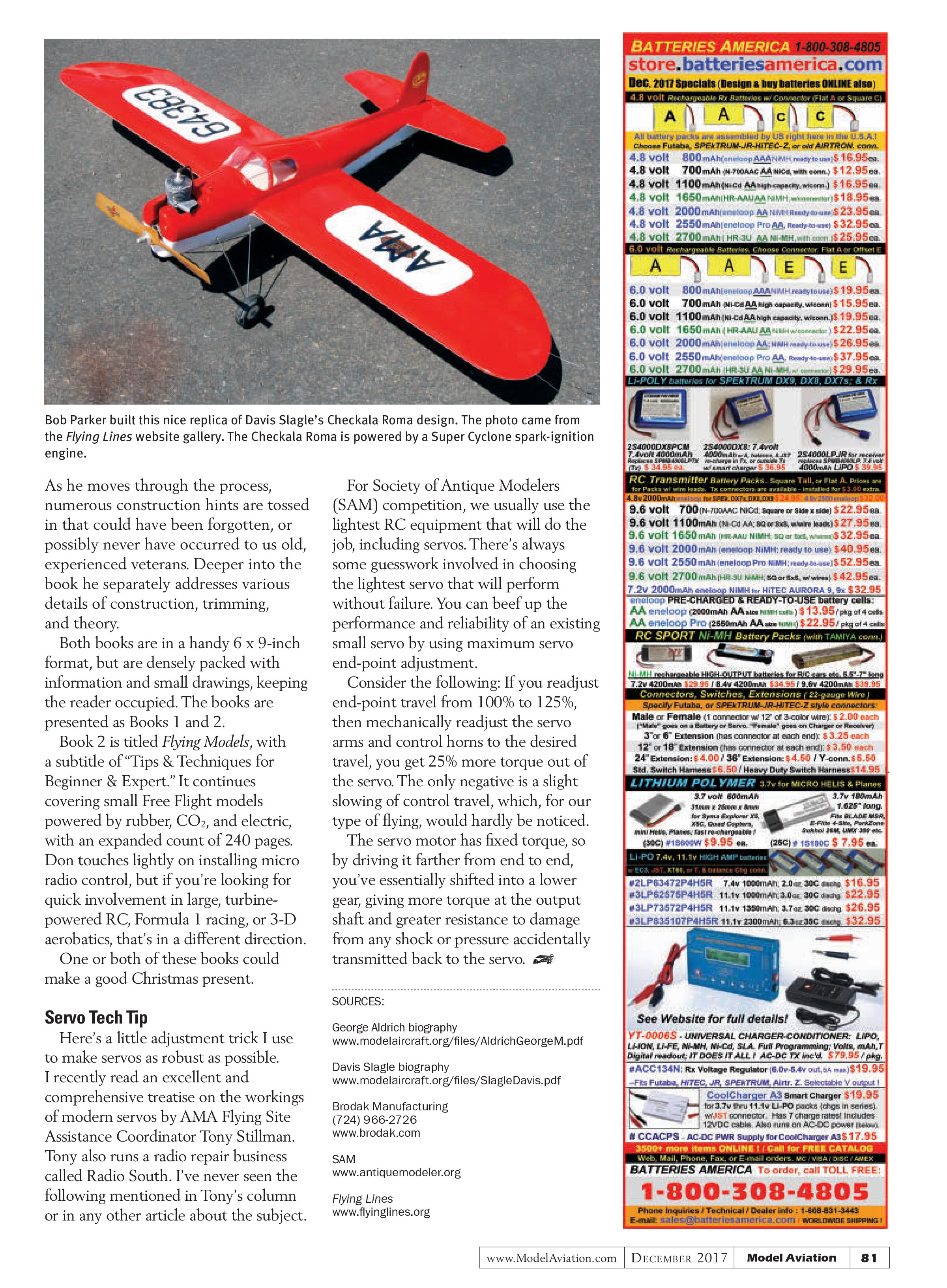
- Checkala Roma
I think there was also an Inna Bananaca, but no Bollica Wallacka. Checkala Roma plans were published in the April 1947 issue of Air Trails magazine.
I had not heard any more about Davie until recently. I saw a photograph of him in apparent great health and holding a nice-looking RC biplane that he had designed. Davie, if you’re reading this, please send me an email and say hello.
Book Review(s)
Mike Markowski has wide-ranging aviation interests and experience. He runs Aeronautical Publishers, which, as one might imagine, publishes aviation books. The books cover topics about model building, as well as full-scale aviation, including hang gliding and aviation history. Let’s peek inside a couple of his model-building offerings. Both are written by Don Ross.
The books were published and reviewed by several sources, but they have been refreshed with new copyright dates within the last couple of years. The first book, Rubber Powered Model Airplanes, is aimed at teaching the basics of our black arts, and could serve as a textbook for a beginning modelers’ class.
Don starts with step-by-step instructions for building basic models.

Bob Parker built this nice replica of Davis Slagle’s Checkala Roma design. The photo came from the Flying Lines website gallery. The Checkala Roma is powered by a Super Cyclone spark-ignition engine.
As he moves through the process, numerous construction hints are tossed in that could have been forgotten, or possibly never have occurred to us old, experienced veterans. Deeper into the book he separately addresses various details of construction, trimming, and theory.
Both books are in a handy 6 x 9-inch format, but are densely packed with information and small drawings, keeping the reader occupied. The books are presented as Books 1 and 2.
Book 2 is titled Flying Models, with a subtitle of “Tips & Techniques for Beginner & Expert.” It continues covering small Free Flight models powered by rubber, CO2, and electric, with an expanded count of 240 pages. Don touches lightly on installing micro radio control, but if you’re looking for quick involvement in large, turbine-powered RC, Formula 1 racing, or 3-D aerobatics, that’s in a different direction.
One or both of these books could make a good Christmas present.
Servo Tech Tip
Here’s a little adjustment trick I use to make servos as robust as possible. I recently read an excellent and comprehensive treatise on the workings of modern servos by AMA Flying Site Assistance Coordinator Tony Stillman. Tony also runs a radio repair business called Radio South. I’ve never seen the following mentioned in Tony’s column or in any other article about the subject.
For Society of Antique Modelers (SAM) competition, we usually use the lightest RC equipment that will do the job, including servos. There’s always some guesswork involved in choosing the lightest servo that will perform without failure. You can beef up the performance and reliability of an existing small servo by using maximum servo end-point adjustment.
Consider the following: If you readjust end-point travel from 100% to 125%, then mechanically readjust the servo arms and control horns to the desired travel, you get 25% more torque out of the servo. The only negative is a slight slowing of control travel, which, for our type of flying, would hardly be noticed.
The servo motor has fixed torque, so by driving it farther from end to end, you’ve essentially shifted into a lower gear, giving more torque at the output shaft and greater resistance to damage from any shock or pressure accidentally transmitted back to the servo.
SOURCES:
George Aldrich biography
www.modelaircraft.org/files/AldrichGeorgeM.pdf
Davis Slagle biography
www.modelaircraft.org/files/SlagleDavis.pdf
Brodak Manufacturing
(724) 966-2726
www.brodak.com
SAM
www.antiquemodeler.org
Flying Lines
www.flyinglines.org