Focal Point
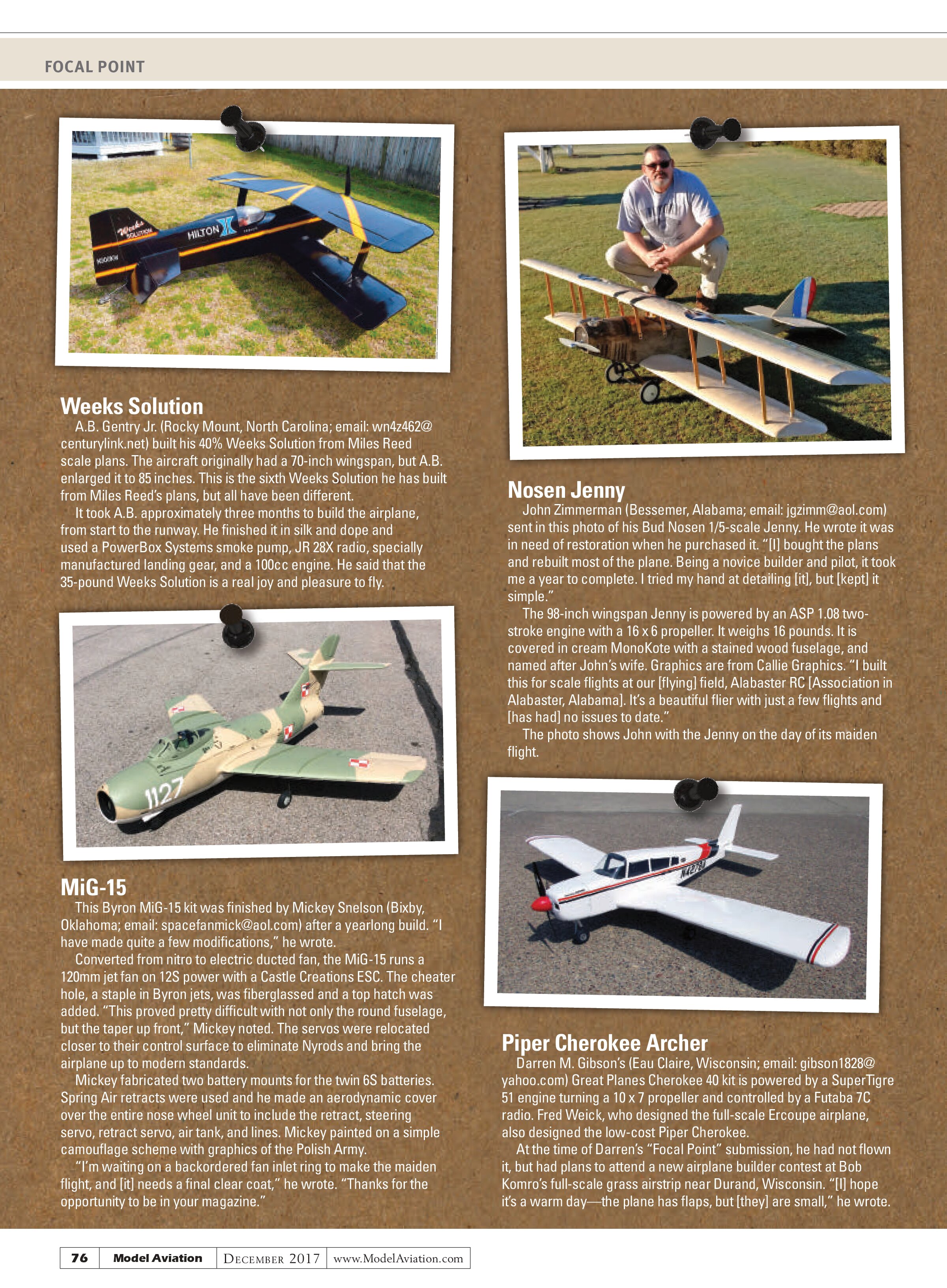
Weeks Solution

A.B. Gentry Jr. (Rocky Mount, North Carolina; email: wn4z462@centurylink.net) built his 40% Weeks Solution from Miles Reed scale plans. The aircraft originally had a 70-inch wingspan, but A.B. enlarged it to 85 inches. This is the sixth Weeks Solution he has built from Miles Reed’s plans, but all have been different.
It took A.B. approximately three months to build the airplane, from start to the runway. He finished it in silk and dope and used a PowerBox Systems smoke pump, JR 28X radio, specially manufactured landing gear, and a 100cc engine. He said that the 35-pound Weeks Solution is a real joy and pleasure to fly.
MiG-15

This Byron MiG-15 kit was finished by Mickey Snelson (Bixby, Oklahoma; email: spacefanmick@aol.com) after a yearlong build. “I have made quite a few modifications,” he wrote.
Converted from nitro to electric ducted fan, the MiG-15 runs a 120mm jet fan on 12S power with a Castle Creations ESC. The cheater hole, a staple in Byron jets, was fiberglassed and a top hatch was added. “This proved pretty difficult with not only the round fuselage, but the taper up front,” Mickey noted. The servos were relocated closer to their control surface to eliminate Nyrods and bring the airplane up to modern standards.
Mickey fabricated two battery mounts for the twin 6S batteries. Spring Air retracts were used and he made an aerodynamic cover over the entire nose wheel unit to include the retract, steering servo, retract servo, air tank, and lines. Mickey painted on a simple camouflage scheme with graphics of the Polish Army.
“I’m waiting on a backordered fan inlet ring to make the maiden flight, and [it] needs a final clear coat,” he wrote. “Thanks for the opportunity to be in your magazine.”
Nosen Jenny

John Zimmerman (Bessemer, Alabama; email: jg zimm@aol.com) sent in this photo of his Bud Nosen 1/5-scale Jenny. He wrote it was in need of restoration when he purchased it. “[I] bought the plans and rebuilt most of the plane. Being a novice builder and pilot, it took me a year to complete. I tried my hand at detailing [it], but [kept] it simple.”
The 98-inch wingspan Jenny is powered by an ASP 1.08 two-stroke engine with a 16 x 6 propeller. It weighs 16 pounds. It is covered in cream MonoKote with a stained wood fuselage, and named after John’s wife. Graphics are from Callie Graphics. “I built this for scale flights at our [flying] field, Alabaster RC [Association in Alabaster, Alabama]. It’s a beautiful flier with just a few flights and [has had] no issues to date.”
The photo shows John with the Jenny on the day of its maiden flight.
Piper Cherokee Archer

Darren M. Gibson’s (Eau Claire, Wisconsin; email: gibson1828@yahoo.com) Great Planes Cherokee 40 kit is powered by a SuperTigre 51 engine turning a 10 x 7 propeller and controlled by a Futaba 7C radio. Fred Weick, who designed the full-scale Ercoupe airplane, also designed the low-cost Piper Cherokee.
At the time of Darren’s “Focal Point” submission, he had not flown it, but had plans to attend a new airplane builder contest at Bob Komro’s full-scale grass airstrip near Durand, Wisconsin. “[I] hope it’s a warm day—the plane has flaps, but [they] are small,” he wrote.
The Thrill

Larry Kruse (Lawton, Oklahoma; email: aircats@att.net) sent in this photo of an airplane inspired by B.B. King’s song “The Thrill is Gone.” The high school team of (L-R) Devan Morris, Anthony Young, and Titus Kara built this airplane as its 2016 entry in Oklahoma State University’s annual statewide Speedfest competition.
The young men, known as Team Frigate from the Great Plains Technology Center, computer designed their own airfoil and modified an old Pylon Racing kit into this entry. It placed first, set a new event speed record, and was selected as the best-built airplane of the competition. Larry had the pleasure of serving as the team’s mentor.
“These kids are special because they returned to the team for three years and built a new plane each year—all during after-school hours—and won the statewide competition twice,” Larry wrote. “They all began pursuing aeronautical engineering degrees this year as they started their college careers.”
Bell P-63 Kingcobra

John Lane’s (Northville, Michigan; email: jrlane@wowway.com) model of a Bell P-63 Kingcobra was built from plans by Mark Rittinger that were published in the January 2014 Model Aviation. It has a 57-inch wingspan with a balsa-covered foam wing and built-up balsa fuselage. The electric-powered P-63 uses a 4S 2,200 mAh LiPo battery, a 770 Kv motor, and a 70-amp ESC.
“This is the hand-launched version,” John wrote. “You can also build it with retracts. It sits atop a launch ‘cart’ designed by one of our club members.” John is a member of the Flying Pilgrims club, where the photo was taken.
AT-6 Texan

Michael Pollock (Okemos, Michigan; email: mikepp@hotmail.com) built his AT-6 Texan from an old House of Balsa kit, and wanted to make it as scalelike as possible. “I modeled it after planes that were stationed at the naval air base in Guantanamo Bay as part of the VC-10 Squadron,” he wrote.
His build incorporated a number of modifications to the plans. The most involved change was converting the 44-inch wingspan military trainer to electric power. The canopy area is now removable for easier battery access.
Other details include using a Great Planes ElectriFly RimFire .10 motor, micro wing servos, modified landing gear for easier grass-field landings, UltraCote covering, and graphics purchased from Callie Graphics.
Fleet Finch II

John Burrill (Normal, Illinois; email: john.burrill@comcast.net) submitted a photo of his 1/4-scale Fleet Finch II, one of two types of aircraft used as Canadian primary trainers during World War II in the British Commonwealth Air Training Plan. The full-scale Fleet Finch II now resides at the No. 6 RCAF Dunnville Museum in Dunnville, Ontario, Canada.
“I had the opportunity [to take] a passenger ride in it during the time of its previous owner, and the type has always been special,” John stated. “Two friends, no longer with us, were trained on Finches before going on to operational training and combat as pilots.”
The model has a 7-foot wingspan and is powered by a Quadra 35 engine. John began construction on it a number of years ago in Kingston, Ontario, and finished this summer in Normal, Illinois. The photo was taken by Greg Vertrees, an AMA and Central Illinois Radio Control Society club member.