Charging forward
Greg Gimlick
maelectrics@gimlick.com
I want to wish everyone happy holidays for whatever you celebrate during this time of year. I hope it is wonderful and your new year is even better.
Because the December issue historically has a helicopter theme, I’m going to look at some matters you’ve written to me about RC helicopters that also apply to airplanes. I’ll leave the big helis to Chris Mulcahy in the “RC Helicopters” column, and stay out of his area of expertise.

Helicopter Chargers
There really isn’t any difference between helicopter and airplane chargers. There are helis that use LiPo battery packs up to 14S (6S packs are common), but for the most part, readers asked about charging packs for micro and mini aircraft that use odd connectors that are unlike the EC3, EC6, XT60, and Deans connectors that you find in most airplanes.
Many of these are single-cell packs from 180 mAh up to approximately 300 mAh. For your big packs, check out the Bump charging system that I built, which is detailed in my “Electrics” column in the August 2017 issue of Model Aviation.


More Connector Confusion
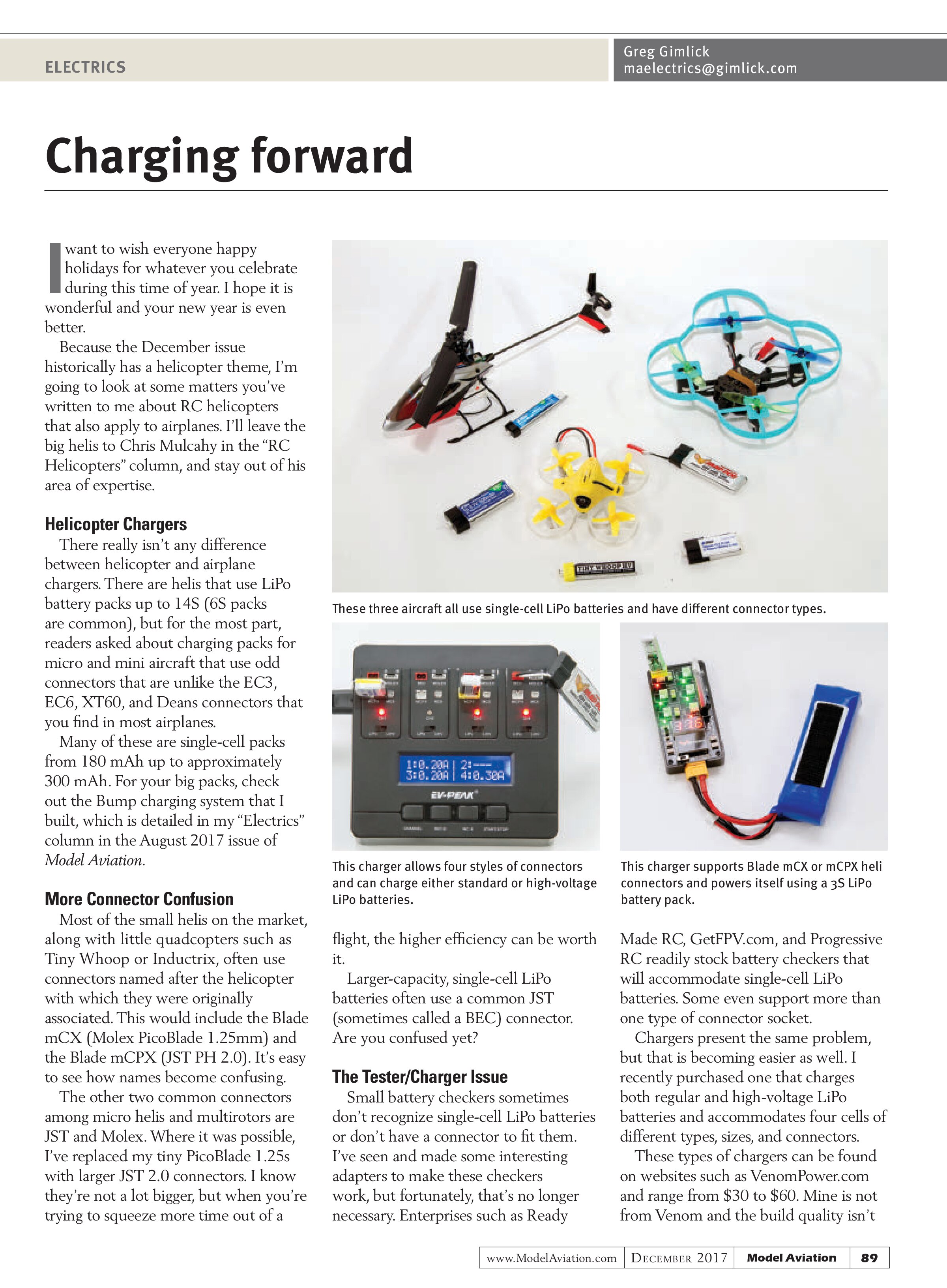
Most of the small helis on the market, along with little quadcopters such as Tiny Whoop or Inductrix, often use connectors named after the helicopter with which they were originally associated. This would include the Blade mCX (Molex PicoBlade 1.25mm) and the Blade mCPX (JST PH 2.0). It’s easy to see how names become confusing.
The other two common connectors among micro helis and multirotors are JST and Molex. Where it was possible, I’ve replaced my tiny PicoBlade 1.25s with larger JST 2.0 connectors. I know they’re not a lot bigger, but when you’re trying to squeeze more time out of a flight, the higher efficiency can be worth it.
Larger-capacity, single-cell LiPo batteries often use a common JST (sometimes called a BEC) connector. Are you confused yet?
The Tester/Charger Issue
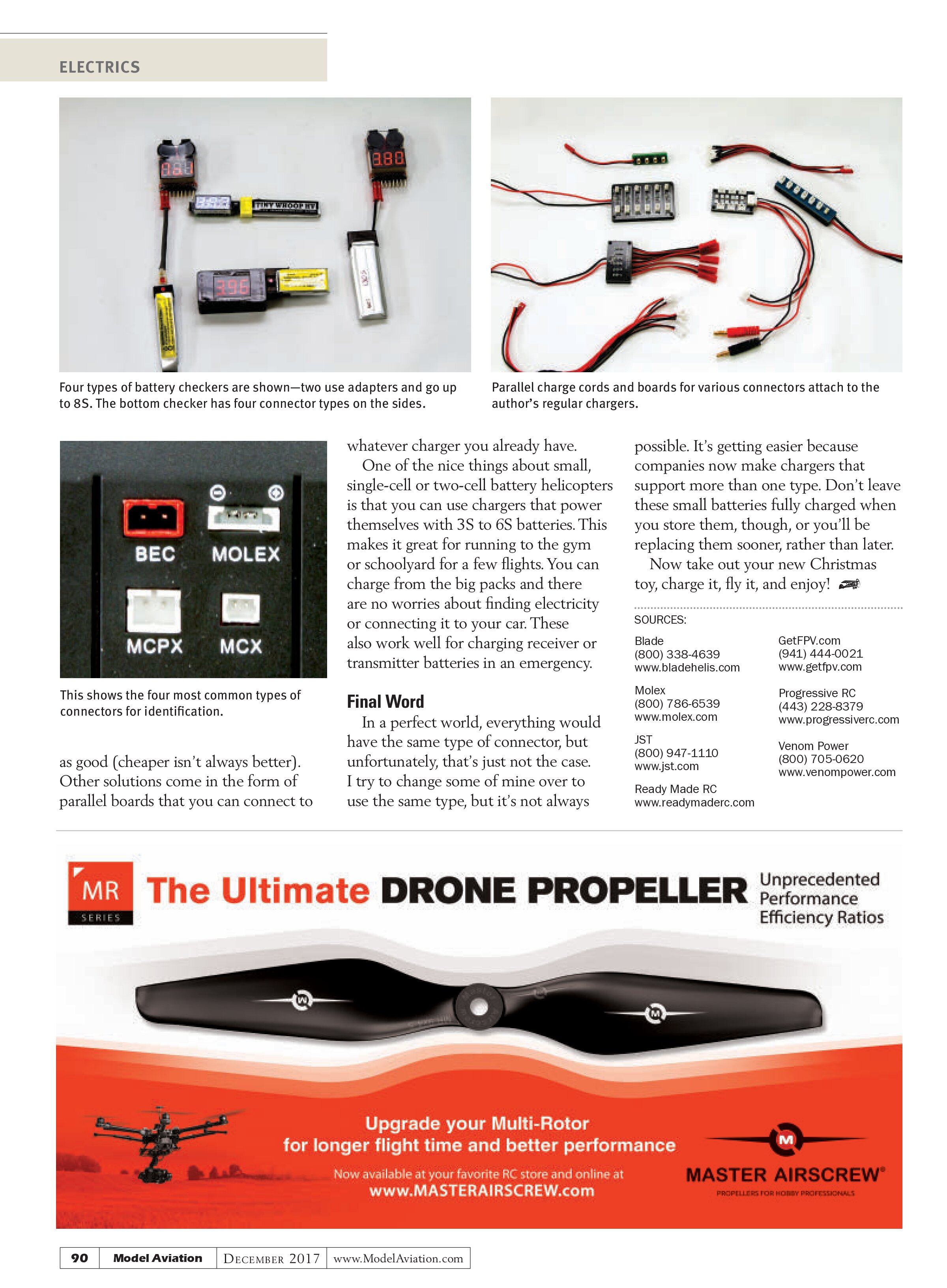
Small battery checkers sometimes don’t recognize single-cell LiPo batteries or don’t have a connector to fit them. I’ve seen and made some interesting adapters to make these checkers work, but fortunately, that’s no longer necessary. Enterprises such as Ready Made RC, GetFPV.com, and Progressive RC readily stock battery checkers that will accommodate single-cell LiPo batteries. Some even support more than one type of connector socket.
Chargers present the same problem, but that is becoming easier as well. I recently purchased one that charges both regular and high-voltage LiPo batteries and accommodates four cells of different types, sizes, and connectors.
These types of chargers can be found on websites such as VenomPower.com and range from $30 to $60. Mine is not from Venom and the build quality isn’t


as good (cheaper isn’t always better). Other solutions come in the form of parallel boards that you can connect to whatever charger you already have.
One of the nice things about small, single-cell or two-cell battery helicopters is that you can use chargers that power themselves with 3S to 6S batteries. This makes it great for running to the gym or schoolyard for a few flights. You can charge from the big packs and there are no worries about finding electricity or connecting it to your car. These also work well for charging receiver or transmitter batteries in an emergency.
Final Word
In a perfect world, everything would have the same type of connector, but unfortunately, that’s just not the case. I try to change some of mine over to use the same type, but it’s not always possible. It’s getting easier because companies now make chargers that support more than one type. Don’t leave these small batteries fully charged when you store them, though, or you’ll be replacing them sooner, rather than later.
Now take out your new Christmas toy, charge it, fly it, and enjoy!
SOURCES:
Blade
(800) 338-4639
www.bladehelis.com
Molex
(800) 786-6539
www.molex.com
JST
(800) 947-1110
www.jst.com
Ready Made RC
www.readymaderc.com
GetFPV.com
(941) 444-0021
www.getfpv.com
Progressive RC
(443) 228-8379
www.progressiverc.com
Venom Power
(800) 705-0620
www.venompower.com