Have you ever heard of the Rudevator?
Bob Noll
bobrc@aol.com
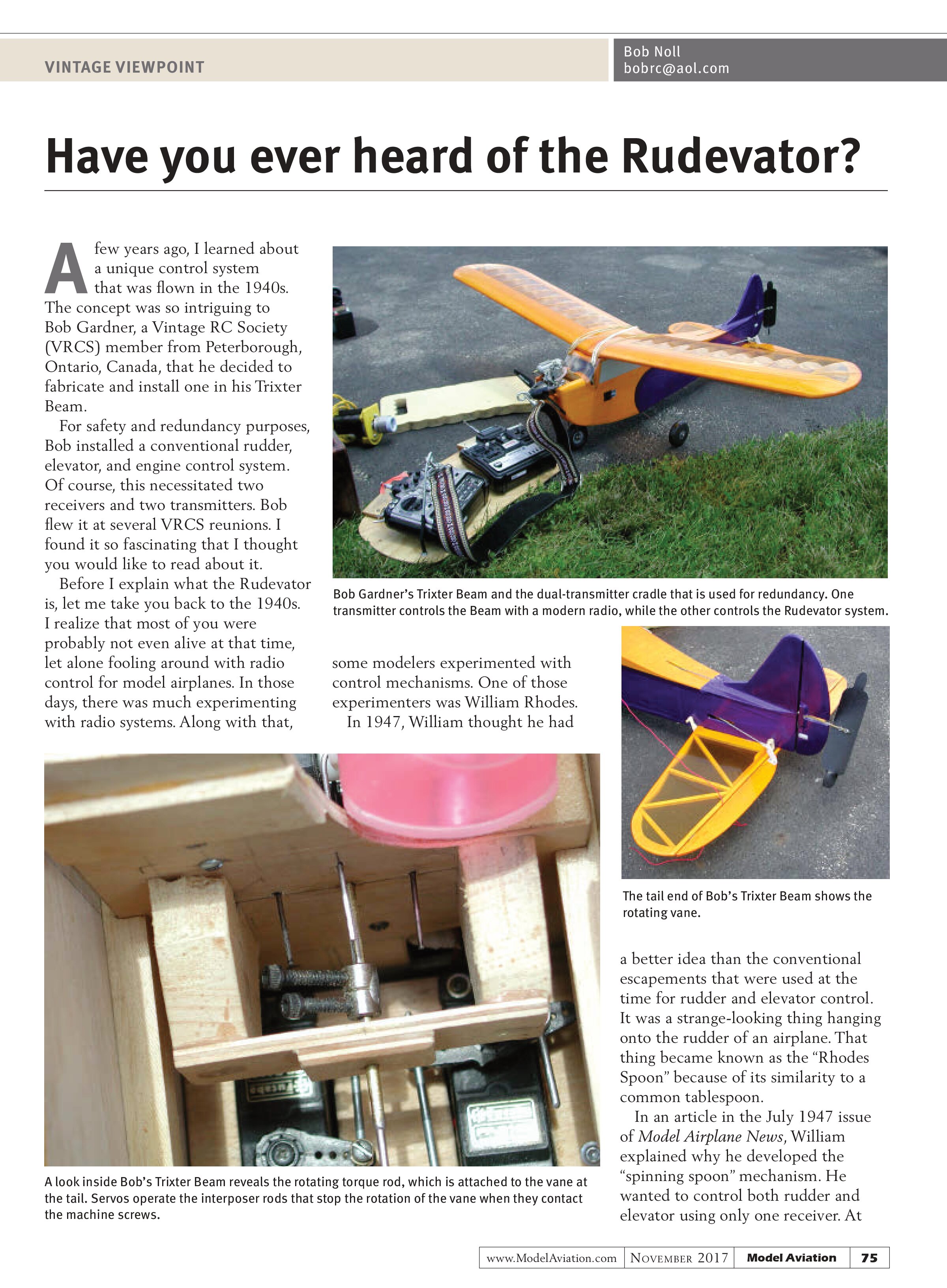
A few years ago, I learned about a unique control system that was flown in the 1940s. The concept was so intriguing to Bob Gardner, a Vintage RC Society (VRCS) member from Peterborough, Ontario, Canada, that he decided to fabricate and install one in his Trixter Beam.
For safety and redundancy purposes, Bob installed a conventional rudder, elevator, and engine control system. Of course, this necessitated two receivers and two transmitters. Bob flew it at several VRCS reunions. I found it so fascinating that I thought you would like to read about it.

Before I explain what the Rudevator is, let me take you back to the 1940s. I realize that most of you were probably not even alive at that time, let alone fooling around with radio control for model airplanes. In those days, there was much experimenting with radio systems. Along with that, some modelers experimented with control mechanisms. One of those experimenters was William Rhodes. In 1947, William thought he had


a better idea than the conventional escapements that were used at the time for rudder and elevator control. It was a strange-looking thing hanging onto the rudder of an airplane. That thing became known as the “Rhodes Spoon” because of its similarity to a common tablespoon.
In an article in the July 1947 issue of Model Airplane News, William explained why he developed the “spinning spoon” mechanism. He wanted to control both rudder and elevator using only one receiver. At

the time, some modelers used two receivers to control both functions.
Here is how it worked. The spoon was actually a spinning rotary vane that could be stopped at any desired position. When stopped in a particular position (for example, facing left), the model would yaw to the left.
At first, William used a small electric motor to rotate the spoon, but he later determined that he could make the spoon rotate by shaping it so that the air from the propeller would rotate it, thereby eliminating the need for the electric motor. The spoon would whirl so quickly that it did not affect the flight of the airplane.
William next had to develop a selector mechanism. He wrote about two types of units that could be used for selection. The first was a hit-and-miss situation, but it operated successfully if getting the sequence correct was practiced.
It was made by fastening a four-spoke wheel to the end of the shaft, to which the spoon was attached. The disadvantage of the unit was that you never knew what position would come up first when the transmitter key was depressed. After the first position was recognized, the subsequent positions could be determined because the sequence would always be up, right, down, and left.
In the April 1948 issue of Model Airplane News, H.H. Owbridge wrote about his improvements to the Rhodes Spoon, which he called the Rudevator. It used a special escapement that could provide a number of positions for better model control. H.H. used small tabs added to the end of the vane, causing the Rudevator to spin and provide no control until it was stopped on command. H.H. commercialized his design and offered it for sale. At $15, it was not cheap.
In a September 1950 Model Airplane News article, H.H. described the various improvements to his design. The new mechanism was called the Super Rudevator. The article stated, “Rudevator and particularly Super Rudevator are undoubtedly tops in giving the most control for the simplest installation.”

“Coordinated elevator-rudder on turns, plus elevator action, plus two-speed engine, plus shut off.”
Hank Bourgeois, in a two-part Model Airplane News construction article in February and March 1952, presented a model called the Javelin, specially designed for the Rudevator system. It had a protrusion in the tail section of the aircraft to house the special escapement for providing control.
In part two, I found another interesting tidbit. Hank had come up with a unique control box to use with his Rudevator system. The control box was nothing more than a small aluminum box with an eight-pole rotary switch installed inside. The four sides of the box represented the control positions; the four corners of the box were the neutral positions.
A small handle on the front could be turned (always clockwise) to point to the control positions. The Rudevator would follow the control handle. With the control handle pointed up, the Rudevator selector would stop on the up position.
By 1953, as escapements improved and motorized servos began coming onto the scene, the Rudevator concept fell by the wayside, but it was one of the most interesting control systems that I had ever heard about. It was especially exciting to see Bob Gardner fly his Trixter Beam at a VRCS reunion.
Because I got into RC in 1953, I had not heard about the Rudevator system. It sure would have been an interesting project for this mechanical engineer.
Until next time, continue to enjoy building and flying vintage RC models. If you are not already a member, the VRCS is an AMA Special Interest Group, and would love to have you as a new member.
SOURCES: