Planting that first aviation seed ...
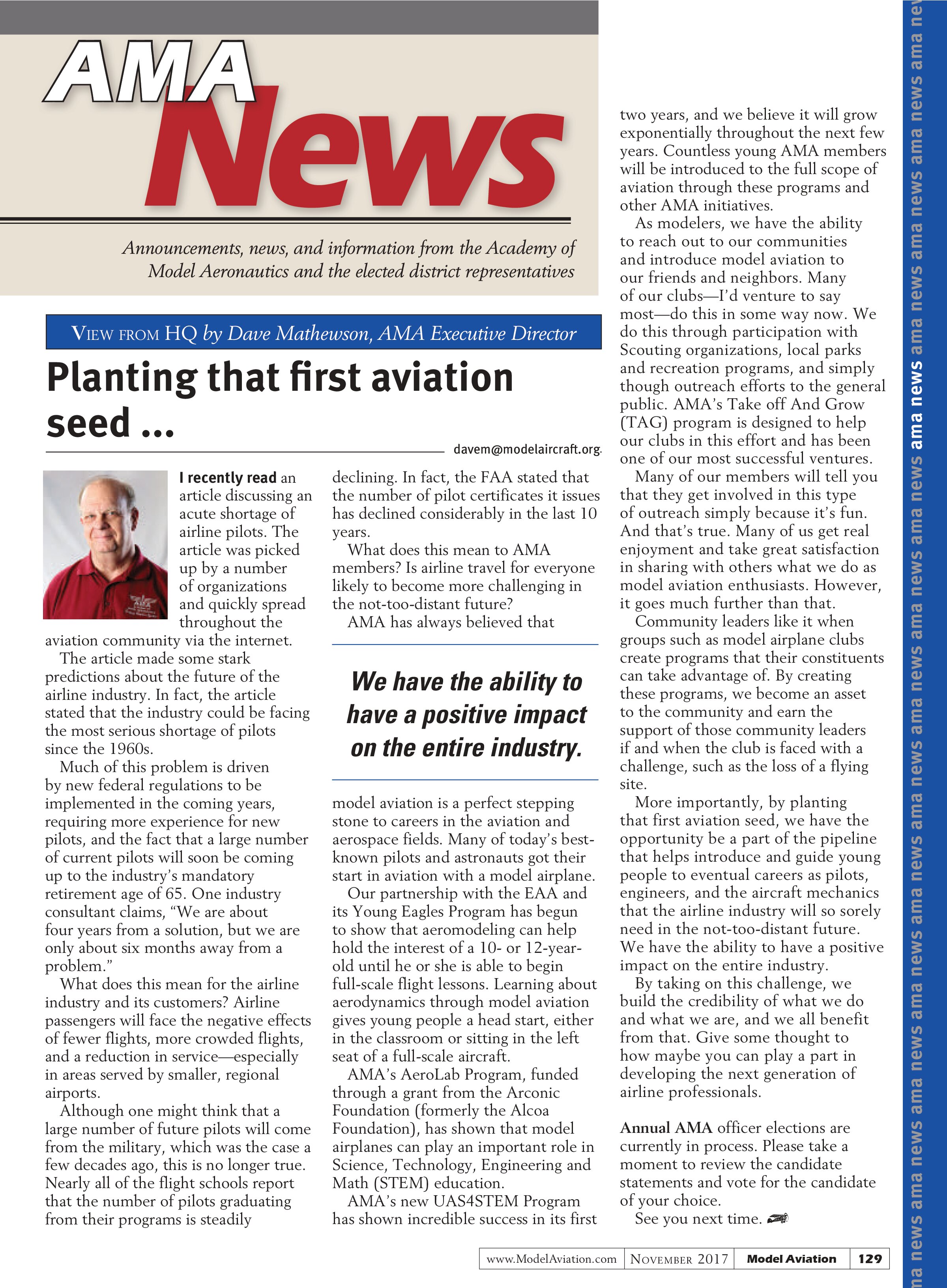
View from HQ by Dave Mathewson, AMA Executive Director

I recently read an article discussing an acute shortage of airline pilots. The article was picked up by a number of organizations and quickly spread throughout the aviation community via the internet.
The article made some stark predictions about the future of the airline industry. In fact, the article stated that the industry could be facing the most serious shortage of pilots since the 1960s.
Much of this problem is driven by new federal regulations to be implemented in the coming years, requiring more experience for new pilots, and the fact that a large number of current pilots will soon be coming up to the industry’s mandatory retirement age of 65. One industry consultant claims, “We are about four years from a solution, but we are only about six months away from a problem.”
What does this mean for the airline industry and its customers? Airline passengers will face the negative effects of fewer flights, more crowded flights, and a reduction in service—especially in areas served by smaller, regional airports.
Although one might think that a large number of future pilots will come from the military, which was the case a few decades ago, this is no longer true. Nearly all of the flight schools report that the number of pilots graduating from their programs is steadily declining. In fact, the FAA stated that the number of pilot certificates it issues has declined considerably in the last 10 years.
What does this mean to AMA members? Is airline travel for everyone likely to become more challenging in the not-too-distant future?
AMA has always believed that
We have the ability to have a positive impact on the entire industry.
model aviation is a perfect stepping stone to careers in the aviation and aerospace fields. Many of today’s best-known pilots and astronauts got their start in aviation with a model airplane.
Our partnership with the EAA and its Young Eagles Program has begun to show that aeromodeling can help hold the interest of a 10- or 12-year-old until he or she is able to begin full-scale flight lessons. Learning about aerodynamics through model aviation gives young people a head start, either in the classroom or sitting in the left seat of a full-scale aircraft.
AMA’s AeroLab Program, funded through a grant from the Arconic Foundation (formerly the Alcoa Foundation), has shown that model airplanes can play an important role in Science, Technology, Engineering and Math (STEM) education.
AMA’s new UAS4STEM Program has shown incredible success in its first two years, and we believe it will grow exponentially throughout the next few years. Countless young AMA members will be introduced to the full scope of aviation through these programs and other AMA initiatives.
As modelers, we have the ability to reach out to our communities and introduce model aviation to our friends and neighbors. Many of our clubs—I’d venture to say most—do this in some way now. We do this through participation with Scouting organizations, local parks and recreation programs, and simply through outreach efforts to the general public. AMA’s Take off And Grow (TAG) program is designed to help our clubs in this effort and has been one of our most successful ventures.
Many of our members will tell you that they get involved in this type of outreach simply because it’s fun. And that’s true. Many of us get real enjoyment and take great satisfaction in sharing with others what we do as model aviation enthusiasts. However, it goes much further than that.
Community leaders like it when groups such as model airplane clubs create programs that their constituents can take advantage of. By creating these programs, we become an asset to the community and earn the support of those community leaders if and when the club is faced with a challenge, such as the loss of a flying site.
More importantly, by planting that first aviation seed, we have the opportunity be a part of the pipeline that helps introduce and guide young people to eventual careers as pilots, engineers, and the aircraft mechanics that the airline industry will so sorely need in the not-too-distant future. We have the ability to have a positive impact on the entire industry.
By taking on this challenge, we build the credibility of what we do and what we are, and we all benefit from that. Give some thought to how maybe you can play a part in developing the next generation of airline professionals.
Annual AMA officer elections are currently in process. Please take a moment to review the candidate statements and vote for the candidate of your choice.
See you next time.