Spinning a propeller yarn
Dave Gee
safetycolumn@cs.com
Who came up with the idea of putting big, sharp, whirling propellers on the front of a flying machine, anyway? How did that first conversation go?
“Ya know, we could just hang a kind of fan on the nose. If we make it really big, and hook up enough horsepower, it might get the whole thing off the ground.”
“Yeah, but what if someone gets in the way?”
“Aw, relax. Who would ever be fool enough to put their hand into spinning blades?”
Well, actually, I would—and a lot of other modelers too. Allan Wells was kind enough to send an account of his little incident:
“I am a longtime foamie airplane flier, but a beginner at First-Person View [FPV]. I am very safety minded, but last Sunday I made a mistake with my 250-size FPV drone. I was on vacation at a remote, but unfamiliar, flying site. I got disoriented and ended up landing on a hill not too far away. I thought I would pick up the drone and put it back on level ground and then fly some more.
“Without disarming the drone, I picked it up while holding the transmitter. Just like so many others have done, I accidentally bumped the throttle. Those little 5 x 3 propellers are sharp! It just nicked the side of my little finger. Actually, after the wound was cleaned up, there were eight or 10 shallow cuts along my finger. No stitches needed.
“Now I am working on developing the habit of not touching the drone until after I have disarmed it and tested it to make sure it is disarmed. For a little while, I will have a sore finger as a reminder.”
This phenomenon of multiple cuts is an unpleasant surprise to the victim. Electric motors are becoming pretty powerful these days, and even a small one can transfer a lot of energy to our vulnerable hands. The model and body part are usually in motion relative to each other, so instead of just one cut we get the whole multi-slice treatment.
Like a Ninja Sushi Chef With Four Arms
Quadcopters, drones, and multirotors—by any name, these aircraft are the current rage. Sadly, too many beginner pilots are learning the same old lesson, times four: Keep your hands away from the rotor blades.
Many of these pilots are new to the hobby and new AMA members. I’m receiving more stories about multirotor propeller strikes, and I wish there were a way to head them off at the pass before they find out the hard way.
One challenge of safe quadcopter handling is that so little of the aircraft can be safely grabbed. To pick one up by the central body, you must reach past the rotor blades. This means it is even more important to have them de-energized when hands are nearby.
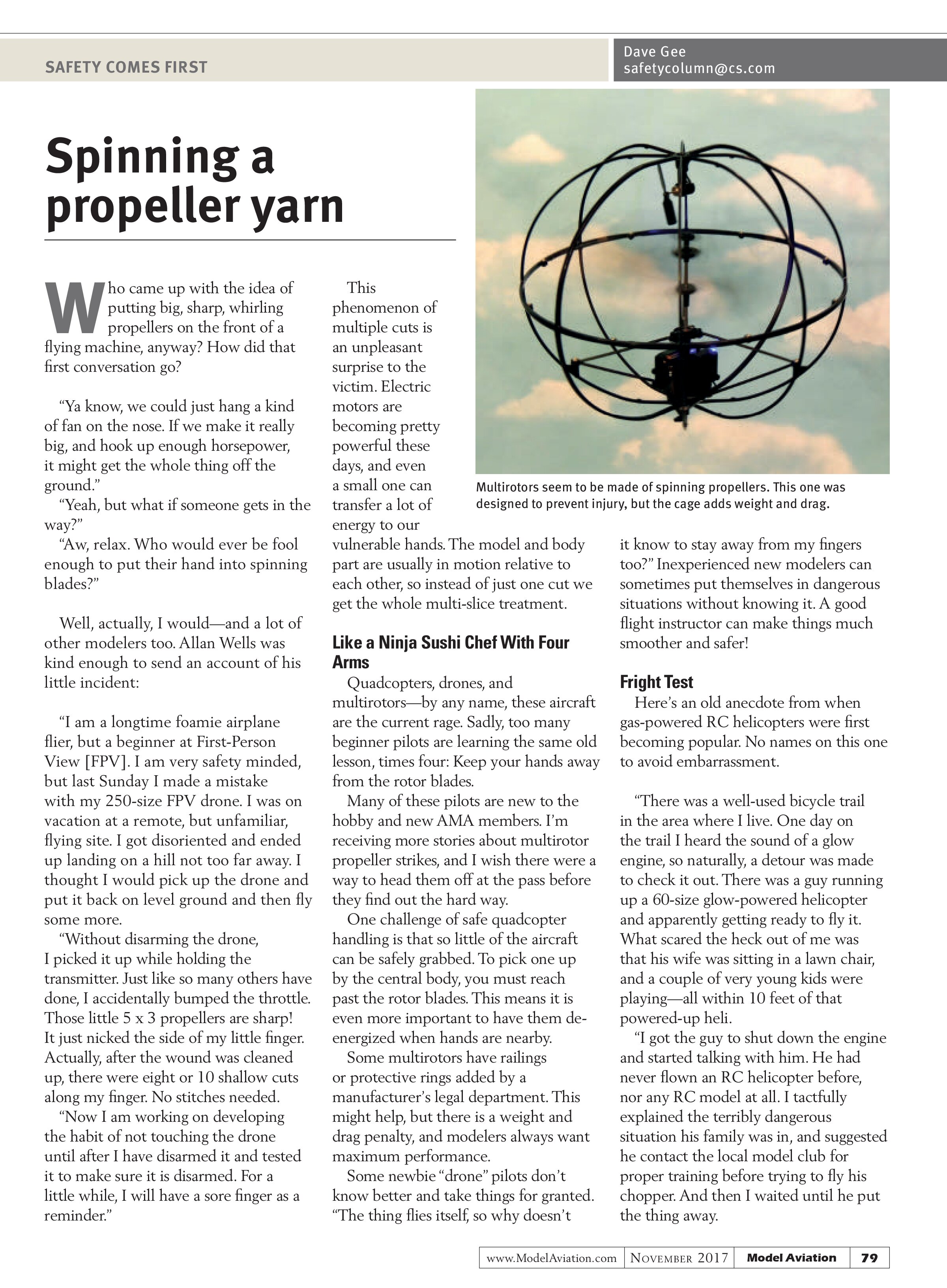
Some multirotors have railings or protective rings added by a manufacturer’s legal department. This might help, but there is a weight and drag penalty, and modelers always want maximum performance.
Some newbie “drone” pilots don’t know better and take things for granted. “The thing flies itself, so why doesn’t

it know to stay away from my fingers too?” Inexperienced new modelers can sometimes put themselves in dangerous situations without knowing it. A good flight instructor can make things much smoother and safer!
Fright Test
Here’s an old anecdote from when gas-powered RC helicopters were first becoming popular. No names on this one to avoid embarrassment.
“There was a well-used bicycle trail in the area where I live. One day on the trail I heard the sound of a glow engine, so naturally, a detour was made to check it out. There was a guy running up a 60-size glow-powered helicopter and apparently getting ready to fly it. What scared the heck out of me was that his wife was sitting in a lawn chair, and a couple of very young kids were playing—all within 10 feet of that powered-up heli.
“I got the guy to shut down the engine and started talking with him. He had never flown an RC helicopter before, nor any RC model at all. I tactfully explained the terribly dangerous situation his family was in, and suggested he contact the local model club for proper training before trying to fly his chopper. And then I waited until he put the thing away.
“This event was posted and discussed online, and I was surprised at the varied opinions of modelers. Some said I had no business interfering with the guy and his model. Many thought that the police should have been called. It seemed to me that long before the police arrived, there could have been tragic results. I still think about what could have happened had I arrived 15 minutes later.”
Those Pesky Stains
Another anonymous note came from an old friend who didn’t enjoy the fame he received from a mention in this column a few months back.
He flew a full-scale medical helicopter for quite a while and told me he learned that hydrogen peroxide is excellent for removing blood stains from clothing, in addition to being a useful sterilization medium for small wounds, such as what careless modelers might incur.
Now how did he know? I mean, why would he think I might need to remove blood stains from my workshop britches?
Mystery Airplane Question
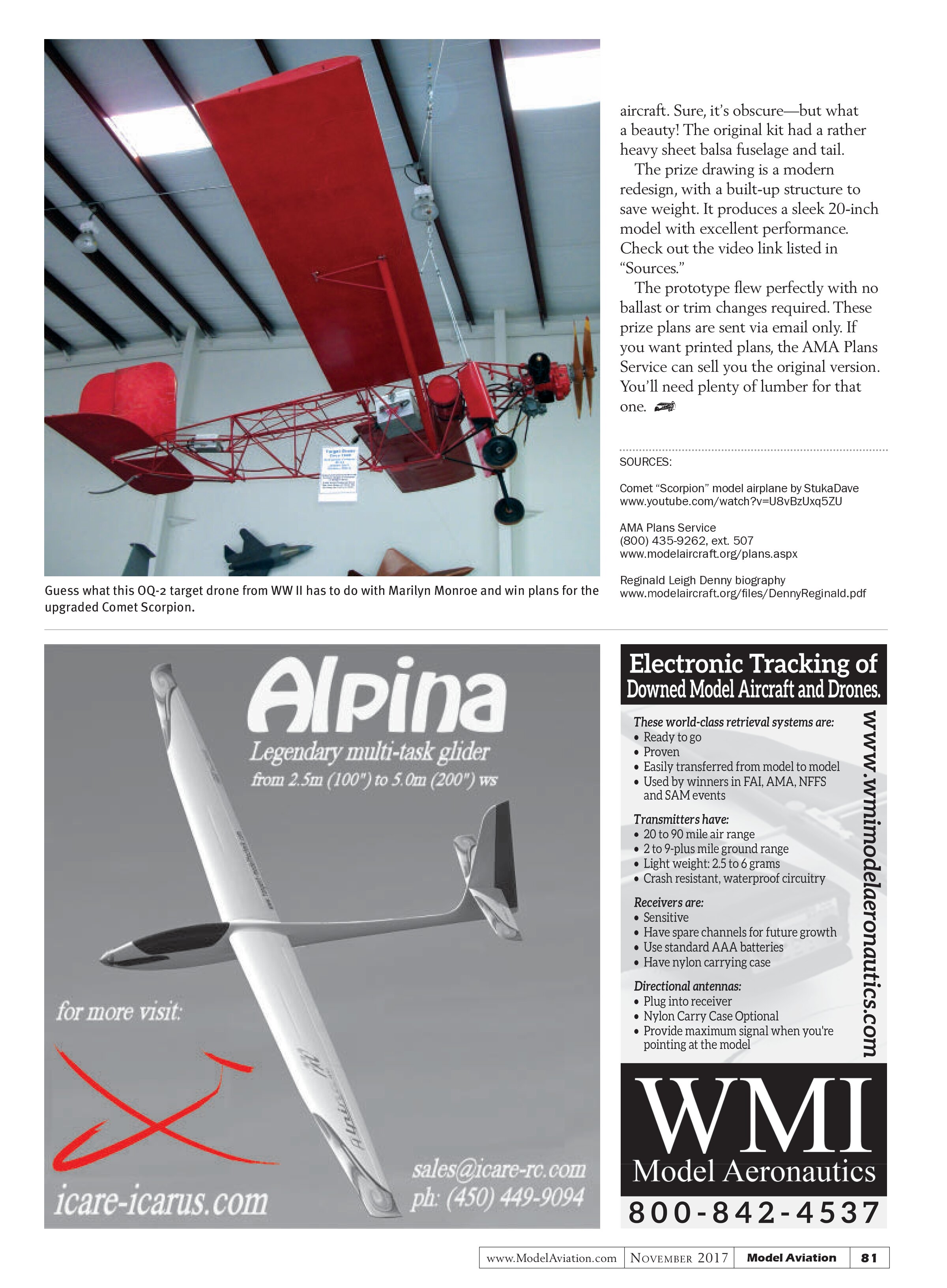
You want drones? I got your drones right here. This mystery airplane is an OQ-2 target drone from World War II. The photo shows the fuselage uncovered for display. Dashing old-time movie star Reginald Denny owned a famous Hollywood hobby shop in those days and produced Dennymite engines to power his Dennyplane model aircraft. When the war started, he began the Radioplane Company and built remote-controlled target drones for the military. The Radioplane OQ-2 was the first mass-produced drone.
The puzzle question is: What does the OQ-2 have to do with Marilyn Monroe? If you know the answer, email me at the address listed at the beginning of my column and receive Comet Scorpion digital plans. Don’t despair! If you’re stumped, I’ll send you the prize plans anyway.
Comet Scorpion Prize Plans
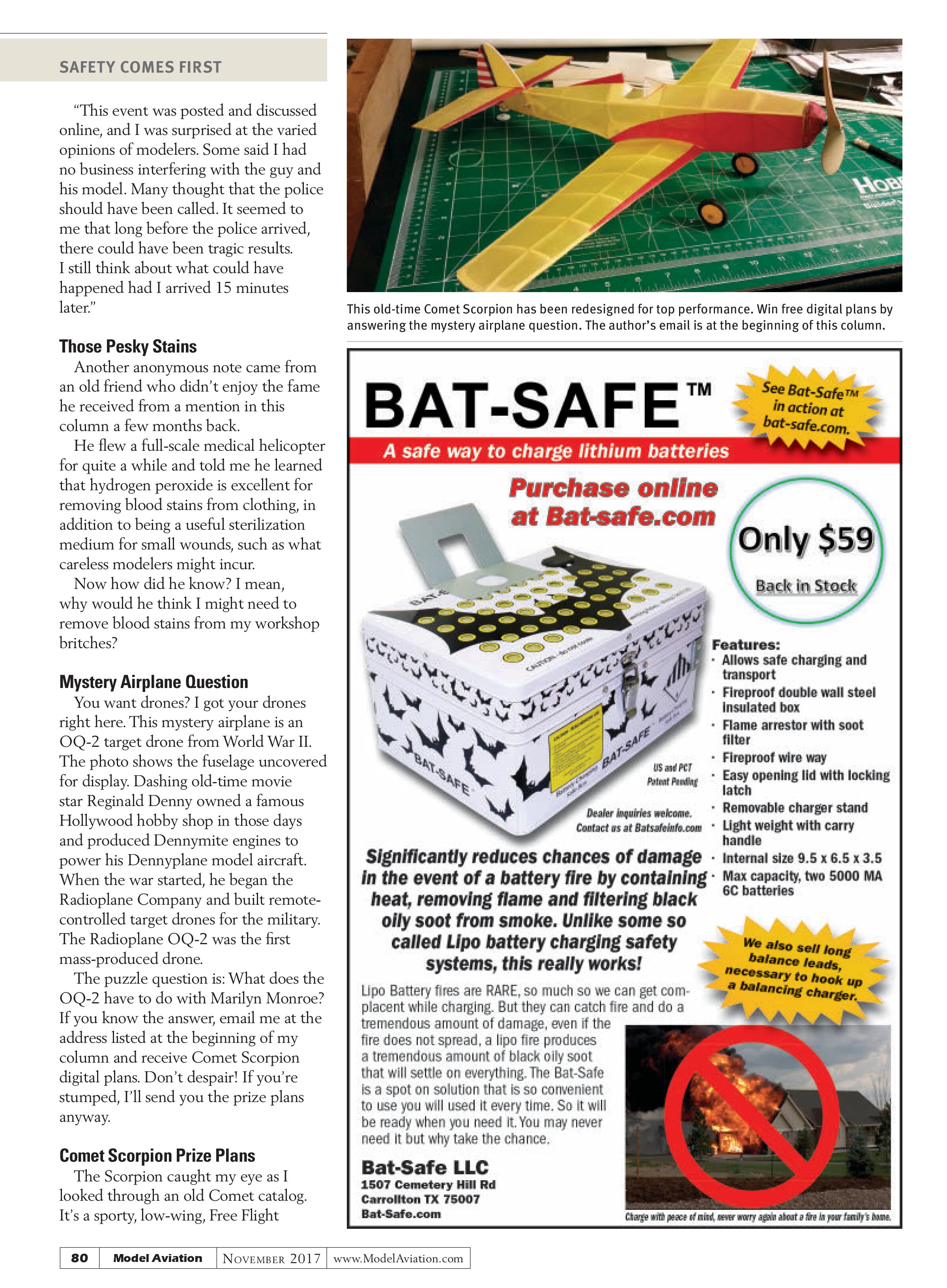
The Scorpion caught my eye as I looked through an old Comet catalog. It’s a sporty, low-wing, Free Flight

aircraft. Sure, it’s obscure—but what a beauty! The original kit had a rather heavy sheet balsa fuselage and tail.
The prize drawing is a modern redesign, with a built-up structure to save weight. It produces a sleek 20-inch model with excellent performance. Check out the video link listed in “Sources.”
The prototype flew perfectly with no ballast or trim changes required. These prize plans are sent via email only. If you want printed plans, the AMA Plans Service can sell you the original version. You’ll need plenty of lumber for that one.
Sources:
Comet “Scorpion” model airplane by StukaDave
www.youtube.com/watch?v=U8vBzUxq5ZU
AMA Plans Service
(800) 435-9262, ext. 507
www.modelaircraft.org/plans.aspx
Reginald Leigh Denny biography
www.modelaircraft.org/files/DennyReginald.pdf