2017 World F3B Soaring Championship
by Gordon Buckland
gordon@gatorf3b.com
Every two years, the best F3B Soaring pilots in the world gather for the FAI World Championship. The event is attended by teams from around the world including Japan, Chile, Australia, and many European countries.
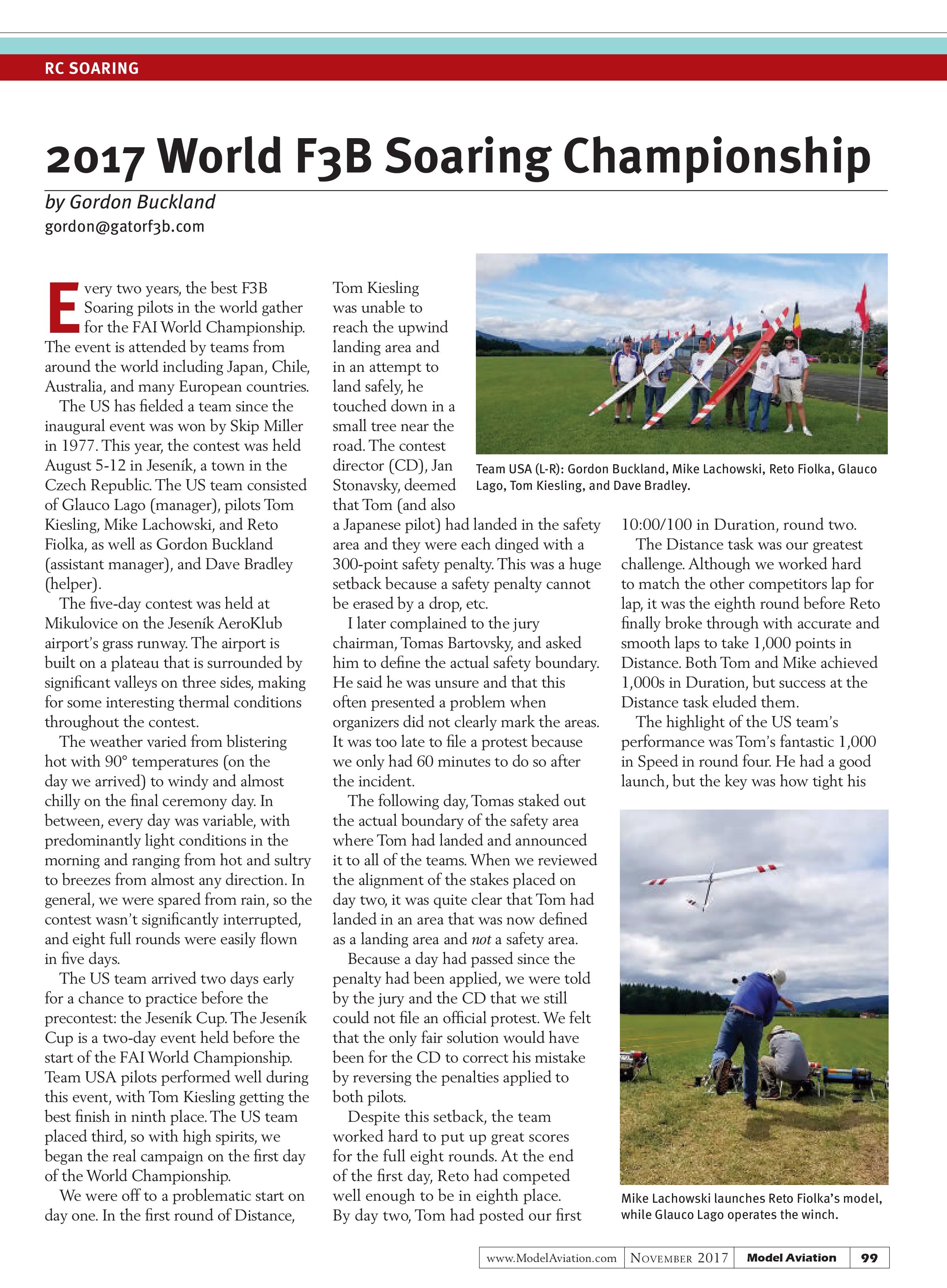
The US has fielded a team since the inaugural event was won by Skip Miller in 1977. This year, the contest was held August 5-12 in Jeseník, a town in the Czech Republic. The US team consisted of Glauco Lago (manager), pilots Tom Kiesling, Mike Lachowski, and Reto Fiolka, as well as Gordon Buckland (assistant manager), and Dave Bradley (helper).
The five-day contest was held at Mikulovice on the Jeseník AeroKlub airport’s grass runway. The airport is built on a plateau that is surrounded by significant valleys on three sides, making for some interesting thermal conditions throughout the contest.
The weather varied from blistering hot with 90° temperatures (on the day we arrived) to windy and almost chilly on the final ceremony day. In between, every day was variable, with predominantly light conditions in the morning and ranging from hot and sultry to breezes from almost any direction. In general, we were spared from rain, so the contest wasn’t significantly interrupted, and eight full rounds were easily flown in five days.
The US team arrived two days early for a chance to practice before the precontest: the Jeseník Cup. The Jeseník Cup is a two-day event held before the start of the FAI World Championship. Team USA pilots performed well during this event, with Tom Kiesling getting the best finish in ninth place. The US team placed third, so with high spirits, we began the real campaign on the first day of the World Championship.
We were off to a problematic start on day one. In the first round of Distance,
Tom Kiesling was unable to reach the upwind landing area and in an attempt to land safely, he touched down in a small tree near the road. The contest director (CD), Jan Stonavsky, deemed that Tom (and also a Japanese pilot) had landed in the safety area and they were each dinged with a 300-point safety penalty. This was a huge setback because a safety penalty cannot be erased by a drop, etc.
I later complained to the jury chairman, Tomas Bartovsky, and asked him to define the actual safety boundary. He said he was unsure and that this often presented a problem when organizers did not clearly mark the areas. It was too late to file a protest because we only had 60 minutes to do so after the incident.
The following day, Tomas staked out the actual boundary of the safety area where Tom had landed and announced it to all of the teams. When we reviewed the alignment of the stakes placed on day two, it was quite clear that Tom had landed in an area that was now defined as a landing area and not a safety area.
Because a day had passed since the penalty had been applied, we were told by the jury and the CD that we still could not file an official protest. We felt that the only fair solution would have been for the CD to correct his mistake by reversing the penalties applied to both pilots.
Despite this setback, the team worked hard to put up great scores for the full eight rounds. At the end of the first day, Reto had competed well enough to be in eighth place. By day two, Tom had posted our first

Team USA (L-R): Gordon Buckland, Mike Lachowski, Reto Fiolka, Glauco Lago, Tom Kiesling, and Dave Bradley.
10:00/100 in Duration, round two.
The Distance task was our greatest challenge. Although we worked hard to match the other competitors lap for lap, it was the eighth round before Reto finally broke through with accurate and smooth laps to take 1,000 points in Distance. Both Tom and Mike achieved 1,000s in Duration, but success at the Distance task eluded them.
The highlight of the US team’s performance was Tom’s fantastic 1,000 in Speed in round four. He had a good launch, but the key was how tight his

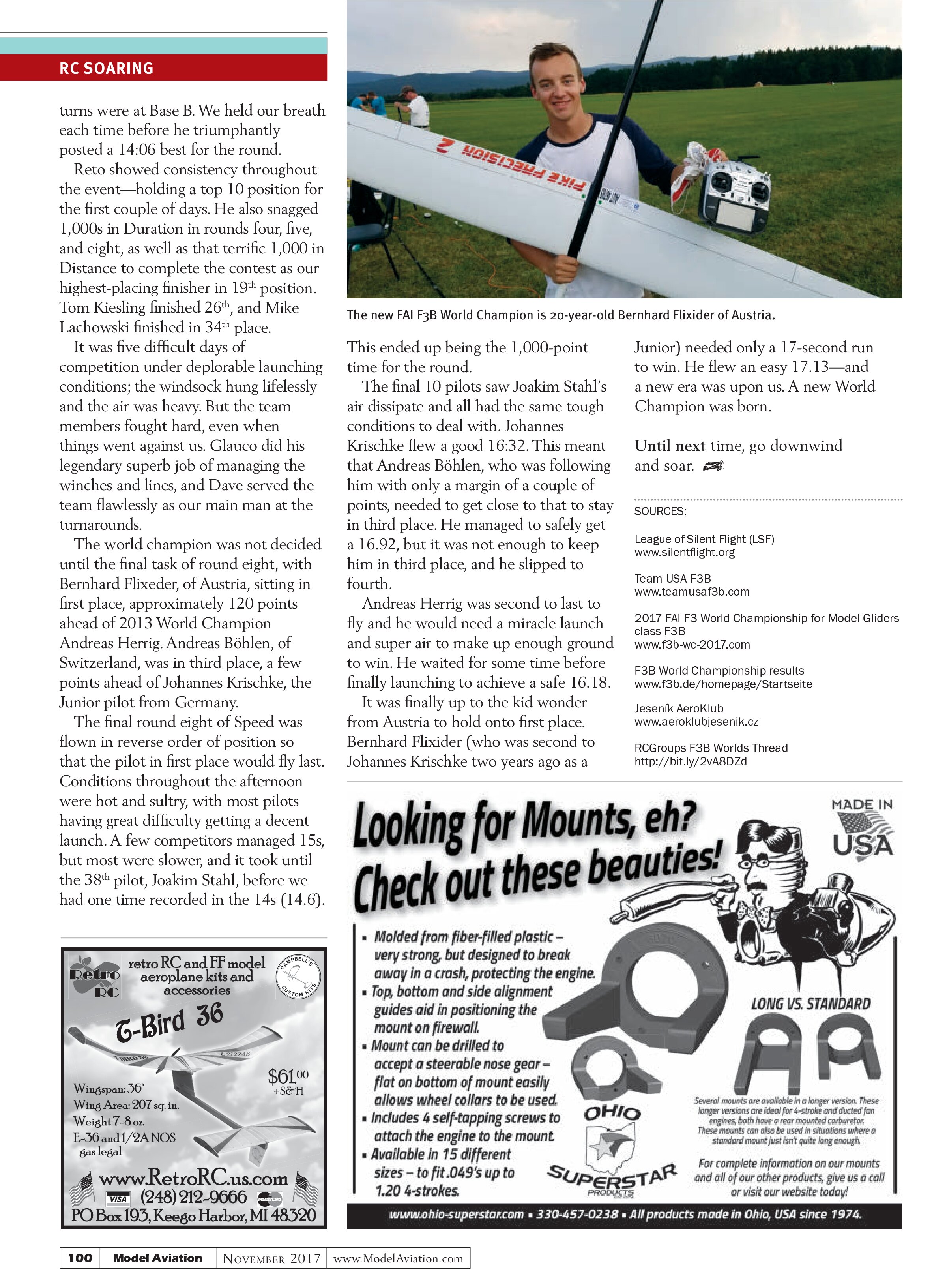
Mike Lachowski launches Reto Fiolka’s model, while Glauco Lago operates the winch.
turns were at Base B. We held our breath each time before he triumphantly posted a 14:06 best for the round.
Reto showed consistency throughout the event—holding a top 10 position for the first couple of days. He also snagged 1,000s in Duration in rounds four, five, and eight, as well as that terrific 1,000 in Distance to complete the contest as our highest-placing finisher in 19th position. Tom Kiesling finished 26th, and Mike Lachowski finished in 34th place.
It was five difficult days of competition under deplorable launching conditions; the windsock hung lifelessly and the air was heavy. But the team members fought hard, even when things went against us. Glauco did his legendary superb job of managing the winches and lines, and Dave served the team flawlessly as our main man at the turnarounds.
The world champion was not decided until the final task of round eight, with Bernhard Flixeder, of Austria, sitting in first place, approximately 120 points ahead of 2013 World Champion Andreas Herrig. Andreas Böhlen, of Switzerland, was in third place, a few points ahead of Johannes Krischke, the Junior pilot from Germany.
The final round eight of Speed was flown in reverse order of position so that the pilot in first place would fly last. Conditions throughout the afternoon were hot and sultry, with most pilots having great difficulty getting a decent launch. A few competitors managed 15s, but most were slower, and it took until the 38th pilot, Joakim Stahl, before we had one time recorded in the 14s (14.6).
This ended up being the 1,000-point time for the round.
The final 10 pilots saw Joakim Stahl’s air dissipate and all had the same tough conditions to deal with. Johannes Krischke flew a good 16:32. This meant that Andreas Böhlen, who was following him with only a margin of a couple of points, needed to get close to that to stay in third place. He managed to safely get a 16.92, but it was not enough to keep him in third place, and he slipped to fourth.
Andreas Herrig was second to last to fly and he would need a miracle launch and super air to make up enough ground to win. He waited for some time before finally launching to achieve a safe 16.18.
It was finally up to the kid wonder from Austria to hold onto first place. Bernhard Flixider (who was second to Johannes Krischke two years ago as a Junior) needed only a 17-second run to win. He flew an easy 17.13—and a new era was upon us. A new World Champion was born.
Until next time, go downwind and soar.

SOURCES:
League of Silent Flight (LSF)
www.silentflight.org
Team USA F3B
www.teamusaf3b.com
2017 FAI F3 World Championship for Model Gliders class F3B
www.f3b-wc-2017.com
F3B World Championship results
www.f3b.de/homepage/Startseite
Jeseník AeroKlub
www.aeroklubjesenik.cz
RCGroups F3B Worlds Thread
http://bit.ly/2vA8DZd