Going with electric power
by Don Grissom
dongrissom@hilltopflyers.com
We are again approaching the end of the season for RC Combat. With only a few events remaining, it is already time to start getting ready for next year.
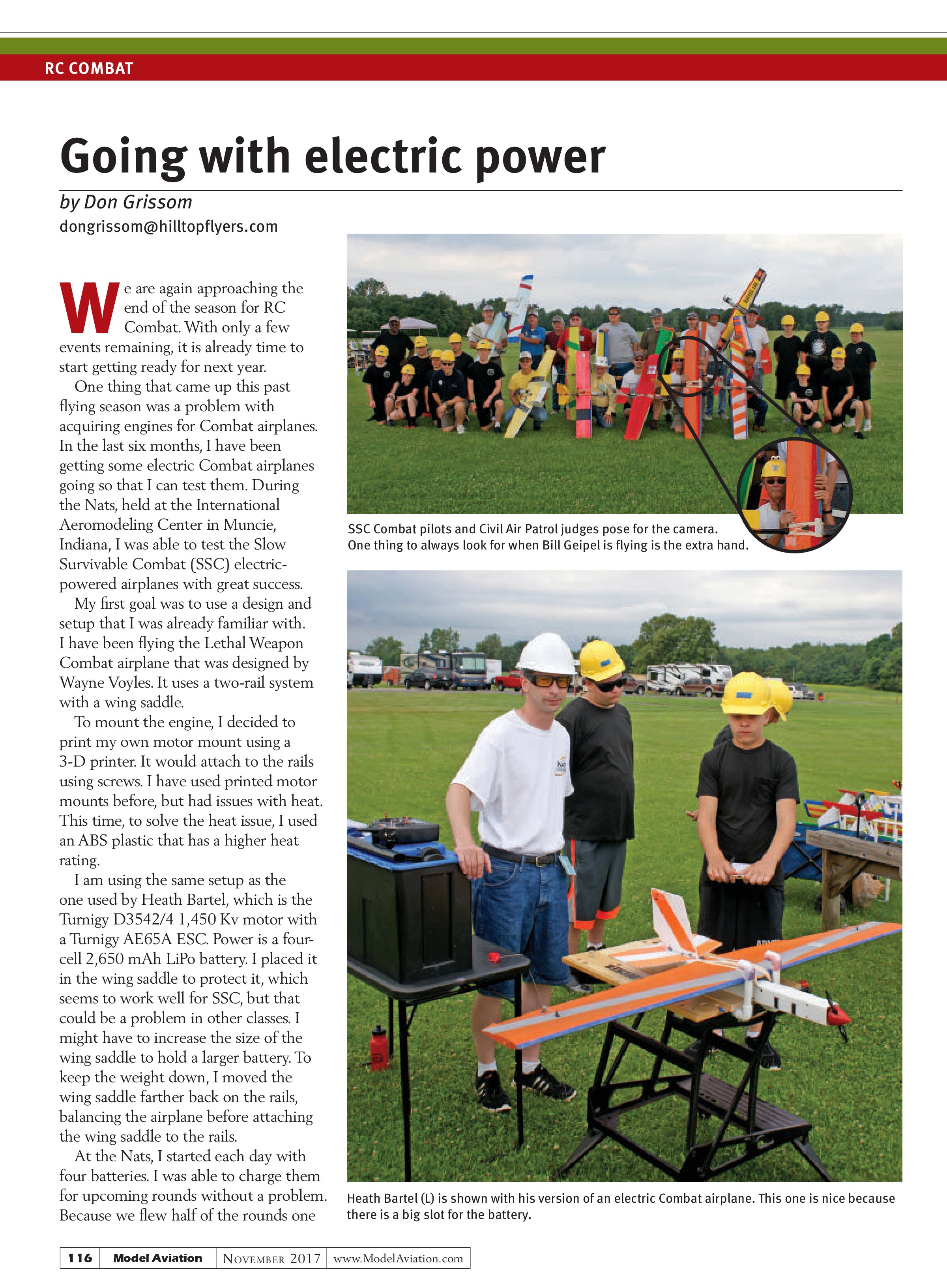
One thing that came up this past flying season was a problem with acquiring engines for Combat airplanes. In the last six months, I have been getting some electric Combat airplanes going so that I can test them. During the Nats, held at the International Aeromodeling Center in Muncie, Indiana, I was able to test the Slow Survivable Combat (SSC) electric-powered airplanes with great success.
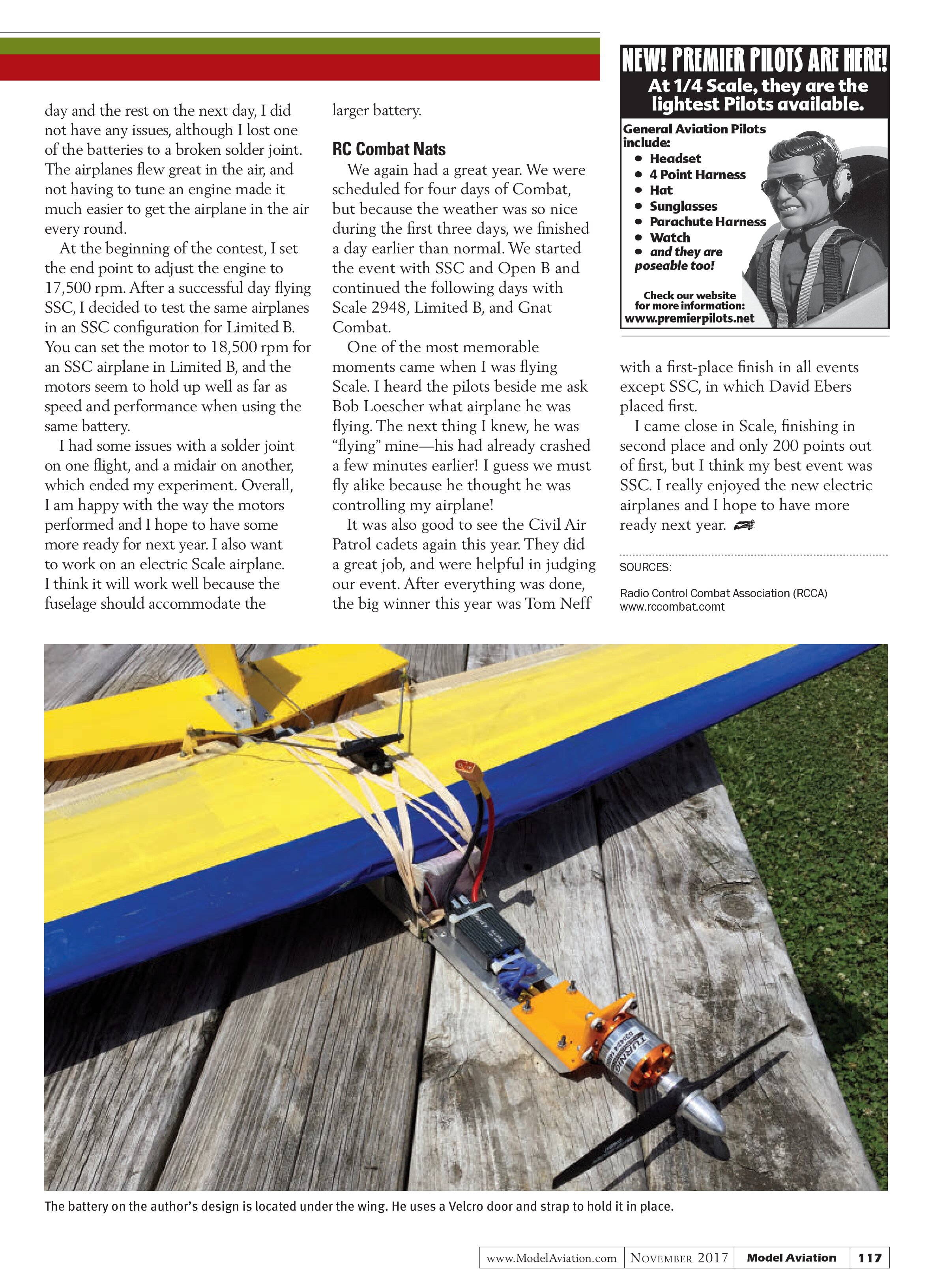
My first goal was to use a design and setup that I was already familiar with. I have been flying the Lethal Weapon Combat airplane that was designed by Wayne Voyles. It uses a two-rail system with a wing saddle.
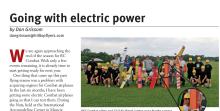
To mount the engine, I decided to print my own motor mount using a 3-D printer. It would attach to the rails using screws. I have used printed motor mounts before, but had issues with heat. This time, to solve the heat issue, I used an ABS plastic that has a higher heat rating.
I am using the same setup as the one used by Heath Bartel, which is the Turnigy D3542/4 1,450 Kv motor with a Turnigy AE65A ESC. Power is a four-cell 2,650 mAh LiPo battery. I placed it in the wing saddle to protect it, which seems to work well for SSC, but that could be a problem in other classes. I might have to increase the size of the wing saddle to hold a larger battery. To keep the weight down, I moved the wing saddle farther back on the rails, balancing the airplane before attaching the wing saddle to the rails.
At the Nats, I started each day with four batteries. I was able to charge them for upcoming rounds without a problem. Because we flew half of the rounds one

day and the rest on the next day, I did not have any issues, although I lost one of the batteries to a broken solder joint. The airplanes flew great in the air, and not having to tune an engine made it much easier to get the airplane in the air every round.
At the beginning of the contest, I set the end point to adjust the engine to 17,500 rpm. After a successful day flying SSC, I decided to test the same airplanes in an SSC configuration for Limited B. You can set the motor to 18,500 rpm for an SSC airplane in Limited B, and the motors seem to hold up well as far as speed and performance when using the same battery.
I had some issues with a solder joint on one flight, and a midair on another, which ended my experiment. Overall, I am happy with the way the motors performed and I hope to have some more ready for next year. I also want to work on an electric Scale airplane. I think it will work well because the fuselage should accommodate the larger battery.
RC Combat Nats
We again had a great year. We were scheduled for four days of Combat, but because the weather was so nice during the first three days, we finished a day earlier than normal. We started the event with SSC and Open B and continued the following days with Scale 2948, Limited B, and Gnat Combat.
One of the most memorable moments came when I was flying Scale. I heard the pilots beside me ask Bob Loescher what airplane he was flying. The next thing I knew, he was “flying” mine—his had already crashed a few minutes earlier! I guess we must fly alike because he thought he was controlling my airplane!
It was also good to see the Civil Air Patrol cadets again this year. They did a great job, and were helpful in judging our event. After everything was done, the big winner this year was Tom Neff with a first-place finish in all events except SSC, in which David Ebers placed first.
I came close in Scale, finishing in second place and only 200 points out of first, but I think my best event was SSC. I really enjoyed the new electric airplanes and I hope to have more ready next year.

SOURCES:
Radio Control Combat Association (RCCA)
www.rccombat.com