Peanut Scale model creates FF Rubber fun!
While browsing in a used bookstore, Gene Smith found a pocket encyclopedia of world aircraft and purchased it. He looked through it many times, hoping for a creative spark, and kept coming back to a Danish design, the Skandinavisk KZ.III Laerke (Lark). Similar-looking to a Piper Cub, with an interesting history, Gene thought the KZ.III would make a good flier.

The Skandinavisk KZ.III was designed in Denmark while the country was under Nazi occupation. It was intended as a short-takeoff-and-landing (STOL) airplane for use by the Danish Air Ambulance Service. The aircraft’s maiden flight was in 1944, but out of the 64 Larks that were built, only three were delivered to the ambulance service. The civilian version that Gene modeled his aircraft after was equipped with a 100 hp Cirrus Minor engine.
Gene joked that “… lighter models fly better,” and recommended 1/20-inch square balsa to frame the fuselage, although 1/16 square balsa could be used. The fuselage narrowed at the nose, so joining it could be made easier by using 1/20 x 1/8 balsa rather than 1/20-inch square for the front vertical brace. Instead of joining the nose with 1/20 square balsa, a full front former was made from soft 1/8-inch sheet balsa. Top and bottom formers were added, including the “instrument panel,” and soft 1/32-inch sheet balsa was sanded thinner to easily be wrapped around the top and bottom of the cowl.

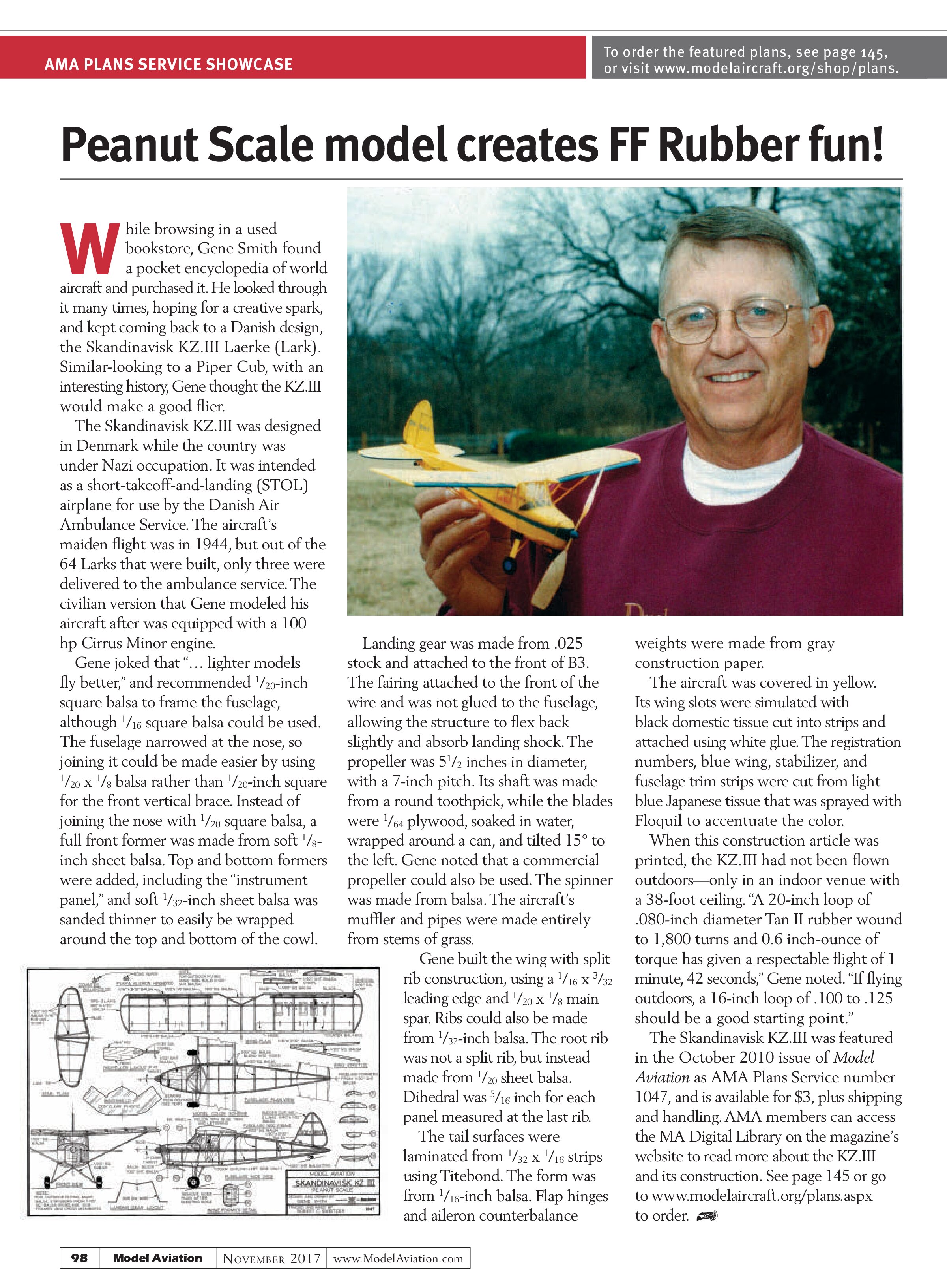
Landing gear was made from .025 stock and attached to the front of B3. The fairing attached to the front of the wire and was not glued to the fuselage, allowing the structure to flex back slightly and absorb landing shock. The propeller was 5 1/2 inches in diameter, with a 7-inch pitch. Its shaft was made from a round toothpick, while the blades were 1/64 plywood, soaked in water, wrapped around a can, and tilted 15° to the left. Gene noted that a commercial propeller could also be used. The spinner was made from balsa. The aircraft’s muffler and pipes were made entirely from stems of grass.
Gene built the wing with split rib construction, using a 1/16 x 3/32 leading edge and 1/20 x 1/8 main spar. Ribs could also be made from 1/32-inch balsa. The root rib was not a split rib, but instead made from 1/20 sheet balsa. Dihedral was 5/16 inch for each panel measured at the last rib.
The tail surfaces were laminated from 1/32 x 1/16 strips using Titebond. The form was from 1/16-inch balsa. Flap hinges and aileron counterbalance weights were made from gray construction paper.
The aircraft was covered in yellow. Its wing slots were simulated with black domestic tissue cut into strips and attached using white glue. The registration numbers, blue wing, stabilizer, and fuselage trim strips were cut from light blue Japanese tissue that was sprayed with Floquil to accentuate the color.
When this construction article was printed, the KZ.III had not been flown outdoors—only in an indoor venue with a 38-foot ceiling. “A 20-inch loop of .080-inch diameter Tan II rubber wound to 1,800 turns and 0.6 inch-ounce of torque has given a respectable flight of 1 minute, 42 seconds,” Gene noted. “If flying outdoors, a 16-inch loop of .100 to .125 should be a good starting point.”
The Skandinavisk KZ.III was featured in the October 2010 issue of Model Aviation as AMA Plans Service number 1047, and is available for $3, plus shipping and handling. AMA members can access the MA Digital Library on the magazine’s website to read more about the KZ.III and its construction. See page 145 or go to www.modelaircraft.org/plans.aspx to order.