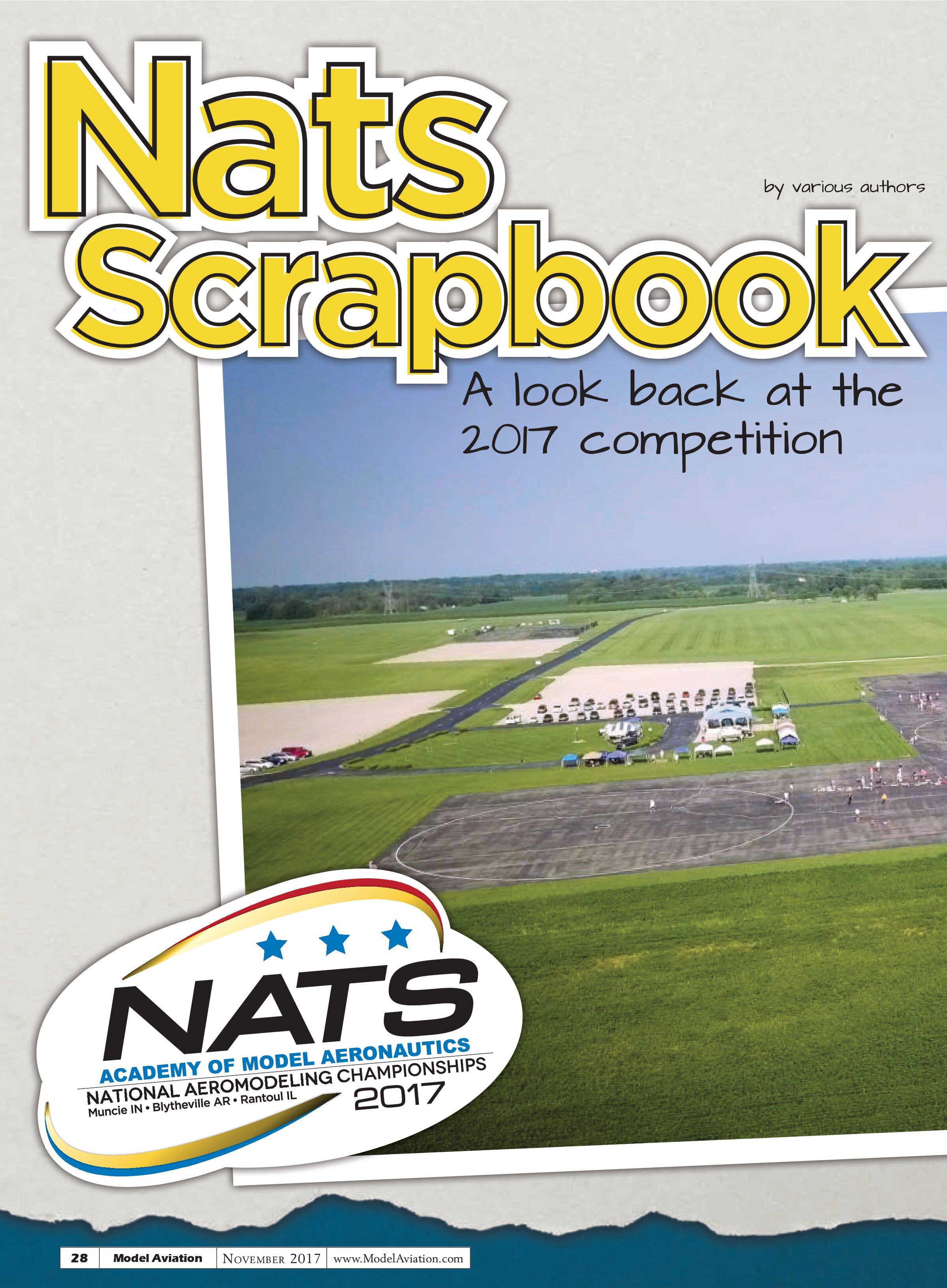
The 2017 Nats, an annual favorite event for many pilots from across the country and around the world, kicked off June 23 and concluded August 3. Most of the events were held at the International Aeromodeling Center (IAC) in Muncie, Indiana, while two were held in other locations.
For the first time, the RC Aerobatics (Pattern) Nats were held in Blytheville, Arkansas, at the historic Eaker Air Force Base, which is known today as the Blytheville Air Force Base. National Radio Controlled Scale Aerobatics (NSRCA) officials moved the event there in hopes of attracting pilots from other areas of the US to the competition. This year’s July 25-29 contest had 76 registered pilots.
For the second consecutive year, the Indoor Free Flight (FF) Nats took place at the Rantoul National Aviation Center, in Rantoul, Illinois. The number of competitors was slightly less this year, but those who attended took advantage of some site improvements.
To see more from the 2017 Nats, view albums for each event on the AMA Flickr page at www.flickr.com/photos/modelaircraft. You can also read daily reports in NatsNews at amablog.modelaircraft.org/nats.
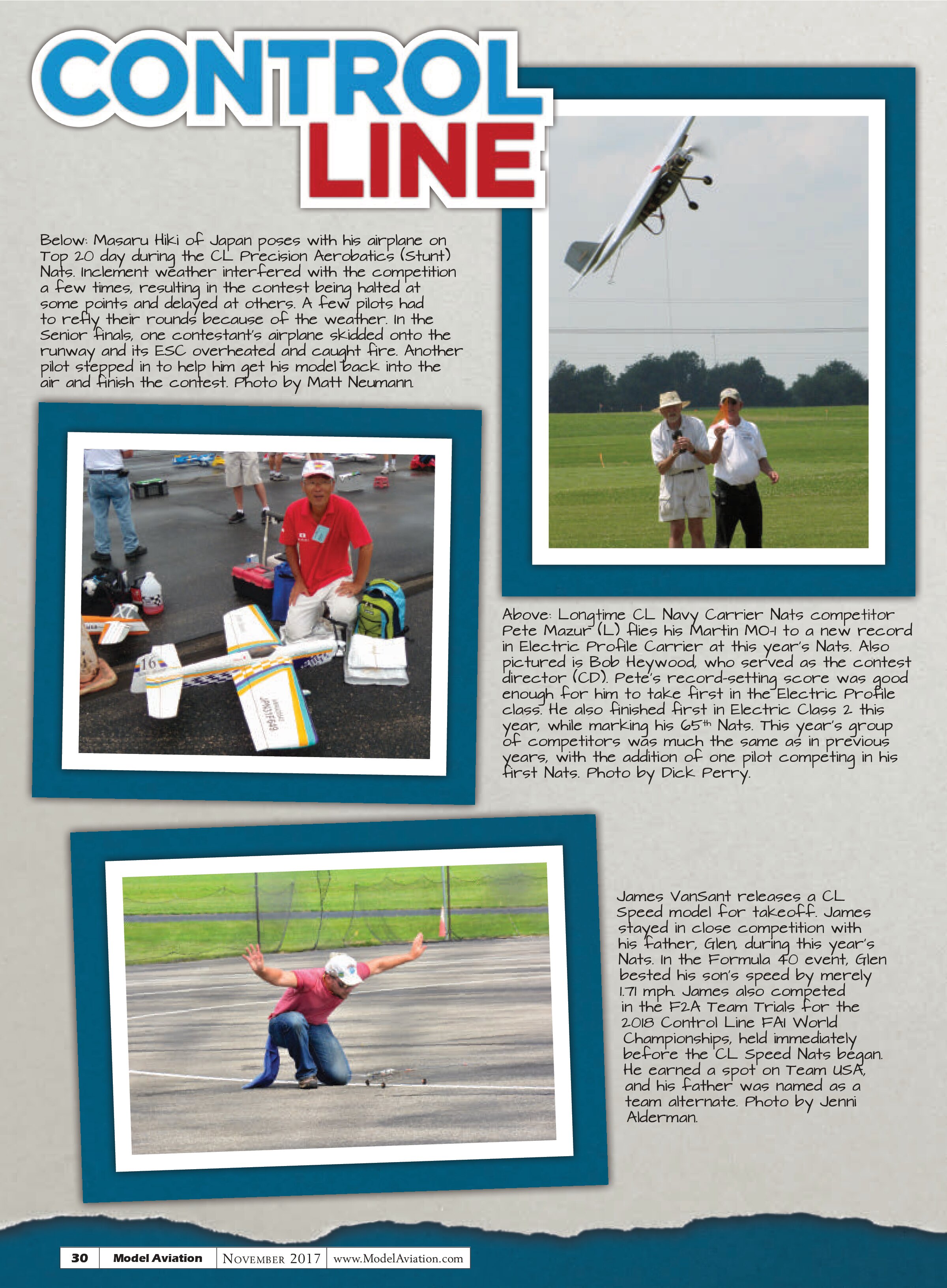
Below: Masaru Hiki of Japan poses with his airplane on Top 2.0 day during the CL Precision Aerobatics (Stunt) Nats. Inclement weather interfered with the competition a few times, resulting in the contest being halted at some points and delayed at others. A few pilots had to re-fly their rounds because of the weather. In the Senior finals, one contestant’s airplane skidded onto the runway and its ESC overheated and caught fire. Another pilot stepped in to help him get his model back into the air and finish the contest. Photo by Matt Neumann.
Below: Masaru Hiki of Japan poses with his airplane on Top 2.0 day during the CL Precision Aerobatics (Stunt) Nats. Inclement weather interfered with the competition a few times, resulting in the contest being halted at some points and delayed at others. A few pilots had to re-fly their rounds because of the weather. In the Senior finals, one contestant’s airplane skidded onto the runway and its ESC overheated and caught fire. Another pilot stepped in to help him get his model back into the air and finish the contest.Photo by Matt Neumann.
Above: Longtime CL Navy Carrier Nats competitor Pete Mazur (L) flies his Martin MO-1 to a new record in Electric Profile Carrier at this year’s Nats. Also pictured is Bob Heywood, who served as the contest director (CD). Pete’s record-setting score was good enough for him to take first in the Electric Profile class. He also finished first in Electric Class 2 this year, while marking his 65th Nats. This year’s group of competitors was much the same as in previous years, with the addition of one pilot competing in his first Nats. Photo by Dick Perry.
Above: Longtime CL Navy Carrier Nats competitor Pete Mazur (L) flies his Martin MO-1 to a new record in Electric Profile Carrier at this year’s Nats. Also pictured is Bob Heywood, who served as the contest director (CD). Pete’s record-setting score was good enough for him to take first in the Electric Profile class. He also finished first in Electric Class 2 this year, while marking his 65th Nats. This year’s group of competitors was much the same as in previous years, with the addition of one pilot competing in his first Nats.Photo by Dick Perry.
James VanSant releases a CL Speed model for takeoff. James stayed in close competition with his father, Glen, during this year’s Nats. In the Formula 40 event, Glen bested his son’s speed by merely 1.71 mph. James also competed in the F2A Team Trials for the 2018 Control Line FAI World Championships, held immediately before the CL Speed Nats began. He earned a spot on Team USA, and his father was named as a team alternate. Photo by Jenni Alderman.
James VanSant releases a CL Speed model for takeoff. James stayed in close competition with his father, Glen, during this year’s Nats. In the Formula 40 event, Glen bested his son’s speed by merely 1.71 mph. James also competed in the F2A Team Trials for the 2018 Control Line FAI World Championships, held immediately before the CL Speed Nats began. He earned a spot on Team USA, and his father was named as a team alternate.Photo by Jenni Alderman.
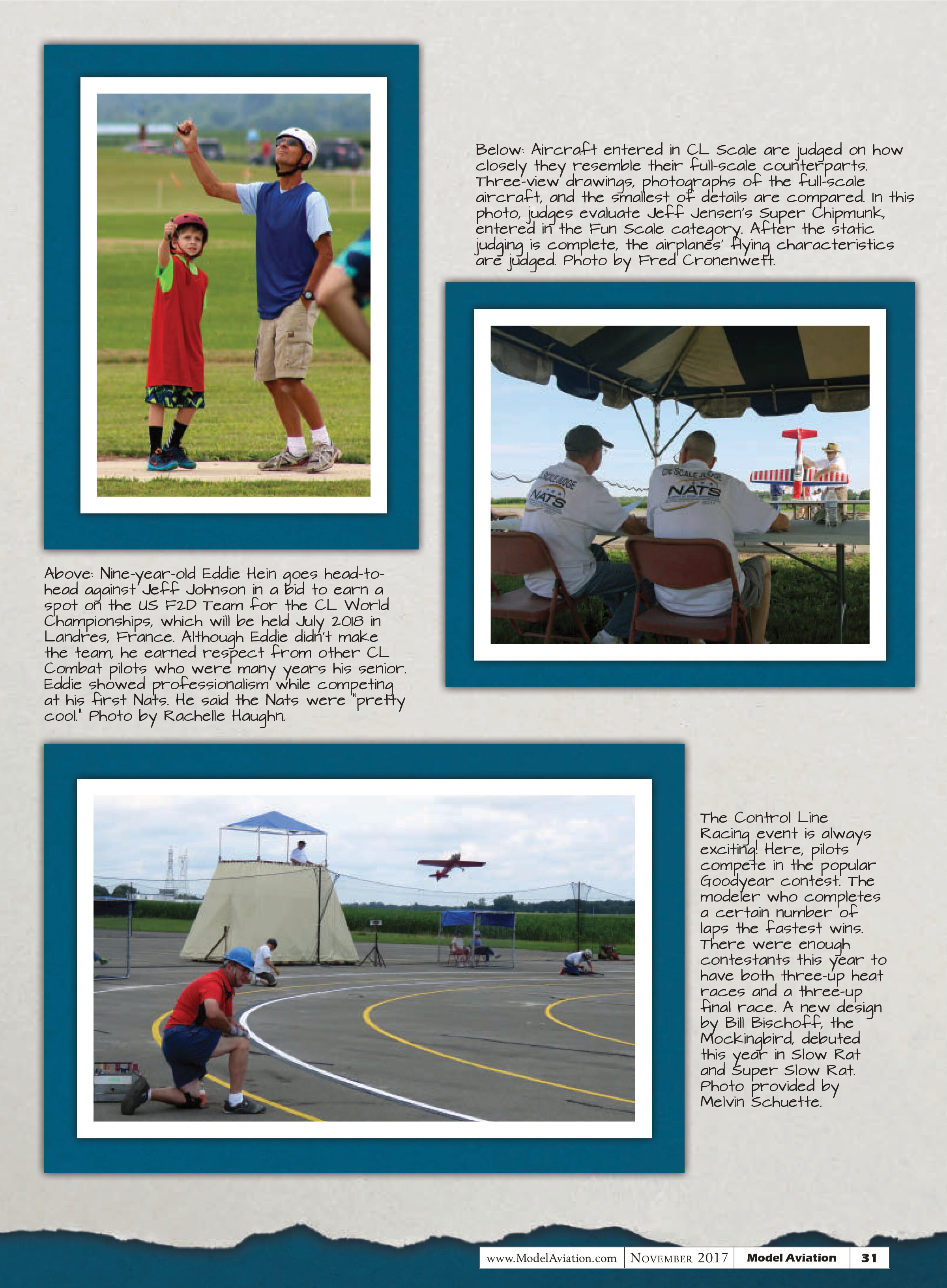
Above: Nine-year-old Eddie Hein goes head-to-head against Jeff Johnson in a bid to earn a spot on the US F2D Team for the CL World Championships, which will be held July 2018 in Landres, France. Although Eddie didn’t make the team, he earned respect from other CL Combat pilots who were many years his senior. Eddie showed professionalism while competing at his first Nats. He said the Nats were “pretty cool.” Photo by Rachelle Haughn.
Above: Nine-year-old Eddie Hein goes head-to-head against Jeff Johnson in a bid to earn a spot on the US F2D Team for the CL World Championships, which will be held July 2018 in Landres, France. Although Eddie didn’t make the team, he earned respect from other CL Combat pilots who were many years his senior. Eddie showed professionalism while competing at his first Nats. He said the Nats were “pretty cool.”Photo by Rachelle Haughn.
Below: Aircraft entered in CL Scale are judged on how closely they resemble their full-scale counterparts. Three-view drawings, photographs of the full-scale aircraft, and the smallest of details are compared. In this photo, judges evaluate Jeff Jensen’s Super Chipmunk, entered in the Fun Scale category. After the static judging is complete, the airplanes’ flying characteristics are judged. Photo by Fred Cronenwett.
Below: Aircraft entered in CL Scale are judged on how closely they resemble their full-scale counterparts. Three-view drawings, photographs of the full-scale aircraft, and the smallest of details are compared. In this photo, judges evaluate Jeff Jensen’s Super Chipmunk, entered in the Fun Scale category. After the static judging is complete, the airplanes’ flying characteristics are judged.Photo by Fred Cronenwett.
The Control Line Racing event is always exciting! Here, pilots compete in the popular Goodyear contest. The modeler who completes a certain number of laps the fastest wins. There were enough contestants this year to have both three-up heat races and a three-up final race. A new design by Bill Bischoff, the Mockingbird, debuted this year in Slow Rat and Super Slow Rat. Photo provided by Melvin Schuette.
The Control Line Racing event is always exciting! Here, pilots compete in the popular Goodyear contest. The modeler who completes a certain number of laps the fastest wins. There were enough contestants this year to have both three-up heat races and a three-up final race. A new design by Bill Bischoff, the Mockingbird, debuted this year in Slow Rat and Super Slow Rat.Photo provided by Melvin Schuette.
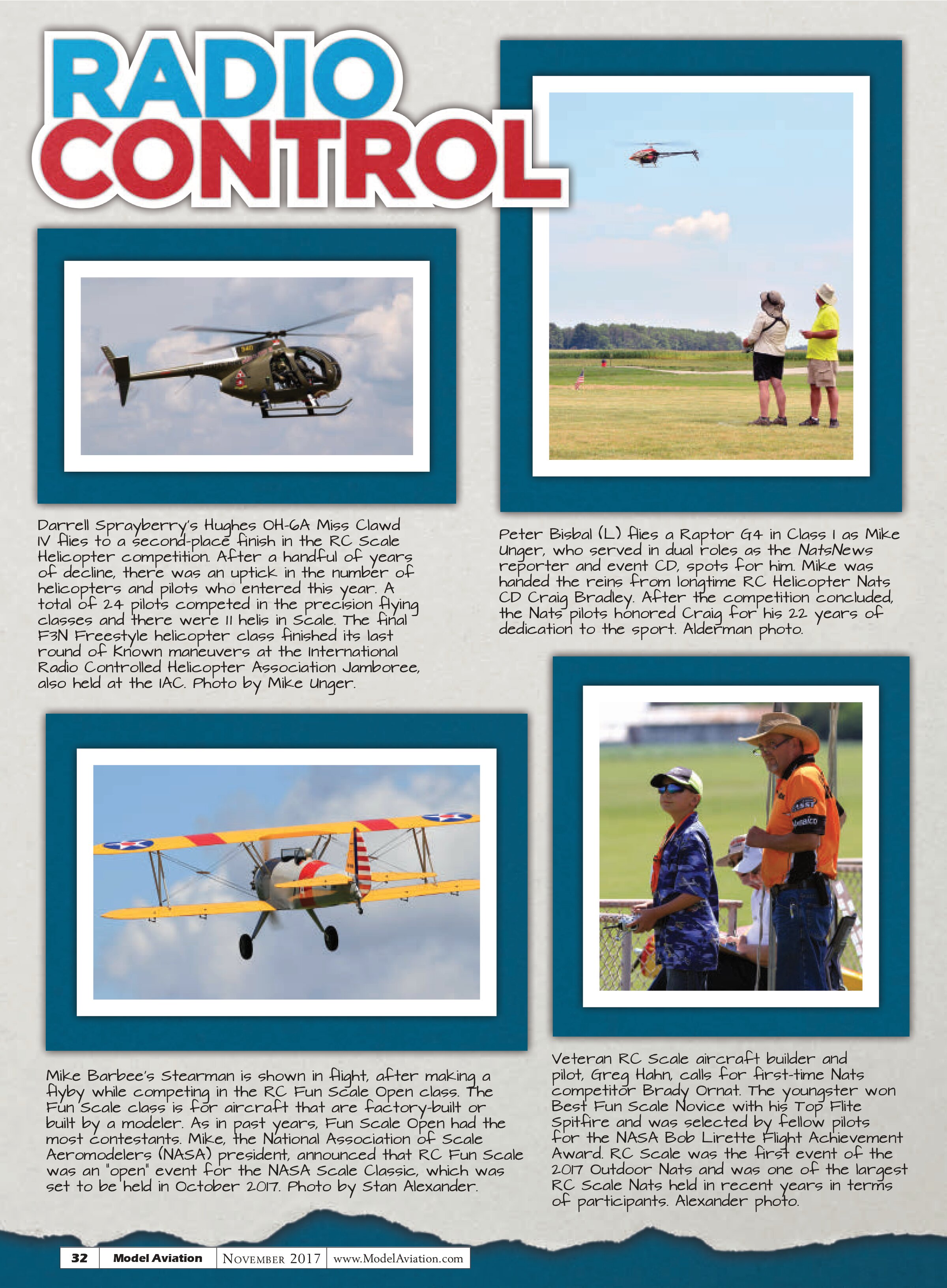
Darrell Sprayberry’s Hughes OH-6A Miss Clawd IV flies to a second-place finish in the RC Scale Helicopter competition. After a handful of years of decline, there was an uptick in the number of helicopters and pilots who entered this year. A total of 24 pilots competed in the precision flying classes and there were 11 entries in Scale. The final F3N Freestyle helicopter class finished its last round of Known maneuvers at the International Radio Controlled Helicopter Association Jamboree, also held at the IAC.Photo by Mike Unger.
Mike Barbee’s Stearman is shown in flight, after making a flyby while competing in the RC Fun Scale Open class. The Fun Scale class is for aircraft that are factory-built or built by a modeler. As in past years, Fun Scale Open had the most contestants. Mike, the National Association of Scale Aeromodelers (NASA) president, announced that RC Fun Scale was an “open” event for the NASA Scale Classic, which was set to be held in October 2017.Photo by Stan Alexander.
Peter Bisbal (L) flies a Raptor G4 in Class I as Mike Unger, who served in dual roles as the NatsNews reporter and event CD, spots for him. Mike was handed the reins from longtime RC Helicopter Nats CD Craig Bradley. After the competition concluded, the Nats pilots honored Craig for his 22 years of dedication to the sport.Alderman photo.
Veteran RC Scale aircraft builder and pilot, Greg Hahn, calls for first-time Nats competitor Brady Ornat. The youngster won Best Fun Scale Novice with his Top Flite Spitfire and was selected by fellow pilots for the NASA Bob Lirette Flight Achievement Award. RC Scale was the first event of the 2017 Outdoor Nats and was one of the largest RC Scale Nats held in recent years in terms of participants.Alexander photo.
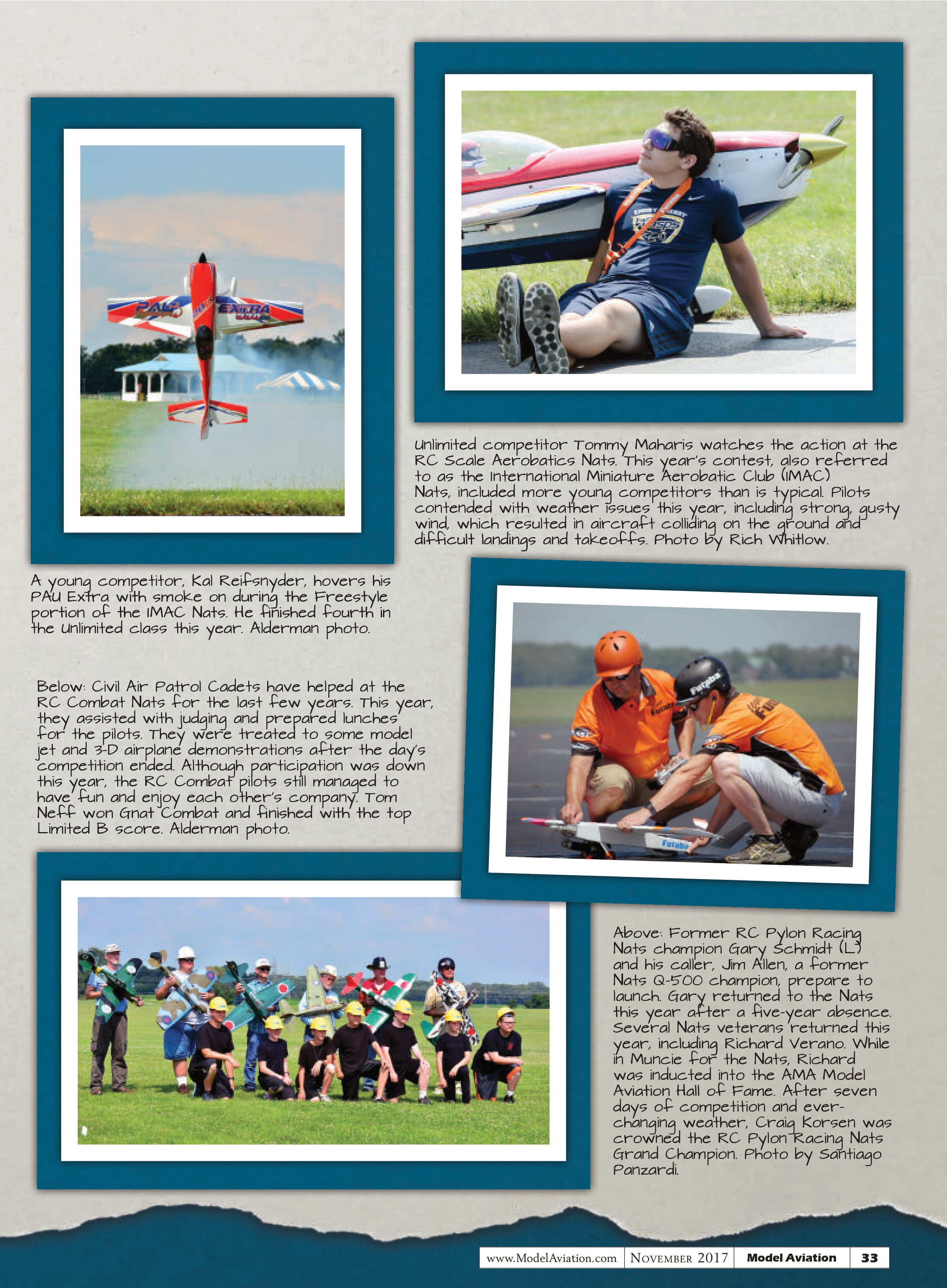
A young competitor, Kal Reifsnyder, hovers his PAU Extra with smoke on during the Freestyle portion of the IMAC Nats. He finished fourth in the Unlimited class this year.Alderman photo.
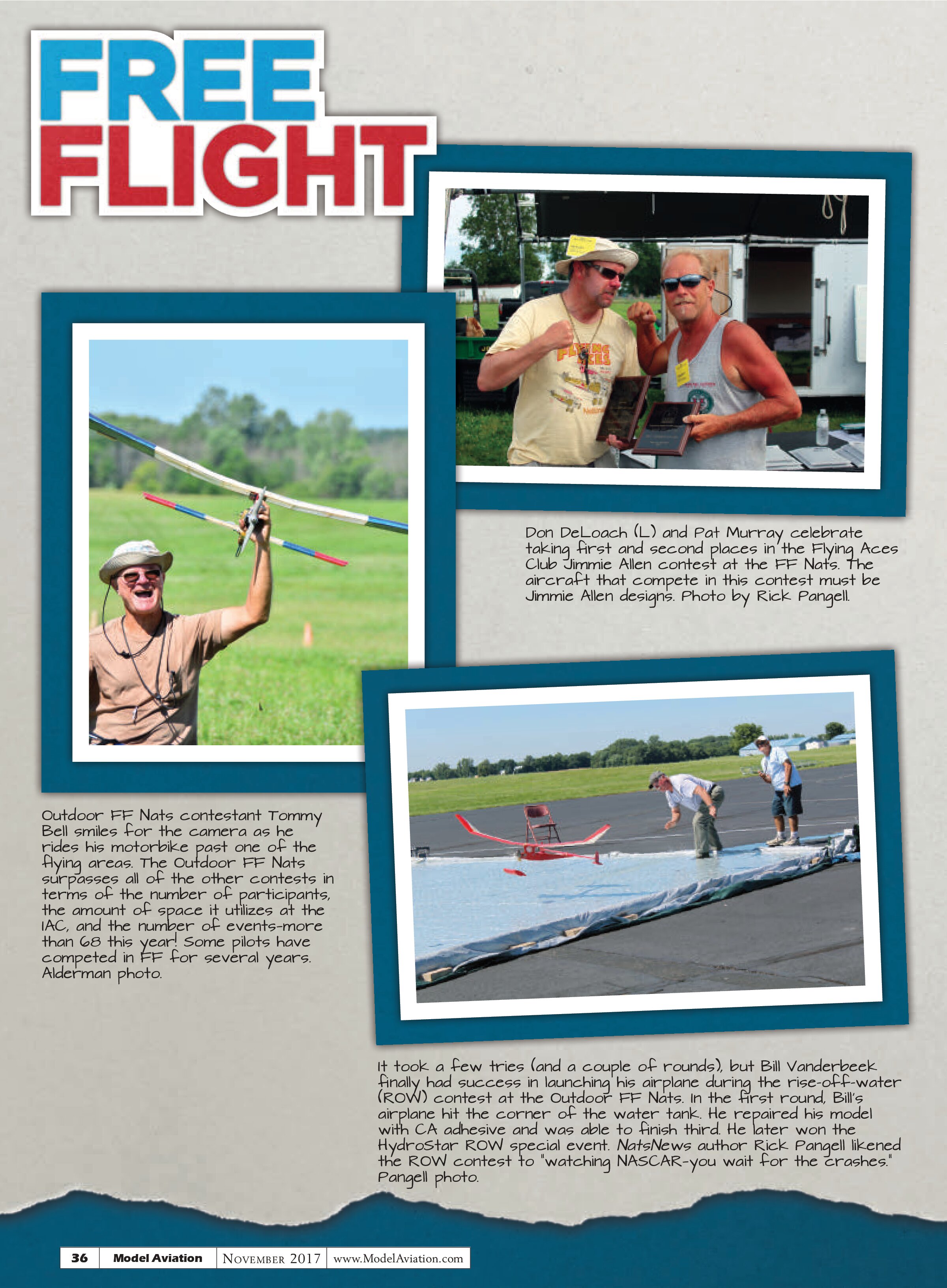
Below: Civil Air Patrol Cadets have helped at the RC Combat Nats for the last few years. This year, they assisted with judging and prepared lunches for the pilots. They were treated to some model jet and 3-D airplane demonstrations after the day’s competition ended. Although participation was down this year, the RC Combat pilots still managed to have fun and enjoy each other’s company. Tom Neff won Gnat Combat and finished with the top Limited B score. Alderman photo.
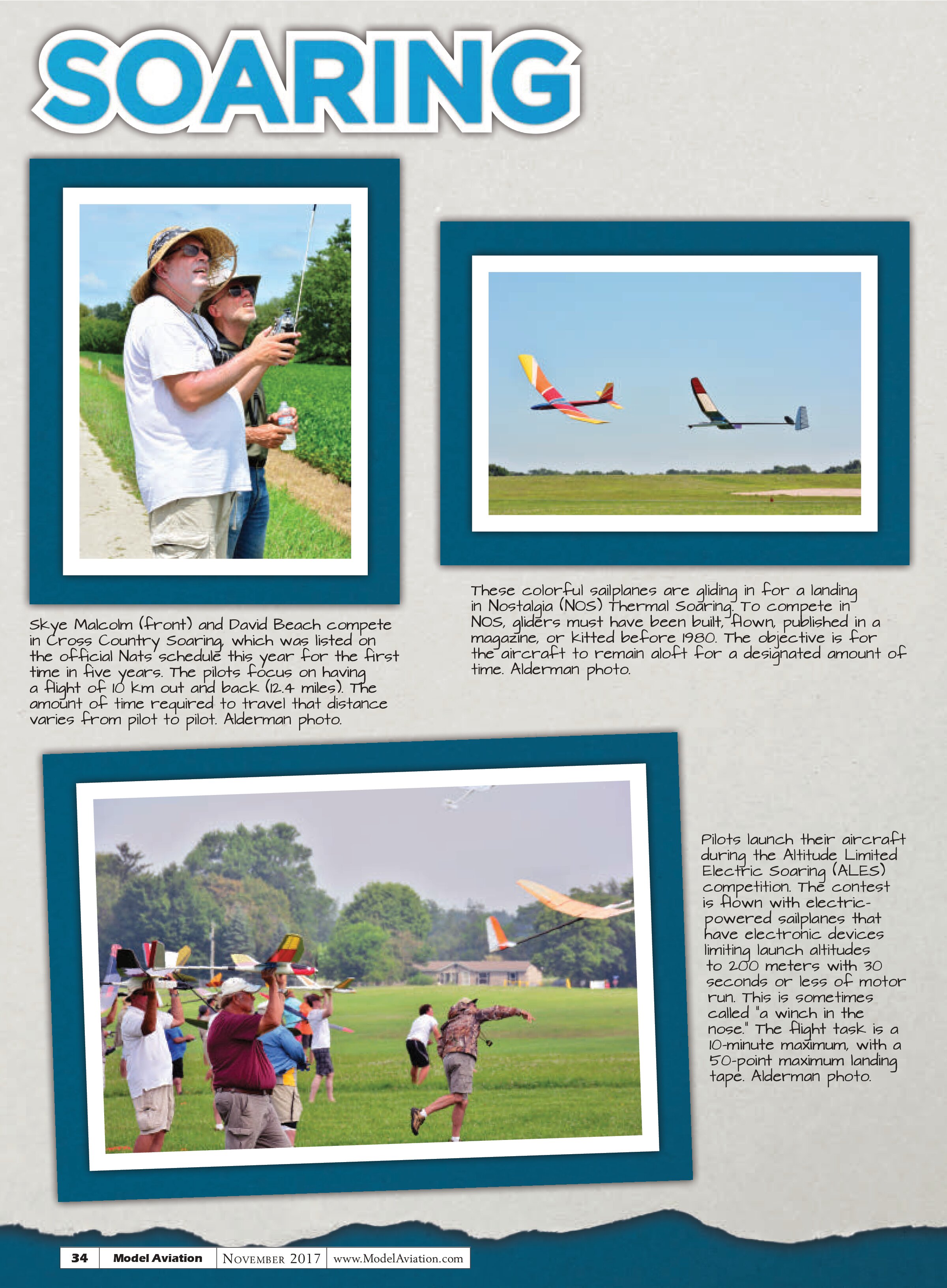
Unlimited competitor Tommy Maharis watches the action at the RC Scale Aerobatics Nats. This year’s contest, also referred to as the International Miniature Aerobatic Club (IMAC) Nats, included more young competitors than is typical. Pilots contended with weather issues this year, including strong, gusty wind, which resulted in aircraft colliding on the ground and difficult landings and takeoffs.Photo by Rich Whitlow.
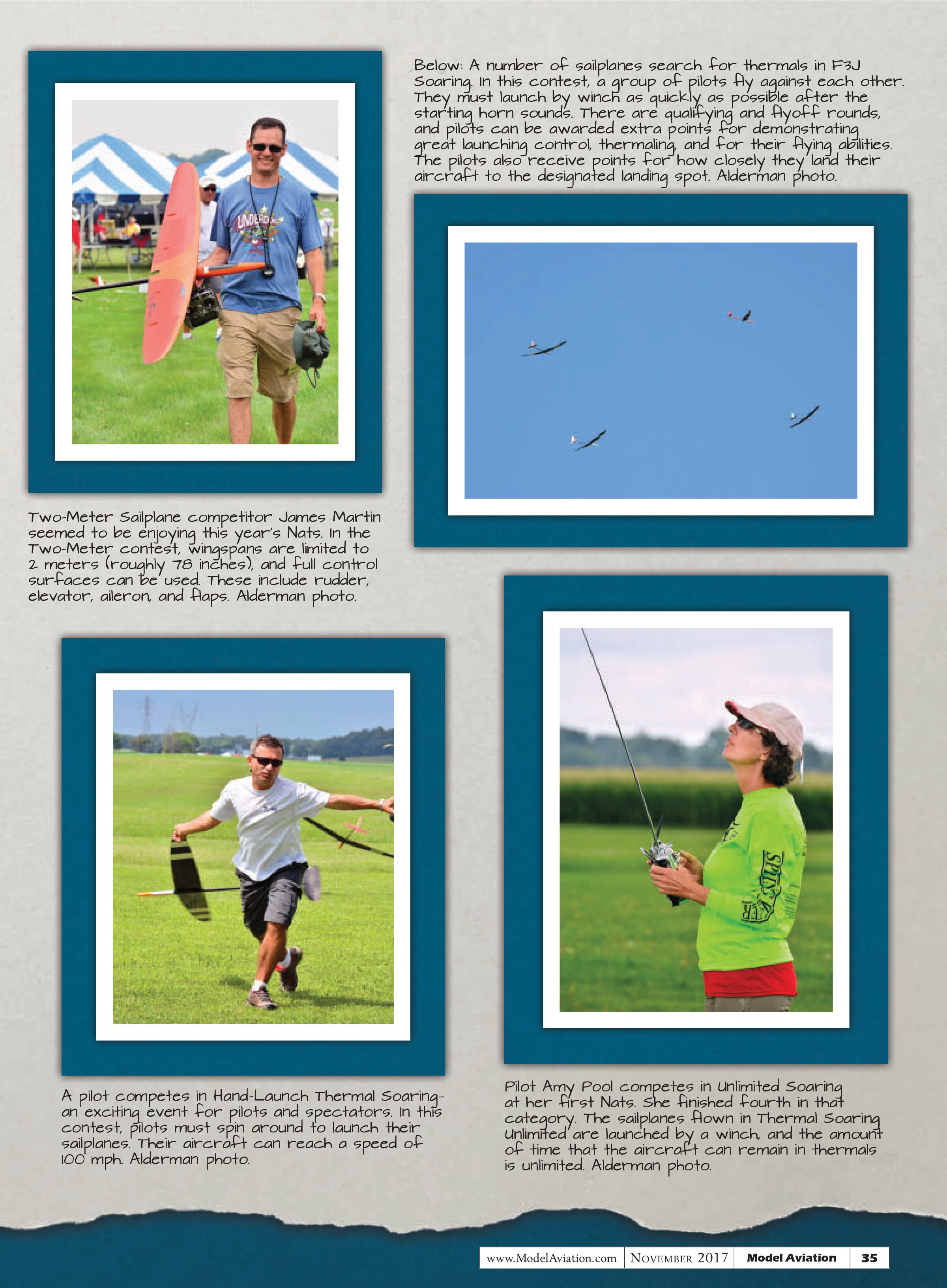
Above: Former RC Pylon Racing Nats champion Gary Schmidt (L) and his caller, Jim Allen, a former Nats Q-500 champion, prepare to launch. Gary returned to the Nats this year after a five-year absence. Several Nats veterans returned this year, including Richard Verano. While in Muncie for the Nats, Richard was inducted into the AMA Model Aviation Hall of Fame. After seven days of competition and ever-changing weather, Craig Korsen was crowned the RC Pylon Racing Nats Grand Champion.Photo by Santiago Panzardi.
Skye Malcolm (front) and David Beach compete in Cross Country Soaring, which was listed on the official Nats schedule this year for the first time in five years. The pilots focus on having a flight of 10 km out and back (12.4 miles). The amount of time required to travel that distance varies from pilot to pilot.Alderman photo.
These colorful sailplanes are gliding in for a landing in Nostalgia (NOS) Thermal Soaring. To compete in NOS, gliders must have been built, flown, published in a magazine, or kitted before 1980. The objective is for the aircraft to remain aloft for a designated amount of time.Alderman photo.
Pilots launch their aircraft during the Altitude Limited Electric Soaring (ALES) competition. The contest is flown with electric-powered sailplanes that have electronic devices limiting launch altitudes to 200 meters with 30 seconds or less of motor run. This is sometimes called “a winch in the nose.” The flight task is a 10-minute maximum, with a 50-point maximum landing tape.Alderman photo.
Two-Meter Sailplane competitor James Martin seemed to be enjoying this year’s Nats. In the Two-Meter contest, wingspans are limited to 2 meters (roughly 78 inches), and full control surfaces can be used. These include rudder, elevator, aileron, and flaps.Alderman photo.
Below: A number of sailplanes search for thermals in F3J Soaring. In this contest, a group of pilots fly against each other. They must launch by winch as quickly as possible after the starting horn sounds. There are qualifying and Flyoff rounds, and pilots can be awarded extra points for demonstrating great launching control, thermaling, and for their flying abilities. The pilots also receive points for how closely they land their aircraft to the designated landing spot.Alderman photo.
A pilot competes in Hand-Launch Thermal Soaring—an exciting event for pilots and spectators. In this contest, pilots must spin around to launch their sailplanes. Their aircraft can reach a speed of 100 mph.Alderman photo.
Pilot Amy Pool competes in Unlimited Soaring at her first Nats. She finished fourth in that category. The sailplanes flown in Thermal Soaring Unlimited are launched by a winch, and the amount of time that the aircraft can remain in thermals is unlimited.Alderman photo.
Outdoor FF Nats contestant Tommy Bell smiles for the camera as he rides his motorbike past one of the flying areas. The Outdoor FF Nats surpasses all of the other contests in terms of the number of participants, the amount of space it utilizes at the IAC, and the number of events—more than 68 this year! Some pilots have competed in FF for several years.
Outdoor FF Nats contestant Tommy Bell smiles for the camera as he rides his motorbike past one of the flying areas. The Outdoor FF Nats surpasses all of the other contests in terms of the number of participants, the amount of space it utilizes at the IAC, and the number of events-more than 68 this year! Some pilots have competed in FF for several years.Alderman photo.
Don DeLoach (L) and Pat Murray celebrate taking first and second places in the Flying Aces Club Jimmie Allen contest at the FF Nats. The aircraft that compete in this contest must be Jimmie Allen designs.
Don DeLoach (L) and Pat Murray celebrate taking first and second places in the Flying Aces Club Jimmie Allen contest at the FF Nats. The aircraft that compete in this contest must be Jimmie Allen designs.Photo by Rick Pangell.
It took a few tries (and a couple of rounds), but Bill Vanderbeek finally had success in launching his airplane during the rise-off-water (ROW) contest at the Outdoor FF Nats. In the first round, Bill’s airplane hit the corner of the water tank. He repaired his model with CA adhesive and was able to finish third. He later won the HydroStar ROW special event. NatsNews author Rick Pangell likened the ROW contest to “watching NASCAR—you wait for the crashes.”
It took a few tries (and a couple of rounds), but Bill Vanderbeek finally had success in launching his airplane during the rise-off-water (ROW) contest at the Outdoor FF Nats. In the first round, Bill’s airplane hit the corner of the water tank. He repaired his model with CA adhesive and was able to finish third. He later won the HydroStar ROW special event. NatsNews author Rick Pangell likened the ROW contest to “watching NASCAR—you wait for the crashes.”Pangell photo.
On the Road!
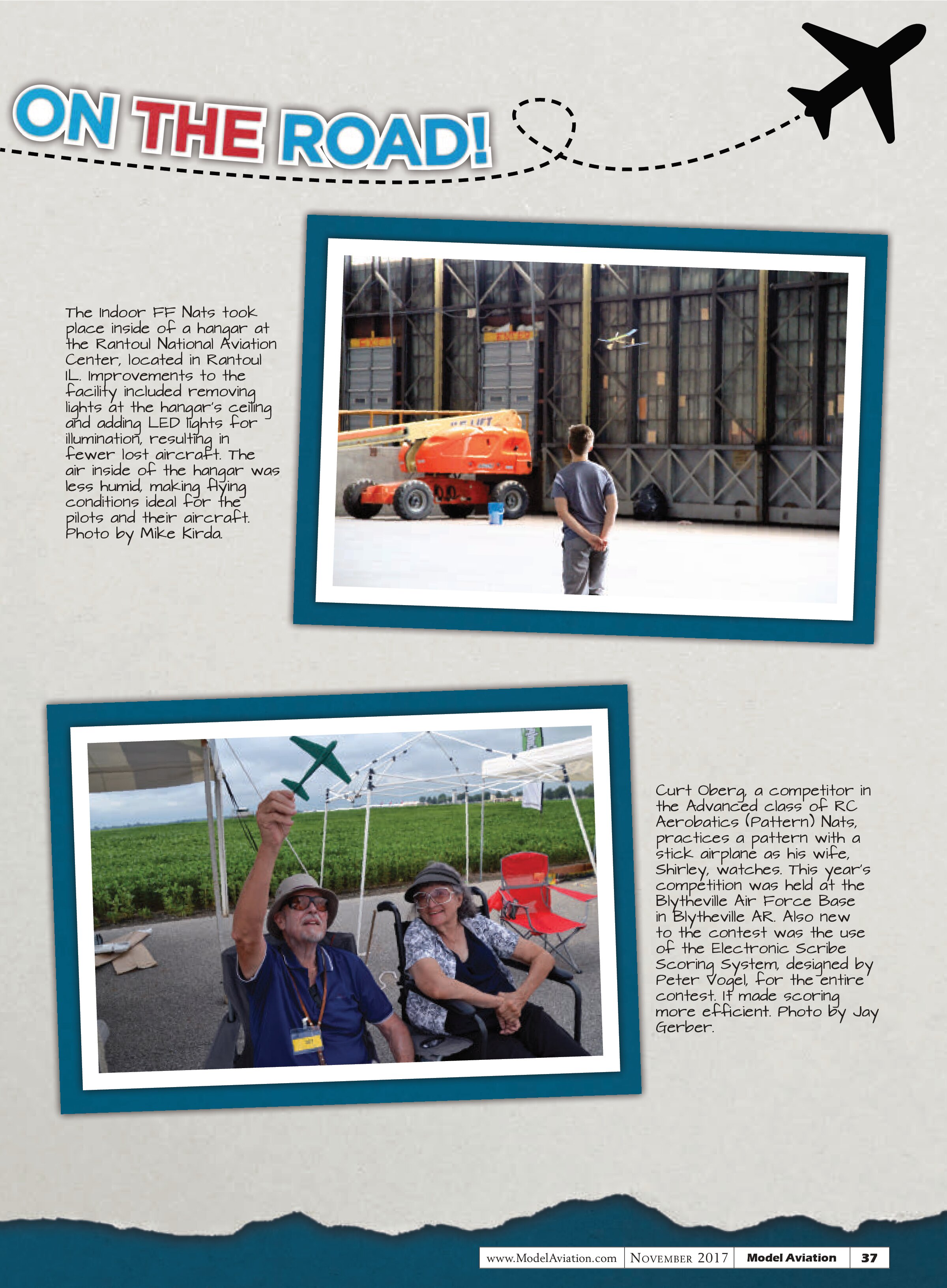
The Indoor FF Nats took place inside of a hangar at the Rantoul National Aviation Center, located in Rantoul IL. Improvements to the facility included removing lights at the hangar’s ceiling and adding LED lights for illumination, resulting in fewer lost aircraft. The air inside of the hangar was less humid, making flying conditions ideal for the pilots and their aircraft.
The Indoor FF Nats took place inside of a hangar at the Rantoul National Aviation Center, located in Rantoul IL. Improvements to the facility included removing lights at the hangar’s ceiling and adding LED lights for illumination, resulting in fewer lost aircraft. The air inside of the hangar was less humid, making flying conditions ideal for the pilots and their aircraft.Photo by Mike Kirda.
Curt Oberg, a competitor in the Advanced class of RC Aerobatics (Pattern) Nats, practices a pattern with a stick airplane as his wife, Shirley, watches. This year’s competition was held at the Blytheville Air Force Base in Blytheville AR. Also new to the contest was the use of the Electronic Scribe Scoring System, designed by Peter Vogel, for the entire contest. It made scoring more efficient.
Curt Oberg, a competitor in the Advanced class of RC Aerobatics (Pattern) Nats, practices a pattern with a stick airplane as his wife, Shirley, watches. This year’s competition was held at the Blytheville Air Force Base in Blytheville AR. Also new to the contest was the use of the Electronic Scribe Scoring System, designed by Peter Vogel, for the entire contest. It made scoring more efficient.Photo by Jay Gerber.