Change is good
Sometimes we need a change in our lives to keep us moving forward and improve our quality of life. As I write this column, I am preparing for a big change in my life. After flying turboprops for the regional airlines throughout the last 28 years, I am heading into training on a new aircraft type!
At 53 years of age, I am not only learning how to fly a new aircraft, but am starting out in a new company. I have chosen to take advantage of a flow-through agreement that Piedmont Airlines offers, allowing me to work for mainline American Airlines. I am not sure what aircraft I will be flying—I will get to bid on that during the first week of training. It should be a challenging and rewarding experience!
My ground school and simulator training will put a stop to my modeling until I am finished, but I did get a chance to complete one last project in time for this column.
New Lightweight Servos
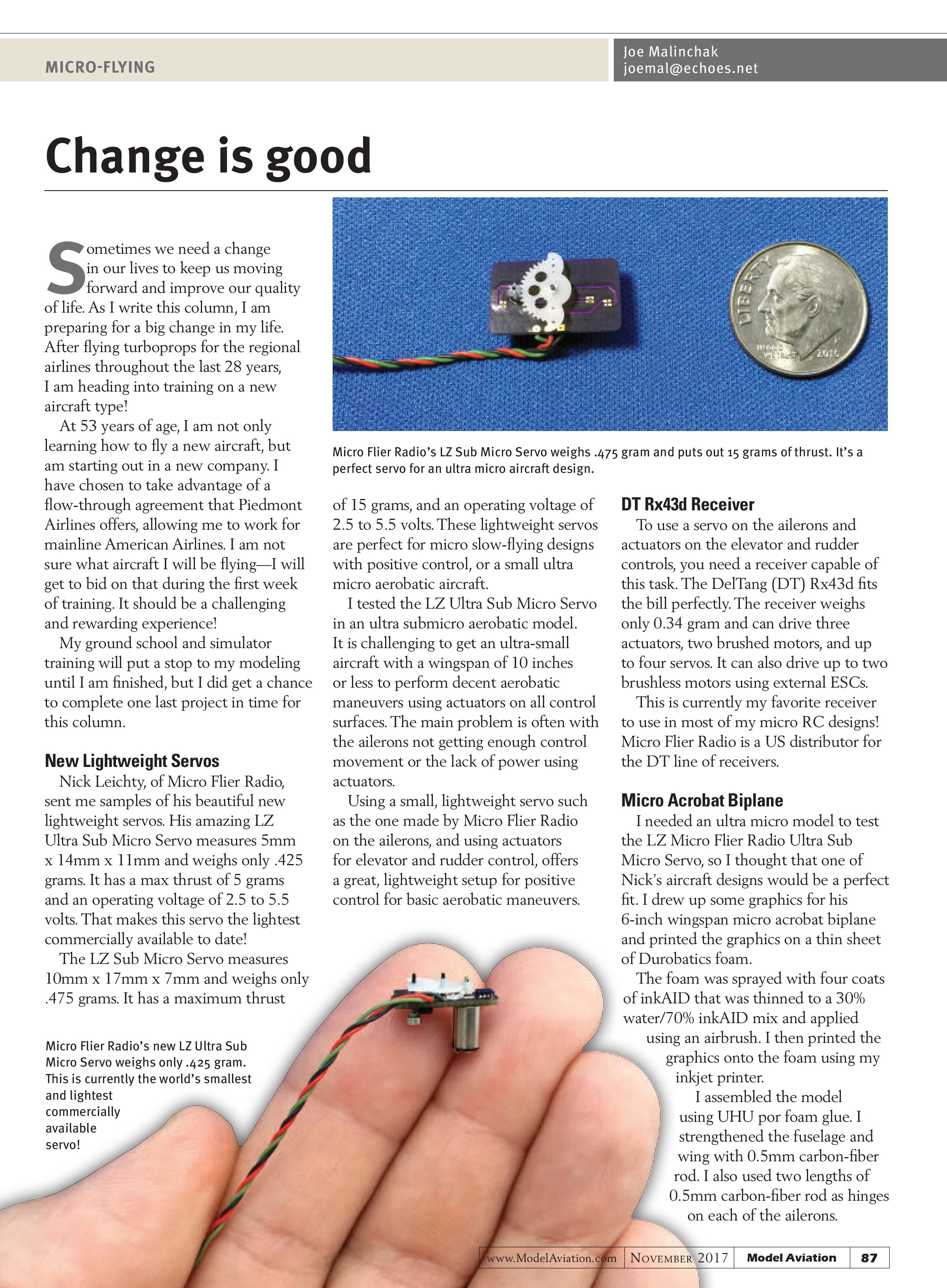
Nick Leichty, of Micro Flier Radio, sent me samples of his beautiful new lightweight servos. His amazing LZ Ultra Sub Micro Servo measures 5mm x 14mm x 11mm and weighs only .425 grams. It has a max thrust of 5 grams and an operating voltage of 2.5 to 5.5 volts. That makes this servo the lightest commercially available to date!
The LZ Sub Micro Servo measures 10mm x 17mm x 7mm and weighs only .475 grams. It has a maximum thrust of 15 grams, and an operating voltage of 2.5 to 5.5 volts. These lightweight servos are perfect for micro slow-flying designs with positive control, or a small ultra micro aerobatic aircraft.
I tested the LZ Ultra Sub Micro Servo in an ultra submicro aerobatic model. It is challenging to get an ultra-small aircraft with a wingspan of 10 inches or less to perform decent aerobatic maneuvers using actuators on all control surfaces. The main problem is often with the ailerons not getting enough control movement or the lack of power using actuators.
Using a small, lightweight servo such as the one made by Micro Flier Radio on the ailerons, and using actuators for elevator and rudder control, offers a great, lightweight setup for positive control for basic aerobatic maneuvers.


DT Rx43d Receiver
To use a servo on the ailerons and actuators on the elevator and rudder controls, you need a receiver capable of this task. The DelTang (DT) Rx43d fits the bill perfectly. The receiver weighs only 0.34 gram and can drive three actuators, two brushed motors, and up to four servos. It can also drive up to two brushless motors using external ESCs.
This is currently my favorite receiver to use in most of my micro RC designs! Micro Flier Radio is a US distributor for the DT line of receivers.
Micro Acrobat Biplane
I needed an ultra micro model to test the LZ Micro Flier Radio Ultra Sub Micro Servo, so I thought that one of Nick’s aircraft designs would be a perfect fit. I drew up some graphics for his 6-inch wingspan micro acrobat biplane and printed the graphics on a thin sheet of Durobatics foam.
The foam was sprayed with four coats of inkAID that was thinned to a 30% water/70% inkAID mix and applied using an airbrush. I then printed the graphics onto the foam using my inkjet printer.
I assembled the model using UHU por foam glue. I strengthened the fuselage and wing with 0.5mm carbon-fiber rod. I also used two lengths of 0.5mm carbon-fiber rod as hinges on each of the ailerons.
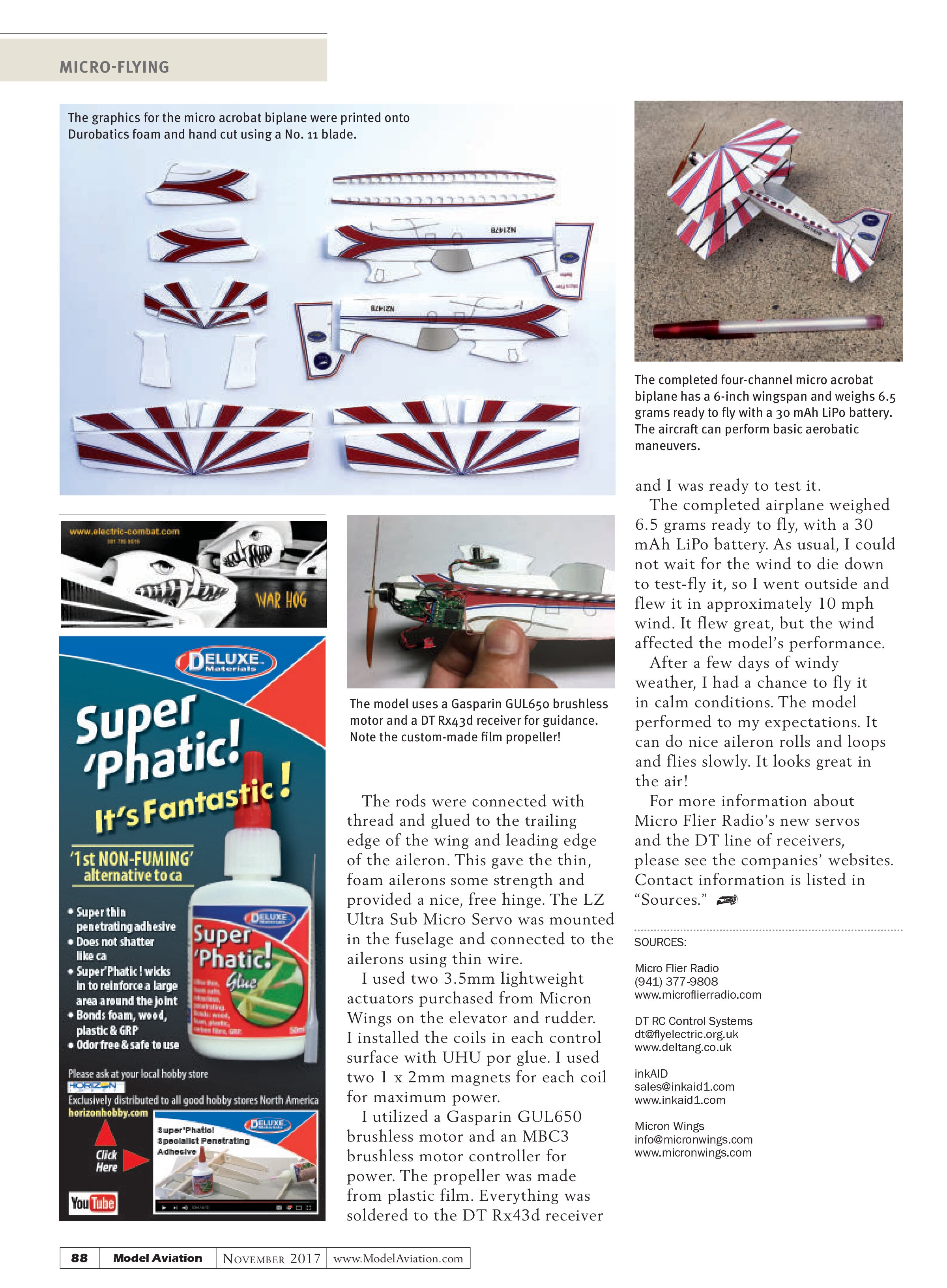
The graphics for the micro acrobat biplane were printed onto Durobatics foam and hand cut using a No. 11 blade.

The model uses a Gasparin GUL650 brushless motor and a DT Rx43d receiver for guidance. Note the custom-made film propeller!

The rods were connected with thread and glued to the trailing edge of the wing and leading edge of the aileron. This gave the thin foam ailerons some strength and provided a nice, free hinge. The LZ Ultra Sub Micro Servo was mounted in the fuselage and connected to the ailerons using thin wire.
I used two 3.5mm lightweight actuators purchased from Micron Wings on the elevator and rudder. I installed the coils in each control surface with UHU por glue. I used two 1 x 2mm magnets for each coil for maximum power.
I utilized a Gasparin GUL650 brushless motor and an MBC3 brushless motor controller for power. The propeller was made from plastic film. Everything was soldered to the DT Rx43d receiver and I was ready to test it.

The completed airplane weighed 6.5 grams ready to fly, with a 30 mAh LiPo battery. As usual, I could not wait for the wind to die down to test-fly it, so I went outside and flew it in approximately 10 mph wind. It flew great, but the wind affected the model’s performance.
After a few days of windy weather, I had a chance to fly it in calm conditions. The model performed to my expectations. It can do nice aileron rolls and loops and flies slowly. It looks great in the air!
For more information about Micro Flier Radio’s new servos and the DT line of receivers, please see the companies’ websites. Contact information is listed in “Sources.”
Sources:
Micro Flier Radio
(941) 377-9808
www.microflierradio.com
DT RC Control Systems
dt@flyelectric.org.uk
www.deltang.co.uk
inkAID
sales@inkaid1.com
www.inkaid1.com
Micron Wings
info@micronwings.com
www.micronwings.com