I Am the AMA
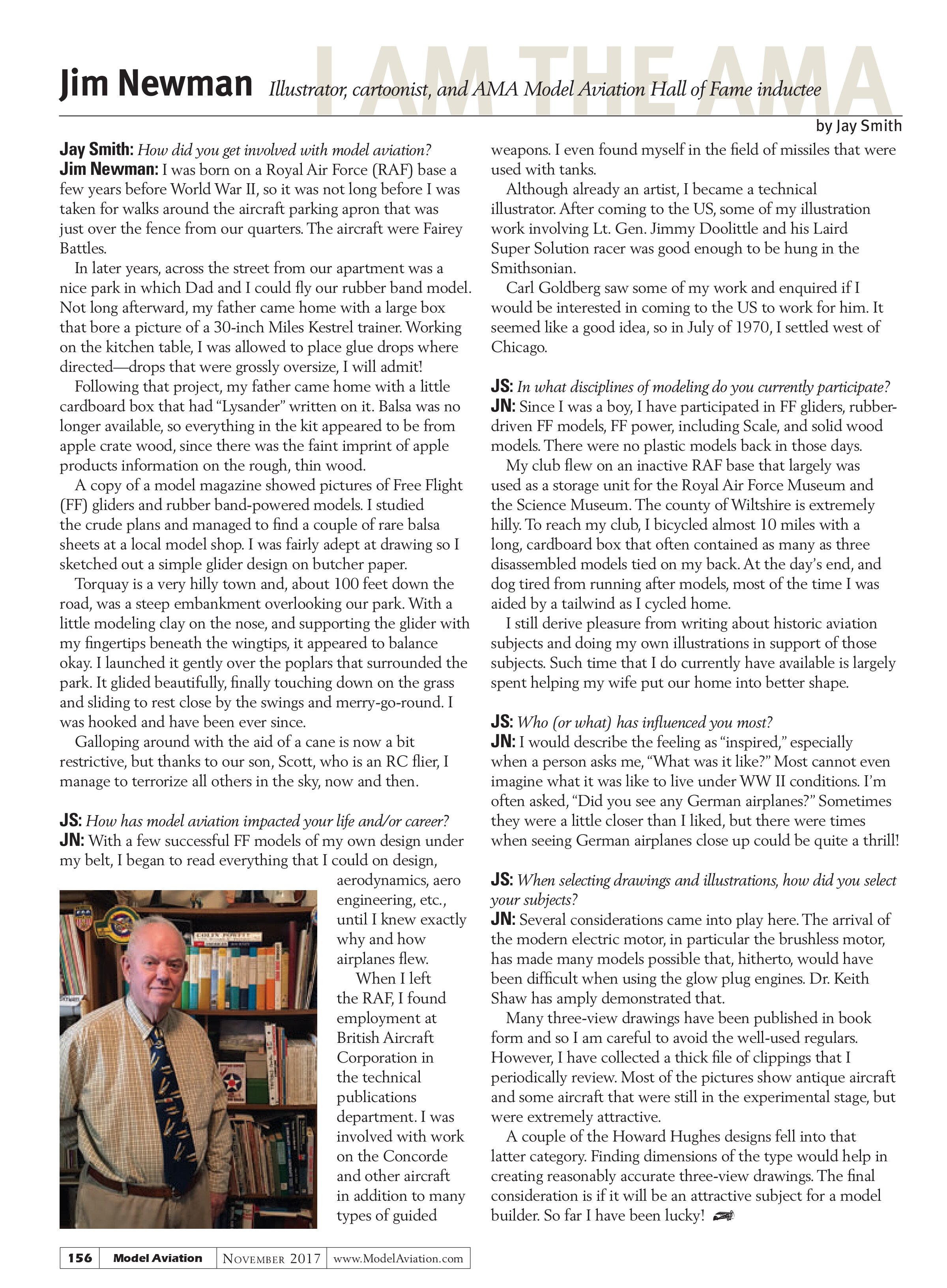
Jim Newman Illustrator, cartoonist, and AMA Model Aviation Hall of Fame inductee
by Jay Smith
Jay Smith: How did you get involved with model aviation?
Jim Newman: I was born on a Royal Air Force (RAF) base a few years before World War II, so it was not long before I was taken for walks around the aircraft parking apron that was just over the fence from our quarters. The aircraft were Fairey Battles.
In later years, across the street from our apartment was a nice park in which Dad and I could fly our rubber band model. Not long afterward, my father came home with a large box that bore a picture of a 30-inch Miles Kestrel trainer. Working on the kitchen table, I was allowed to place glue drops where directed—drops that were grossly oversize, I will admit!
Following that project, my father came home with a little cardboard box that had “Lysander” written on it. Balsa was no longer available, so everything in the kit appeared to be from apple crate wood, since there was the faint imprint of apple products information on the rough, thin wood.
A copy of a model magazine showed pictures of Free Flight (FF) gliders and rubber band-powered models. I studied the crude plans and managed to find a couple of rare balsa sheets at a local model shop. I was fairly adept at drawing so I sketched out a simple glider design on butcher paper.
Torquay is a very hilly town and, about 100 feet down the road, was a steep embankment overlooking our park. With a little modeling clay on the nose, and supporting the glider with my fingertips beneath the wingtips, it appeared to balance okay. I launched it gently over the poplars that surrounded the park. It glided beautifully, finally touching down on the grass and sliding to rest close by the swings and merry-go-round. I was hooked and have been ever since.
Galloping around with the aid of a cane is now a bit restrictive, but thanks to our son, Scott, who is an RC flier, I manage to terrorize all others in the sky, now and then.
JS: How has model aviation impacted your life and/or career?
JN: With a few successful FF models of my own design under my belt, I began to read everything that I could on design,

aerodynamics, aero engineering, etc., until I knew exactly why and how airplanes flew. When I left the RAF, I found employment at British Aircraft Corporation in the technical publications department. I was involved with work on the Concorde and other aircraft in addition to many types of guided weapons. I even found myself in the field of missiles that were used with tanks.
Although already an artist, I became a technical illustrator. After coming to the US, some of my illustration work involving Lt. Gen. Jimmy Doolittle and his Laird Super Solution racer was good enough to be hung in the Smithsonian.
Carl Goldberg saw some of my work and enquired if I would be interested in coming to the US to work for him. It seemed like a good idea, so in July of 1970, I settled west of Chicago.
JS: In what disciplines of modeling do you currently participate?
JN: Since I was a boy, I have participated in FF gliders, rubber-driven FF models, FF power, including Scale, and solid wood models. There were no plastic models back in those days.
My club flew on an inactive RAF base that largely was used as a storage unit for the Royal Air Force Museum and the Science Museum. The county of Wiltshire is extremely hilly. To reach my club, I bicycled almost 10 miles with a long, cardboard box that often contained as many as three disassembled models tied on my back. At the day’s end, and dog tired from running after models, most of the time I was aided by a tailwind as I cycled home.
I still derive pleasure from writing about historic aviation subjects and doing my own illustrations in support of those subjects. Such time that I do currently have available is largely spent helping my wife put our home into better shape.
JS: Who (or what) has influenced you most?
JN: I would describe the feeling as “inspired,” especially when a person asks me, “What was it like?” Most cannot even imagine what it was like to live under WW II conditions. I’m often asked, “Did you see any German airplanes?” Sometimes they were a little closer than I liked, but there were times when seeing German airplanes close up could be quite a thrill!
JS: When selecting drawings and illustrations, how did you select your subjects?
JN: Several considerations came into play here. The arrival of the modern electric motor, in particular the brushless motor, has made many models possible that, hitherto, would have been difficult when using the glow plug engines. Dr. Keith Shaw has amply demonstrated that.
Many three-view drawings have been published in book form and so I am careful to avoid the well-used regulars. However, I have collected a thick file of clippings that I periodically review. Most of the pictures show antique aircraft and some aircraft that were still in the experimental stage, but were extremely attractive.
A couple of the Howard Hughes designs fell into that latter category. Finding dimensions of the type would help in creating reasonably accurate three-view drawings. The final consideration is if it will be an attractive subject for a model builder. So far I have been lucky!