Designs for Gas One-Design
by Gene Smith
grwhiskey@brightok.net
Aircraft for the 2018 One-Design Gas event are both Early Nostalgia models—the Smarty and the Jasco Streak. Build and fly them with early ½A Nostalgia Gas (NosGas) Free Flight (FF) rules and engines.
Both are available through the AMA Plans Service. The Jasco Streak is #24480 and the Smarty is #20590. The National Free Flight Society (NFFS) also has the Smarty plans (P332), and BMJR Models has kits for both the Smarty and the Jasco Streak, which the company calls the Streak.
FF Scale Performance
The performance of Scale FF models has improved greatly throughout the last couple of decades. There are several compelling reasons to consider adding a dethermalizer (DT) to your Scale FF model.
The most important reason is that a DT will save your model when you are flight trimming. My first Corben Super Ace would have been lost in thermals four times before its first contest, had it not been equipped with a DT.
When you are flying in a mass launch, a DT can keep your model on the field in the first heat or two. As a rule, anything longer than a minute keeps you in the hunt, so you can put in a healthy number of turns and still stay on the field.
You can set the DT for a long time in the final round. Put an extra turn in the DT and it is easy to get a 4- or 5-minute flight. How long you set the timer for depends on how much of a risk you’re willing to take on possibly losing your model.
There is a downside to using a DT. If you set it too short, you can knock yourself out of competition in a mass launch or timed event. This is the voice of experience.
Stretch Cord for Timers
I use a .009 wire coil spring to activate the viscous timers on my Gas FF models, but I have settled on .75mm clear stretch cord to activate the timers on my Scale FF models. It’s sold in craft stores in the beading section.
I tie a simple overhand knot to make a loop in the timer end of the cord. The stretch cord doesn’t like to hold a knot, so I put a tiny drop of white craft glue on the knot for insurance. The stretch cord is typically approximately ¾ of the length of the fuselage. It is tied to 4-pound test monofilament that holds down the stabilizer.
Calibrating Timers
Calibrating your timer is a matter of trial and error. I use a Sharpie to mark the cord where I think the knot should be and tie the knot just snug enough to test. If I have to shorten or lengthen the line, I pull out the knot with fine-tip tweezers and retie it, using the mark as a guide.
On Flying Aces Club (FAC) mass-launch event models, I aim for 3 to 4 minutes with one turn of the timer. On a total of three flight event models, I aim for slightly more than 2 minutes on one turn.
Viscous Timers
Temperature will marginally affect the speed of a viscous timer. When the temperature is cooler, it will run longer; when it is warmer, it will run faster. I like to “exercise” the timer at the start of a session, turning it full circle several times before the first calibration of the day. It helps to remove any “stiffness” in the viscous material in the timer. Overall, I find viscous timers to be consistent.


Bad Axe Embryo and Martin Mauler
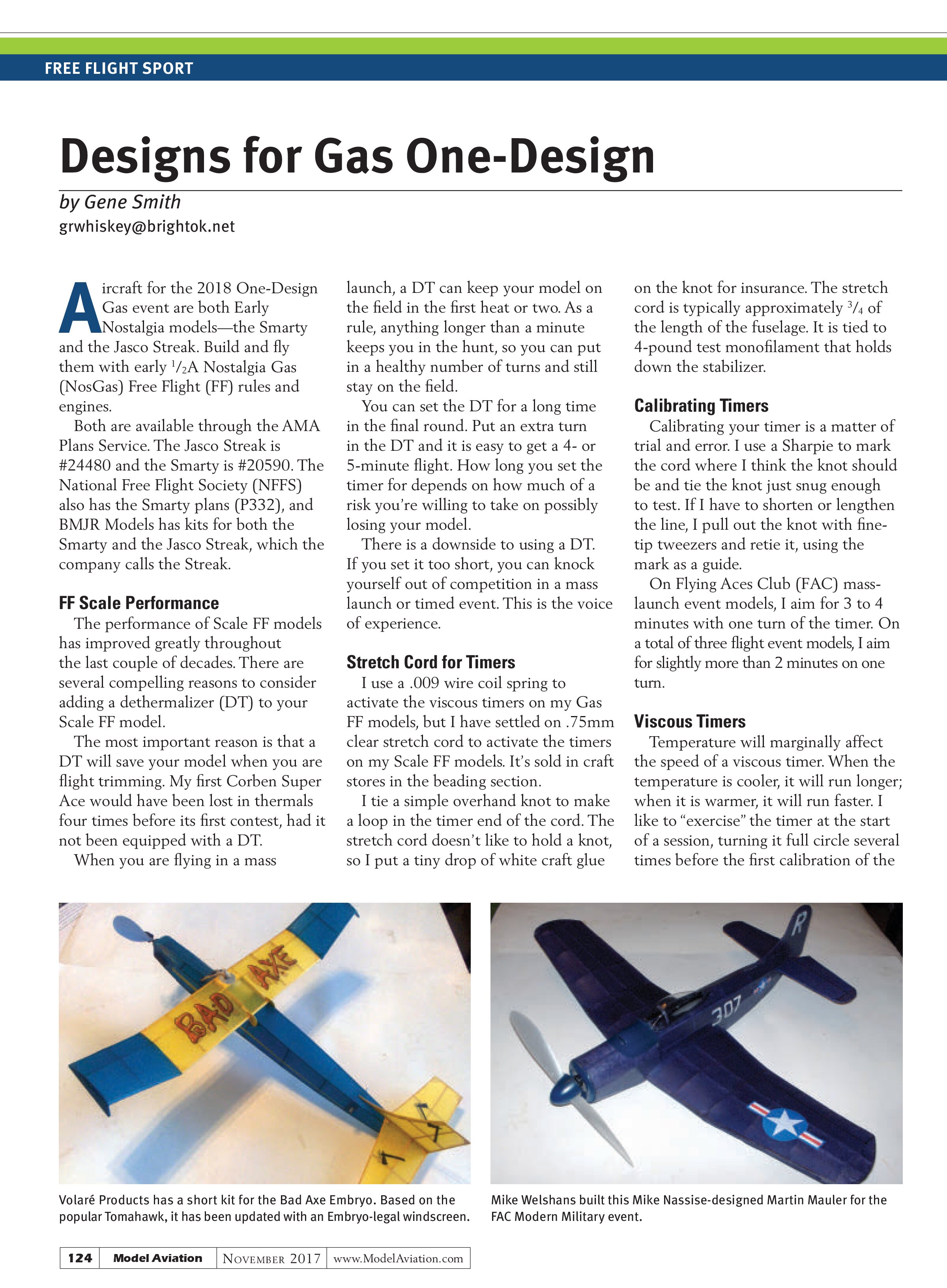
Mike Welshans sent a picture of the Bad Axe Embryo that he built from a Volaré Products short kit. Weighing 21 grams without rubber, it’s slightly heavier than planned, but it still has good potential. The DT is a fuse-activated pop-up wing.

Mike installed a Gizmo Geezer propeller assembly that added to the weight, but it also eliminated the need to braid the motor. George Bredehoft, owner of Volaré Products, flew his Bad Axe to victory at this year’s FF Nats.
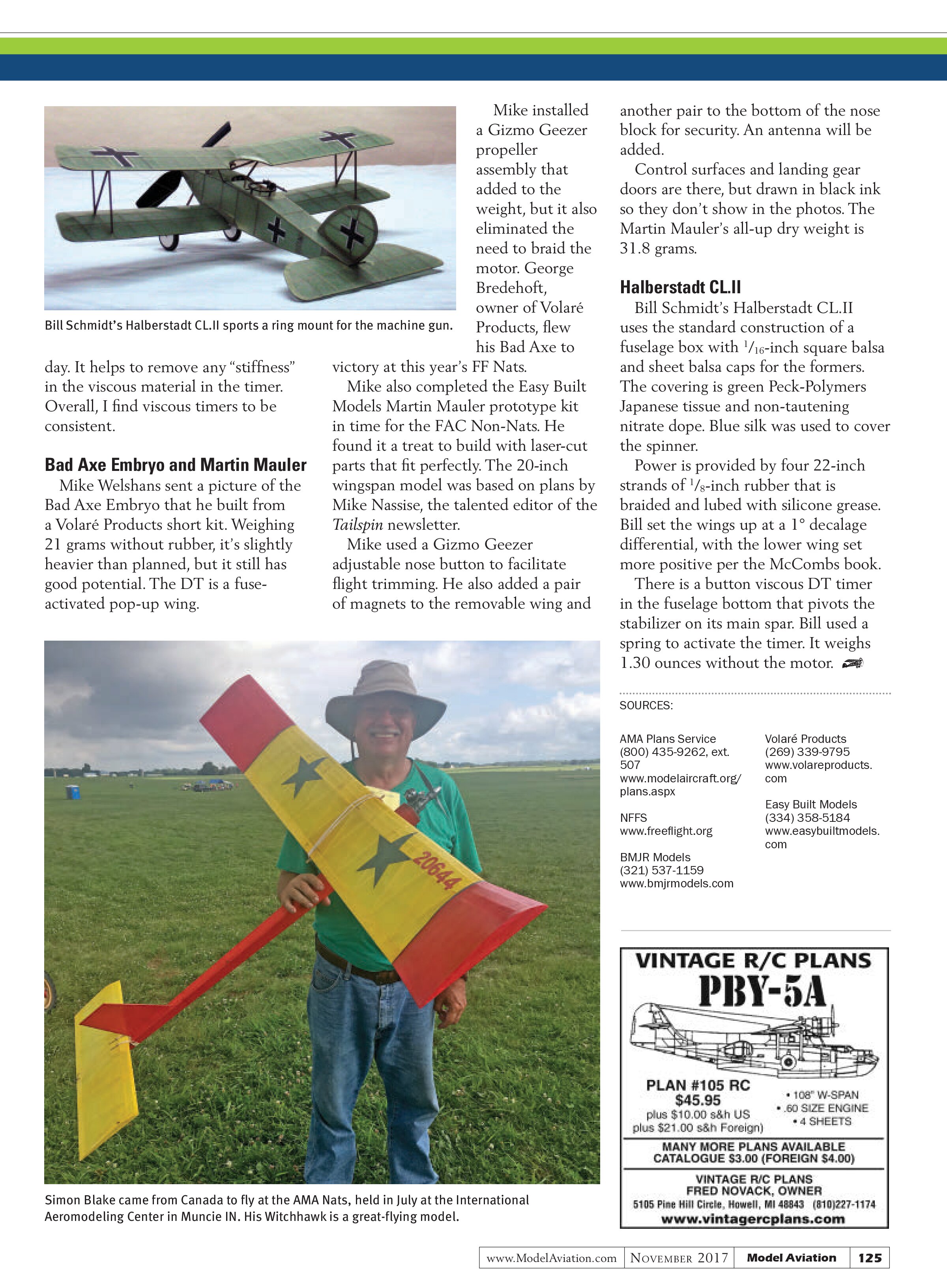
Mike also completed the Easy Built Models Martin Mauler prototype kit in time for the FAC Non-Nats. He found it a treat to build with laser-cut parts that fit perfectly. The 20-inch wingspan model was based on plans by Mike Nassise, the talented editor of the Tailspin newsletter.
Mike used a Gizmo Geezer adjustable nose button to facilitate flight trimming. He also added a pair of magnets to the removable wing and another pair to the bottom of the nose block for security. An antenna will be added.
Control surfaces and landing gear doors are there, but drawn in black ink so they don’t show in the photos. The Martin Mauler’s all-up dry weight is 31.8 grams.
Halberstadt CL.II
Bill Schmidt’s Halberstadt CL.II uses the standard construction of a fuselage box with 1/16-inch square balsa and sheet balsa caps for the formers. The covering is green Peck-Polymers Japanese tissue and non-tautening nitrate dope. Blue silk was used to cover the spinner.
Power is provided by four 22-inch strands of 1/8-inch rubber that is braided and lubed with silicone grease. Bill set the wings up at a 1° decalage differential, with the lower wing set more positive per the McCombs book.
There is a button viscous DT timer in the fuselage bottom that pivots the stabilizer on its main spar. Bill used a spring to activate the timer. It weighs 1.30 ounces without the motor.
SOURCES:
AMA Plans Service
(800) 435-9262, ext. 507
www.modelaircraft.org/plans.aspx
BMJR Models
(321) 537-1159
www.bmj rmodels.com
Volaré Products
(269) 339-9795
www.volareproducts.com
Easy Built Models
(334) 358-5184
www.easybuiltmodels.com