Focal Point
Sky Skimmer

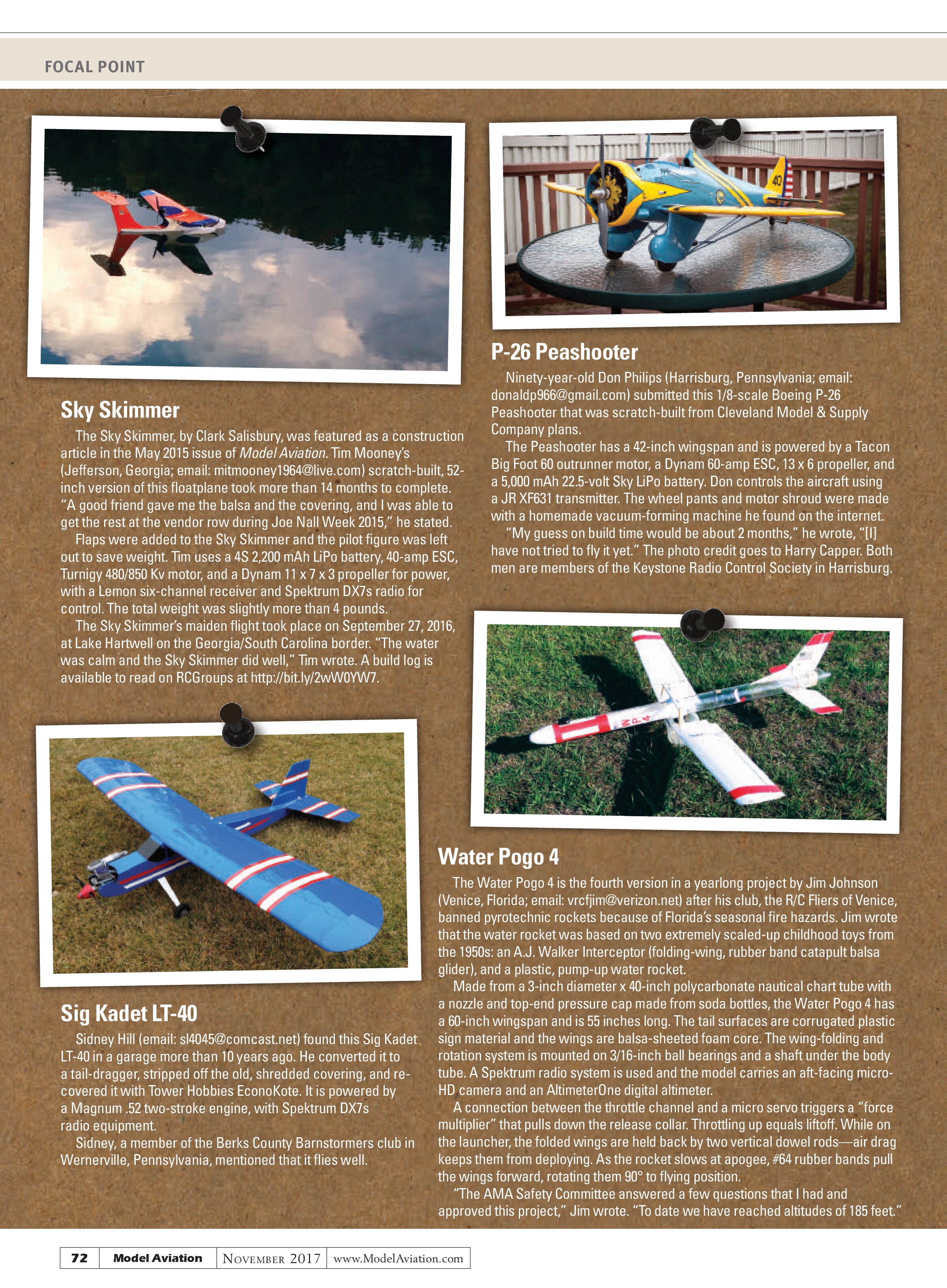
The Sky Skimmer, by Clark Salisbury, was featured as a construction article in the May 2015 issue of Model Aviation. Tim Mooney’s (Jefferson, Georgia; email: mitmooney1964@live.com) scratch-built, 52-inch version of this floatplane took more than 14 months to complete. “A good friend gave me the balsa and the covering, and I was able to get the rest at the vendor row during Joe Nall Week 2015,” he stated.
Flaps were added to the Sky Skimmer and the pilot figure was left out to save weight. Tim uses a 4S 2,200 mAh LiPo battery, 40-amp ESC, Turnigy 480/850 Kv motor, and a Dynam 11 x 7 x 3 propeller for power, with a Lemon six-channel receiver and Spektrum DX7s radio for control. The total weight was slightly more than 4 pounds.
The Sky Skimmer’s maiden flight took place on September 27, 2016, at Lake Hartwell on the Georgia/South Carolina border. “The water was calm and the Sky Skimmer did well,” Tim wrote. A build log is available to read on RCGroups at http://bit.ly/2wW0YW7.
Sig Kadet LT-40

Sidney Hill (email: sl4045@comcast.net) found this Sig Kadet LT-40 in a garage more than 10 years ago. He converted it to a tail-dragger, stripped off the old, shredded covering, and re-covered it with Tower Hobbies EconoKote. It is powered by a Magnum .52 two-stroke engine, with Spektrum DX7s radio equipment.
Sidney, a member of the Berks County Barnstormers club in Wernersville, Pennsylvania, mentioned that it flies well.
P-26 Peashooter

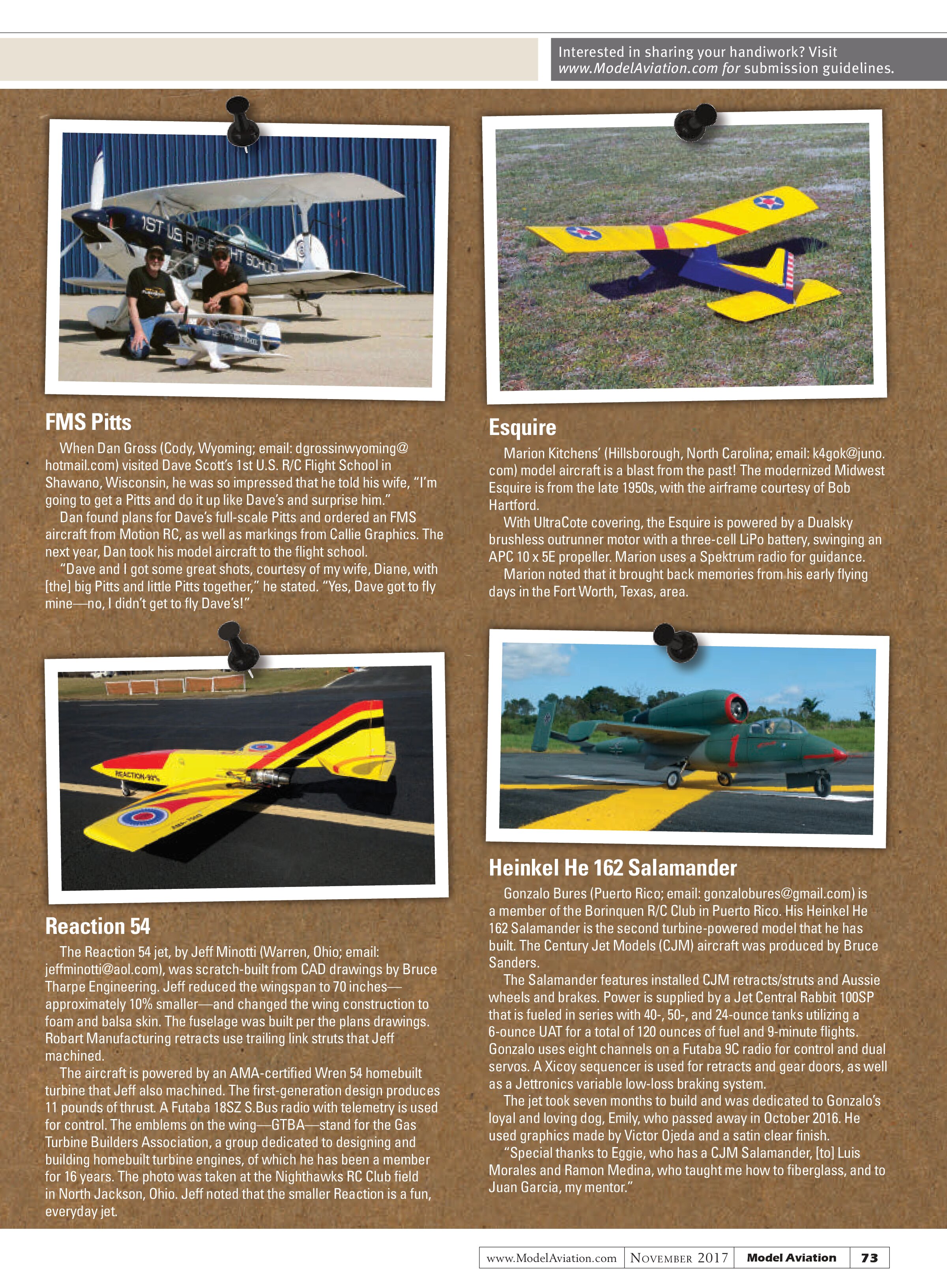
Ninety-year-old Don Philips (Harrisburg, Pennsylvania; email: donaldp966@gmail.com) submitted this 1/8-scale Boeing P-26 Peashooter that was scratch-built from Cleveland Model & Supply Company plans.
The Peashooter has a 42-inch wingspan and is powered by a Tacon Big Foot 60 outrunner motor, a Dynam 60-amp ESC, 13 x 6 propeller, and a 5,000 mAh 22.5-volt Sky LiPo battery. Don controls the aircraft using a JR XFG631 transmitter. The wheel pants and motor shroud were made with a homemade vacuum-forming machine he found on the internet.
“My guess on build time would be about 2 months,” he wrote, “[I] have not tried to fly it yet.” The photo credit goes to Harry Capper. Both men are members of the Keystone Radio Control Society in Harrisburg.
Water Pogo 4

The Water Pogo 4 is the fourth version in a yearlong project by Jim Johnson (Venice, Florida; email: vrcfijm@verizon.net) after his club, the R/C Fliers of Venice, banned pyrotechnic rockets because of Florida’s seasonal fire hazards. Jim wrote that the water rocket was based on two extremely scaled-up childhood toys from the 1950s: an A.J. Walker Interceptor (folding-wing, rubber band catapult balsa glider), and a plastic, pump-up water rocket.
Made from a 3-inch diameter x 40-inch polycarbonate nautical chart tube with a nozzle and top-end pressure cap made from soda bottles, the Water Pogo 4 has a 60-inch wingspan and is 55 inches long. The tail surfaces are corrugated plastic sign material and the wings are balsa-sheeted foam core. The wing-folding and rotation system is mounted on 3/16-inch ball bearings and a shaft under the body tube. A Spektrum radio system is used and the model carries an aft-facing micro-HD camera and an AltimeterOne digital altimeter.
A connection between the throttle channel and a micro servo triggers a “force multiplier” that pulls down the release collar. Throttling up equals liftoff. While on the launcher, the folded wings are held back by two vertical dowel rods—air drag keeps them from deploying. As the rocket slows at apogee, #64 rubber bands pull the wings forward, rotating them 90° to flying position.
“The AMA Safety Committee answered a few questions that I had and approved this project,” Jim wrote. “To date we have reached altitudes of 185 feet.”
FMS Pitts

When Dan Gross (Cody, Wyoming; email: dgrossinwyoming@hotmail.com) visited Dave Scott’s 1st U.S. R/C Flight School in Shawano, Wisconsin, he was so impressed that he told his wife, “I’m going to get a Pitts and do it up like Dave’s and surprise him.”
Dan found plans for Dave’s full-scale Pitts and ordered an FMS aircraft from Motion RC, as well as markings from Callie Graphics. The next year, Dan took his model aircraft to the flight school.
“Dave and I got some great shots, courtesy of my wife, Diane, with [the] big Pitts and little Pitts together,” he stated. “Yes, Dave got to fly mine—no, I didn’t get to fly Dave’s!”
Reaction 54

The Reaction 54 jet, by Jeff Minotti (Warren, Ohio; email: jeffminotti@aol.com), was scratch-built from CAD drawings by Bruce Tharpe Engineering. Jeff reduced the wingspan to 70 inches—approximately 10% smaller—and changed the wing construction to foam and balsa skin. The fuselage was built per the plans drawings. Robart Manufacturing retracts use trailing link struts that Jeff machined.
The aircraft is powered by an AMA-certified Wren 54 homebuilt turbine that Jeff also machined. The first-generation design produces 11 pounds of thrust. A Futaba 18SZ S.Bus radio with telemetry is used for control. The emblems on the wing—GTBA—stand for the Gas Turbine Builders Association, a group dedicated to designing and building homebuilt turbine engines, of which he has been a member for 16 years. The photo was taken at the Nighthawks RC Club field in North Jackson, Ohio. Jeff noted that the smaller Reaction is a fun, everyday jet.
Esquire

Marion Kitchens’ (Hillsborough, North Carolina; email: k4gok@juno.com) model aircraft is a blast from the past! The modernized Midwest Esquire is from the late 1950s, with the airframe courtesy of Bob Hartford.
With UltraCote covering, the Esquire is powered by a Dualsky brushless outrunner motor with a three-cell LiPo battery, swinging an APC 10 x 5E propeller. Marion uses a Spektrum radio for guidance.
Marion noted that it brought back memories from his early flying days in the Fort Worth, Texas, area.
Heinkel He 162 Salamander

Gonzalo Bures (Puerto Rico; email: gonzalobures@gmail.com) is a member of the Borinquen R/C Club in Puerto Rico. His Heinkel He 162 Salamander is the second turbine-powered model that he has built. The Century Jet Models (CJM) aircraft was produced by Bruce Sanders.
The Salamander features installed CJM retracts/struts and Aussie wheels and brakes. Power is supplied by a Jet Central Rabbit 100SP that is fueled in series with 40-, 50-, and 24-ounce tanks utilizing a 6-ounce UAT for a total of 120 ounces of fuel and 9-minute flights. Gonzalo uses eight channels on a Futaba 9C radio for control and dual servos. A Xicoy sequencer is used for retracts and gear doors, as well as a Jettronics variable low-loss braking system.
The jet took seven months to build and was dedicated to Gonzalo’s loyal and loving dog, Emily, who passed away in October 2016. He used graphics made by Victor Ojeda and a satin clear finish.
“Special thanks to Eggie, who has a CJM Salamander, [to] Luis Morales and Ramon Medina, who taught me how to fiberglass, and to Juan Garcia, my mentor.”