Weighing inspiration
Thayer Syme
thayer@flying-models.com
Inspiration usually comes when we least expect it. Take, for example, the tale of Archimedes measuring the displacement, and thus metallurgy, of his king’s crown.
I recently had a eureka moment of my own, and although it is an insignificant blip in the history of mankind, it is something that I know will save me some workshop time throughout the coming years.
It’s confession time. Yes, I am one of those nuts who methodically weighs each piece of balsa wood coming into the workshop, marking it with its average density. That number later helps when choosing stock for new projects. Until a few days ago, I would weigh a sheet of wood in grams and compare those numbers with conversion tables for different thicknesses that I worked up years ago.
This two-step process was slightly cumbersome because I needed to scan the columns of figures to find the density equivalent for each sheet’s weight. Furthermore, I could never decide if it was faster to pencil the weight onto each sheet in a stack before referencing the tables, or go through the full process, inking the density onto each piece before moving to the next.
In truth, I never gave the matter much thought. Weighing and converting the numbers was just something that I did as part of my workshop routine. On the other hand, I also know that on more than a few occasions, I have spent an hour or so involved in the process.
That all changed last week. For nearly 25 years, I have had a digital scale in my shop for weighing balsa, completed models, and other items. My scale has a capacity of 1,200 grams, or slightly more than 42 ounces, and a resolution of 0.1 gram. This range is nearly ideal for most of my weighing tasks.
I love the convenience of easily zeroing container weights, and I often place small models on cardboard boxes

or other shims to support them above the pan. You won’t get an accurate weight if the landing gear is resting on the workbench, or if you don’t discount the blocking weight.
Another handy feature is the ability to “count” items of uniform weight. In this instance, I manually count a certain number of objects then place them on the scale and press the tare button to indicate the known quantity. For this particular scale, those reference amounts are 5, 10, 20, and 50 units.
My recent epiphany was that I could also use this counting function to determine the average density of a sheet of balsa wood. Balsa density varies greatly, but standard units, such as pounds and cubic feet, do not.
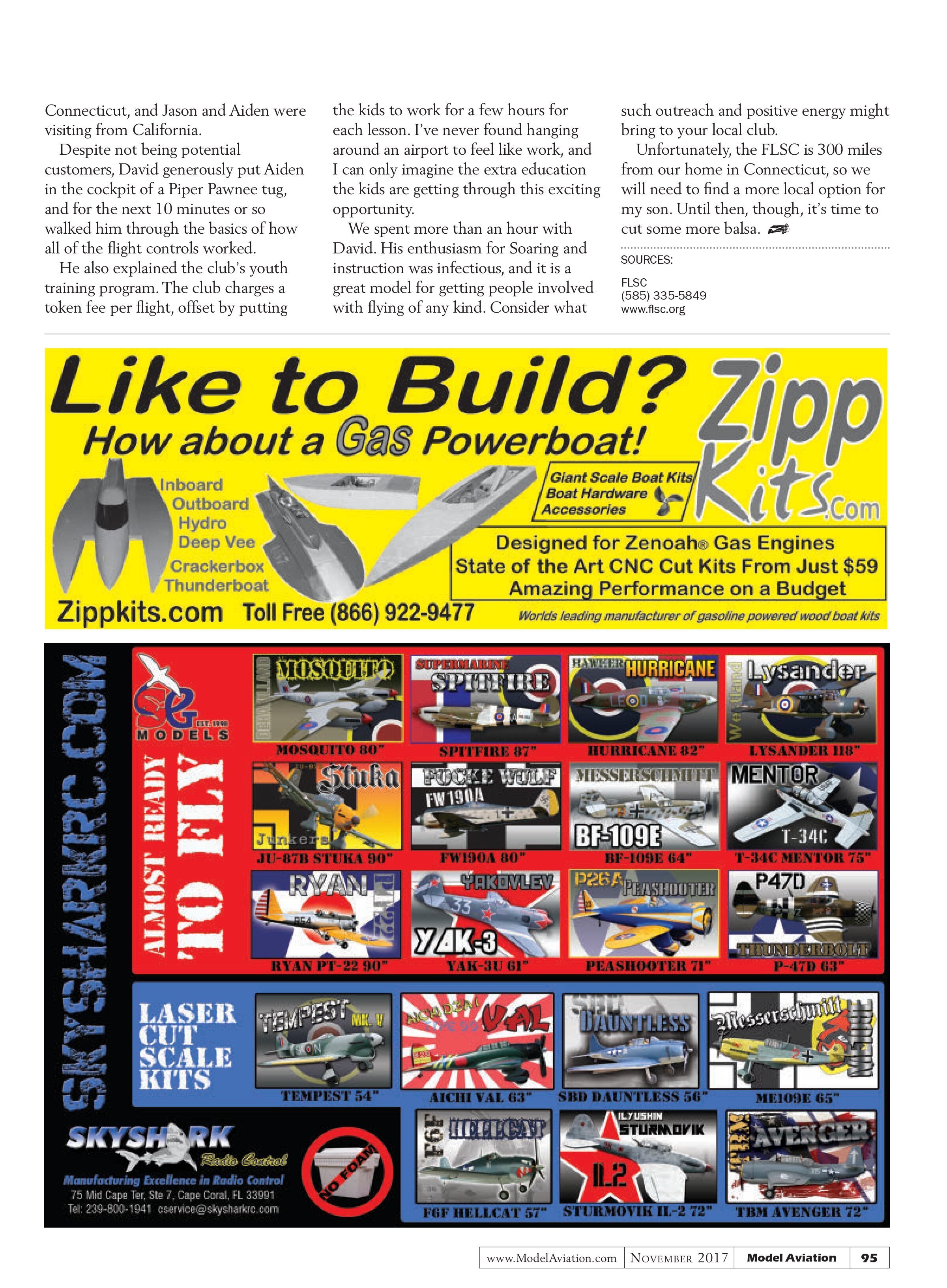
Consider for a moment a sheet of balsa measuring ⅛ x 3 x 36 inches, with an average density of 8 pounds per cubic foot. Some relatively simple school math tells us that it weighs exactly 1 ounce. Accepting that, we can surmise that a sheet weighing half that same ounce will have a density of 8/2, or 4 pounds per cubic foot, while another sheet at ¾ ounce (6/8) would be a 6-pound per cubic foot piece of wood.
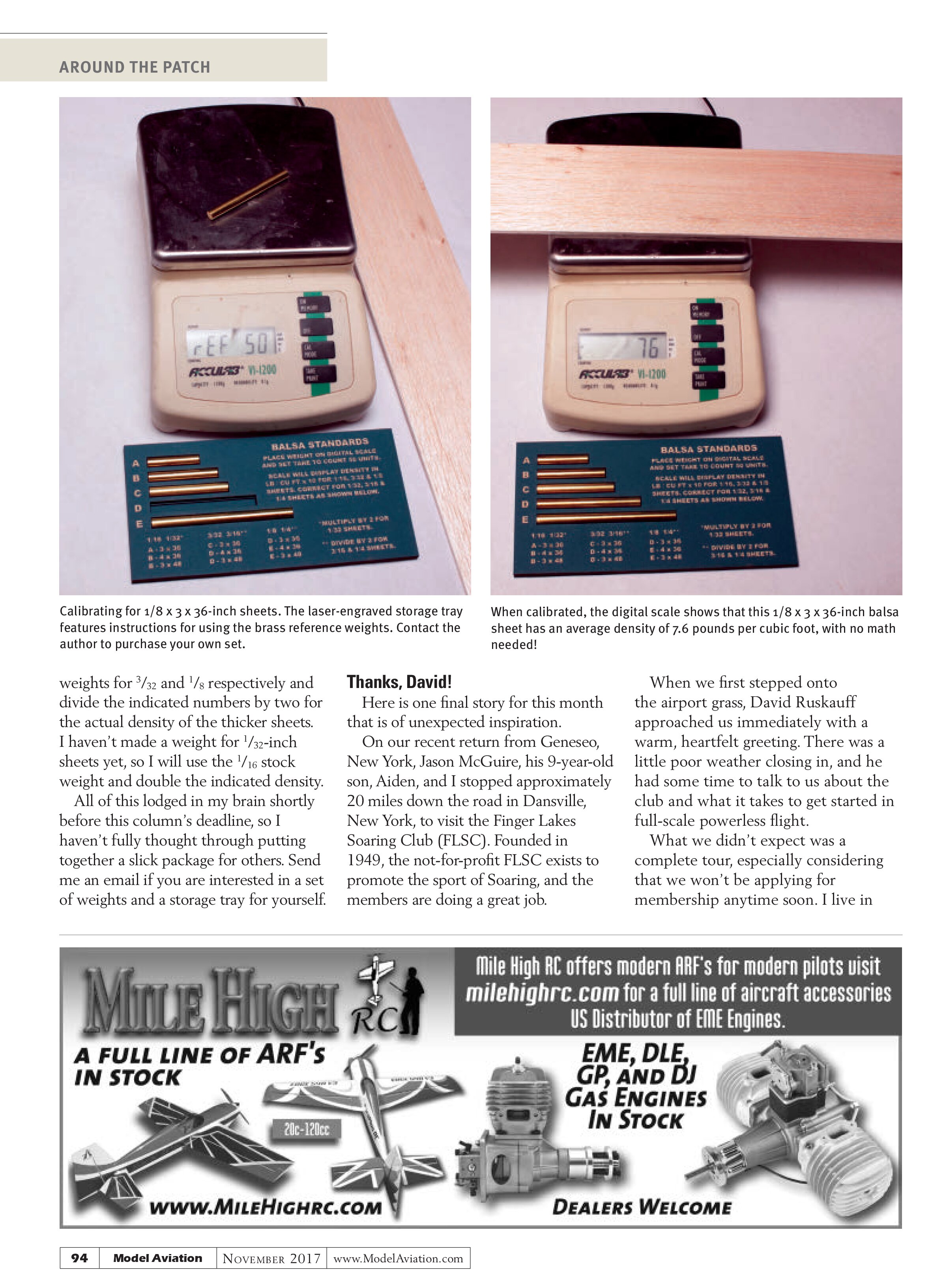
Expanding on this, I machined a ⅝-ounce brass reference weight. Placing it on the pan then setting the scale to its counting function for five items, instantly converted the scale to a direct-reading, balsa-density-calculating, digital time-saver! Putting on a 1-ounce reference weight (or balsa sheet) now displays 8; ½ ounce shows 4, etc.
Measuring in whole pounds is a little coarse. A 7-pound piece of wood could actually be anything from 6.5 to 7.49. Instead, I set the scale to count 50 and mentally divide by 10. That piece of wood might now “count” at 68 or 72, reflecting 6.8 or 7.2 pounds per cubic foot. Easily getting within ¹⁄₁₀ pound suits my needs well.
This system is based on measuring full sheets of wood, and my initial trial was just for 3 x 36 sheets. I have since machined a set of five weights, to include ¹⁄₁₆-inch and ³⁄₃₂-inch stock, as well as 4 x 36 and 3 x 48 sheets—my most commonly used sizes.
A little more math accommodates other thicknesses. I don’t use as much ³⁄₁₆ or ¼-inch wood, so I will use my
weights for ³⁄₃₂ and ⅛ respectively and divide the indicated numbers by two for the actual density of the thicker sheets. I haven’t made a weight for ¹⁄₃₂-inch sheets yet, so I will use the ¹⁄₁₆ stock weight and double the indicated density.
All of this lodged in my brain shortly before this column’s deadline, so I haven’t fully thought through putting together a slick package for others. Send me an email if you are interested in a set of weights and a storage tray for yourself.


Thanks, David!
Here is one final story for this month that is of unexpected inspiration.
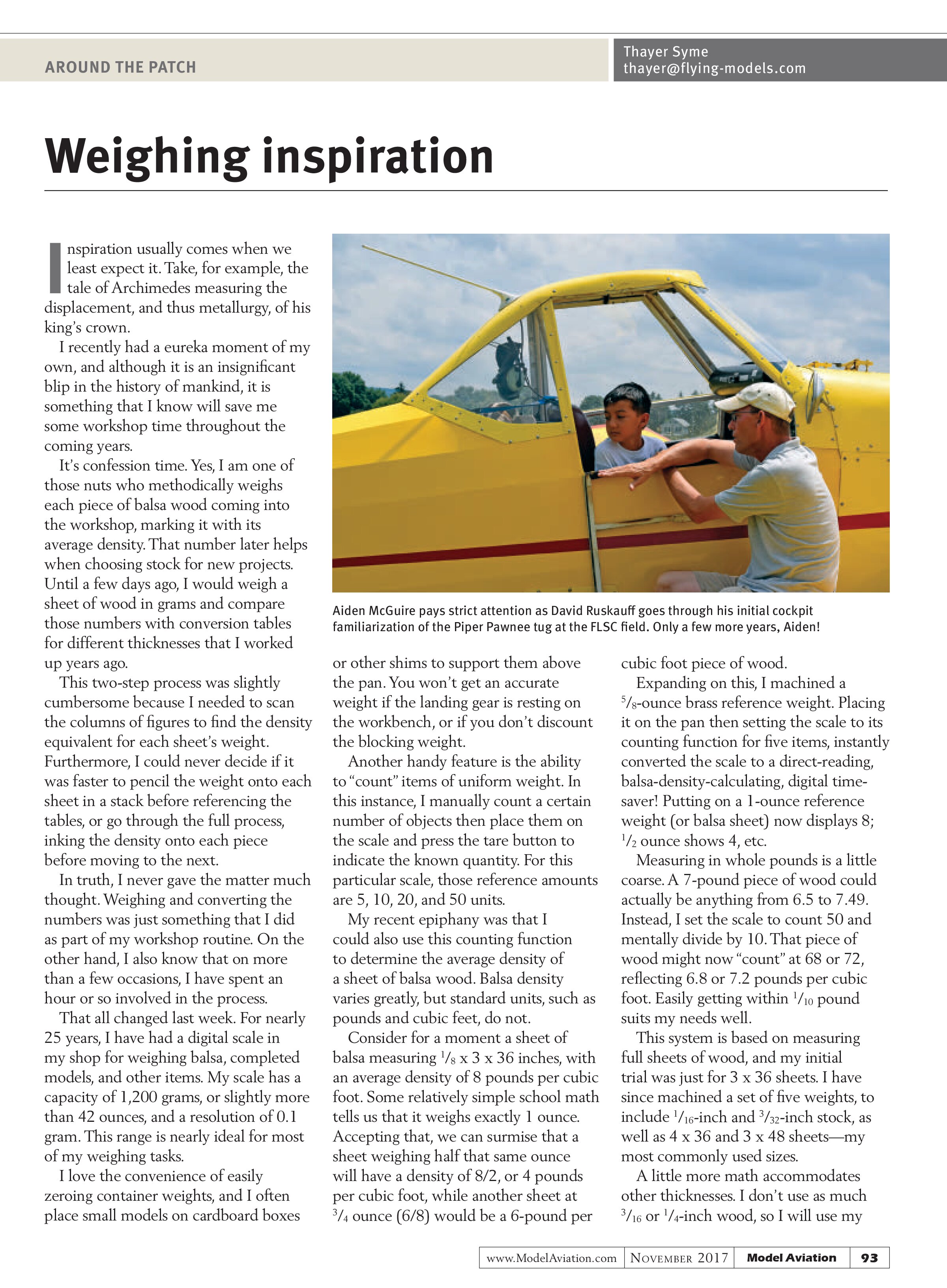
On our recent return from Geneseo, New York, Jason McGuire, his 9-year-old son, Aiden, and I stopped approximately 20 miles down the road in Dansville, New York, to visit the Finger Lakes Soaring Club (FLSC). Founded in 1949, the not-for-profit FLSC exists to promote the sport of Soaring, and the members are doing a great job.
When we first stepped onto the airport grass, David Ruskauff approached us immediately with a warm, heartfelt greeting. There was a little poor weather closing in, and he had some time to talk to us about the club and what it takes to get started in full-scale powerless flight.
What we didn’t expect was a complete tour, especially considering that we won’t be applying for membership anytime soon. I live in Connecticut, and Jason and Aiden were visiting from California.
Despite not being potential customers, David generously put Aiden in the cockpit of a Piper Pawnee tug, and for the next 10 minutes or so walked him through the basics of how all of the flight controls worked.
He also explained the club’s youth training program. The club charges a token fee per flight, offset by putting the kids to work for a few hours for each lesson. I’ve never found hanging around an airport to feel like work, and I can only imagine the extra education the kids are getting through this exciting opportunity.
We spent more than an hour with David. His enthusiasm for Soaring and instruction was infectious, and it is a great model for getting people involved with flying of any kind. Consider what such outreach and positive energy might bring to your local club.
Unfortunately, the FLSC is 300 miles from our home in Connecticut, so we will need to find a more local option for my son. Until then, though, it’s time to cut some more balsa.
SOURCES:
FLSC
(585) 335-5849
www.flsc.org