Now you’re flyin’ with gas!
Patrick Sherman
lucidity@roswellflighttestcrew.com
It is a fact as predictable as the tides: battery-powered drones fly for 20 minutes. Try adding a bigger battery and you need larger motors, propellers, and ESCs to lift it—and you end up right back where you started because you need more power to drive them. The problem is that there is no practical way to improve on the LiPo batteries that power all modern drones. They are the most energy-dense batteries ever made, and it is impossible to pack in any more juice without creating an unacceptable fire risk. Lithium-sulfur batteries show promise, but they are currently confined to the lab, and hydrogen fuel cells have been proven to work, but they are expensive, and hydrogen isn’t sold at the corner store. So, why not try gasoline? It’s a potent power source that is cheap, widely available, and it has been used in model aviation for decades. That is the task that Dr. Christopher Hagen, an associate professor at Oregon State University, set for himself and his team.
Electric Company
The reason that gasoline isn’t used as fuel for drones is because drones run on electricity, which is a requirement fundamental to their design. To maintain its stability in the air, the propellers of a multirotor speed up and slow down hundreds of times each second—much faster than any gas engine could manage—but well within the capabilities of an electric motor. It is possible to build a gas-powered multirotor that turns all of its propellers at a constant speed, using variable-pitch propellers to make constant, tiny adjustments; however, you deprive the system of the simple, robust design that makes drones so reliable. The solution is to use a gas engine to generate electricity onboard then use that electricity to power the drone. Of course, by the time you load an engine, a generator, and a fuel tank onto the drone, you’ve added a lot of weight to the design.
Tom Herron, an electrical and mechanical engineer on Christopher’s team, had the idea to use a heavy-lift multirotor motor as a generator. “The problem is that those big motors are all brushless, and for a long time, you couldn’t use brushless motors as generators,” Tom explained. He was aware of a potential solution: full synchronous recirculation. “Essentially, the ESC acts as a brake, converting the rotational energy of the propeller back into electricity that can be used to recharge the battery or power the other motors,” he said. Unfortunately, no manufacturers were building drone ESCs capable of full synchronous recirculation—or so Tom thought.
Down the Road
Ironically, in the same small city where Tom lives and works, Bend, Oregon, drone powertrain manufacturer KDE Direct was developing a full synchronous recirculation system to solve a different problem.

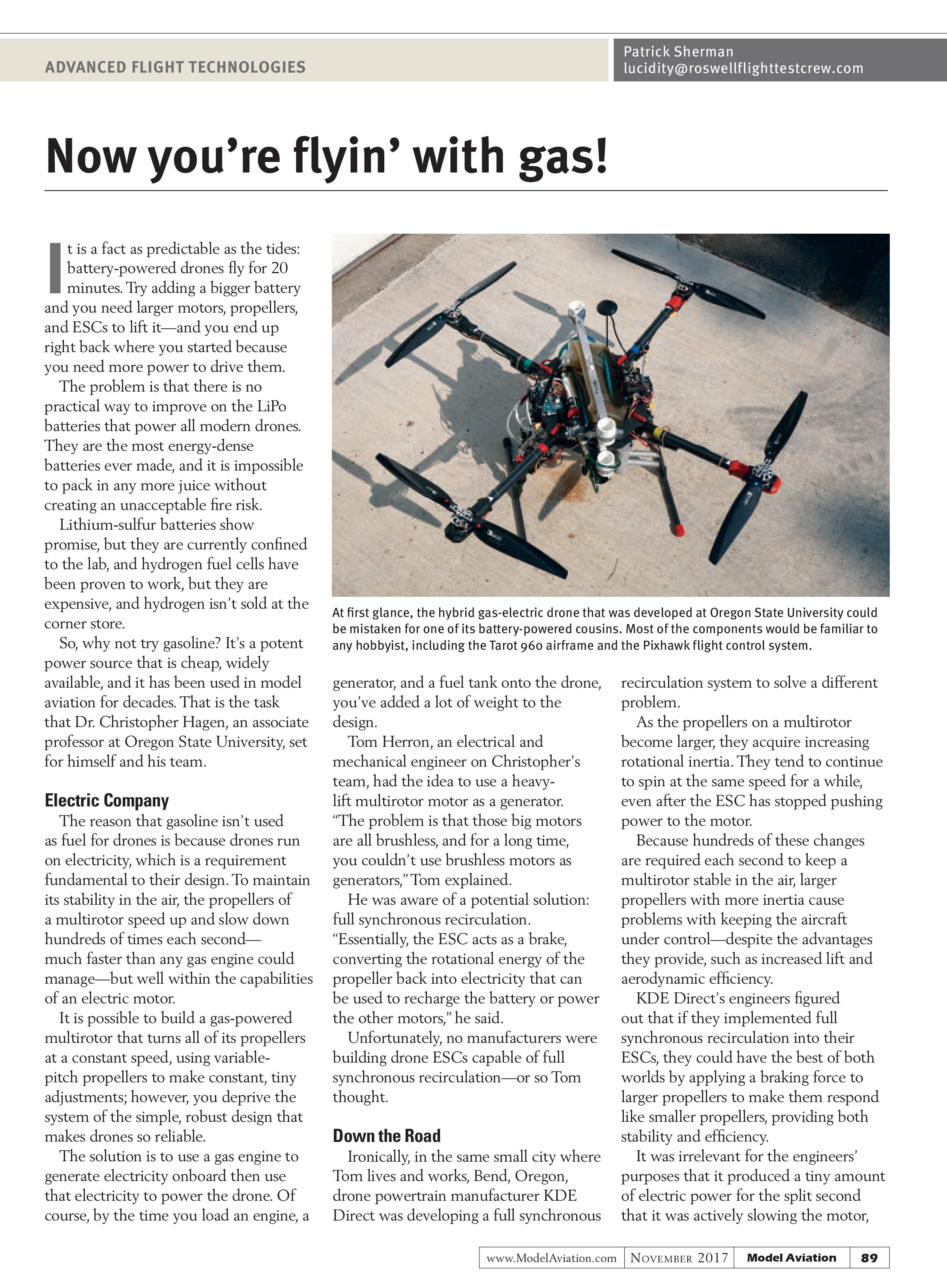
At first glance, the hybrid gas-electric drone that was developed at Oregon State University could be mistaken for one of its battery-powered cousins. Most of the components would be familiar to any hobbyist, including the Tarot 960 airframe and the Pixhawk flight control system.
As the propellers on a multirotor become larger, they acquire increasing rotational inertia. They tend to continue to spin at the same speed for a while, even after the ESC has stopped pushing power to the motor. Because hundreds of these changes are required each second to keep a multirotor stable in the air, larger propellers with more inertia cause problems with keeping the aircraft under control—despite the advantages they provide, such as increased lift and aerodynamic efficiency. KDE Direct’s engineers figured out that if they implemented full synchronous recirculation into their ESCs, they could have the best of both worlds by applying a braking force to larger propellers to make them respond like smaller propellers, providing both stability and efficiency. It was irrelevant for the engineers’ purposes that it produced a tiny amount of electric power for the split second that it was actively slowing the motor,

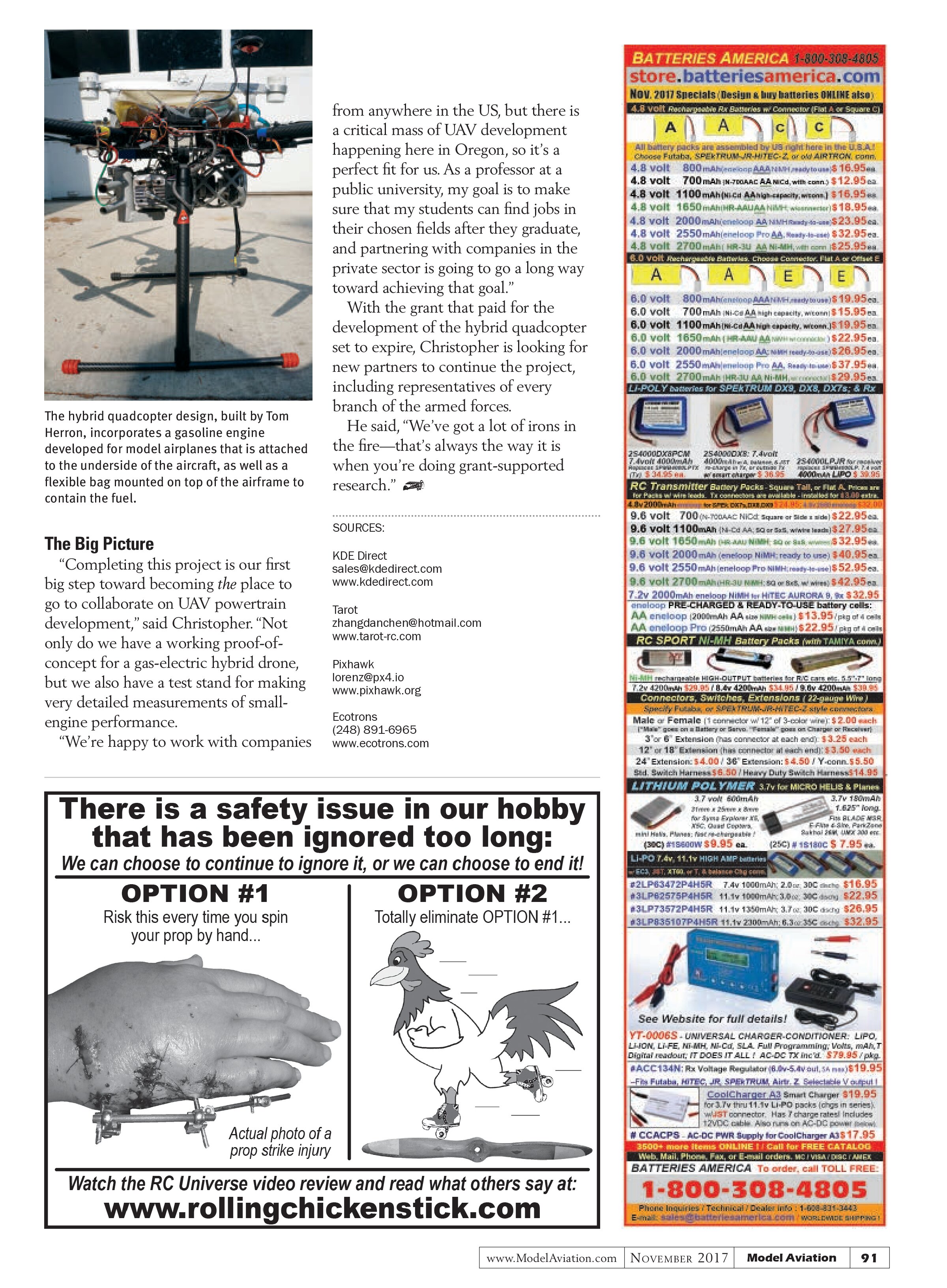
The hybrid quadcopter design, built by Tom Herron, incorporates a gasoline engine developed for model airplanes that is attached to the underside of the aircraft, as well as a flexible bag mounted on top of the airframe to contain the fuel.
The Big Picture
“Completing this project is our first big step toward becoming the place to go to collaborate on UAV powertrain development,” said Christopher. “Not only do we have a working proof-of-concept for a gas-electric hybrid drone, but we also have a test stand for making very detailed measurements of small-engine performance.
“We’re happy to work with companies from anywhere in the US, but there is a critical mass of UAV development happening here in Oregon, so it’s a perfect fit for us. As a professor at a public university, my goal is to make sure that my students can find jobs in their chosen fields after they graduate, and partnering with companies in the private sector is going to go a long way toward achieving that goal.”
With the grant that paid for the development of the hybrid quadcopter set to expire, Christopher is looking for new partners to continue the project, including representatives of every branch of the armed forces.
He said, “We’ve got a lot of irons in the fire—that’s always the way it is when you’re doing grant-supported research.”
SOURCES:
KDE Direct
sales@kdedirect.com
www.kdedirect.com
Tarot
zhangdanchen@hotmail.com
www.tarot-rc.com
Pixhawk
lorenz@px4.io
www.pixhawk.org
Ecotrons
(248) 891-6965
www.ecotrons.com