Out-of-the-ordinary flier

It has often been said that variety is the spice of life. Where modeling is concerned, I couldn’t agree more. As modelers, we tend to drift into our own vein, but sometimes it’s fun to step outside the norm and do something totally different from what we’re accustomed.
Case in point, not long ago I picked up the April 2017 issue of Aeromodeller magazine, which is published in the United Kingdom, and came across pullout plans for a Pisceocopter. For whatever reason, although it took a few minutes to figure out what I was looking at, it was more than I could get past and I had to build one. Until then, I’d never even heard of a Pisceocopter.
The Pisceocopter is a simple Free Flight (FF) design that piqued my curiosity, simply because it is so out of the ordinary. It took a few minutes of looking over the plans to figure out how it worked.
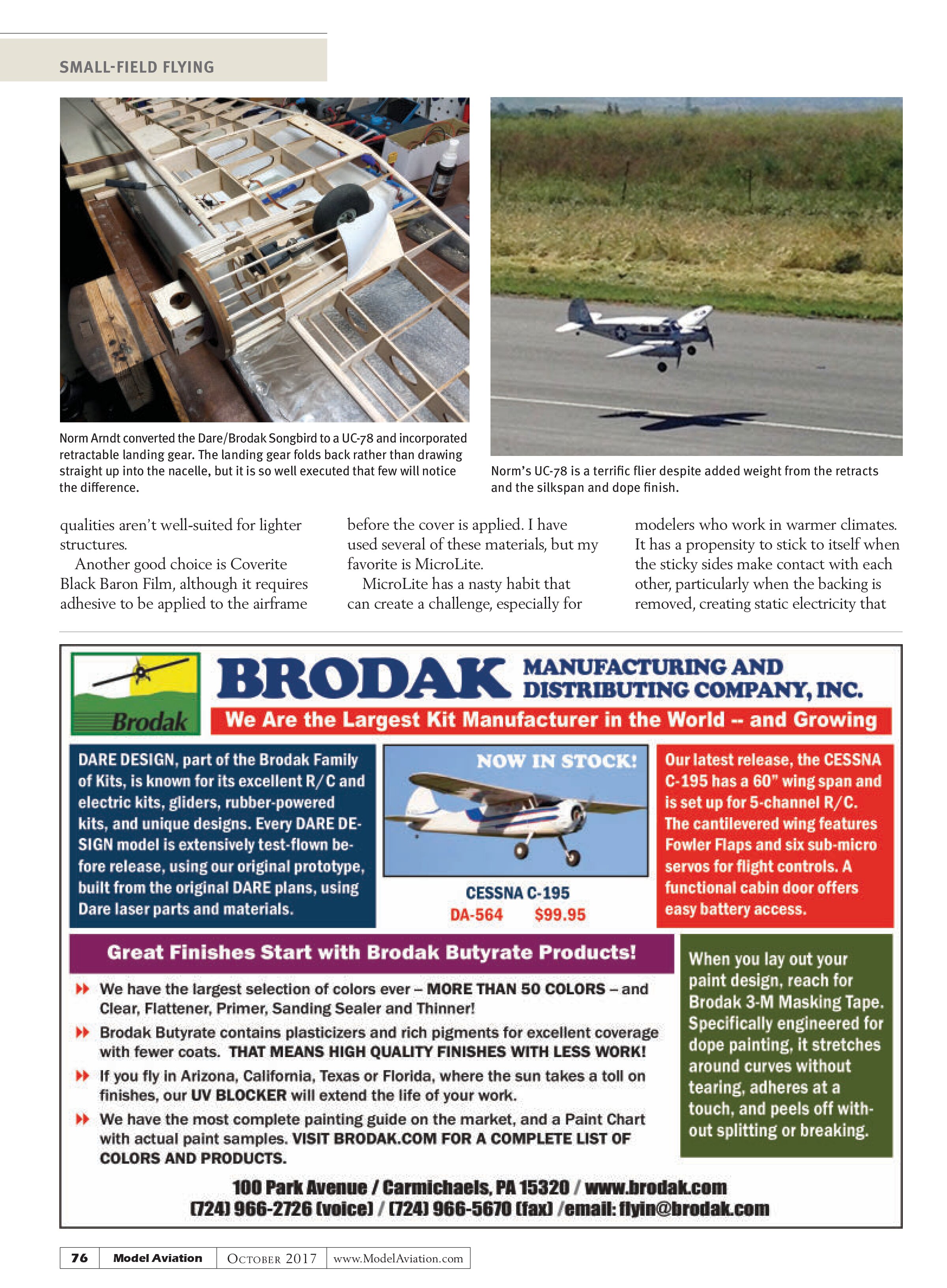
The model features a Rogallo wing (also referred to as a Parawing), which is a triangular platform with the airfoil shape resulting from a loosely applied cover. The tailplane is also triangular, with minimal structure in both. The propulsion system is a rubber-powered, vertically flapping tail driven by a simple crank system. The connecting rod is fabricated from a paper clip.
The model was constructed from scrap balsa, wire, and tissue, and is so simple to build that it went together in only a couple of hours. At the risk of sounding skeptical, I was pleasantly surprised to find that the odd little model flew quite well. I’ve flown RC Rogallo wings in the past, and although they need to be flown properly, they do fly well.
If you are frequently on the lookout for something different, there’s no telling when some oddball design will present itself and create an interesting diversion.
Covering Tip
While I’m on the subject of building, I’ll pass along a covering tip that came to me. The covering material used on park flyers—scale or otherwise, and especially large park flyers that are 60-inch wingspan single- and multiengine types—will make a significant difference in the model’s overall flying weight.
Throughout the years, there have been several materials available, including iron-on Mylar such as Coverite MicroLite (.6 ounces per square yard), UltraCote Lite (1.6 ounces per square yard), and MonoKote (3.4 ounces per square yard). MonoKote is good stuff, but its weight and its extreme shrinking


qualities aren’t well-suited for lighter structures.
Another good choice is Coverite Black Baron Film, although it requires adhesive to be applied to the airframe before the cover is applied. I have used several of these materials, but my favorite is MicroLite.
MicroLite has a nasty habit that can create a challenge, especially for modelers who work in warmer climates. It has a propensity to stick to itself when the sticky sides make contact with each other, particularly when the backing is removed, creating static electricity that draws it unto itself. When this happens on a hot day, you simply can’t separate it.
To remedy this problem, lay the material flat on a table, backing side up, then peel the backing off, allowing the static electricity to make it cling to the table. Sprinkle a small amount of unscented talcum powder on the sticky side and rub it off with a soft cloth or paper towel. The fine coating of powder will eliminate the problem of the material sticking to itself, but will in no way affect its adhesion to the model.
I have spoken with several modelers throughout the years and a few had quit using MicroLite for this reason, but after trying the powder trick, they were happy with the results, and some even went back to using MicroLite.
Two UC-78s
Photos have been rolling in from modelers who have been busy building some nice aircraft. Two photos that recently came in are of a UC-78 light military transport airplane that was adapted from the Cessna Bobcat.
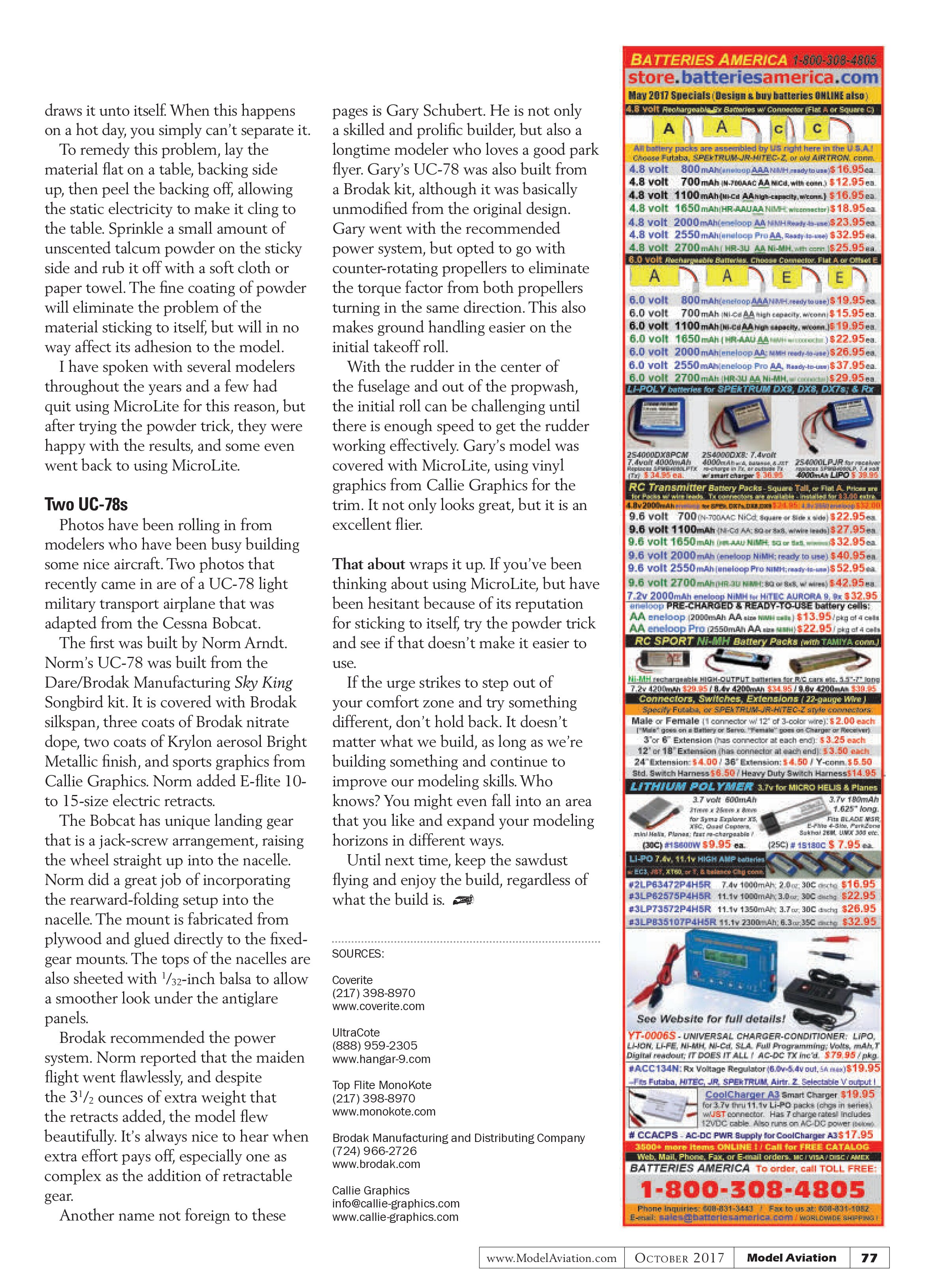
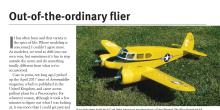
The first was built by Norm Arndt. Norm’s UC-78 was built from the Dare/Brodak Manufacturing Sky King Songbird kit. It is covered with Brodak silkspan, three coats of Brodak nitrate dope, two coats of Krylon aerosol Bright Metallic finish, and sports graphics from Callie Graphics. Norm added E-flite 10- to 15-size electric retracts.
The Bobcat has unique landing gear that is a jack-screw arrangement, raising the wheel straight up into the nacelle. Norm did a great job of incorporating the rearward-folding setup into the nacelle. The mount is fabricated from plywood and glued directly to the fixed-gear mounts. The tops of the nacelles are also sheeted with 1/32-inch balsa to allow a smoother look under the antiglare panels.
Brodak recommended the power system. Norm reported that the maiden flight went flawlessly, and despite the 3½ ounces of extra weight that the retracts added, the model flew beautifully. It’s always nice to hear when extra effort pays off, especially one as complex as the addition of retractable gear.
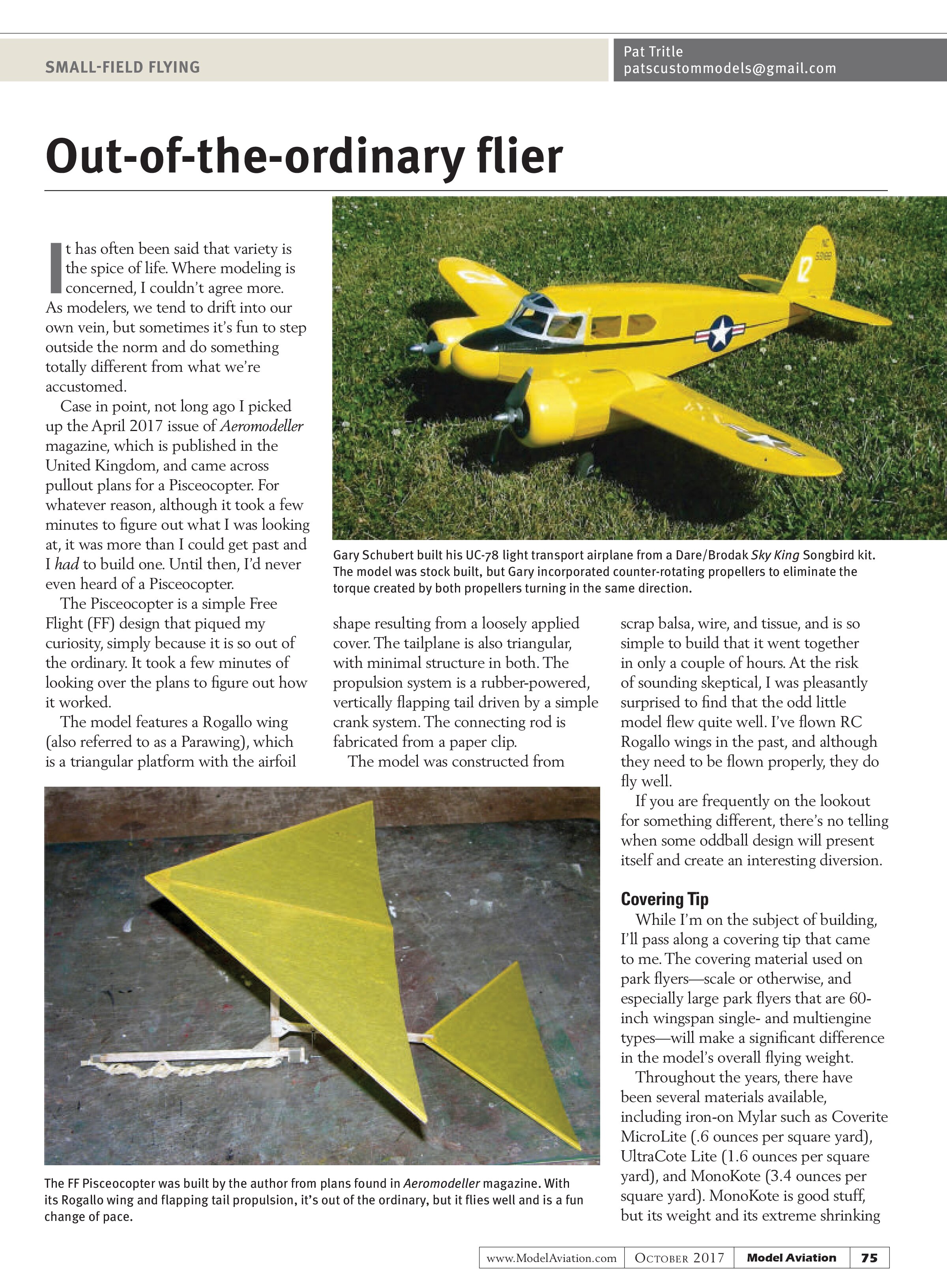
Another name not foreign to these pages is Gary Schubert. He is not only a skilled and prolific builder, but also a longtime modeler who loves a good park flyer. Gary’s UC-78 was also built from a Brodak kit, although it was basically unmodified from the original design. Gary went with the recommended power system, but opted to go with counter-rotating propellers to eliminate the torque factor from both propellers turning in the same direction. This also makes ground handling easier on the initial takeoff roll.
With the rudder in the center of the fuselage and out of the propwash, the initial roll can be challenging until there is enough speed to get the rudder working effectively. Gary’s model was covered with MicroLite, using vinyl graphics from Callie Graphics for the trim. It not only looks great, but it is an excellent flier.
That about wraps it up. If you’ve been thinking about using MicroLite, but have been hesitant because of its reputation for sticking to itself, try the powder trick and see if that doesn’t make it easier to use.
If the urge strikes to step out of your comfort zone and try something different, don’t hold back. It doesn’t matter what we build, as long as we’re building something and continue to improve our modeling skills. Who knows? You might even fall into an area that you like and expand your modeling horizons in different ways.
Until next time, keep the sawdust flying and enjoy the build, regardless of what the build is.
SOURCES:
Coverite
(217) 398-8970
www.coverite.com
UltraCote
(888) 959-2305
www.hangar-9.com
Top Flite MonoKote
(217) 398-8970
www.monokote.com
Brodak Manufacturing and Distributing Company
(724) 966-2726
www.brodak.com
Callie Graphics
info@callie-graphics.com
www.callie-graphics.com