What are you doing for the hobby?
Jennifer Lea Reynolds
jensunshine3@gmail.com
Much of life today involves an “immediately, if not sooner” approach. Through social media and even on television, we watch the news unfold instantaneously, thanks to live video feeds and scrolling Twitter comments.
We’re expected to handle work projects quickly. Some of us may even drive fast, talk fast, and (ahem) decide to purchase an airplane or three a tad faster than our bank account can handle.
I tend to hover between such immediacy and knowing when it’s time to stop and smell the roses. Still, I’m aware that instant gratification, expediency, and expectations associated with it are proverbial signs of the times—like it or not. In fact, keeping this in mind could play a role when encouraging others to get involved and stay involved in RC flying. It’s all about balance.
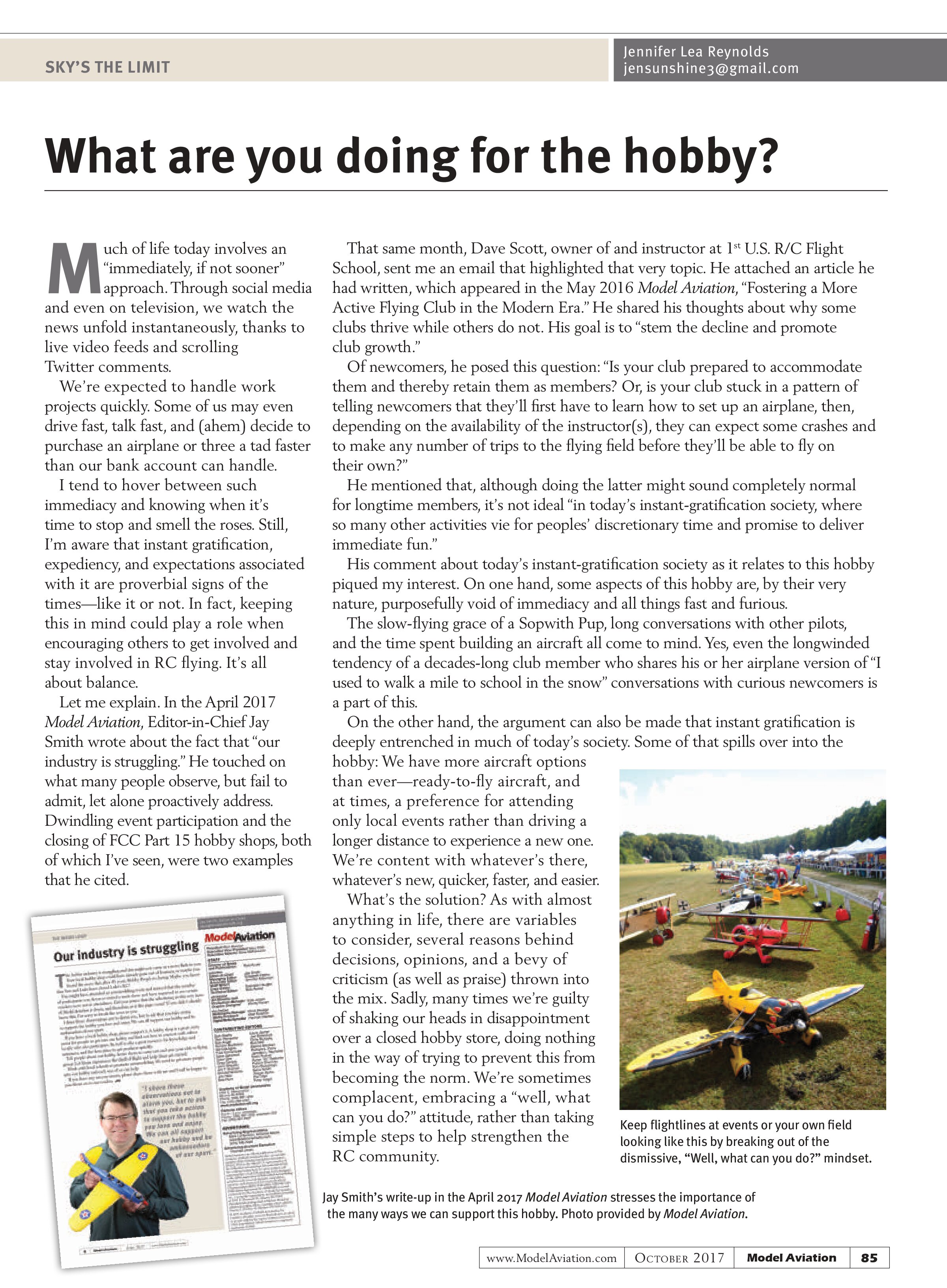
Let me explain. In the April 2017 Model Aviation, Editor-in-Chief Jay Smith wrote about the fact that “our industry is struggling.” He touched on what many people observe, but fail to admit, let alone proactively address. Dwindling event participation and the closing of FCC Part 15 hobby shops, both of which I’ve seen, were two examples that he cited.

That same month, Dave Scott, owner of and instructor at 1st U.S. R/C Flight School, sent me an email that highlighted that very topic. He attached an article he had written, which appeared in the May 2016 Model Aviation, “Fostering a More Active Flying Club in the Modern Era.” He shared his thoughts about why some clubs thrive while others do not. His goal is to “stem the decline and promote club growth.”
Of newcomers, he posed this question: “Is your club prepared to accommodate them and thereby retain them as members? Or, is your club stuck in a pattern of telling newcomers that they’ll first have to learn how to set up an airplane, then, depending on the availability of the instructor(s), they can expect some crashes and to make any number of trips to the flying field before they’ll be able to fly on their own?”
He mentioned that, although doing the latter might sound completely normal for longtime members, it’s not ideal “in today’s instant-gratification society, where so many other activities vie for peoples’ discretionary time and promise to deliver immediate fun.”
His comment about today’s instant-gratification society as it relates to this hobby piqued my interest. On one hand, some aspects of this hobby are, by their very nature, purposefully void of immediacy and all things fast and furious.
The slow-flying grace of a Sopwith Pup, long conversations with other pilots, and the time spent building an aircraft all come to mind. Yes, even the longwinded tendency of a decades-long club member who shares his or her airplane version of “I used to walk a mile to school in the snow” conversations with curious newcomers is a part of this.
On the other hand, the argument can also be made that instant gratification is deeply entrenched in much of today’s society. Some of that spills over into the hobby: We have more aircraft options than ever—ready-to-fly aircraft, and at times, a preference for attending only local events rather than driving a longer distance to experience a new one. We’re content with whatever’s there, whatever’s new, quicker, faster, and easier.

What’s the solution? As with almost anything in life, there are variables to consider, several reasons behind decisions, opinions, and a bevy of criticism (as well as praise) thrown into the mix. Sadly, many times we’re guilty of shaking our heads in disappointment over a closed hobby store, doing nothing in the way of trying to prevent this from becoming the norm. We’re sometimes complacent, embracing a “well, what can you do?” attitude, rather than taking simple steps to help strengthen the RC community.
Finding Balance
Again, I’m a fan of striking a balance. It’s good to embrace our personalities when it comes to interacting with newcomers. It’s fine to go against the instant-gratification grain and fly (or teach someone how to fly) in a manner that best suits you.
At the same time, it might also be worth occasionally breaking out of a routine by giving a jet or quadcopter a whirl, or by cutting to the chase and helping someone actually fly before several long months pass. At the very least, no matter what our approach is,
let’s focus on the positive aspects of this hobby so that newcomers head back home or to work and tell others about their good experiences and, more importantly, head back to the flying field!
Do we, as hobbyists, hang tightly to the “this is how we’ve always done it” thoughts? Or are we flexible, able to find a happy medium that will appeal to those who enjoy such tendencies while also dipping our toes in new waters?
Think Outside the Buddy Box
Jay encouraged us to be “ambassadors of our sport” in that April issue, suggesting supporting local hobby shops, working with schools to promote aeromodeling, and telling others about this exciting hobby. “Invite them to come out and visit your club or flying group,” he wrote.
Dave pointed out that part of maintaining an interest in flying in today’s instant-gratification world involves publicity. He noted that the “first significant trait on display at successful clubs in the modern era is that their leadership is constantly promoting flying!” He discussed club leaders doing everything to ensure that a new person gets in the air sooner rather than later, of camaraderie, and of flying

as an escape from life’s daily stressors.
As a former public relations specialist, I agree. In this case, it’s not always about billboards and taking out costly newspaper ads. It’s about consistently getting the word out to generate public interest, which in turn will lead to increased visibility.
Whether it’s more people at the flightline or more product sales, publicity can help tremendously. It’s about lending an ear, extending a positive voice, helping others, and spreading the word in a way that conveys a sense of community.
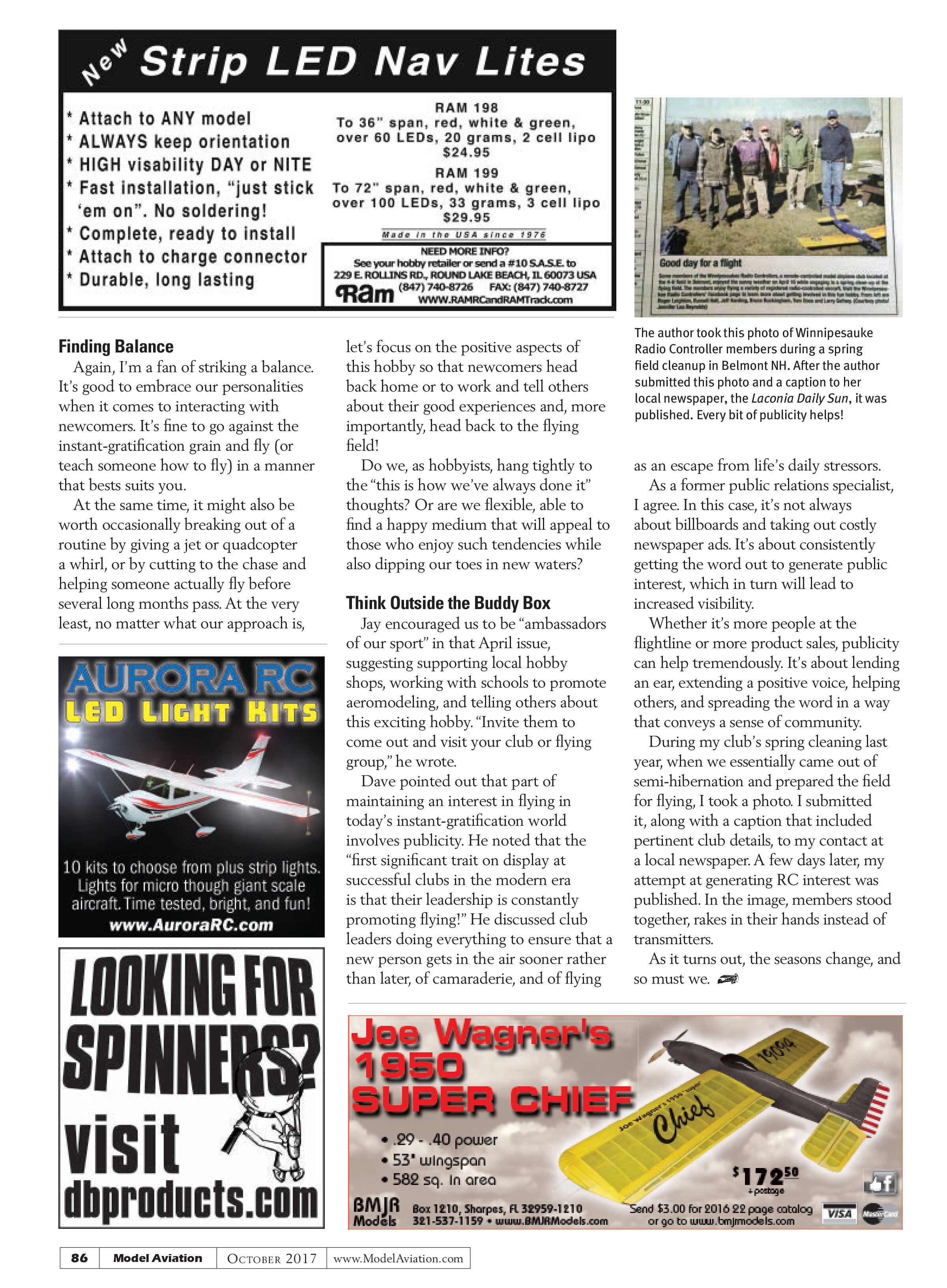
During my club’s spring cleaning last year, when we essentially came out of semi-hibernation and prepared the field for flying, I took a photo. I submitted it, along with a caption that included pertinent club details, to my contact at a local newspaper. A few days later, my attempt at generating RC interest was published. In the image, members stood together, rakes in their hands instead of transmitters.
As it turns out, the seasons change, and so must we.