Back to basics
Dave Gee
safetycolumn@cs.com
I don’t like the phrase “back to basics,” but because this issue of Model Aviation is themed for builders, it’s just right for a discussion about safety. Experienced builders don’t need to “go back” to the fundamentals because they stick with them and never leave. Building a model aircraft is great fun and pretty darn safe to begin with, but smart modelers understand the importance of basic Personal Protective Equipment (PPE) to avoid injury.
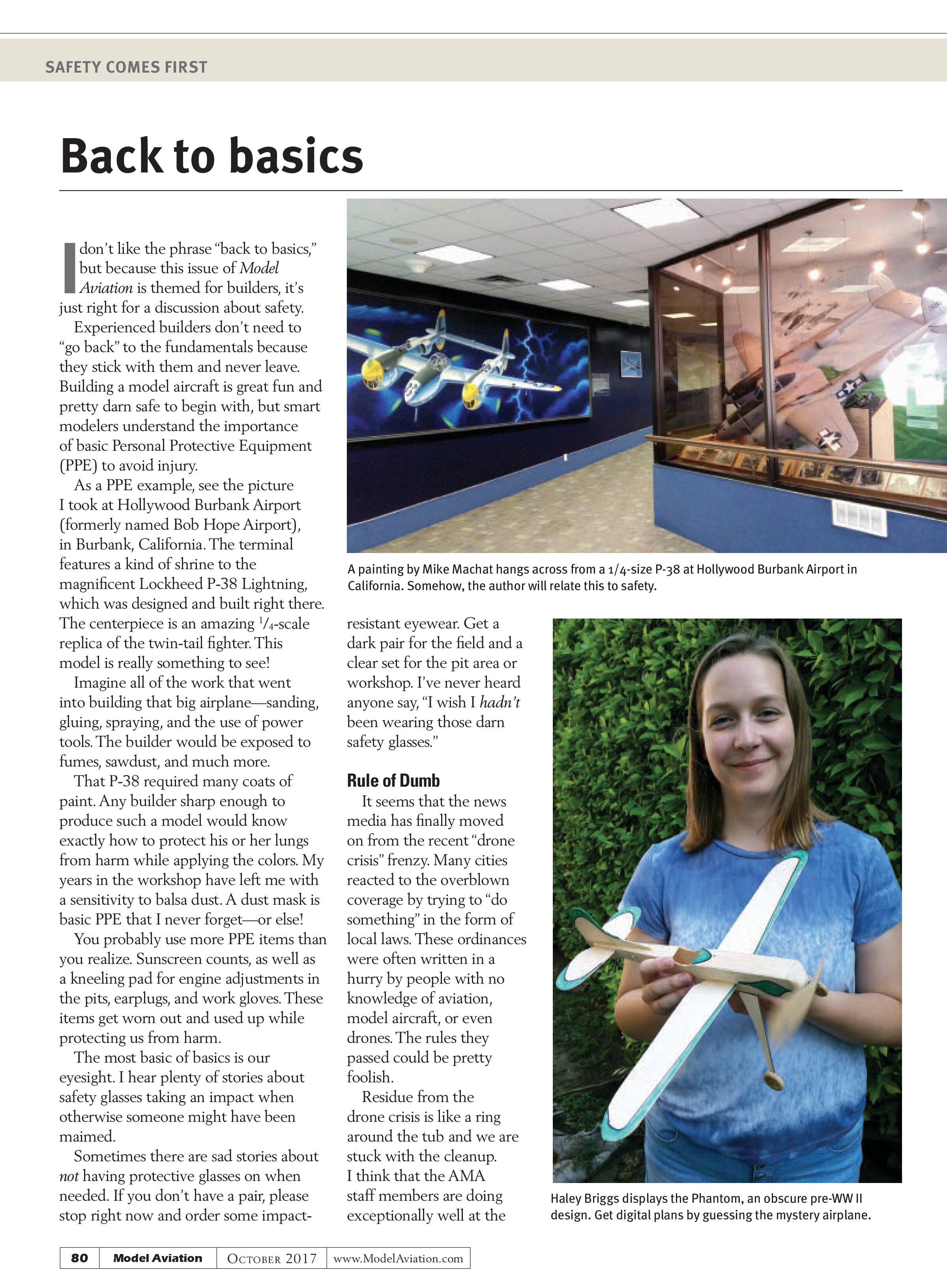
As a PPE example, see the picture I took at Hollywood Burbank Airport (formerly named Bob Hope Airport), in Burbank, California. The terminal features a kind of shrine to the magnificent Lockheed P-38 Lightning, which was designed and built right there. The centerpiece is an amazing 1/4-scale replica of the twin-tail fighter. This model is really something to see!
Imagine all of the work that went into building that big airplane—sanding, gluing, spraying, and the use of power tools. The builder would be exposed to fumes, sawdust, and much more.
That P-38 required many coats of paint. Any builder sharp enough to produce such a model would know exactly how to protect his or her lungs from harm while applying the colors. My years in the workshop have left me with a sensitivity to balsa dust. A dust mask is basic PPE that I never forget—or else!
You probably use more PPE items than you realize. Sunscreen counts, as well as a kneeling pad for engine adjustments in the pits, earplugs, and work gloves. These items get worn out and used up while protecting us from harm.
The most basic of basics is our eyesight. I hear plenty of stories about safety glasses taking an impact when otherwise someone might have been maimed.
Sometimes there are sad stories about not having protective glasses on when needed. If you don’t have a pair, please stop right now and order some impact-

resistant eyewear. Get a dark pair for the field and a clear set for the pit area or workshop. I’ve never heard anyone say, “I wish I hadn’t been wearing those darn safety glasses.”
Rule of Dumb
It seems that the news media has finally moved on from the recent “drone crisis” frenzy. Many cities reacted to the overblown coverage by trying to “do something” in the form of local laws. These ordinances were often written in a hurry by people with no knowledge of aviation, model aircraft, or even drones. The rules they passed could be pretty foolish.
Residue from the drone crisis is like a ring around the tub and we are stuck with the cleanup. I think that the AMA staff members are doing exceptionally well at the national level. They have truly saved our sport. Perhaps we can make a difference in our hometowns, too.
Some local laws are a safety hazard. They can be far too restrictive or even nonsensical. We want pilots to fly safely, in designated areas that are laid out according to the guidelines of a community-based organization’s safety program. If hastily passed local rules get in the way of safe flight operations, maybe we can help get them changed.
I live in Los Angeles, where the city council has banned all types of model aircraft night flying. Every type of model is lumped together. We know that a 12-inch park flyer is a lot different than a 45-pound multirotor, but does your city council?
The Los Angeles ordinance is so broadly written that if my club spends an evening helping a Scout troop build and fly Delta Darts in a meeting room, we are subject to criminal penalties. A new modeler wouldn’t even know about these unexpected restrictions and might try flying in a more dangerous spot. That’s a safety issue for sure!
Local clubs can get involved and improve this situation. When elections come around, invite public office candidates to speak at your meeting. Educate them and make friends. They want votes and we have an issue for them to support. Bring some kids to the council meeting and use your allotted three minutes to speak about how an educational hobby is being hurt by laws that make us less safe.


Age Is Just a Number
Earle Levine brought up an interesting topic:
“Due to a recent incident, a discussion took place about young people flying at our RC club field. Do you know of any clubs with rules about young people on the flightline as pilots? Should they be allowed to be at the flightline by themselves, or should a parent or other qualified adult be with them? If so, up until what age? Could they have a skill test to show [their] ability to fly solo?”
Well, he had me stumped! The AMA Safety Code doesn’t mention age, and I’m not aware of any such requirements at the RC fields near me. My guess is that the matter doesn’t come up often these days because younger fliers can’t get a model and flight gear to the field without a car.
In the olden times, a kid’s bike could carry everything needed to fly a .049 gas-powered airplane. Nowadays, there is either an adult behind the wheel or the pilot is old enough to have a driver’s license and vehicle.
It seems as though this issue would have a lot of variables and the pilot’s age is only one of them. How mature is the kid in question? As a lad, I had quite a mischievous nature (actually, not much has changed throughout the years). Any kid like I was shouldn’t be anywhere near the flightline without supervision. Most young people these days are more level-headed. So what age is still too young?
Is it a crowded, urban RC field or out in open country? How about the size and weight of the aircraft in use? Does a multirotor require more maturity than a sport trainer just because it has more propellers?
If your club has ever had an issue with unsupervised young pilots or has an age requirement for flightline access, please email me. I’ll share the information that comes in. We want young people to feel welcome in our hobby, but there must be a safe flightline for everyone.
A Shark-Mouthed Mystery
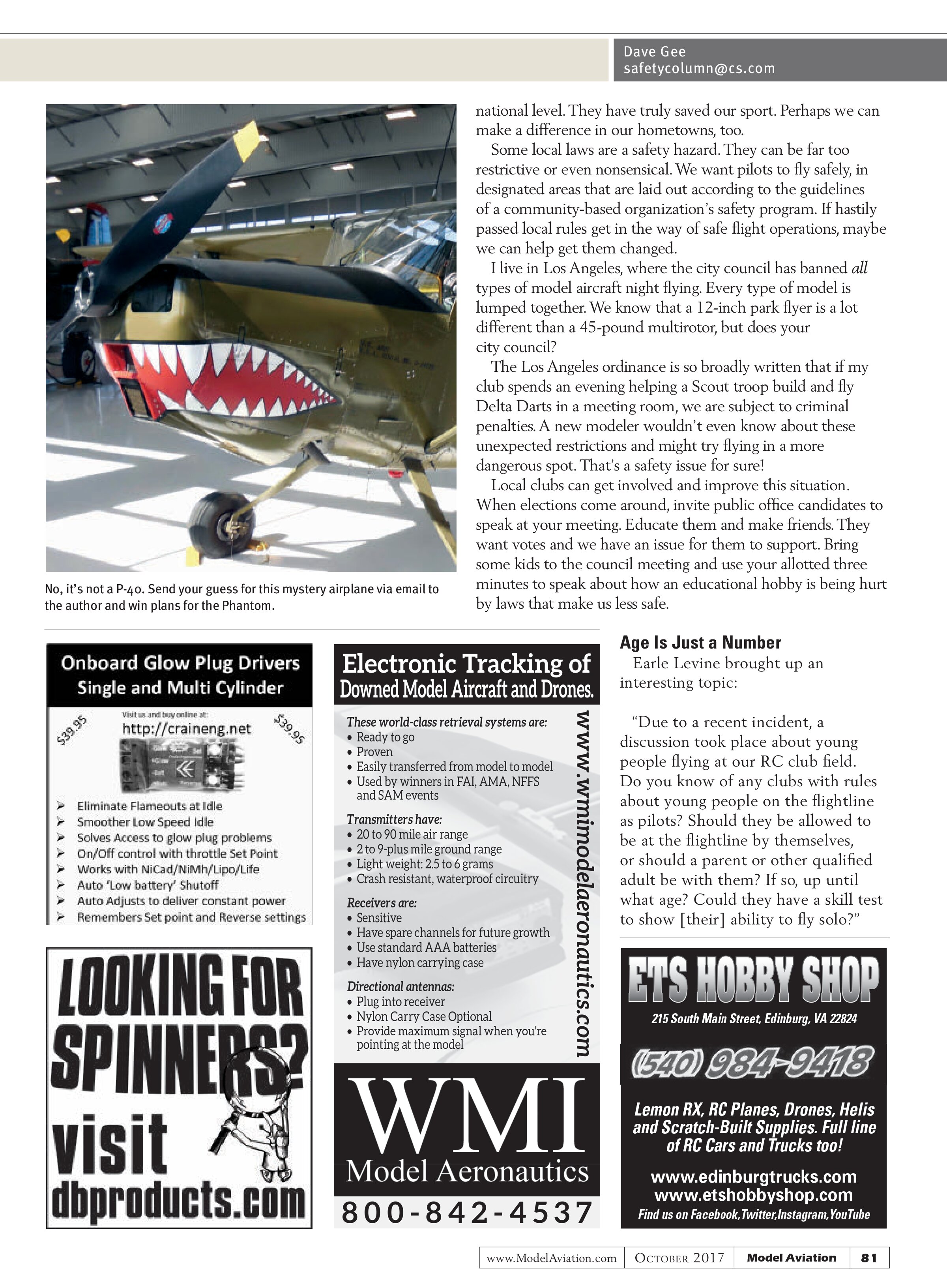
It’s time for another mystery airplane contest! Despite the snarling shark mouth on that airplane, it’s not a Flying Tiger P-40. Email me your guess as to what the name of this pint-size warbird is and I’ll send you digital plans and parts templates for a truly rare flying machine. My address is at the beginning of this column.
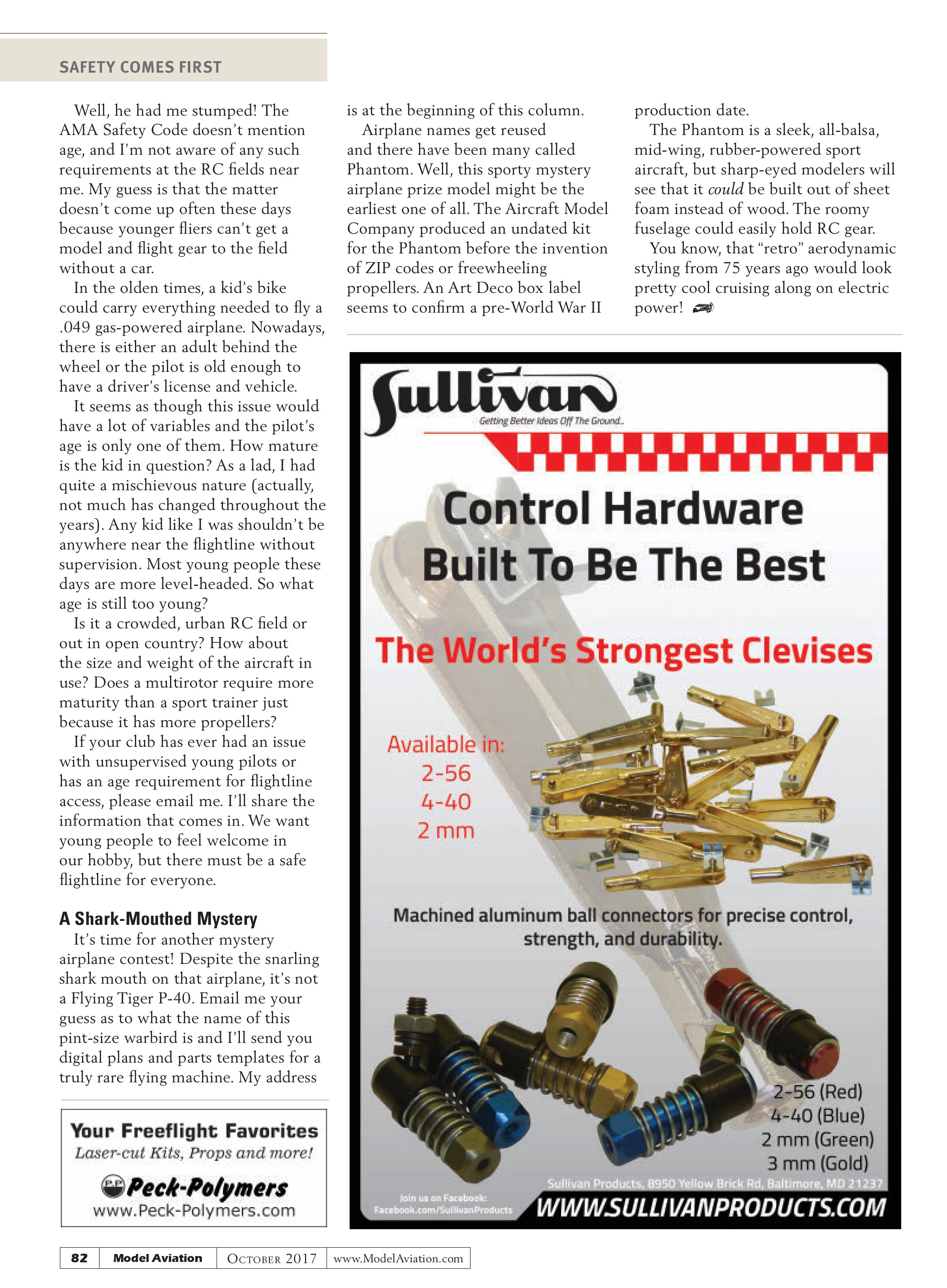
Airplane names get reused and there have been many called Phantom. Well, this sporty mystery airplane prize model might be the earliest one of all. The Aircraft Model Company produced an undated kit for the Phantom before the invention of ZIP codes or freewheeling propellers. An Art Deco box label seems to confirm a pre-World War II production date.
The Phantom is a sleek, all-balsa, mid-wing, rubber-powered sport aircraft, but sharp-eyed modelers will see that it could be built out of sheet foam instead of wood. The roomy fuselage could easily hold RC gear. You know, that “retro” aerodynamic styling from 75 years ago would look pretty cool cruising along on electric power!