Trainer introduces a new generation to CL


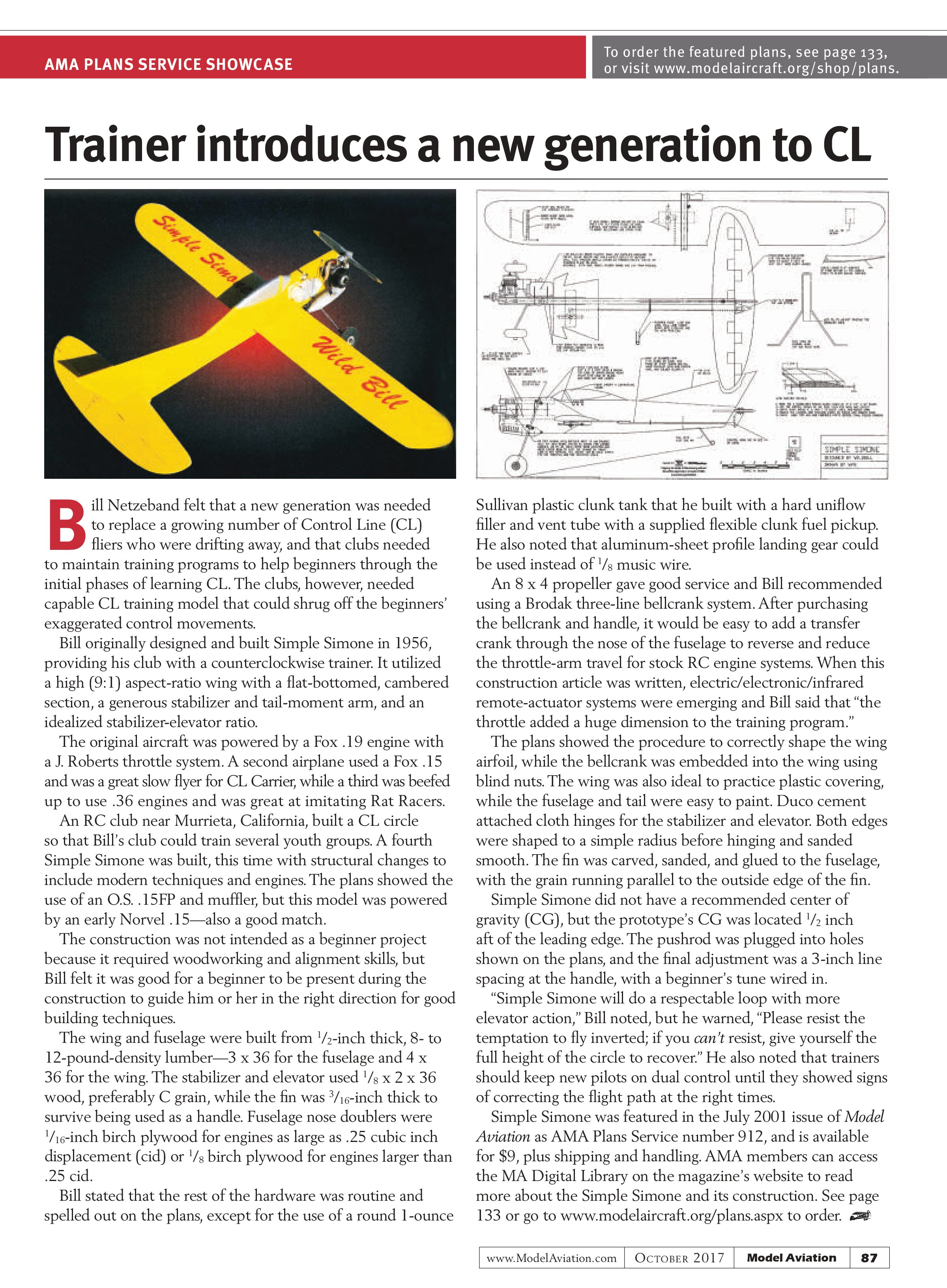
Bill Netzeband felt that a new generation was needed to replace a growing number of Control Line (CL) fliers who were drifting away, and that clubs needed to maintain training programs to help beginners through the initial phases of learning CL. The clubs, however, needed capable CL training model that could shrug off the beginners’ exaggerated control movements.
Bill originally designed and built Simple Simone in 1956, providing his club with a counterclockwise trainer. It utilized a high (9:1) aspect-ratio wing with a flat-bottomed, cambered section, a generous stabilizer and tail-moment arm, and an idealized stabilizer-elevator ratio.
The original aircraft was powered by a Fox .19 engine with a J. Roberts throttle system. A second airplane used a Fox .15 and was a great slow flyer for CL Carrier, while a third was beefed up to use .36 engines and was great at imitating Rat Racers.
An RC club near Murrieta, California, built a CL circle so that Bill’s club could train several youth groups. A fourth Simple Simone was built, this time with structural changes to include modern techniques and engines. The plans showed the use of an O.S. .15FP and muffler, but this model was powered by an early Norvel .15—also a good match.
The construction was not intended as a beginner project because it required woodworking and alignment skills, but Bill felt it was good for a beginner to be present during the construction to guide him or her in the right direction for good building techniques.
The wing and fuselage were built from ½-inch thick, 8- to 12-pound-density lumber—3 x 36 for the fuselage and 4 x 36 for the wing. The stabilizer and elevator used ⅛ x 2 x 36 wood, preferably C grain, while the fin was ⅜-inch thick to survive being used as a handle. Fuselage nose doublers were ¹⁄₁₆-inch birch plywood for engines as large as .25 cubic inch displacement (cid) or ⅛ birch plywood for engines larger than .25 cid.
Bill stated that the rest of the hardware was routine and spelled out on the plans, except for the use of a round 1-ounce Sullivan plastic clunk tank that he built with a hard uniflow filler and vent tube with a supplied flexible clunk fuel pickup. He also noted that aluminum-sheet profile landing gear could be used instead of ⅛ music wire.
An 8 x 4 propeller gave good service and Bill recommended using a Brodak three-line bellcrank system. After purchasing the bellcrank and handle, it would be easy to add a transfer crank through the nose of the fuselage to reverse and reduce the throttle-arm travel for stock RC engine systems. When this construction article was written, electric/electronic/infrared remote-actuator systems were emerging and Bill said that “the throttle added a huge dimension to the training program.”
The plans showed the procedure to correctly shape the wing airfoil, while the bellcrank was embedded into the wing using blind nuts. The wing was also ideal to practice plastic covering, while the fuselage and tail were easy to paint. Duco cement attached cloth hinges for the stabilizer and elevator. Both edges were shaped to a simple radius before hinging and sanded smooth. The fin was carved, sanded, and glued to the fuselage, with the grain running parallel to the outside edge of the fin.
Simple Simone did not have a recommended center of gravity (CG), but the prototype’s CG was located ½ inch aft of the leading edge. The pushrod was plugged into holes shown on the plans, and the final adjustment was a 3-inch line spacing at the handle, with a beginner’s tune wired in.
“Simple Simone will do a respectable loop with more elevator action,” Bill noted, but he warned, “Please resist the temptation to fly inverted; if you can’t resist, give yourself the full height of the circle to recover.” He also noted that trainers should keep new pilots on dual control until they showed signs of correcting the flight path at the right times.
Simple Simone was featured in the July 2001 issue of Model Aviation as AMA Plans Service number 912, and is available for $9, plus shipping and handling. AMA members can access the MA Digital Library on the magazine’s website to read more about the Simple Simone and its construction. See page 133 or go to www.modelaircraft.org/plans.aspx to order.