I AM THE AMA
Pat Trittle
Aircraft designer and Model Aviation columnist
by Jay Smith
Jay Smith: How did you get involved with model aviation?
Pat Trittle: My dad was an airplane mechanic and a private pilot. As a kid, I spent time flying low and slow above Iowa and Nebraska. I’ve always been fascinated by airplanes, especially the early civilian types, which is where my main modeling interests lie.
I began building plastic models around age 5. I took an interest in rubber-powered Free Flight (FF), and before long, I could make them fly. My next step was Control Line (CL) with a Cox Golden Bee .049 on a Veco Tomahawk. In high school drafting class, I would resize and redraw existing FF plans. Those early drawings actually laid the foundation for what would come.
JS: How has model aviation impacted your life and/or career?
PT: Modeling has always been a major part of my life. When I was young, many items were unavailable, so I would either scrounge around for something that would work, or simply make it. I would scratch-build from plans—often ones that I had redrawn to a suitable size from magazine plans. That was the foundation for my “design style.”
In the late 1980s, after many years of flying FF and CL, I designed a ¹⁄₆-scale Piper Pacer to learn to fly RC. It didn’t work out, so I built a Midwest Aerostar and learned to fly it.
After spending four years in the Air Force, 17 years in auto repair, and two years part-time on a UAV project, I went full-time into modeling in 1993, custom building anything that came my way, including plastic and wood display models, RC and CL models, architectural models, restorations, and even a couple of 1:1 scale mockups. I was able to appreciate the skills I gained from scrounging or making the things I needed.
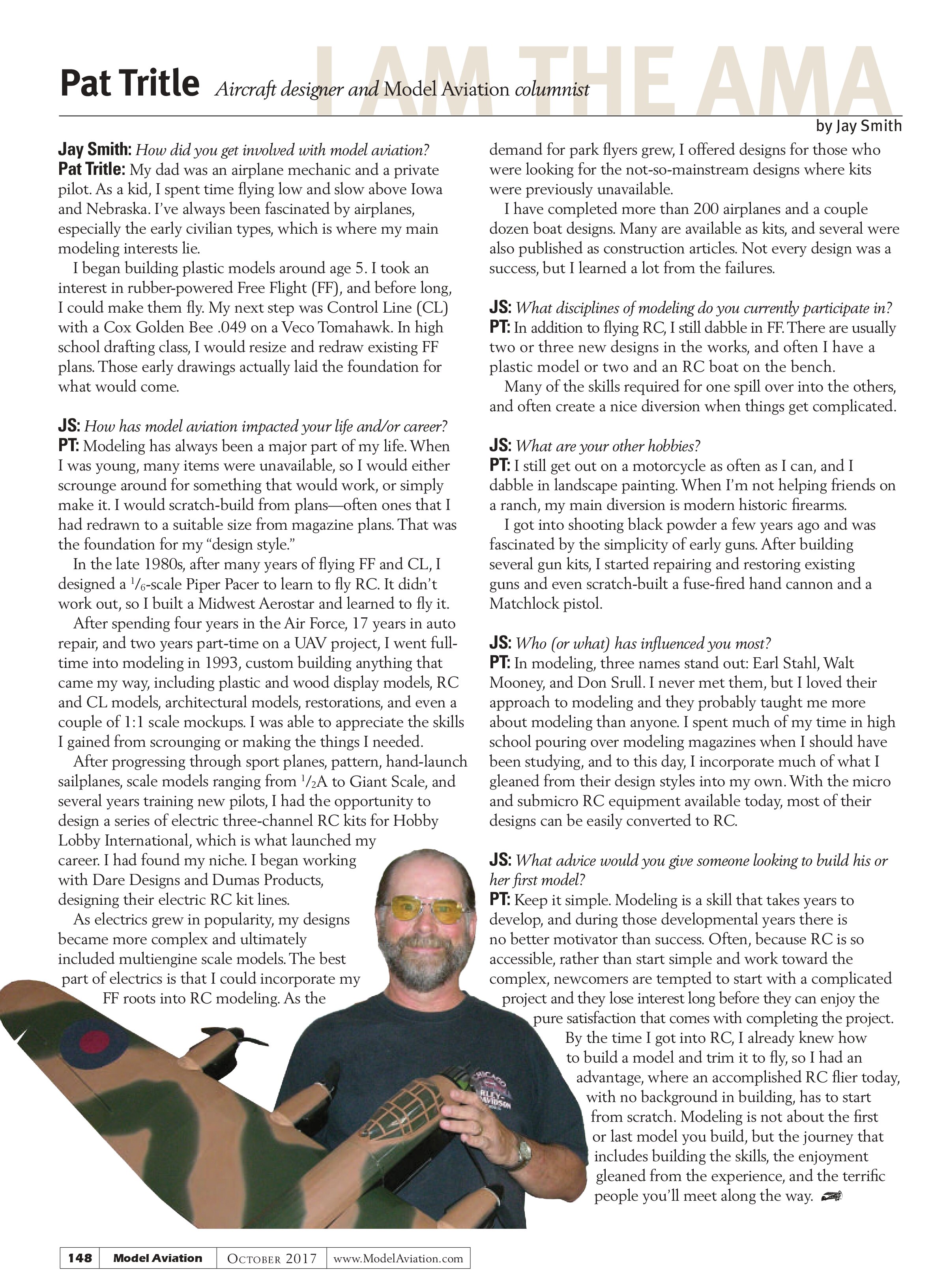
After progressing through sport planes, pattern, hand-launch sailplanes, scale models ranging from ¹⁄₂A to Giant Scale, and several years training new pilots, I had the opportunity to design a series of electric three-channel RC kits for Hobby Lobby International, which is what launched my career. I had found my niche. I began working with Dare Designs and Dumas Products, designing their electric RC kit lines.
As electrics grew in popularity, my designs became more complex and ultimately included multiengine scale models. The best part of electrics is that I could incorporate my FF roots into RC modeling. As the

I have completed more than 200 airplanes and a couple dozen boat designs. Many are available as kits, and several were also published as construction articles. Not every design was a success, but I learned a lot from the failures.
JS: What disciplines of modeling do you currently participate in?
PT: In addition to flying RC, I still dabble in FF. There are usually two or three new designs in the works, and often I have a plastic model or two and an RC boat on the bench.
Many of the skills required for one spill over into the others, and often create a nice diversion when things get complicated.
JS: What are your other hobbies?
PT: I still get out on a motorcycle as often as I can, and I dabble in landscape painting. When I’m not helping friends on a ranch, my main diversion is modern historic firearms.
I got into shooting black powder a few years ago and was fascinated by the simplicity of early guns. After building several gun kits, I started repairing and restoring existing guns and even scratch-built a fuse-fired hand cannon and a Matchlock pistol.
JS: Who (or what) has influenced you most?
PT: In modeling, three names stand out: Earl Stahl, Walt Mooney, and Don Srull. I never met them, but I loved their approach to modeling and they probably taught me more about modeling than anyone. I spent much of my time in high school pouring over modeling magazines when I should have been studying, and to this day, I incorporate much of what I gleaned from their design styles into my own. With the micro and submicro RC equipment available today, most of their designs can be easily converted to RC.
JS: What advice would you give someone looking to build his or her first model?
PT: Keep it simple. Modeling is a skill that takes years to develop, and during those developmental years there is no better motivator than success. Often, because RC is so accessible, rather than start simple and work toward the complex, newcomers are tempted to start with a complicated project and they lose interest long before they can enjoy the pure satisfaction that comes with completing the project.
By the time I got into RC, I already knew how to build a model and trim it to fly, so I had an advantage, where an accomplished RC flier today, with no background in building, has to start from scratch. Modeling is not about the first or last model you build, but the journey that includes building the skills, the enjoyment gleaned from the experience, and the terrific people you’ll meet along the way.