Focal Point
Super Sniffer

Mike McCulloch (Hartsville, South Carolina; email: mikemc_1944@hotmail.com) was inspired to build the Super Sniffer from a Model Aviation article and by a member of Mike’s club who builds Old-Timer kits. Mike said that he enjoyed the experience of covering the model with Coverite.
The Super Sniffer kit was sold by BMJR Models as an RC Texaco aircraft and is powered by a Himax 2812 brushless outrunner motor, Hitec electronics, and a 9 x 4.5 propeller. “It flies fine,” Mike wrote.
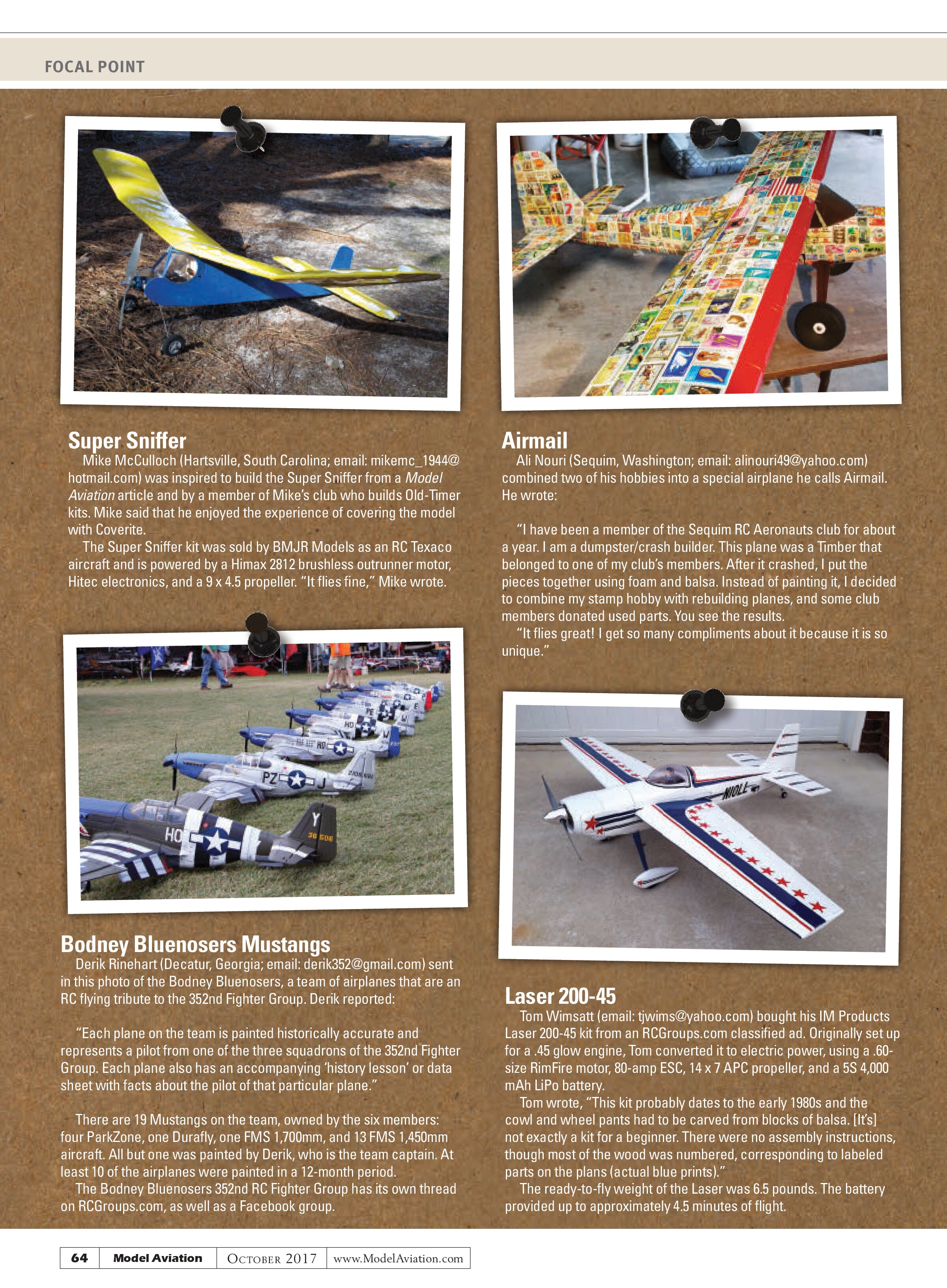
Bodney Bluenosers Mustangs

Derik Rinehart (Decatur, Georgia; email: derik352@gmail.com) sent in this photo of the Bodney Bluenosers, a team of airplanes that are an RC flying tribute to the 352nd Fighter Group. Derik reported:
“Each plane on the team is painted historically accurate and represents a pilot from one of the three squadrons of the 352nd Fighter Group. Each plane also has an accompanying ‘history lesson’ or data sheet with facts about the pilot of that particular plane.”
There are 19 Mustangs on the team, owned by the six members: four ParkZone, one Durafly, one FMS 1,700mm, and 13 FMS 1,450mm aircraft. All but one was painted by Derik, who is the team captain. At least 10 of the airplanes were painted in a 12-month period.
The Bodney Bluenosers 352nd RC Fighter Group has its own thread on RCGroups.com, as well as a Facebook group.
Airmail

Ali Nouri (Sequim, Washington; email: alinouri49@yahoo.com) combined two of his hobbies into a special airplane he calls Airmail. He wrote:
“I have been a member of the Sequim RC Aeronauts club for about a year. I am a dumpster/crash builder. This plane was a Timber that belonged to one of my club’s members. After it crashed, I put the pieces together using foam and balsa. Instead of painting it, I decided to combine my stamp hobby with rebuilding planes, and some club members donated used parts. You see the results.
“It flies great! I get so many compliments about it because it is so unique.”
Laser 200-45

Tom Wimsatt (email: tjwims@yahoo.com) bought his IM Products Laser 200-45 kit from an RCGroups.com classified ad. Originally set up for a .45 glow engine, Tom converted it to electric power, using a .60-size RimFire motor, 80-amp ESC, 14 x 7 APC propeller, and a 5S 4,000 mAh LiPo battery.
Tom wrote, “This kit probably dates to the early 1980s and the cowl and wheel pants had to be carved from blocks of balsa. [It’s] not exactly a kit for a beginner. There were no assembly instructions, though most of the wood was numbered, corresponding to labeled parts on the plans (actual blue prints).”
The ready-to-fly weight of the Laser was 6.5 pounds. The battery provided up to approximately 4.5 minutes of flight.
Super Sportster Kit Bash

Nick Ziegler (email: a100dork3@yahoo.com) sent in a “Focal Point” submission for Jeff Ziegler (Moline, Illinois). Jeff built a one-off Great Planes Super Sportster twin. Starting with the original ARF, Jeff took it home, stripped the covering off, and kit-bashed the aircraft.
The custom airplane is set up with E-flite electric retracts, Cobra motors, Hitec ESCs, and Hitec servos. With weak batteries, the GPS noted that it had a speed of 96 mph.
Recovering and painting the airplane took a lot of work, but the Super Sportster was a huge hit on social media sites where people were following the build. Nick noted, “Jeff also has a framed-up 1.20-size [model], so stay tuned.”
Tommy Morse Sea Scout

The Tommy Morse 1/6-scale Sea Scout that Carlos Rangel (Tucson, Arizona; email: rcpilot663@gmail.com) built is from a Balsa USA kit and is covered with fabric and powered by an E-flite motor. “I researched the history of the Tommy Morse and discovered that it was used as a seaplane scout,” Carlos wrote. “Using photos from a full-scale museum Tommy on floats, I scratch-built the foam-core floats to scale.”
Carlos took the photo at Canyon Lake in Arizona. He stated, “Our Southern Arizona Modelers club (AMA 1191) organizes a biannual fun float-fly at this lake. Each time we have had more participants. Float flying is a blast!”
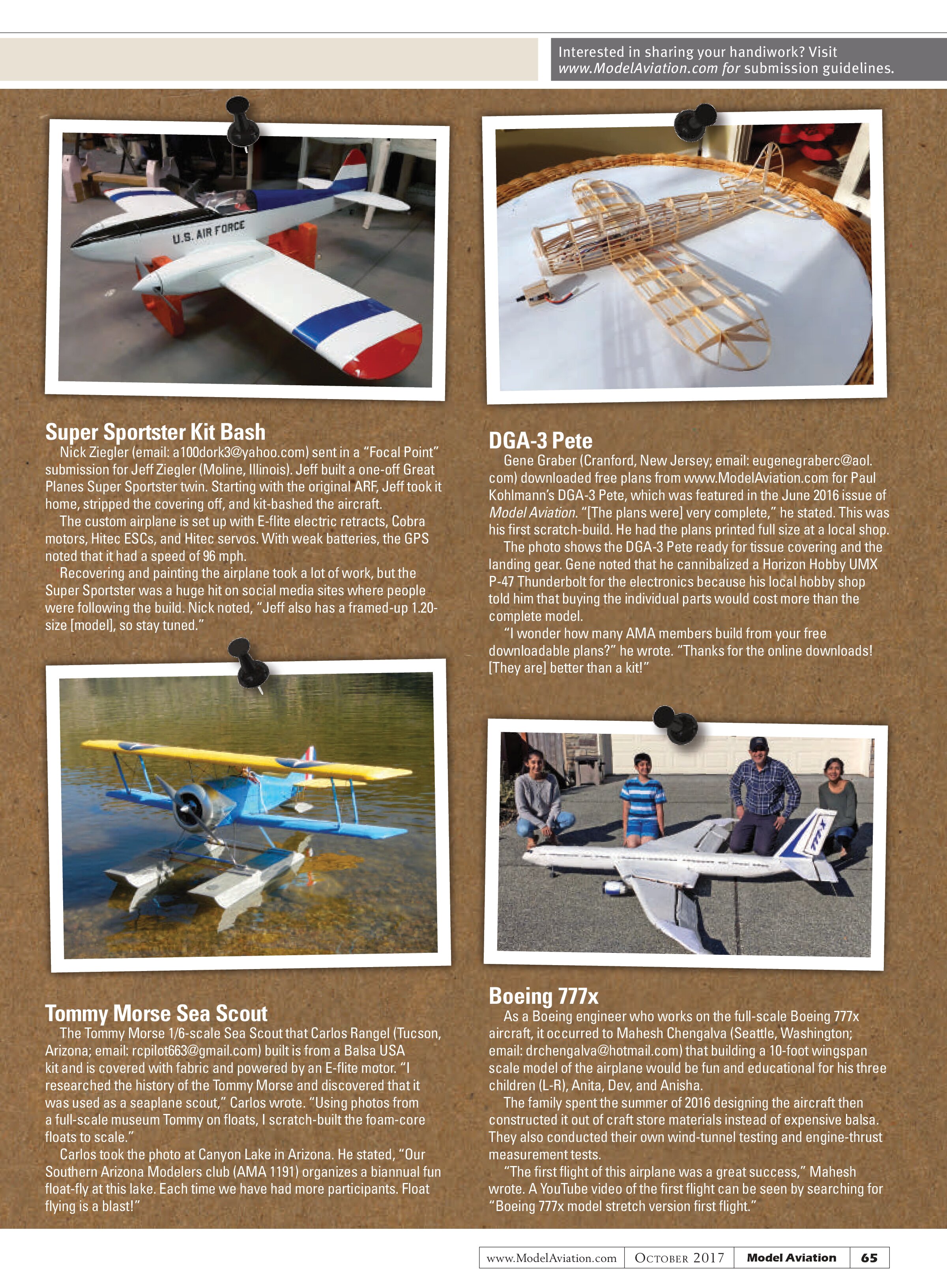
DGA-3 Pete

Gene Graber (Cranford, New Jersey; email: eugenegraber@aol.com) downloaded free plans from www.ModelAviation.com for Paul Kohlmann’s DGA-3 Pete, which was featured in the June 2016 issue of Model Aviation. “[The plans were] very complete,” he stated. This was his first scratch-build. He had the plans printed full size at a local shop.
The photo shows the DGA-3 Pete ready for tissue covering and the landing gear. Gene noted that he cannibalized a Horizon Hobby UMX P-47 Thunderbolt for the electronics because his local hobby shop told him that buying the individual parts would cost more than the complete model.
“I wonder how many AMA members build from your free downloadable plans?” he wrote. “Thanks for the online downloads! [They are] better than a kit!”
Boeing 777x

As a Boeing engineer who works on the full-scale Boeing 777x aircraft, it occurred to Mahesh Chengalva (Seattle, Washington; email: drchengalva@hotmail.com) that building a 10-foot wingspan scale model of the airplane would be fun and educational for his three children (L-R), Anita, Dev, and Anisha.
The family spent the summer of 2016 designing the aircraft then constructed it out of craft store materials instead of expensive balsa. They also conducted their own wind-tunnel testing and engine-thrust measurement tests.
“The first flight of this airplane was a great success,” Mahesh wrote. A YouTube video of the first flight can be seen by searching for “Boeing 777x model stretch version first flight.”