Flying Site Assistance by Tony Stillman, Flying Site Coordinator
U.S. Army Corps of Engineers

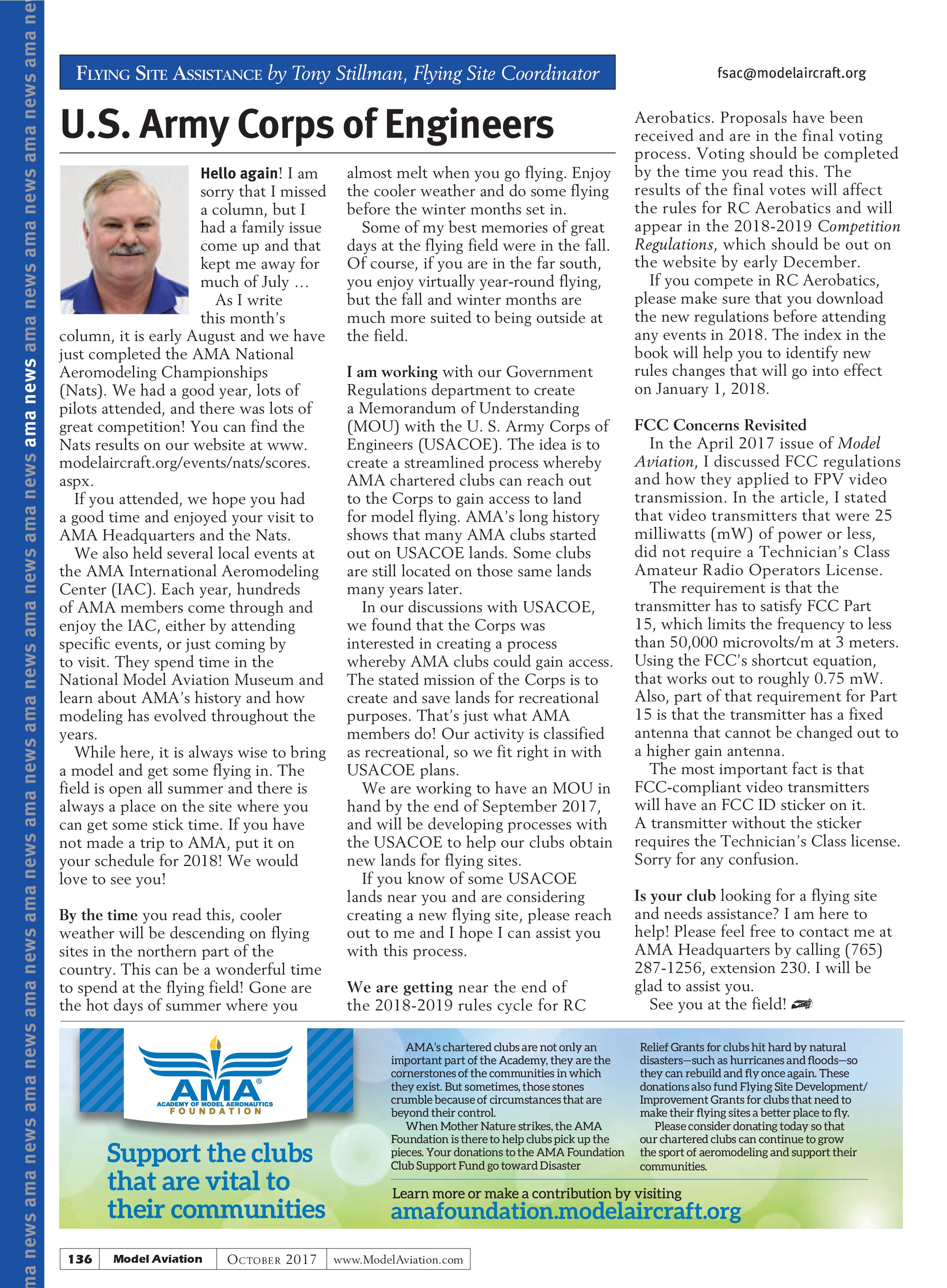
Hello again! I am sorry that I missed a column, but I had a family issue come up and that kept me away for much of July …
As I write this month’s column, it is early August and we have just completed the AMA National Aeromodeling Championships (Nats). We had a good year, lots of pilots attended, and there was lots of great competition! You can find the Nats results on our website at www.modelaircraft.org/events/nats/scores.aspx.
If you attended, we hope you had a good time and enjoyed your visit to AMA Headquarters and the Nats.
We also held several local events at the AMA International Aeromodeling Center (IAC). Each year, hundreds of AMA members come through and enjoy the IAC, either by attending specific events, or just coming by to visit. They spend time in the National Model Aviation Museum and learn about AMA’s history and how modeling has evolved throughout the years.
While here, it is always wise to bring a model and get some flying in. The field is open all summer and there is always a place on the site where you can get some stick time. If you have not made a trip to AMA, put it on your schedule for 2018! We would love to see you!
By the time you read this, cooler weather will be descending on flying sites in the northern part of the country. This can be a wonderful time to spend at the flying field! Gone are the hot days of summer where you almost melt when you go flying. Enjoy the cooler weather and do some flying before the winter months set in.
Some of my best memories of great days at the flying field were in the fall. Of course, if you are in the far south, you enjoy virtually year-round flying, but the fall and winter months are much more suited to being outside at the field.
I am working with our Government Regulations department to create a Memorandum of Understanding (MOU) with the U. S. Army Corps of Engineers (USACOE). The idea is to create a streamlined process whereby AMA chartered clubs can reach out to the Corps to gain access to land for model flying. AMA’s long history shows that many AMA clubs started out on USACOE lands. Some clubs are still located on those same lands many years later.
In our discussions with USACOE, we found that the Corps was interested in creating a process whereby AMA clubs could gain access. The stated mission of the Corps is to create and save lands for recreational purposes. That’s just what AMA members do! Our activity is classified as recreational, so we fit right in with USACOE plans.
We are working to have an MOU in hand by the end of September 2017, and will be developing processes with the USACOE to help our clubs obtain new lands for flying sites.
If you know of some USACOE lands near you and are considering creating a new flying site, please reach out to me and I hope I can assist you with this process.
We are getting near the end of the 2018-2019 rules cycle for RC Aerobatics. Proposals have been received and are in the final voting process. Voting should be completed by the time you read this. The results of the final votes will affect the rules for RC Aerobatics and will appear in the 2018-2019 Competition Regulations, which should be out on the website by early December.
If you compete in RC Aerobatics, please make sure that you download the new regulations before attending any events in 2018. The index in the book will help you to identify new rules changes that will go into effect on January 1, 2018.
FCC Concerns Revisited
In the April 2017 issue of Model Aviation, I discussed FCC regulations and how they applied to FPV video transmission. In the article, I stated that video transmitters that were 25 milliwatts (mW) of power or less, did not require a Technician’s Class Amateur Radio Operators License.
The requirement is that the transmitter has to satisfy FCC Part 15, which limits the frequency to less than 50,000 microvolts/m at 3 meters. Using the FCC’s shortcut equation, that works out to roughly 0.75 mW. Also, part of that requirement for Part 15 is that the transmitter has a fixed antenna that cannot be changed out to a higher gain antenna.
The most important fact is that FCC-compliant video transmitters will have an FCC ID sticker on it. A transmitter without the sticker requires the Technician’s Class license. Sorry for any confusion.
Is your club looking for a flying site and needs assistance? I am here to help! Please feel free to contact me at AMA Headquarters by calling (765) 287-1256, extension 230. I will be glad to assist you.
See you at the field!