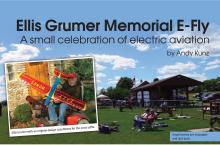
Ellis Grumer Memorial E-Fly
A small celebration of electric aviation
by Andy Kunz


Small events are our past, present, and future. They are the heartbeat and future of the aeromodeling hobby—the only type that most model aviators will ever attend. This article is about one of those small events.
The Lehigh Valley Radio Control Society (LVRCS) Electric Meet was started in 1987 in Easton, Pennsylvania, after club member Ellis Grumer attended the nearby 1986 Keystone Radio Control (KRC) club Electric Fly in Souderton, Pennsylvania. Hosted every year on the first weekend in June, the meet draws roughly 40 or so pilots from Pennsylvania, Virginia, Maryland, New Jersey, upstate New York and Long Island, as well as a few from beyond.
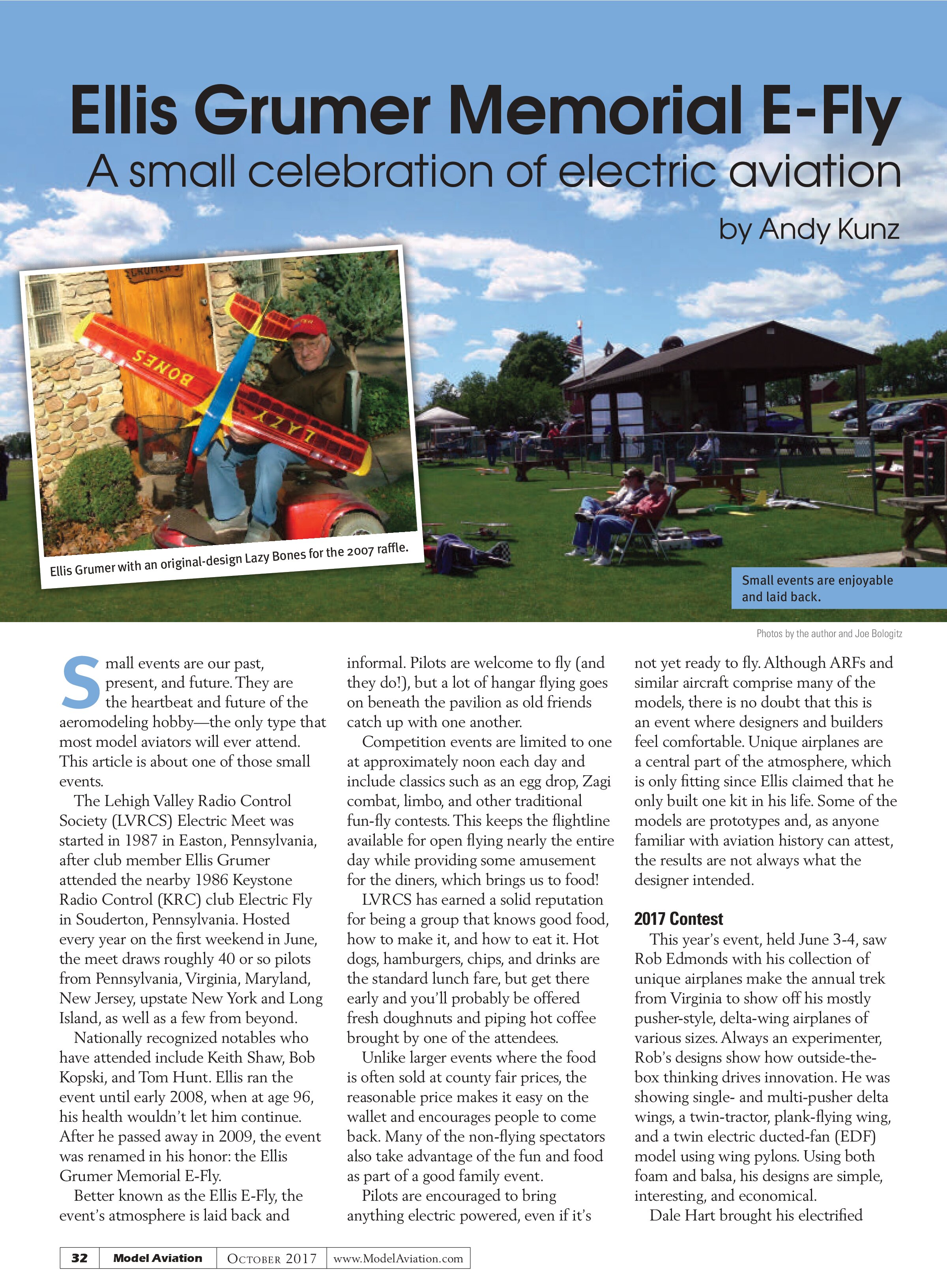
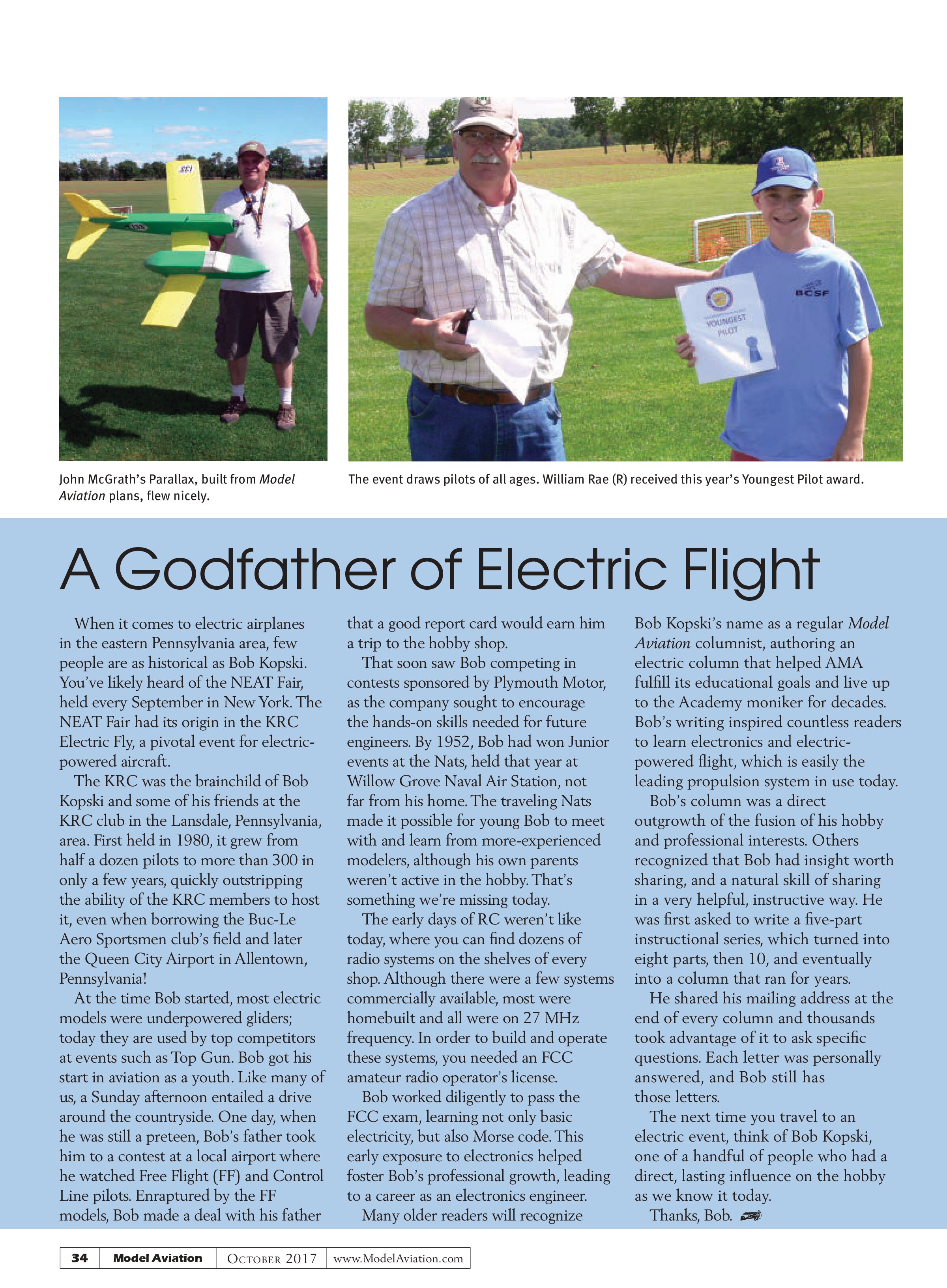
Nationally recognized notables who have attended include Keith Shaw, Bob Kopski, and Tom Hunt. Ellis ran the event until early 2008, when at age 96, his health wouldn’t let him continue. After he passed away in 2009, the event was renamed in his honor: the Ellis Grumer Memorial E-Fly.
Better known as the Ellis E-Fly, the event’s atmosphere is laid back and informal. Pilots are welcome to fly (and they do!), but a lot of hangar flying goes on beneath the pavilion as old friends catch up with one another.
Competition events are limited to one at approximately noon each day and include classics such as an egg drop, Zagi combat, limbo, and other traditional fun-fly contests. This keeps the flightline available for open flying nearly the entire day while providing some amusement for the diners, which brings us to food!
LVRCS has earned a solid reputation for being a group that knows good food, how to make it, and how to eat it. Hot dogs, hamburgers, chips, and drinks are the standard lunch fare, but get there early and you’ll probably be offered fresh doughnuts and piping hot coffee brought by one of the attendees.
Unlike larger events where the food is often sold at county fair prices, the reasonable price makes it easy on the wallet and encourages people to come back. Many of the non-flying spectators also take advantage of the fun and food as part of a good family event.
Pilots are encouraged to bring anything electric powered, even if it’s not yet ready to fly. Although ARFs and similar aircraft comprise many of the models, there is no doubt that this is an event where designers and builders feel comfortable. Unique airplanes are a central part of the atmosphere, which is only fitting since Ellis claimed that he only built one kit in his life. Some of the models are prototypes and, as anyone familiar with aviation history can attest, the results are not always what the designer intended.
2017 Contest
This year’s event, held June 3-4, saw Rob Edmonds with his collection of unique airplanes make the annual trek from Virginia to show off his mostly pusher-style, delta-wing airplanes of various sizes. Always an experimenter, Rob’s designs show how outside-the-box thinking drives innovation. He was showing single- and multi-pusher delta wings, a twin-tractor, plank-flying wing, and a twin electric ducted-fan (EDF) model using wing pylons. Using both foam and balsa, his designs are simple, interesting, and economical.
Dale Hart brought his electrified


The Spirit of Electric Flight
Not many of us know someone whose first memory of airplanes is of surplus Curtiss Jennys at the end of World War I and who lived to see aircraft return from outer space. John Ellis Grumer was one such man. Born in 1912 to a mail carrier, Ellis related that his first airplane memories were of a group of Jennys flying westward over the family home in Phillipsburg, New Jersey.
Ellis’ service in World War II was at the local Ingersoll-Rand (IR) plant, where his skill in setup was deemed more valuable to the war effort than if he’d been carrying a gun. In fact, IR was his only full-time employer throughout his entire life. After retiring early because of a medical condition, Ellis was able to engage in his hobbies: photography, model airplanes, music (upright bass and violin), and dote on his wife, Marguerite.
Ellis was known not just for his craftsmanship, but also as someone who frequently experimented with something new. Whether building a model for the first or fifth time, he would look for and try a new material or technique. Foam found its way into airplanes as a substitute for balsa blocks; cut vinyl lettering could be substituted for hand-cut MonoKote trim.
Electric-powered airplanes were one of those experiments. His success with them, largely thanks to Bob Kopski, made Ellis nitro free, long before most club members even had their first electric experience.
Eager to learn, Ellis read Keith Shaw’s writings regarding the use of multiple smaller spars along the leading edge. He quickly adapted the practice for his own airplanes because it was stronger and more attractive.
He read Bob Boucher’s book on electric motors and Tom Hunt’s writings about gearboxes. Understanding brushless outrunner motors as essentially an electric gearbox, Ellis quickly adopted them for his last few models.
Following a trip to the KRC club in 1986, he started the annual Electric Fly with the LVRCS, to help spread the word of electric flight. The KRC morphed into the Northeast Electric Aircraft Technology (NEAT) Fair, but Ellis’ meet kept on going, changing its character little despite multiple contest directors throughout more than 30 years.
Not only did he learn, but he taught and encouraged. He shared new techniques that he had learned from others, he evangelized the club about the possibilities of electric flight, and he encouraged countless young modelers, musicians, and photographers to follow their dreams.’
Be like Ellis.

Hangar 9 Phoenix 7. His model started life as a nitro-powered airplane for another club member. When Dale got it, he replaced the Rossi .60 with a Scorpion HK-4025-740 (helicopter motor), a 6S 4,500 mAh Turnigy nano-tech 35-70 battery pack, and a YEP 80-amp ESC, and changed out the air retracts for E-flite electrics.
The result flies as well as the original, but is much quieter, simpler to maintain, and weighs only 8.25 pounds. Dale’s goal was to have it sound and perform like a piped nitro aircraft. He easily hit the target 15,000 rpm and it draws only 80 amps after being fitted with a Rev-Up 11 x 7 wooden propeller.
Awards
Although the Ellis E-Fly isn’t a competition, there are a few awards to be won. The Youngest Pilot award went to William Rae, age 12. William is well on his way as a pilot—he had no trouble with his E-flite Pulse 15e.
Another unusual airplane that showed up was the Parallax (Model Aviation, May 2014). Built by John McGrath, it took the Technical Achievement award. It certainly is an unusual airplane to pilot, and it attracted much attention.
Carl Catino won both Best Scale for his FlightLine RC P-38 and Best EDF award for his ROC Super Scorpion. Carl has a reputation in the club for terrific-looking airplanes and he deserved these awards. He’s a great pilot.
The Best Sport award was for the Manzano Laser Works Stunt Trainer by Andy Kunz. Based on a 1950s Control Line design by Walt Musciano, it includes many features that are found on modern aerobatic airplanes, without giving up the old-school looks. Power comes from an E-flite Power 32 and 4S 3,800 mAh LiPo battery with an E-flite 60-amp ESC. Andy added a small brushed ESC to drive red LEDs in the exhaust ports of a giant faux Cox engine.
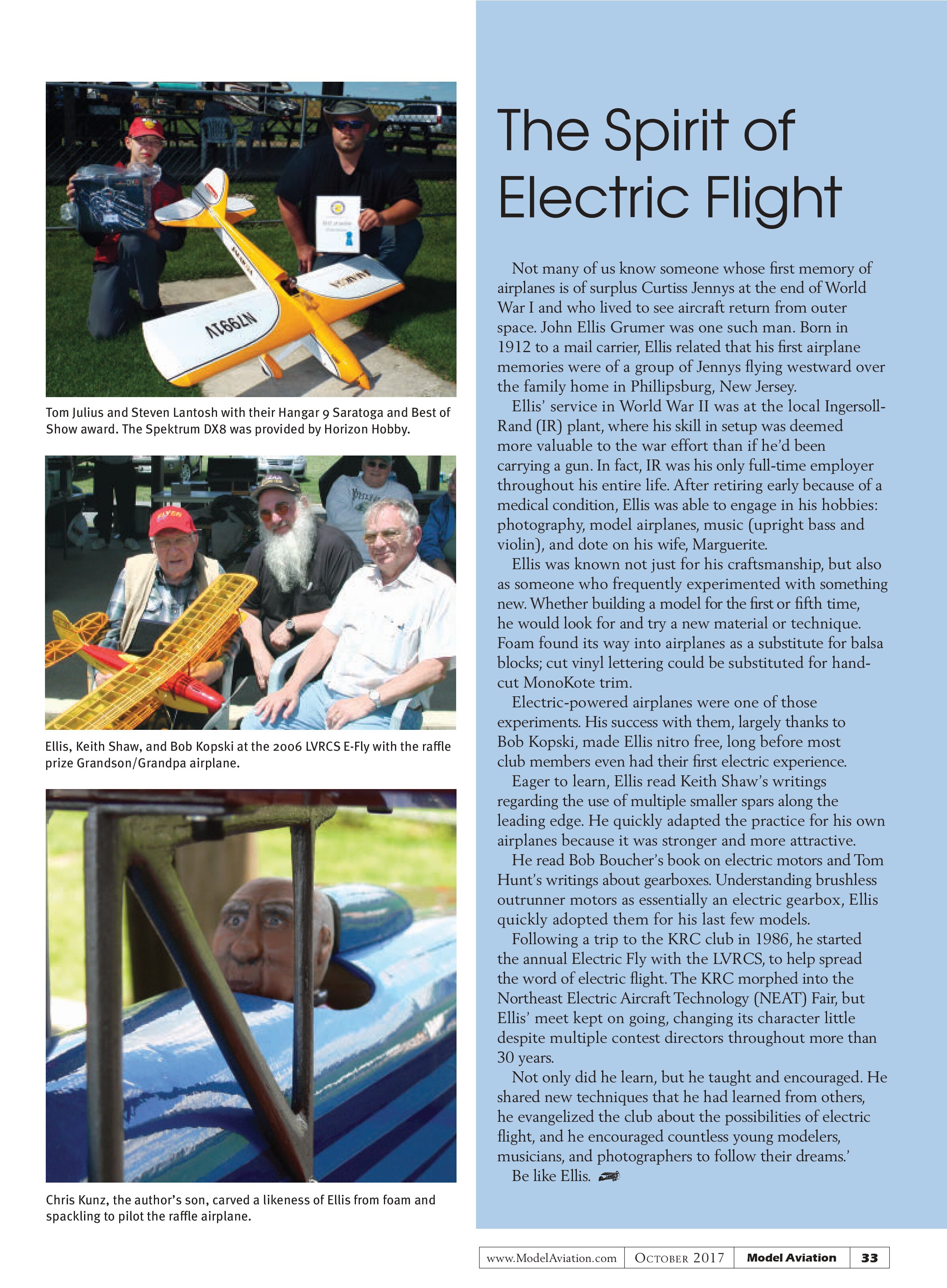
The Best of Show (Pilots’ Choice) award, sponsored by Horizon Hobby, went to Tom Julius and his stepson, Steven Lantosh, for their Hangar 9 Saratoga, powered by an E-flite Power 46 and a 4S 3,200 mAh Kinesxis LiPo battery pack. Tom’s wife, Beth, was there, encouraging and supporting her men as they pursued a common interest. It certainly is good to see a family out for a day of fun in the sun. They won a new Spektrum DX8 Gen 2 transmitter for their efforts.
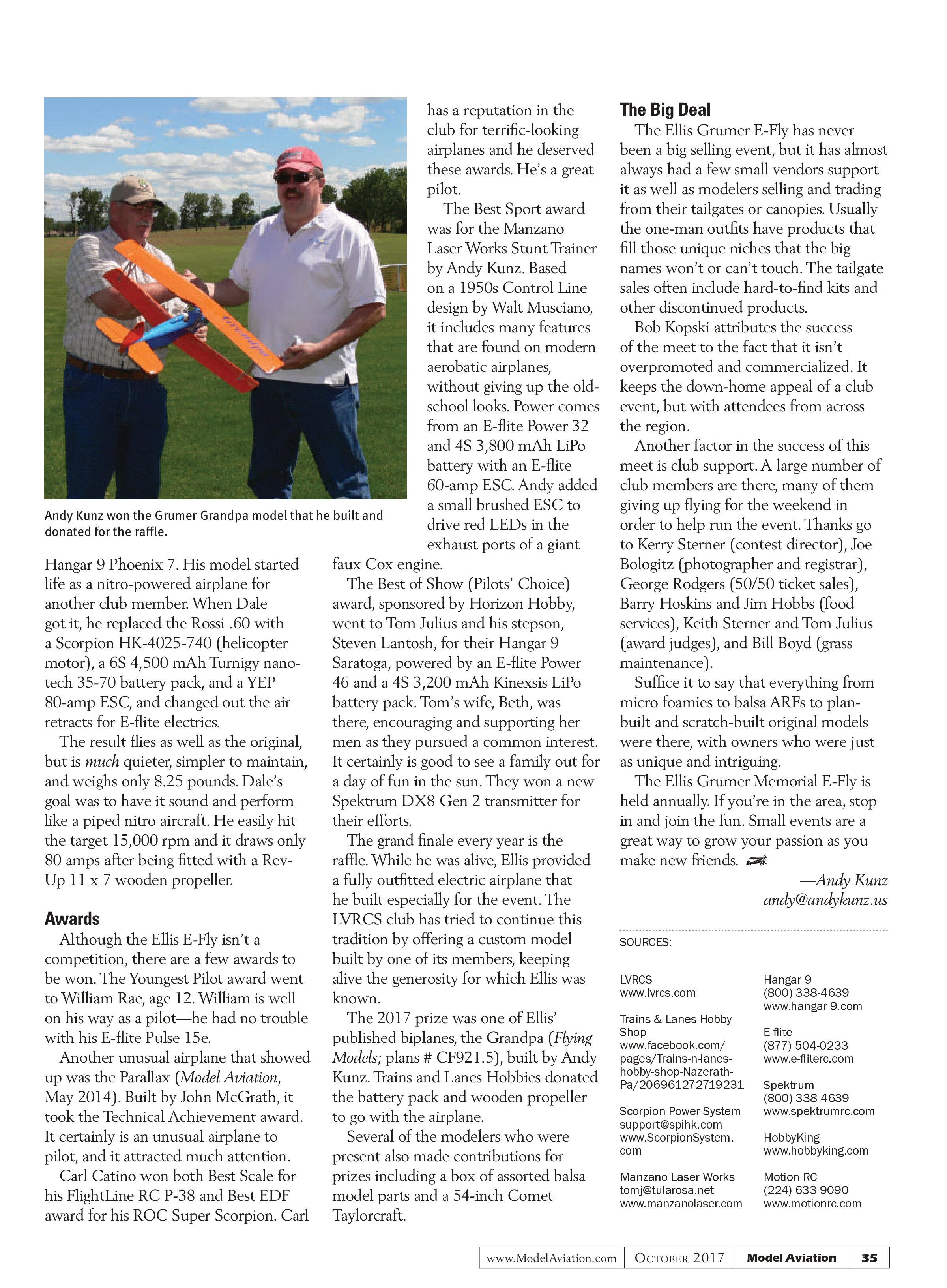
The grand finale every year is the raffle. While he was alive, Ellis provided a fully outfitted electric airplane that he built especially for the event. The LVRCS club has tried to continue this tradition by offering a custom model built by one of its members, keeping alive the generosity for which Ellis was known.
The 2017 prize was one of Ellis’ published biplanes, the Grandpa (Flying Models; plans # CF921.5), built by Andy Kunz. Trains and Lanes Hobbies donated the battery pack and wooden propeller to go with the airplane.
Several of the modelers who were present also made contributions for prizes including a box of assorted balsa model parts and a 54-inch Comet Taylorcraft.
The Big Deal
The Ellis Grumer E-Fly has never been a big selling event, but it has almost always had a few small vendors support it as well as modelers selling and trading from their tailgates or canopies. Usually the one-man outfits have products that fill those unique niches that the big names won’t or can’t touch. The tailgate sales often include hard-to-find kits and other discontinued products.
Bob Kopski attributes the success of the meet to the fact that it isn’t overpromoted and commercialized. It keeps the down-home appeal of a club event, but with attendees from across the region.
Another factor in the success of this meet is club support. A large number of club members are there, many of them giving up flying for the weekend in order to help run the event. Thanks go to Kerry Sterner (contest director), Joe Bologitz (photographer and registrar), George Rodgers (50/50 ticket sales), Barry Hoskins and Jim Hobbs (food services), Keith Sterner and Tom Julius (award judges), and Bill Boyd (grass maintenance).
Suffice it to say that everything from micro foamies to balsa ARFs to plan-built and scratch-built original models were there, with owners who were just as unique and intriguing.
The Ellis Grumer Memorial E-Fly is held annually. If you’re in the area, stop in and join the fun. Small events are a great way to grow your passion as you make new friends.
—Andy Kunz
andy@andykunz.us
SOURCES:
LVRCS
www.lvrcs.com
Trains & Lanes Hobby Shop
www.facebook.com/pages/Trains-n-lanes-hobby-shop-Nazareth-Pa/20696127271...
Scorpion Power System
support@spihk.com
www.ScorpionSystem.com
Manzano Laser Works
tomj@tularosa.net
www.manzanolaser.com
Hangar 9
(800) 338-4639
www.hangar-9.com
E-flite
(877) 504-0233
www.e-fliterc.com
Spektrum
(800) 338-4639
www.spektrumrc.com
HobbyKing
www.hobbyking.com
Motion RC
(224) 633-9090
www.motionrc.com