In the Air
Membership news and updates
from AMA Headquarters
Club Holds RC Camp
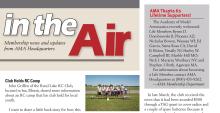
John Griffen of the Rend Lake RC Club, located in Ina, Illinois, shared some information about an RC camp that his club held for local youth.
I want to share a little back story for how this came about. When I was younger, I remember finding out that there was a local RC club holding regular meetings in town. I was only 10 or 11 at the time, but nonetheless wanted my parents to take me to one of these meetings.
The day came and my parents drove me to the meeting site. They patiently waited in the parking lot as I went in. Before the meeting started, a couple of members said hi and asked my name and that was about it—as they started and ended their meeting. I attended a couple more meetings and it was much the same—never really being welcomed or introduced to the hobby!
So I will state it now: don’t you think for a minute that kids don’t remember first impressions! I have told myself over the years that when the time was right, and if the opportunity presented itself, I would make every effort to help introduce kids to the RC hobby! Now, some 30 years later, that’s exactly what we are doing here at the Rend Lake RC Club in southern Illinois!
In our club’s May blog post, we announced that Rend Lake College and its president, Terry Wilkerson, had given the club great news in October 2016 that a new RC flying field would be constructed on the east side of campus! This led to a great new working relationship with the college.
During this meeting, the topic of how the college does summer camps for kids every year came up and Terry asked if we could make an RC camp happen. Just like that, the opportunity presented itself!
With it settled that the club would do a camp, the real work began. Lots of reading on AMA’s website led to calling AMA District VI Vice President Randy Cameron. From that conversation, an AMA Take off And Grow (TAG) grant was pursued. It was written for two Apprentice S airplanes and two buddy-box setups that would be used for the club’s open houses and, of course, RC kids’ camps.


In late March, the club received the news that it had been awarded $500 through a TAG grant to cover radios and a couple of spare batteries. Because it wasn’t enough to also cover getting the Apprentices, Randy stopped in Mount Vernon, Illinois, to personally present the Rend Lake RC Club with two Apprentice airplanes—filling the needs for the camp and open houses.
AMA also sent a box of goodies to go to the camp. In it were balsa rubber band-powered Sky Streaks, foam plate gliders, Model Aviation magazines, and much more!
RC Kids Camp took place June 5-8, 2017. What an exciting four days! Here is a breakdown of what we did for the first RC Kids Camp:
Day 1: All materials were gathered to build a Flite Test Sparrow glider. With nine kids in the camp, this took a little more than two hours to complete. During the build, we also explained control surfaces and the effects of their movements.
When the gliders were complete, we had a lesson on center of gravity (CG) and balancing. That left just enough time to go outside and practice throwing the gliders and adjusting elevators and the CG.
Day 2: We picked up where we left off and finished adjusting the gliders. With that complete, we started building balsa Sky Streak rubber band-powered airplanes from AMA. Kids assembled their models and the club members assisted them by adding the dihedral to the wings and using CA to secure them in place. With the gliders and Sky Streaks complete, we headed off to an indoor sports complex for distance and longest flight contests.
The AMA Plans Service

The AMA Plans Service now houses all plans formerly sold through Model Builder magazine, Bill Northrop’s Plan Service, and the Scratch Builder’s Almanac. There are more than 1,000 plans in the collection.
The Curtiss Hawk P-6E, drawn by Charlie Smith, comes from Bill Northrop’s NASCO collection. The aircraft has a 65-inch wingspan and would make a great project. It comes printed on three large sheets with helpful scale information.
You can order the Curtiss Hawk P-6E, plans number S103, for $35 by calling AMA Plans Service at (800) 435-9262, extension 507.
Day 3: Today we started on RC. The kids were split into two groups. One group went to the indoor sports complex where they were taught how to fly a Blade Inductrix quadcopter—first by sight, then by monitor, and finally by flying with goggles.
The other group stayed at the flying field, where they received a lesson about control surfaces and stick movements on the radio. After that was complete, we began flying the club’s trainers using buddy-box systems. Campers were given control on straight passes to learn how to fly level. Their second time up was working on coordinated turns, and their last time in the air was flying a complete circuit.
Day 4: Nothing but lots of flying! We tried to get every kid as many flights as possible in the three-hour camp timeframe. Before the youngsters were picked up, each received a “First RC Flight Certificate.”
The club’s first RC Kids Camp was a huge success and we look forward to next year. The key to it all was the members who volunteered their time to help! Without them, this camp would be hard to pull off! So, a big thank-you to the following Rend Lake RC Club members: Dave Black, Bob Trober, Phil Bean, Cliff Christensen, and Al Jones.
To see all of the pictures taken during the week of RC Kids Camp, visit www.rendlakerclub.com/kids-camp-2017.
—by John Griffen
One Year of Flying
An AMA member was honored by his club and AMA for flying every day for one year.

George R. Baker, of Church Hill, Tennessee, completed his 365th flight on July 22. He is a member of the TiredIron Aviation club and the Johnson City Radio Controllers.
During the Johnson City Radio Controllers’ runway dedication event, TiredIron Aviation club members presented George with a cake and a new Freewing F-86 jet to mark his milestone and to thank him for all that he does for his clubs.
After sharing his story with AMA’s Marketing department, AMA created a certificate for George, signed by AMA Executive Director Dave Mathewson, and sent it to him, along with a pin. He was pleased when he received it.
George endured harsh weather conditions and took his model airplanes on vacation with him to achieve his goal.

Model Aviation in America, 100 Years Ago
It had only been approximately 10 years since the first two American modeling clubs were founded: the Junior Aero Club of the United States (later “of America”), founded by Miss. E. Lillian Todd (circa 1907), and the New York Model Aero Club (circa 1910). By 1917, aeromodeling was becoming quite a popular pastime in the US. There were roughly 25 clubs across the country that year.
Of all of the aircraft flown, the twin pusher model airplane was king. World records that year included three made by Phillip Breckenridge (Illinois Model Aero Club): 2,200 feet for hand-launch tractor distance; 227.4 seconds for rise-off-ground (ROG) tractor duration; and 2,685 feet for ROG tractor distance. Ward Pease also set a record of 3,364 feet for ROG distance for twin pusher-type models.
One of the publications that produced model aviation columns at the time was Aerial Age Weekly. The column was called “Model News” and it was edited by George A. Cavanagh (and sometimes Harry Schultz). George was the model editor of Aerial Age Weekly and Harry was the president of the Aero Science Club of America.
“Model News” featured information about new aircraft being created or exhibited, notes on aeromodeling in general, and reports about club activities.
An amusing entry in the January 29, 1917, issue reported that the Nebraska Model Aero Club had arranged for the first model flying contest in Lincoln, Nebraska. The governor, governor-elect, and mayor were invited to judge the competition. “Among the twenty-four machines expected will be all classes of gliders and of planes whose motive power consists of rubberbands. One exhibition machine will be shown, constructed of aluminum throughout, with a gas engine to furnish the propulsion,” was stated in the column.
The column continued, “Col. John G. Maher, one of those interested in the contest, is enthusiastic about aeroplane flying as a sport for boys. ‘It develops the mechanical ingenuity to the highest degree and is a clean and invigorating sport, which ought to be encouraged.’”
George also wrote a book in 1916 titled Model Aeroplanes and their Motors—A Practical Guide for Beginners with drawings by Harry. (It was republished in 1917 with a slight title change, Model Aeroplanes and their Engines—A Practical Guide for Beginners.)
The Aero Club of America had formed the first National Model Aeroplane Competition (a predecessor to the modern Nats) during the previous year. As the US entered World War I, building and competing decreased because many modelers went to war. In 1917 and the following year, the National

Model Airplane Competition was called off.
The popularity of model airplane flying picked up again after the end of the war. It took a few more years, however, to get participation numbers back up.
If you have any papers, photographs, or items pertaining to the early years of modeling, please don’t hesitate to contact the National Model Aviation Museum. We would love to hear about them.
Here are 16 of the known early modeling clubs operating in 1917:
- Aero Club of Pennsylvania (Philadelphia)
- Aero Science Club of America (New York)
- Bay Ridge Model Club (New York)
- Buffalo Aero Science Club (New York)
- Concord Model Aero Club (Massachusetts)
- Denver Model Aero Club (Colorado)
- Illinois Model Aero Club
- Long Island Model Aero Club (New York)
- Milwaukee Model Aero Club (Wisconsin)
- Model Aero Club of Oxford (Pennsylvania)
- Nebraska Model Aero Club
- Pacific Northwest Model Aero Club (Seattle)
- Plattsburg Model Aero Club (New York)
- Springfield Model Aero Club (Massachusetts)
- Texas Model Aero Club
- Youngstown Model Aero Club (Ohio)


A few modelers who participated in model aviation in 1917 included:
- Mel Anderson: Built his first model in 1917; designed/produced the Super Cyclone engine; owned Mel Anderson Manufacturing Company; AMA Model Aviation Hall of Fame member (1981).
- Joe Dale: Built and flew models with Cecil Peoli and Percy Pierce; received his ham radio license in 1917; worked on radio control for Berkeley Models.
- Charles Hampson Grant: Studied at Princeton University (1913-1918) in civil engineering, where he became a flight student (1917); AMA Fellow (1964); AMA Model Aviation Hall of Fame (1969); National Free Flight Society (NFFS) Hall of Fame (1979); Society of Antique Modelers (SAM) Hall of Fame (1990); Kits and Plans Antiquitous Hall of Fame (1996); served on AMA’s first council (1936).
- Arthur Heinrich: Helped form the New York Model Aero Club; co-owned the family business, Heinrich Aeroplane Company, of Baldwin, New York.
- Percy Pierce: Served in the military during WW I; heavy participant in modeling before and after the war; owned his own model airplane company.
AMA Model Aviation Hall of Fame inductees born in 1917 included:
- Vic Cunnyngham Sr. (1995): Held nine national records; served as Nats event director for many years; AMA District X vice president (1969-1970); NFFS Hall of Fame (1987); SAM Hall of Fame (1991); Blacksheep Squadron Spirit Award (1994).
- William “Bill” L. Effinger (1986): Started Berkeley Models (1933); NFFS Hall of Fame (1981); Kits and Plans Antiquitous Hall of Fame (1996).
- Ed Lorenz (1980): Designed transmitters, receivers, parts, and kits for companies such as Berkeley Models, Ace R/C, Polk’s, and American Hobbies; AMA Distinguished Service Award (1973); Vintage RC Society (VRCS) Hall of Fame (1974); Howard McEntee Award (1974); Chair of the FCC Frequency Committee (1963-1973).
- John Pond (1987): Owned John Pond Plans Service; AMA District X vice president (1964-1968); NFFS Hall of Fame (1983); SAM Hall of Fame (1989); Kits and Plans Antiquitous Hall of Fame (2000).
- Henry Struck (1976): Grand champion at the Chicago Nats (1941); model designs published in Air Trails, Model Airplane News, Flying Aces, and the Zaic Yearbooks; NFFS Hall of Fame (1978); AMA Distinguished Service Award (1985); SAM Hall of Fame (1990); AMA Fellow (1998).
Some of the model aircraft supply companies and distributors that were in business in 1917 (not an all-inclusive list): A.A.C. Model Aircrafters, Brooklyn Aeroplane Supply Co., Ideal Aeroplane & Supply Co., Lawrence Airplane Model & Supply Co., The Model Supply House, The White Aeroplane Co., and Wading River Mfg. Co.
—National Model Aviation Museum staff