Responses to questions
I received two responses to a question in my May 2017 column about escapements with the electronics attached.
Tony Oravec wrote:
“Bob, that is a Babcock SE-2M escapement. I’m a bit hazy after 53 years, but I believe the transistors on the back end were a switcher there to allow a quick blip activation of a throttle control escapement on a ‘relay-less’ receiver.”
Bill and Bunny Kuhlman wrote:
“That’s a Babcock Mark II escapement. Around the time this escapement was available, Ace R/C put out a transistorized switcher [that] could be used in place of the relay. I believe that the extra electronics pack on the back of the escapement, while not the switcher Ace manufactured (which had one transistor and was quite small), could be a similar product from another source.”


Rudder-Only Control
“How in the world did you manage to fly an airplane with only rudder control?” I am frequently asked this, and the first answer is that you must have an airplane that is designed for rudder-only flying. What does that mean? A look back at some of the successful designs reveals several important features.
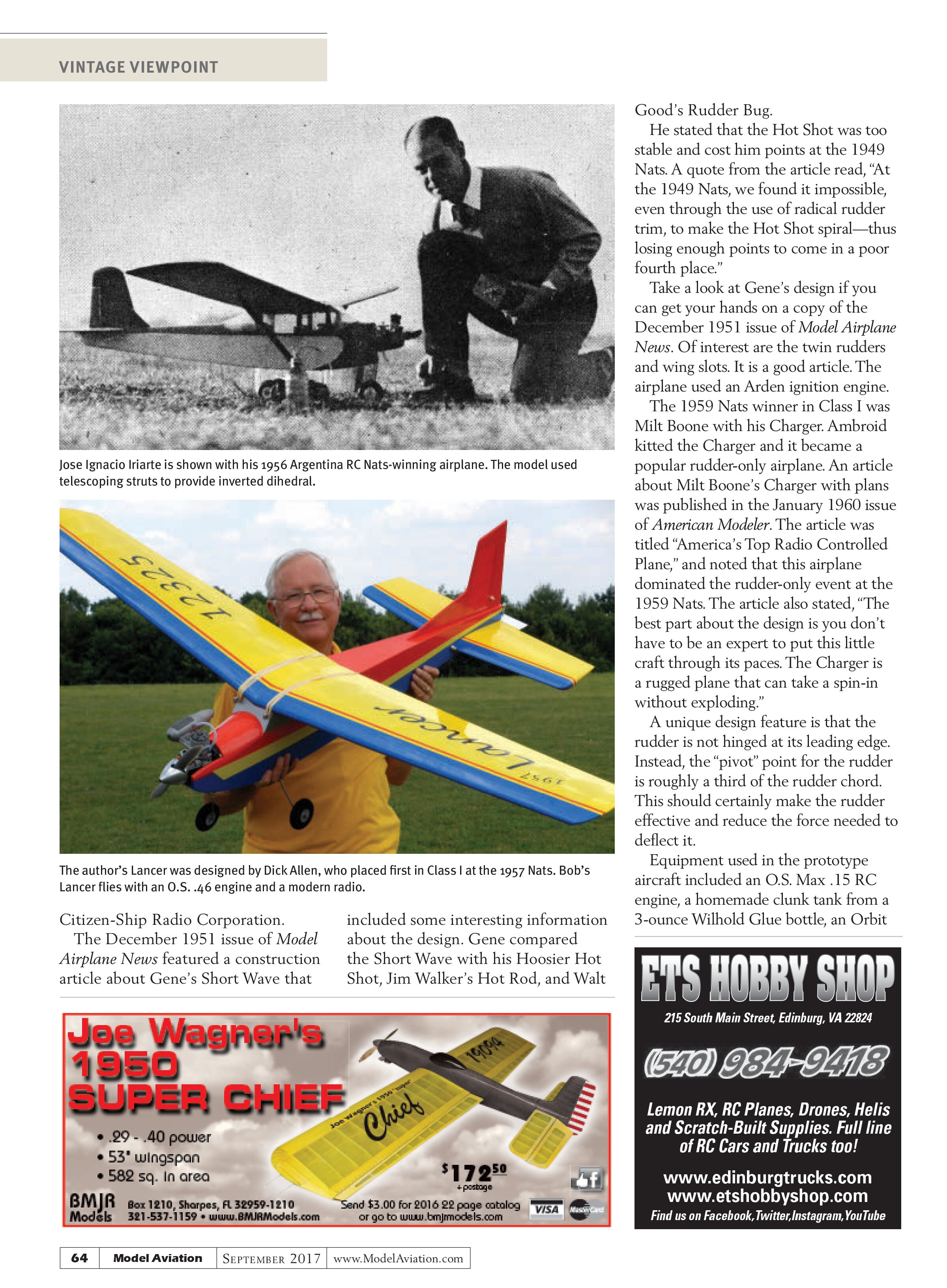
I have a few rudder-only airplanes in my hangar and they are all high-wing aircraft. Significant dihedral is another characteristic, and nose wheels were prevalent on the larger models in order to keep from breaking those precious wood propellers on landings. I use modern servos and radios with all of my rudder-only airplanes, and they all have engines with throttles.
My Royal Rudderbug is a replica of my first RC airplane. I flew my original Berkeley Royal Rudderbug with a Webra .15 diesel engine and a Babcock compound escapement. That was in 1953. I fly the replica with a Veco .19 engine and a modern receiver and servos. I added an elevator for initial trim flights and then removed the elevator after I was sure the decalage was correct. The wing and stabilizer are attached with rubber bands.
The next rudder-only airplane I built was the Lancer, designed by Dick Allen. Dick placed first in Class I at the 1957 Nats with his Lancer. I again added a small elevator for initial trim flights, which was later removed. To keep things simple and avoid the need for an elevator pushrod, I used a string to provide up-elevator and a rubber band to return it to neutral. I applied a hard stop so that the elevator could not go down past neutral. I fly the Lancer with an O.S. .46 engine, a modern radio, and servos.
Next on my list is a Mini Mambo. I built this aircraft from an Early RC short kit. That company is unfortunately no longer in business. This is a small rudder-only airplane that I fly using a Cox TD .049 engine with a rotary throttle that works incredibly well. The Mini Mambo has a permanently attached stabilizer, so I fly it as built. It is a great flier. I have recently been using my 2.4 GHz single-channel transmitter that I wrote about in my July 2017 column.
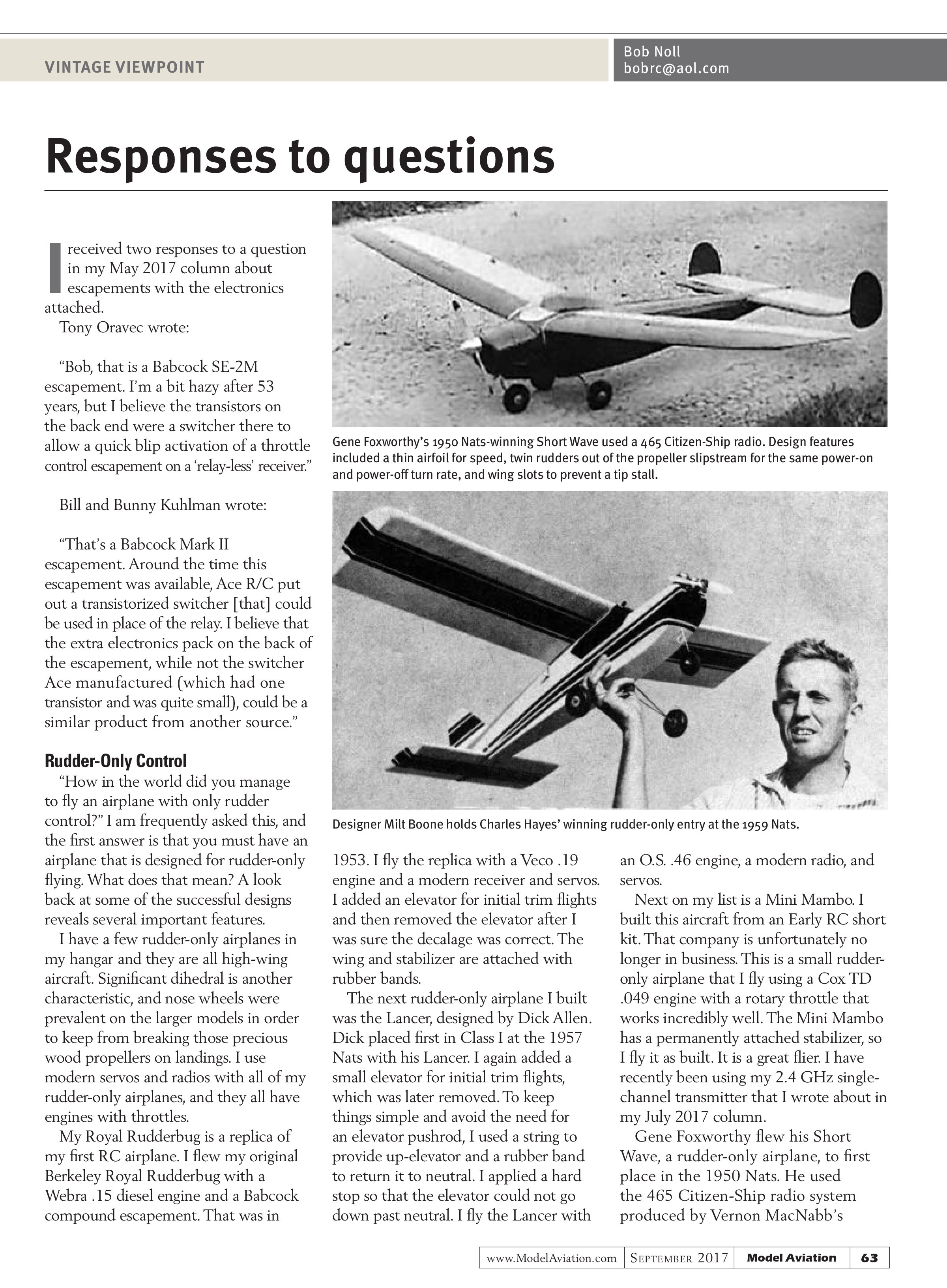
Gene Foxworthy flew his Short Wave, a rudder-only airplane, to first place in the 1950 Nats. He used the 465 Citizen-Ship radio system produced by Vernon MacNabb’s


Citizen-Ship Radio Corporation. The December 1951 issue of Model Airplane News featured a construction article about Gene’s Short Wave that
included some interesting information about the design. Gene compared the Short Wave with his Hoosier Hot Shot, Jim Walker’s Hot Rod, and Walt
single-channel radio, and a Bonner Varicomp escapement with a modified Bonner SN escapement for throttle. The plans were available from Hobby Helpers for 85¢ and included an S.E.5 Control Line Scale airplane.
Jose Ignacio Iriarte, the winner of the 1956 Argentina RC Nats, flew an interesting rudder-only concept. His aircraft flew inverted to clinch the contest. Inverted flight was made easy by
using telescopic spring bumper struts to create inverted dihedral.
All of the winning Class I airplanes at the time had considerable dihedral. All were high-wing aircraft, with the exception of Gene Foxworthy’s Short Wave, which was a shoulder wing model. All had nose wheels, and the wings (and sometimes the stabilizers) were attached with rubber bands.
Yes, rubber-banded wings were
popular because they would come off during the expected rough landings without tearing the fuselage apart.
I have always felt that flying a rudder-only airplane is an art form, even with throttle control and modern radios. Just think what skill it took back in the 1950s.
Give it a try and you will be asked that same question: How in the world did you manage to fly an airplane with only rudder control?