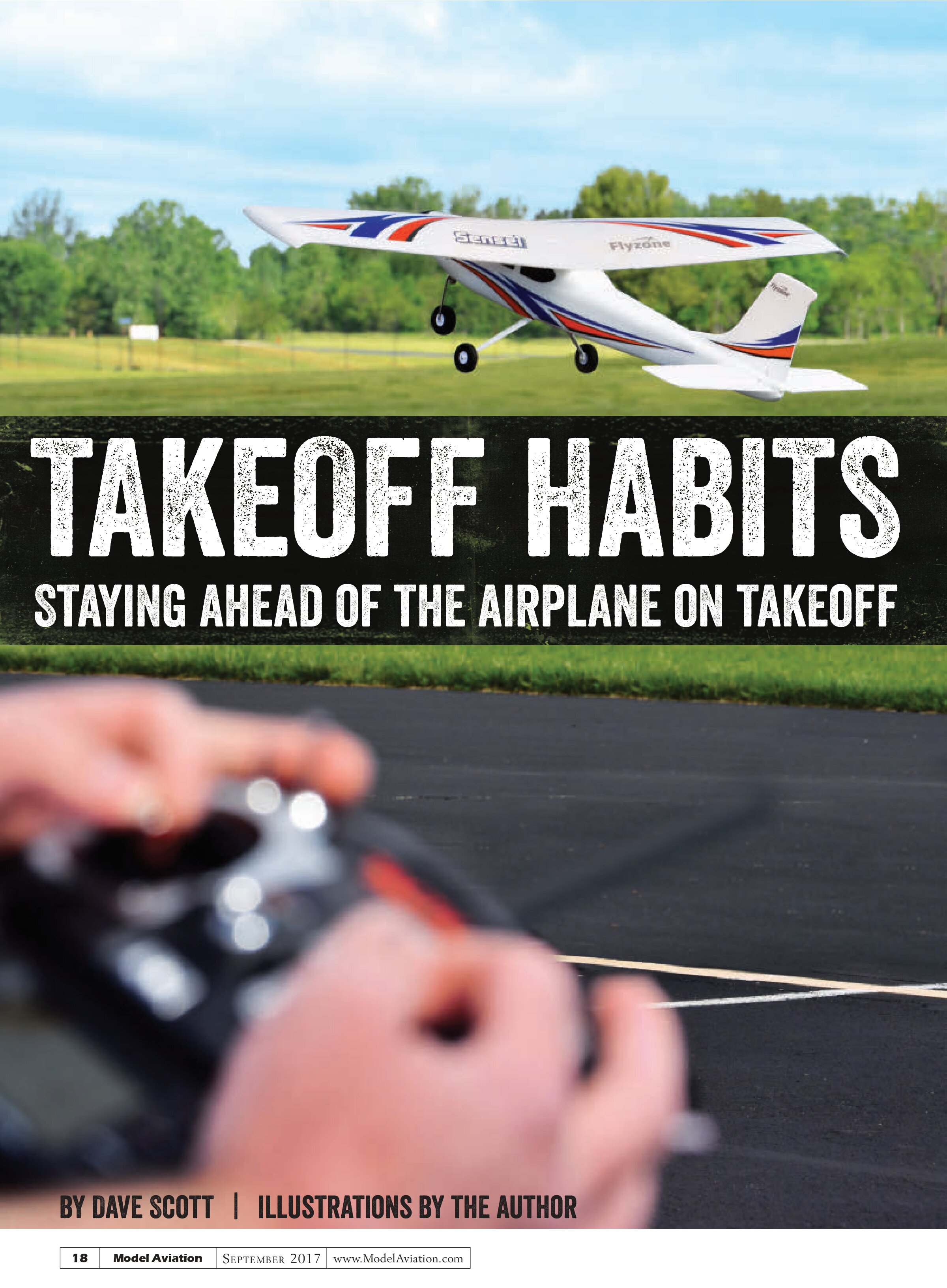
Takeoff Habits
Staying Ahead of the Airplane on Takeoff
By Dave Scott | Illustrations by the Author

Great takeoffs should be routine, even for run-of-the-mill pilots, and yet, I am amazed to see how many pilots struggle to execute smooth takeoffs down the center of the runway. Of course, everything happens for a reason, so there are solutions for consistently achieving professional takeoffs, no matter the aircraft type or conditions.
The difficulties that pilots experience during takeoffs can usually be traced to a lack of planning or detailed instruction when they are learning how to fly. The resulting lack of consistency causes many pilots to assume that the solution to better takeoffs is to get better at reacting to deviations instead of recognizing how those deviations could be minimized.
Of course, the tendency is to blame a lack of consistency on wind, the airplane, the runway surface, etc., but the reality is that, in most cases, those factors only serve to compound existing flaws in a pilot’s takeoff procedures. The following list highlights the most common takeoff shortcomings and omissions, followed by the solutions.
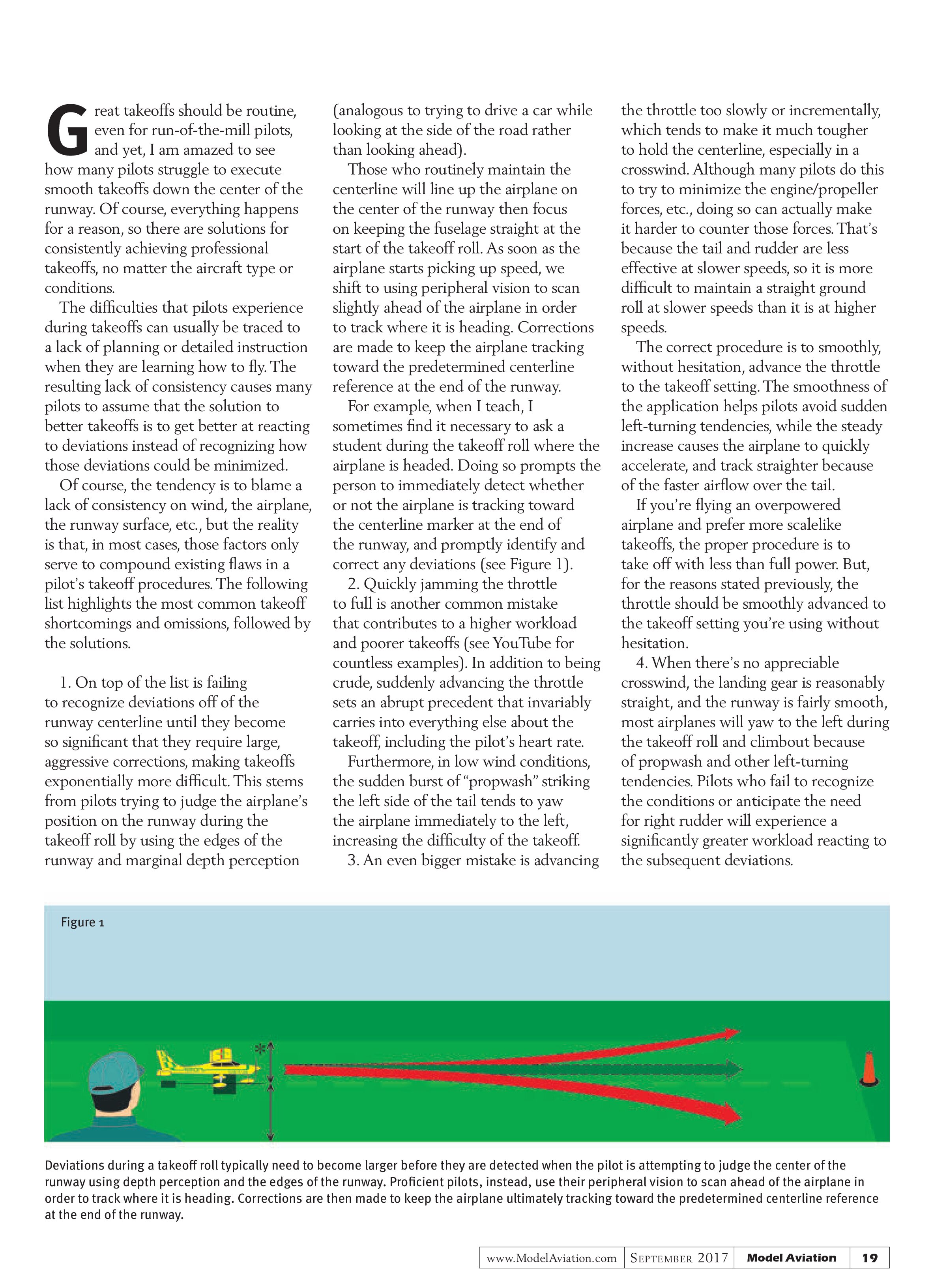
- On top of the list is failing to recognize deviations off of the runway centerline until they become so significant that they require large, aggressive corrections, making takeoffs exponentially more difficult. This stems from pilots trying to judge the airplane’s position on the runway during the takeoff roll by using the edges of the runway and marginal depth perception (analogous to trying to drive a car while looking at the side of the road rather than looking ahead). Those who routinely maintain the centerline will line up the airplane on the center of the runway then focus on keeping the fuselage straight at the start of the takeoff roll. As soon as the airplane starts picking up speed, we shift to using peripheral vision to scan slightly ahead of the airplane in order to track where it is heading. Corrections are made to keep the airplane tracking toward the predetermined centerline reference at the end of the runway. For example, when I teach, I sometimes find it necessary to ask a student during the takeoff roll where the airplane is headed. Doing so prompts the person to immediately detect whether or not the airplane is tracking toward the centerline marker at the end of the runway, and promptly identify and correct any deviations (see Figure 1).
- Quickly jamming the throttle to full is another common mistake that contributes to a higher workload and poorer takeoffs (see YouTube for countless examples). In addition to being crude, suddenly advancing the throttle sets an abrupt precedent that invariably carries into everything else about the takeoff, including the pilot’s heart rate. Furthermore, in low wind conditions, the sudden burst of “propwash” striking the left side of the tail tends to yaw the airplane immediately to the left, increasing the difficulty of the takeoff.
- An even bigger mistake is advancing the throttle too slowly or incrementally, which tends to make it much tougher to hold the centerline, especially in a crosswind. Although many pilots do this to try to minimize the engine/propeller forces, etc., doing so can actually make it harder to counter those forces. That’s because the tail and rudder are less effective at slower speeds, so it is more difficult to maintain a straight ground roll at slower speeds than it is at higher speeds. The correct procedure is to smoothly, without hesitation, advance the throttle to the takeoff setting. The smoothness of the application helps pilots avoid sudden left-turning tendencies, while the steady increase causes the airplane to quickly accelerate, and track straighter because of the faster airflow over the tail. If you’re flying an overpowered airplane and prefer more scalelike takeoffs, the proper procedure is to take off with less than full power. But, for the reasons stated previously, the throttle should be smoothly advanced to the takeoff setting you’re using without hesitation.
- When there’s no appreciable crosswind, the landing gear is reasonably straight, and the runway is fairly smooth, most airplanes will yaw to the left during the takeoff roll and climbout because of propwash and other left-turning tendencies. Pilots who fail to recognize the conditions or anticipate the need for right rudder will experience a significantly greater workload reacting to the subsequent deviations.

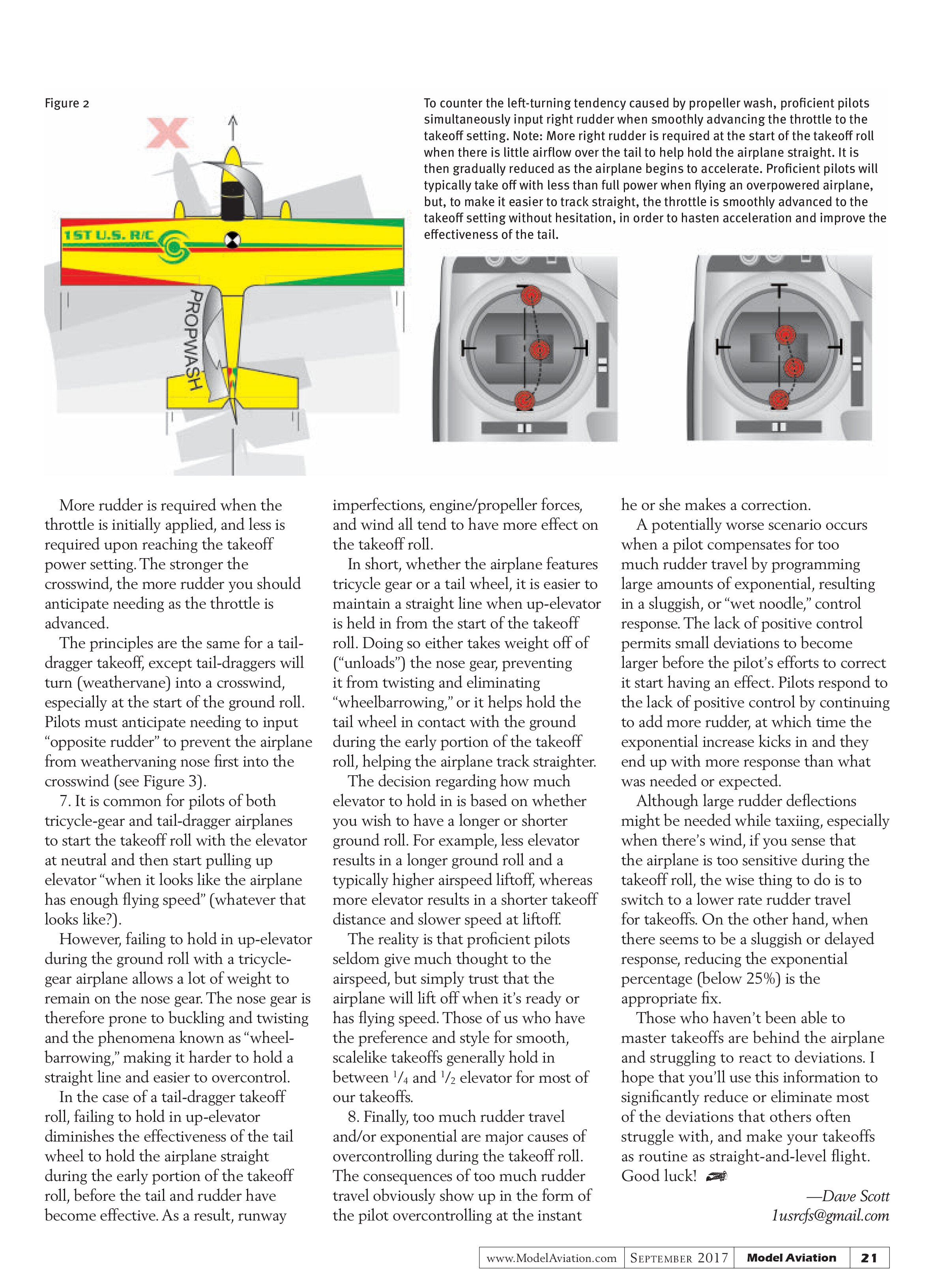
The left-turning-tendency is most powerful at the start of the takeoff roll when there is inadequate airflow over the tail to hold the airplane straight. The airflow diminishes as the airplane picks up speed. When there’s not much of a crosswind, proficient pilots simultaneously input right rudder as they advance the throttle to prevent the airplane from yawing to the left. Specifically, they input more right rudder at the start, and then gradually lessen it upon reaching the takeoff power setting (see Figure 2).
5. Almost all club pilots can be seen allowing their airplanes to drift to the left after lifting off as a result of neutralizing the rudder immediately after the airplane leaves the ground. On top of that, most pilots incorrectly try to correct the yaw to the left with the aileron, which can introduce a variety of other complications, or even magnify the deviation (Google “adverse yaw”). The correct procedure is to continue to hold in some right rudder during the climbout. The amount and duration will depend on a number of factors, but as a rule, the lighter the airplane is for its size and the larger the propeller, the more rudder you will likely need. The rudder is typically no longer needed after the airplane has leveled and built up ample airspeed.
6. Deviations caused by crosswinds tend to be immediate and quickly escalate. Failing to anticipate the necessary rudder corrections at the start of the takeoff roll can quickly put the takeoff into jeopardy. This is particularly true when the throttle is advanced too slowly, resulting in marginal rudder authority.
If you know what to expect, crosswind takeoffs can become routine. As a rule, tricycle-gear airplanes—especially high-wing tricycle-gear airplanes—will tend to be pushed in the direction the wind is blowing during the takeoff roll. Proficient pilots anticipate needing to simultaneously input rudder “into the crosswind” as they advance the throttle, to prevent wind drift. The influence of the crosswind is greatest at the start of the takeoff roll (when there is less airflow over the tail) and then diminishes as the airplane starts picking up speed.
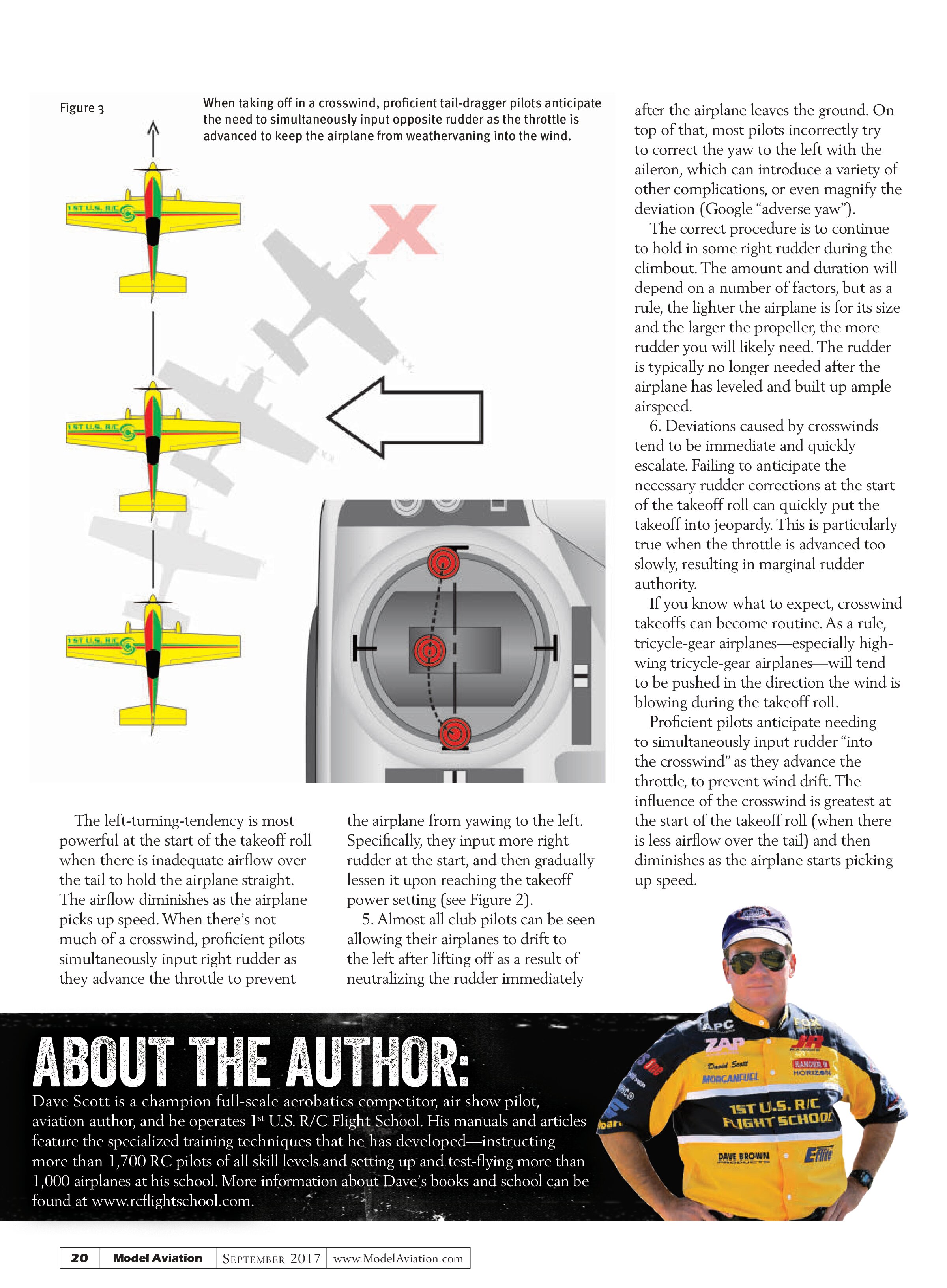
Figure 3
When taking off in a crosswind, proficient tail-dragger pilots anticipate the need to simultaneously input opposite rudder as the throttle is advanced to keep the airplane from weathervaning into the wind.

The left-turning-tendency is most powerful at the start of the takeoff roll when there is inadequate airflow over the tail to hold the airplane straight. The airflow diminishes as the airplane picks up speed. When there’s not much of a crosswind, proficient pilots simultaneously input right rudder as they advance the throttle to prevent the airplane from yawing to the left. Specifically, they input more right rudder at the start, and then gradually lessen it upon reaching the takeoff power setting (see Figure 2).
5. Almost all club pilots can be seen allowing their airplanes to drift to the left after lifting off as a result of neutralizing the rudder immediately after the airplane leaves the ground. On top of that, most pilots incorrectly try to correct the yaw to the left with the aileron, which can introduce a variety of other complications, or even magnify the deviation (Google “adverse yaw”). The correct procedure is to continue to hold in some right rudder during the climbout. The amount and duration will depend on a number of factors, but as a rule, the lighter the airplane is for its size and the larger the propeller, the more rudder you will likely need. The rudder is typically no longer needed after the airplane has leveled and built up ample airspeed.
6. Deviations caused by crosswinds tend to be immediate and quickly escalate. Failing to anticipate the necessary rudder corrections at the start of the takeoff roll can quickly put the takeoff into jeopardy. This is particularly true when the throttle is advanced too slowly, resulting in marginal rudder authority.
If you know what to expect, crosswind takeoffs can become routine. As a rule, tricycle-gear airplanes—especially high-wing tricycle-gear airplanes—will tend to be pushed in the direction the wind is blowing during the takeoff roll. Proficient pilots anticipate needing to simultaneously input rudder “into the crosswind” as they advance the throttle, to prevent wind drift. The influence of the crosswind is greatest at the start of the takeoff roll (when there is less airflow over the tail) and then diminishes as the airplane starts picking up speed.
ABOUT THE AUTHOR:
Dave Scott is a champion full-scale aerobatics competitor, air show pilot, aviation author, and he operates 1st U.S. R/C Flight School. His manuals and articles feature the specialized training techniques that he has developed—instructing more than 1,700 RC pilots of all skill levels and setting up and test-flying more than 1,000 airplanes at his school. More information about Dave’s books and school can be found at www.rcflightschool.com.

Figure 2
To counter the left-turning tendency caused by propeller wash, proficient pilots simultaneously input right rudder when smoothly advancing the throttle to the takeoff setting. Note: More right rudder is required at the start of the takeoff roll when there is little airflow over the tail to help hold the airplane straight. It is then gradually reduced as the airplane begins to accelerate. Proficient pilots will typically take off with less than full power when flying an overpowered airplane, but, to make it easier to track straight, the throttle is smoothly advanced to the takeoff setting without hesitation, in order to hasten acceleration and improve the effectiveness of the tail.

More rudder is required when the throttle is initially applied, and less is required upon reaching the takeoff power setting. The stronger the crosswind, the more rudder you should anticipate needing as the throttle is advanced.
The principles are the same for a tail-dragger takeoff, except tail-draggers will turn (weathervane) into a crosswind, especially at the start of the ground roll. Pilots must anticipate needing to input “opposite rudder” to prevent the airplane from weathervaning nose first into the crosswind (see Figure 3).
7. It is common for pilots of both tricycle-gear and tail-dragger airplanes to start the takeoff roll with the elevator at neutral and then start pulling up elevator “when it looks like the airplane has enough flying speed” (whatever that looks like?).
However, failing to hold in up-elevator during the ground roll with a tricycle-gear airplane allows a lot of weight to remain on the nose gear. The nose gear is therefore prone to buckling and twisting and the phenomena known as “wheel-barrowing,” making it harder to hold a straight line and easier to overcontrol.
In the case of a tail-dragger takeoff roll, failing to hold in up-elevator diminishes the effectiveness of the tail wheel to hold the airplane straight during the early portion of the takeoff roll, before the tail and rudder have become effective. As a result, runway imperfections, engine/propeller forces, and wind all tend to have more effect on the takeoff roll.
In short, whether the airplane features tricycle gear or a tail wheel, it is easier to maintain a straight line when up-elevator is held in from the start of the takeoff roll. Doing so either takes weight off of (“unloads”) the nose gear, preventing it from twisting and eliminating “wheelbarrowing,” or it helps hold the tail wheel in contact with the ground during the early portion of the takeoff roll, helping the airplane track straighter.
The decision regarding how much elevator to hold in is based on whether you wish to have a longer or shorter ground roll. For example, less elevator results in a longer ground roll and a typically higher airspeed liftoff, whereas more elevator results in a shorter takeoff distance and slower speed at liftoff.
The reality is that proficient pilots seldom give much thought to the airspeed, but simply trust that the airplane will lift off when it’s ready or has flying speed. Those of us who have the preference and style for smooth, scalelike takeoffs generally hold in between ¼ and ½ elevator for most of our takeoffs.
8. Finally, too much rudder travel and/or exponential are major causes of overcontrolling during the takeoff roll. The consequences of too much rudder travel obviously show up in the form of the pilot overcontrolling at the instant he or she makes a correction.
A potentially worse scenario occurs when a pilot compensates for too much rudder travel by programming large amounts of exponential, resulting in a sluggish, or “wet noodle,” control response. The lack of positive control permits small deviations to become larger before the pilot’s efforts to correct it start having an effect. Pilots respond to the lack of positive control by continuing to add more rudder, at which time the exponential increase kicks in and they end up with more response than what was needed or expected.
Although large rudder deflections might be needed while taxiing, especially when there’s wind, if you sense that the airplane is too sensitive during the takeoff roll, the wise thing to do is to switch to a lower rate rudder travel for takeoffs. On the other hand, when there seems to be a sluggish or delayed response, reducing the exponential percentage (below 25%) is the appropriate fix.
Those who haven’t been able to master takeoffs are behind the airplane and struggling to react to deviations. I hope that you’ll use this information to significantly reduce or eliminate most of the deviations that others often struggle with, and make your takeoffs as routine as straight-and-level flight. Good luck!
—Dave Scott
1usrcfs@gmail.com